Cloud computing has moved far beyond being a simple alternative to traditional on-premise infrastructure. Today, it is the foundation of how most modern organizations operate. Businesses no longer ask whether they should adopt cloud solutions; instead, they focus on how to design, manage, and optimize cloud environments effectively.
This shift has introduced a new level of complexity. Companies are no longer working with a single cloud provider or a simple setup. Instead, they operate across hybrid environments that combine on-premise systems with public and private clouds. Many also use multi-cloud strategies, distributing workloads across different providers to increase reliability, flexibility, and cost efficiency.
With this evolution, the expectations placed on IT professionals have also changed significantly. It is no longer enough to understand basic cloud concepts. Professionals are now expected to manage performance, ensure security across distributed systems, automate deployments, and maintain operational stability across complex architectures.
This is where specialized certifications like CompTIA Cloud+ become relevant. They aim to validate the practical skills needed to handle these modern challenges rather than focusing on theoretical knowledge alone.
What CompTIA Cloud+ Represents in the IT Industry
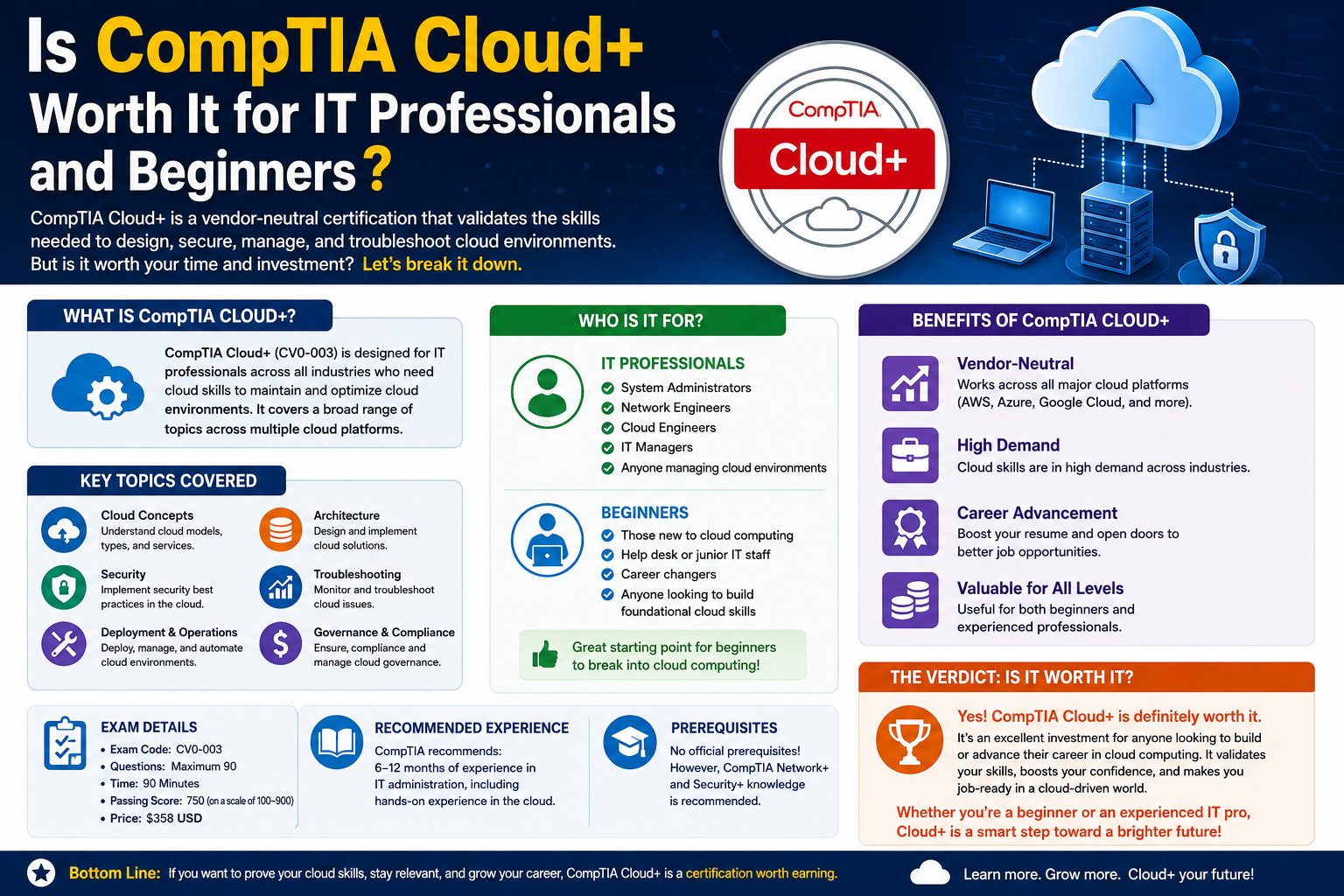
CompTIA Cloud+ is designed as a vendor-neutral certification that validates an individual’s ability to work with cloud technologies across different platforms. Unlike certifications tied to a specific provider, it focuses on universal cloud principles and operational skills.
This means the knowledge gained is not restricted to one ecosystem. Instead, it applies to a wide range of environments, whether an organization uses a single cloud provider or multiple platforms simultaneously.
The certification is structured around real-world responsibilities. It emphasizes tasks such as deploying cloud resources, maintaining system availability, ensuring data security, and optimizing infrastructure performance. These are the kinds of responsibilities commonly assigned to cloud administrators, systems engineers, and infrastructure specialists.
The key idea behind Cloud+ is not memorization of specific tools but understanding how cloud systems function at a deeper operational level. This makes it especially relevant for professionals working in dynamic environments where technologies and platforms can change frequently.
Why Vendor-Neutral Certifications Matter Today
In the early days of cloud computing, many organizations relied heavily on a single provider. As a result, vendor-specific certifications were often sufficient for professionals to demonstrate their skills.
However, the current IT landscape is far more complex. Organizations frequently combine services from multiple providers, integrate legacy systems with cloud platforms, and adopt specialized tools for different workloads. This has created a demand for professionals who understand cloud concepts at a broader level.
Vendor-neutral certifications address this need by focusing on transferable skills. Instead of teaching how to operate within a single ecosystem, they emphasize principles that apply across environments. These include architecture design, security management, automation, scalability, and troubleshooting.
For professionals, this approach provides greater flexibility. Skills learned through vendor-neutral certifications can be applied in various roles and across different organizations, making career transitions smoother and more versatile.
Core Purpose of CompTIA Cloud+
At its core, CompTIA Cloud+ is designed to bridge the gap between theoretical cloud knowledge and practical implementation. It is not focused on entry-level awareness or high-level strategy. Instead, it targets the operational layer of cloud computing.
The certification aims to ensure that professionals can handle day-to-day cloud responsibilities, including system deployment, configuration, monitoring, and optimization. It also places strong emphasis on security and troubleshooting, which are critical in maintaining stable cloud environments.
Another important aspect of Cloud+ is its focus on real-world scenarios. Rather than testing isolated concepts, it evaluates how well a candidate can apply knowledge in practical situations. This makes it more aligned with job performance rather than academic understanding.
In essence, Cloud+ is intended for individuals who are already familiar with IT systems and want to expand their capabilities into cloud operations.
Understanding the Skill Philosophy Behind Cloud+
Unlike many certifications that focus on specific tools or platforms, Cloud+ is built around a skill-based philosophy. It prioritizes what professionals can do rather than what they can remember.
This approach reflects the reality of modern IT environments. Cloud technologies evolve rapidly, and tools change frequently. A professional who understands only a specific interface or platform may struggle when systems are updated or replaced.
Cloud+ addresses this by focusing on foundational skills such as system architecture, workload distribution, security enforcement, and performance optimization. These skills remain relevant even as technologies evolve.
Another important aspect is adaptability. Cloud+ encourages professionals to think in terms of problem-solving rather than tool usage. This mindset allows them to adjust to different environments more easily and respond effectively to unexpected challenges.
Cloud Architecture and Its Growing Complexity
One of the most important areas covered in Cloud+ is cloud architecture. This refers to the design and structure of cloud systems, including how different components interact and support business needs.
Modern cloud architecture is far more complex than traditional IT setups. It often involves multiple layers, including infrastructure, platforms, applications, and security frameworks. Each layer must be carefully designed to ensure efficiency, reliability, and scalability.
Professionals working in cloud environments must understand how to design systems that can handle varying workloads without compromising performance. This includes planning for redundancy, load balancing, and resource allocation.
Cloud architecture also involves making decisions about deployment models. Organizations may choose public, private, or hybrid cloud solutions depending on their requirements. Each model has its own advantages and limitations, and understanding these differences is essential for effective system design.
Security as a Central Pillar of Cloud Operations
Security plays a critical role in cloud environments. As more data and applications move to the cloud, the risk of security breaches, unauthorized access, and data loss increases significantly.
Cloud+ places strong emphasis on security principles, including identity management, access control, encryption, and compliance. These elements are essential for protecting sensitive information and maintaining trust in cloud systems.
One of the key challenges in cloud security is managing access across distributed environments. Unlike traditional systems, cloud infrastructures often involve multiple users, devices, and locations. This requires robust authentication and authorization mechanisms.
Encryption is another important aspect. Data must be protected both at rest and in transit to prevent unauthorized access. Cloud professionals must understand how to implement encryption strategies effectively across different environments.
Compliance is also a major consideration. Organizations must ensure that their cloud operations meet regulatory requirements, which can vary depending on industry and region.
Cloud Deployment in Modern IT Environments
Cloud deployment refers to the process of implementing and configuring cloud resources to support business applications and services. This includes provisioning servers, configuring storage, and setting up networking components.
In modern IT environments, deployment is often automated. Automation tools allow organizations to deploy resources quickly and consistently, reducing the risk of human error.
Cloud+ emphasizes the importance of understanding deployment strategies across different environments. Professionals must be able to work with both manual and automated processes, depending on organizational needs.
Another important aspect is scalability. Cloud systems must be able to adjust resources dynamically based on demand. This requires careful planning and configuration during the deployment phase.
Effective deployment also involves understanding cost implications. Poorly configured systems can lead to unnecessary expenses, making optimization an essential part of the process.
Operations and Maintenance in Cloud Systems
Once cloud systems are deployed, they must be continuously monitored and maintained. This is where cloud operations come into play.
Operations involve managing system performance, ensuring availability, and addressing issues as they arise. This includes monitoring resource usage, analyzing performance metrics, and responding to alerts.
Maintenance also involves regular updates and optimizations. Cloud environments must be adjusted over time to meet changing business needs and technological advancements.
One of the key challenges in cloud operations is maintaining stability across distributed systems. Unlike traditional infrastructure, cloud environments are highly dynamic, requiring constant attention and adjustment.
Professionals must also focus on cost optimization. Cloud resources are often billed based on usage, so inefficient configurations can lead to unnecessary expenses.
Troubleshooting in Distributed Cloud Environments
Troubleshooting is an essential skill in cloud computing. When issues arise, they can affect multiple systems and users simultaneously.
Cloud environments are complex, often involving multiple layers of infrastructure and services. This makes identifying the root cause of issues more challenging compared to traditional systems.
Professionals must be able to analyze logs, monitor system behavior, and isolate problems effectively. This requires a deep understanding of how different components interact within the cloud environment.
Common issues may include connectivity problems, performance degradation, configuration errors, or security breaches. Each of these requires a different approach to resolution.
Cloud+ emphasizes the importance of systematic troubleshooting methods. Rather than relying on guesswork, professionals are trained to follow structured processes to identify and resolve issues efficiently.
The Role of Automation and DevOps Principles
Automation has become a fundamental part of cloud computing. It allows organizations to deploy and manage resources more efficiently while reducing manual effort.
DevOps principles play a key role in this process. They focus on integrating development and operations to create a more streamlined workflow.
In cloud environments, automation is used for tasks such as resource provisioning, configuration management, and system monitoring. This helps improve consistency and reduces the likelihood of errors.
Cloud+ introduces these concepts to help professionals understand how automation fits into modern cloud operations. It also highlights the importance of continuous integration and continuous deployment practices.
These approaches enable organizations to deliver updates and improvements more quickly, improving overall system agility.
Why Cloud+ Reflects Real-World IT Demands
One of the most important aspects of Cloud+ is its alignment with real-world job roles. It is not designed as an academic exercise but as a reflection of actual responsibilities in cloud-based environments.
Professionals who earn this certification are expected to understand how to manage systems in practical scenarios. This includes handling unexpected issues, optimizing performance, and maintaining security under real operational conditions.
The certification also reflects the increasing demand for professionals who can work across different environments. As organizations continue to adopt multi-cloud strategies, the ability to adapt becomes increasingly valuable.
Cloud+ addresses this by focusing on universal skills that remain relevant regardless of platform or provider.
Preparing for the Complexity of Modern Cloud Roles
Cloud roles today are more demanding than ever before. Professionals are expected to understand a wide range of concepts, from infrastructure design to security management and automation.
This complexity requires a strong foundation of knowledge and practical experience. Cloud+ is structured to support this by emphasizing applied learning rather than theoretical concepts alone.
It encourages professionals to think critically, solve problems systematically, and adapt to changing environments. These skills are essential for success in modern IT roles.
As cloud technology continues to evolve, the demand for professionals with this type of skill set is expected to grow even further.
Expanding Career Paths in Cloud-Focused IT Roles
The demand for cloud-related expertise has reshaped traditional IT career paths. Roles that once focused strictly on on-premise infrastructure have evolved into hybrid positions that require cloud awareness, automation skills, and cross-platform knowledge. CompTIA Cloud+ fits into this transformation by supporting professionals who want to expand beyond conventional system administration or networking roles.
Cloud-related job functions are no longer limited to specialized cloud engineers. Instead, cloud responsibilities are now distributed across multiple roles, including systems administrators, network engineers, DevOps engineers, and infrastructure analysts. This shift reflects how deeply cloud computing has integrated into enterprise IT environments.
For systems administrators, cloud knowledge is now essential for managing virtualized infrastructure, automating deployments, and ensuring system availability across distributed environments. Network professionals are also expected to understand how cloud services interact with physical networks, especially in hybrid setups where traffic flows between on-premise systems and cloud platforms.
Cloud+ supports this transition by validating the foundational skills needed to operate in these evolving roles. It does not confine professionals to a single job title but instead broadens their capability to work across multiple IT domains.
How Cloud+ Aligns With Industry Expectations
Modern IT organizations prioritize flexibility, scalability, and resilience. These priorities directly influence the skill sets they look for in cloud professionals. Employers expect individuals to understand not only how cloud systems function but also how to optimize them for performance, cost efficiency, and security.
Cloud+ aligns with these expectations by focusing on operational competence. It emphasizes practical skills such as workload management, infrastructure monitoring, and system troubleshooting. These are the core responsibilities that define day-to-day cloud operations in enterprise environments.
Another important industry expectation is adaptability. Cloud technologies evolve rapidly, and organizations need professionals who can adjust to new tools, platforms, and workflows without extensive retraining. Cloud+ supports this by focusing on principles rather than platform-specific features.
This alignment with industry needs makes Cloud+ particularly relevant for professionals seeking long-term career stability in cloud-related fields.
The Role of Hybrid and Multi-Cloud Environments
Most modern organizations do not rely on a single cloud provider. Instead, they adopt hybrid or multi-cloud strategies to improve resilience and reduce dependency on one vendor. Hybrid cloud environments combine on-premise infrastructure with public cloud services, while multi-cloud environments use multiple cloud providers simultaneously.
These approaches introduce both opportunities and challenges. On one hand, they provide flexibility and redundancy. On the other hand, they increase complexity in management, security, and cost control.
Cloud+ prepares professionals to work within these environments by focusing on cross-platform skills. Instead of teaching a specific provider’s tools, it emphasizes how to manage workloads across different systems, maintain consistent performance, and ensure secure integration between environments.
Understanding hybrid and multi-cloud strategies also requires knowledge of workload distribution. Professionals must decide which applications should run on-premise, which should be migrated to the cloud, and how to balance performance with cost efficiency.
Cloud+ reinforces these decision-making skills by presenting scenarios that reflect real-world enterprise environments.
Cloud Operations and Infrastructure Management
Cloud operations form the backbone of modern IT systems. Once infrastructure is deployed, it must be continuously managed to ensure stability, availability, and performance.
This involves monitoring system health, analyzing resource usage, and responding to performance issues in real time. Cloud environments are highly dynamic, meaning workloads can scale up or down based on demand. As a result, professionals must be able to manage resources efficiently without manual intervention wherever possible.
Infrastructure management also includes maintaining virtual machines, storage systems, and network configurations. Each component must be optimized to ensure smooth interaction with other parts of the system.
Another key aspect of cloud operations is automation. Many operational tasks are now automated using scripts and orchestration tools. This reduces human error and increases efficiency, but it also requires professionals to understand how automation workflows function.
Cloud+ reflects these operational realities by emphasizing system monitoring, resource optimization, and infrastructure management across different cloud environments.
Security Responsibilities in Cloud Environments
Security in cloud computing is more complex than in traditional IT systems. Data is no longer stored in a single physical location, and access points are distributed across multiple platforms and devices. This creates a larger attack surface and increases the importance of strong security practices.
Cloud professionals must manage identity and access control carefully to ensure that only authorized users can access sensitive resources. This involves implementing role-based access systems, multi-factor authentication, and strict permission policies.
Encryption is another essential component of cloud security. Data must be protected both during transmission and while stored in cloud environments. Professionals must understand how to apply encryption methods consistently across different services.
Compliance requirements also play a major role in cloud security. Many industries are subject to strict regulations regarding data protection and privacy. Cloud professionals must ensure that cloud systems meet these regulatory standards while maintaining operational efficiency.
Cloud+ incorporates these security principles by focusing on practical implementation rather than theoretical concepts. This ensures that professionals can apply security practices in real operational environments.
Cost Optimization and Resource Efficiency
One of the most significant advantages of cloud computing is its flexible pricing model. Organizations can scale resources based on demand, paying only for what they use. However, this flexibility can also lead to inefficiencies if resources are not managed properly.
Cost optimization has therefore become a critical responsibility for cloud professionals. It involves monitoring resource usage, identifying inefficiencies, and adjusting configurations to reduce unnecessary expenses.
For example, unused virtual machines, oversized storage allocations, and inefficient workload distribution can all contribute to increased costs. Cloud professionals must be able to identify these issues and implement corrective measures.
Cloud+ emphasizes the importance of balancing performance with cost efficiency. It encourages professionals to think strategically about resource allocation and system design to ensure optimal use of cloud infrastructure.
Monitoring, Logging, and Performance Analysis
Effective cloud management relies heavily on monitoring and performance analysis. Without visibility into system behavior, it becomes difficult to identify issues or optimize performance.
Monitoring tools collect data on system performance, resource usage, and application behavior. This data is then analyzed to detect anomalies, predict potential issues, and support decision-making.
Logging plays a complementary role by recording system events and user activities. Logs provide valuable insights into system behavior and are essential for troubleshooting and security investigations.
Performance analysis involves interpreting this data to identify trends and optimize system configurations. This may include adjusting resource allocation, improving load balancing, or refining deployment strategies.
Cloud+ reinforces these concepts by emphasizing the importance of continuous monitoring and data-driven decision-making in cloud environments.
Troubleshooting Complex Cloud Systems
Troubleshooting in cloud environments is more challenging than in traditional IT systems due to their distributed nature. Issues may originate from multiple sources, including network configurations, application errors, or infrastructure failures.
Professionals must be able to analyze system behavior across different layers to identify the root cause of problems. This often involves examining logs, monitoring metrics, and testing system components individually.
One of the key challenges in cloud troubleshooting is distinguishing between symptoms and actual causes. For example, a performance issue in one application may be caused by resource limitations in another part of the system.
Cloud+ emphasizes structured troubleshooting approaches that focus on systematic problem identification and resolution. This helps professionals handle complex issues more effectively in real-world environments.
Integration of DevOps Practices in Cloud Environments
DevOps has become a central component of modern cloud computing. It integrates development and operations teams to improve collaboration, speed up deployment, and enhance system reliability.
In cloud environments, DevOps practices often involve automation, continuous integration, and continuous deployment. These practices allow organizations to release updates more frequently while maintaining system stability.
Automation plays a key role in DevOps workflows. It reduces manual intervention and ensures consistency across deployments. This includes automating testing, configuration, and infrastructure provisioning.
Cloud+ introduces these concepts to help professionals understand how DevOps principles are applied in cloud environments. It emphasizes the importance of collaboration between development and operations teams in maintaining efficient workflows.
Disaster Recovery and Business Continuity Planning
Disaster recovery is a critical aspect of cloud operations. It involves preparing for unexpected system failures, data loss, or security incidents.
Cloud environments offer several advantages for disaster recovery, including data redundancy and automated backup systems. However, these features must be properly configured to be effective.
Business continuity planning ensures that organizations can continue operating during and after disruptions. This requires careful planning of backup systems, failover mechanisms, and recovery procedures.
Cloud professionals must understand how to design systems that minimize downtime and ensure rapid recovery. This includes distributing workloads across multiple regions and maintaining backup environments.
Cloud+ reinforces these principles by emphasizing resilience and system reliability in cloud architecture.
Governance and Policy Management in Cloud Systems
Cloud governance refers to the set of policies and controls that regulate how cloud resources are used within an organization. It ensures that systems are secure, efficient, and compliant with organizational standards.
Governance involves defining access policies, managing resource allocation, and enforcing compliance rules. It also includes monitoring usage to prevent unauthorized or inefficient use of resources.
Policy management is closely related to governance. It involves creating and enforcing rules that guide how cloud systems are operated.
Cloud+ highlights the importance of governance by focusing on structured management practices that ensure consistency and control across cloud environments.
Enterprise Adoption and Real-World Implementation
Large organizations often adopt cloud computing in phases. They may start by migrating specific workloads before moving entire systems to the cloud.
This gradual approach allows them to manage risk while gaining experience with cloud technologies. However, it also creates complex hybrid environments that require careful coordination.
Cloud professionals working in enterprise environments must understand how to manage these transitions effectively. This includes migrating applications, integrating systems, and maintaining operational continuity.
Cloud+ supports this by focusing on real-world implementation scenarios that reflect enterprise-level challenges.
Evolving Expectations for Cloud Professionals
The expectations placed on cloud professionals continue to evolve as technology advances. Employers now seek individuals who can combine technical expertise with strategic thinking.
This includes understanding how cloud systems align with business goals, how to optimize infrastructure for efficiency, and how to ensure long-term scalability.
Cloud+ reflects these expectations by focusing on both technical and operational skills. It prepares professionals to handle the complexities of modern cloud environments while adapting to future changes in the industry.
The Shift Toward Cloud-Centric Enterprise Architecture
Enterprise IT architecture has undergone a major transformation over the past decade. Traditional infrastructure models, which relied heavily on physical servers and localized data centers, have gradually been replaced by cloud-centric designs. In these modern architectures, cloud platforms serve as the primary foundation for hosting applications, storing data, and delivering services.
This shift is not just about technology adoption. It represents a deeper change in how organizations design, scale, and manage their entire IT ecosystem. Cloud-centric architecture enables faster deployment cycles, improved scalability, and better global accessibility. However, it also introduces new layers of complexity that require skilled professionals to manage effectively.
CompTIA Cloud+ aligns closely with this architectural shift by focusing on the operational and structural aspects of cloud systems. It prepares professionals to understand how different components interact within a distributed environment and how to maintain stability across large-scale deployments.
In enterprise environments, cloud architecture is no longer a separate domain. It is integrated into every aspect of IT strategy, from application development to cybersecurity and business continuity planning.
Understanding Scalability and Elasticity in Cloud Systems
One of the most important advantages of cloud computing is scalability. Scalability refers to the ability of a system to handle increasing workloads by adding resources when needed. This can involve increasing computing power, storage capacity, or network bandwidth.
Elasticity is closely related but slightly different. It refers to the system’s ability to automatically adjust resources in real time based on demand. For example, during peak usage periods, additional resources can be allocated automatically, and during low usage periods, those resources can be reduced.
These capabilities are essential for modern applications that experience unpredictable or variable workloads. E-commerce platforms, streaming services, and global enterprise applications all rely on scalability and elasticity to maintain performance and efficiency.
Cloud professionals must understand how to design systems that support these features effectively. This includes configuring load balancers, managing auto-scaling groups, and optimizing resource allocation policies.
CompTIA Cloud+ emphasizes these concepts by focusing on real-world deployment scenarios where scalability and elasticity are critical for system performance and cost management.
Cloud Storage Models and Data Management Strategies
Data is at the core of every cloud environment. Managing data effectively is essential for ensuring performance, security, and compliance. Cloud systems offer multiple storage models, each designed for specific use cases.
Object storage is commonly used for unstructured data such as images, videos, and backups. It is highly scalable and ideal for large datasets. Block storage, on the other hand, is used for applications that require high performance and low latency, such as databases and transactional systems. File storage provides a shared file system that can be accessed by multiple users or applications.
Understanding these storage models is essential for designing efficient cloud architectures. Each model has its own strengths and limitations, and choosing the right one depends on the specific requirements of the application.
Data management strategies also include backup, replication, and archiving. These processes ensure that data remains available, secure, and recoverable in case of failures or disasters.
Cloud+ incorporates these concepts to ensure professionals understand how to manage data effectively in distributed environments.
Networking in Cloud Environments
Networking is a fundamental component of cloud computing. Unlike traditional networks that operate within a limited physical environment, cloud networks are distributed across multiple data centers and regions.
This introduces new challenges related to connectivity, latency, and security. Cloud professionals must understand how virtual networks are designed and how they interact with physical infrastructure.
Key networking concepts in cloud environments include virtual private networks, subnets, routing tables, and load balancing. These components work together to ensure secure and efficient communication between cloud resources.
Latency is another important consideration. Since cloud resources may be located in different geographic regions, data transfer times can vary. Optimizing network performance requires careful planning and configuration.
Cloud+ emphasizes networking as a critical skill area, ensuring professionals can manage both basic and advanced networking scenarios in cloud environments.
Automation and Infrastructure as Code
Automation has become a defining feature of modern cloud computing. It allows organizations to manage infrastructure more efficiently and reduce manual intervention.
One of the most important automation practices is Infrastructure as Code. This approach involves defining infrastructure configurations using code rather than manual processes. It enables consistent deployment, version control, and rapid scaling of resources.
Infrastructure as Code also improves reliability by reducing human error. Once configurations are defined and tested, they can be reused across different environments.
Automation extends beyond infrastructure provisioning. It also includes system monitoring, configuration management, and deployment pipelines. These automated processes help organizations maintain consistency and efficiency across large-scale systems.
Cloud+ introduces automation concepts to ensure professionals understand how to implement and manage automated workflows in real-world environments.
Security Architecture in Distributed Cloud Systems
Security in cloud computing is not limited to a single layer. It involves multiple layers of protection that work together to secure data, applications, and infrastructure.
One of the key principles in cloud security is the shared responsibility model. This model defines the division of security responsibilities between cloud providers and customers. While providers secure the underlying infrastructure, customers are responsible for securing their data and applications.
This division requires a clear understanding and coordination. Misconfigurations or misunderstandings can lead to security vulnerabilities.
Security architecture in cloud systems includes identity management, network security, data encryption, and threat detection. Each of these components plays a role in protecting cloud environments from unauthorized access and cyber threats.
Cloud+ emphasizes security architecture as a core competency, ensuring professionals can design and maintain secure cloud systems across different environments.
Performance Optimization in Cloud Workloads
Performance optimization is a continuous process in cloud computing. As workloads change and systems scale, performance must be constantly monitored and adjusted.
Several factors influence cloud performance, including resource allocation, network configuration, and application design. Poorly optimized systems can lead to slow response times, increased costs, and reduced user satisfaction.
Cloud professionals must be able to identify performance bottlenecks and implement solutions to address them. This may involve scaling resources, optimizing code, or adjusting system configurations.
Load balancing is another important technique used to distribute workloads evenly across multiple resources. This helps prevent system overload and ensures consistent performance.
Cloud+ emphasizes performance optimization as a key operational responsibility, reflecting its importance in real-world cloud environments.
Cloud Migration Strategies and Challenges
Migrating systems to the cloud is a complex process that requires careful planning and execution. Organizations must consider factors such as application compatibility, data transfer, security, and downtime.
There are several migration strategies, including lift-and-shift, re-platforming, and re-architecting. Each approach has its own advantages and challenges.
Lift-and-shift involves moving applications to the cloud with minimal changes. It is faster but may not fully leverage cloud capabilities. Re-platforming involves making minor adjustments to optimize performance in the cloud. Re-architecting involves redesigning applications to fully utilize cloud-native features.
Cloud professionals must understand these strategies to support effective migration planning. This includes assessing workloads, identifying dependencies, and ensuring minimal disruption during transition.
Cloud+ incorporates migration concepts to prepare professionals for real-world cloud adoption scenarios.
Monitoring, Observability, and System Intelligence
Modern cloud environments require more than basic monitoring. They require observability, which provides deeper insights into system behavior.
Monitoring focuses on tracking predefined metrics such as CPU usage, memory consumption, and network traffic. Observability goes further by analyzing logs, traces, and events to understand system behavior in real time.
This allows professionals to identify complex issues that may not be visible through traditional monitoring tools.
System intelligence also involves using analytics and machine learning to predict potential issues before they occur. This proactive approach helps organizations maintain system stability and prevent downtime.
Cloud+ emphasizes the importance of monitoring and observability in maintaining healthy cloud environments.
Role of Cloud in Digital Transformation
Cloud computing plays a central role in digital transformation initiatives across industries. It enables organizations to modernize their infrastructure, improve agility, and deliver services more efficiently.
Digital transformation is not just about adopting new technologies. It involves rethinking business processes, improving customer experiences, and increasing operational efficiency.
Cloud systems provide the foundation for these changes by offering scalable, flexible, and cost-effective infrastructure.
Cloud professionals are often at the center of these transformation efforts. They are responsible for implementing cloud solutions that align with business objectives and support long-term growth.
Cloud+ supports this role by providing the technical foundation needed to contribute to digital transformation initiatives.
Future Trends in Cloud Computing
Cloud computing continues to evolve rapidly, driven by advancements in technology and changing business needs. Several trends are shaping the future of cloud environments.
One major trend is the increased use of automation and artificial intelligence. These technologies are being integrated into cloud systems to improve efficiency and decision-making.
Another trend is the growth of edge computing, which brings computing resources closer to end users. This reduces latency and improves performance for real-time applications.
Serverless computing is also gaining popularity. It allows developers to build applications without managing underlying infrastructure, further simplifying cloud operations.
Multi-cloud strategies are expected to continue growing as organizations seek flexibility and resilience.
Cloud professionals must stay aware of these trends to remain relevant in the industry. Cloud+ provides a foundation that supports continuous learning and adaptation to future developments.
Long-Term Career Value of Cloud Skills
Cloud skills have long-term value because they are applicable across a wide range of industries and roles. As more organizations adopt cloud technologies, demand for skilled professionals continues to grow.
Cloud-related roles are also evolving. Professionals are no longer limited to technical tasks alone. They are increasingly involved in strategic decision-making, system design, and business optimization.
This expansion of responsibilities increases career opportunities and long-term growth potential.
Cloud+ contributes to this growth by providing a strong foundation in both technical and operational aspects of cloud computing. It helps professionals build the skills needed to adapt to changing industry demands.
Evolving Role of Cloud Professionals in Enterprise IT
The role of cloud professionals has expanded significantly in enterprise environments. They are now responsible not only for managing infrastructure but also for contributing to strategic planning and innovation.
This includes designing scalable systems, optimizing performance, ensuring security compliance, and supporting digital transformation initiatives.
Cloud professionals must also collaborate with development, security, and operations teams to ensure seamless integration across systems.
This evolving role requires a combination of technical expertise, problem-solving skills, and business understanding.
Cloud+ reflects this evolution by preparing professionals for the diverse responsibilities associated with modern cloud environments.
Strengthening Cloud Governance and Operational Discipline
As cloud environments grow in scale and complexity, governance becomes one of the most important pillars of long-term stability. Governance in cloud computing is not simply about enforcing rules; it is about creating a structured framework that ensures resources are used efficiently, securely, and in alignment with organizational goals.
In large enterprises, cloud resources are often provisioned across multiple teams, departments, and even geographic regions. Without proper governance, this can quickly lead to inefficiencies such as resource duplication, inconsistent security policies, and uncontrolled spending. Cloud governance helps prevent these issues by introducing standardized policies that guide how infrastructure is created, accessed, and maintained.
A key part of governance is policy enforcement. This involves defining rules for resource provisioning, user permissions, and system configurations. These policies ensure that all cloud operations follow a consistent structure, regardless of who deploys or manages the resources.
Tagging strategies also play a critical role in governance. By assigning metadata to cloud resources, organizations can track usage, allocate costs, and improve visibility across complex environments. This becomes especially important in multi-cloud setups where resources are distributed across different platforms.
Operational discipline is closely linked to governance. It refers to the consistent execution of best practices in cloud management. This includes maintaining documentation, following standardized deployment procedures, and regularly reviewing system performance.
When governance and operational discipline are properly implemented, organizations gain better control over their cloud environments. This leads to improved efficiency, reduced risk, and more predictable system behavior.
Enhancing Reliability Through Fault-Tolerant Cloud Design
Reliability is one of the most critical expectations in cloud computing. Users and businesses depend on cloud systems to remain available at all times, even in the event of hardware failures, network disruptions, or unexpected spikes in demand.
Fault-tolerant design is a key strategy used to achieve this level of reliability. It involves building systems that can continue functioning even when individual components fail. This is achieved through redundancy, replication, and automated failover mechanisms.
Redundancy ensures that multiple instances of critical components are available at all times. If one instance fails, another can immediately take over without disrupting service. Replication ensures that data is copied across multiple locations, reducing the risk of data loss.
Failover mechanisms automatically redirect traffic or workloads to backup systems when a failure is detected. This process is often seamless to end users, ensuring uninterrupted service.
Another important aspect of reliability is geographic distribution. By spreading resources across multiple regions, organizations can protect themselves against localized outages caused by natural disasters or infrastructure failures.
Cloud professionals must understand how to design and maintain fault-tolerant systems that meet high availability requirements. This includes balancing cost considerations with reliability needs, as higher levels of redundancy often require additional resources.
Fault tolerance is not just a technical requirement; it is a business necessity. Downtime can result in financial loss, reputational damage, and reduced customer trust. Therefore, reliability is a core objective in every cloud deployment strategy.
Building Strategic Thinking for Cloud Decision-Making
Beyond technical skills, cloud professionals are increasingly expected to think strategically. This means understanding how cloud decisions impact broader business objectives, including cost efficiency, scalability, and innovation.
Strategic thinking in cloud environments involves evaluating trade-offs between different architectural choices. For example, a highly scalable system may require more resources, increasing operational costs. Conversely, a cost-optimized system may have limitations in performance or flexibility.
Professionals must be able to analyze these trade-offs and recommend solutions that align with organizational priorities. This requires both technical knowledge and business awareness.
Another aspect of strategic thinking is future planning. Cloud environments are constantly evolving, and systems must be designed with long-term growth in mind. This includes anticipating increases in user demand, data volume, and application complexity.
Cloud professionals also play a role in identifying opportunities for innovation. This may involve recommending new cloud services, improving automation processes, or optimizing existing infrastructure for better performance.
By combining technical expertise with strategic insight, cloud professionals contribute directly to organizational success and digital transformation initiatives.
Conclusion
CompTIA Cloud+ remains a relevant and practical certification for professionals working in or moving toward cloud-focused IT roles. As organizations continue to expand into hybrid and multi-cloud environments, the need for individuals who understand how to manage, secure, and optimize cloud systems across different platforms has become increasingly important.
Unlike vendor-specific certifications, Cloud+ focuses on universal cloud principles and real-world operational skills. This makes it valuable for professionals who want flexibility in their careers and the ability to work across different technologies and environments. It emphasizes core competencies such as cloud architecture, security, deployment, troubleshooting, and automation, all of which are essential in modern IT infrastructure.
The certification also reflects the realities of today’s cloud-driven industry, where responsibilities are no longer limited to a single role or system. Instead, cloud professionals are expected to handle complex, distributed environments while maintaining performance, cost efficiency, and security.
While experience in IT is highly beneficial before pursuing Cloud+, the knowledge gained helps strengthen both technical and strategic capabilities. It supports long-term career growth by building a strong foundation in cloud operations and system management.
Overall, Cloud+ serves as a solid stepping stone for those aiming to advance in cloud computing and adapt to the evolving demands of the digital IT landscape.