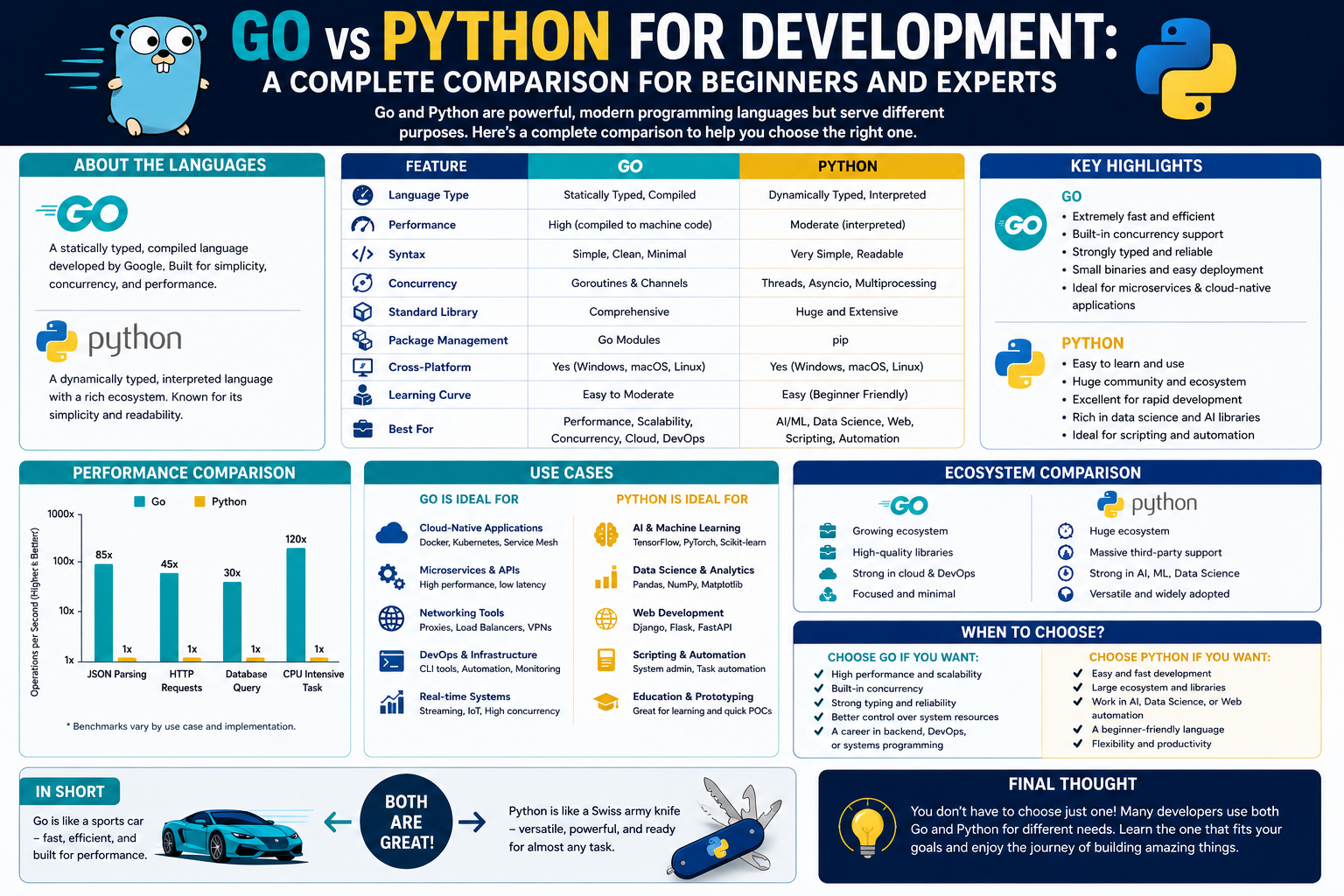
Choosing between Go and Python is not just about picking a programming language—it is about deciding how you want to build, scale, and maintain software over time. Both languages are widely used, both are modern in their own way, and both solve real-world problems effectively. However, they approach those problems with very different philosophies.
To understand which one fits your next project, it is important to go beyond surface-level comparisons and explore how each language is designed, why it was created, and what kinds of problems it is best suited to solve. This section focuses on building that foundation.
Go is often associated with systems that require high performance, scalability, and efficiency under heavy workloads. Python, on the other hand, is known for its simplicity, readability, and versatility across multiple domains such as data analysis, automation, and application development.
Understanding this fundamental difference helps clarify why developers often choose one over the other depending on the nature of the project rather than personal preference alone.
The Evolution and Purpose of Go
Go was created in response to real engineering challenges faced in large-scale software systems. As technology companies began dealing with massive traffic, distributed systems, and complex backend infrastructures, existing programming languages started to show limitations in areas like compilation speed, concurrency handling, and system efficiency.
Go emerged as a solution to these challenges with a strong focus on simplicity and performance. Instead of trying to include every possible feature found in older languages, Go intentionally keeps its design minimal. This allows developers to write software that is easier to maintain while still being highly efficient.
One of the key motivations behind Go was the need for faster development cycles in large systems. Traditional compiled languages often required long build times, which slowed down productivity. Go addressed this by introducing a compiler that is designed for speed, enabling rapid iteration.
Another important goal was improving concurrency support. Modern applications often handle thousands or even millions of simultaneous tasks. Go was designed from the ground up to manage concurrent processes in a lightweight and efficient manner, making it especially powerful in backend systems and network services.
In essence, Go was not designed as a general-purpose experiment. It was built with a very clear engineering mindset: reduce complexity, improve scalability, and optimize performance in distributed environments.
The Philosophy Behind Python’s Design
Python took a very different approach from the beginning. Instead of focusing primarily on system-level performance or low-level optimization, Python prioritized readability and ease of use. Its design philosophy revolves around the idea that code should be easy to understand, even for beginners.
This makes Python especially appealing to people who are new to programming as well as professionals working in fields where programming is a tool rather than a primary discipline. The language removes unnecessary complexity wherever possible so that developers can focus more on solving problems rather than managing syntax rules.
Over time, Python has grown into one of the most widely used programming languages in the world. Its simplicity has allowed it to spread across industries such as finance, education, scientific research, automation, artificial intelligence, and web development.
Unlike languages that were designed for a single purpose, Python evolved into a general-purpose tool. It adapts easily to different environments, making it suitable for small scripts as well as large-scale applications.
What makes Python particularly powerful is its ecosystem. Over the years, developers have built extensive libraries and frameworks that extend its capabilities far beyond its core functionality. This allows Python to remain lightweight while still being extremely powerful when needed.
Design Differences and Their Impact on Development
One of the most important differences between Go and Python lies in their design principles. Go is built with strict rules and structured patterns that encourage consistency across large teams. Python, on the other hand, provides flexibility and freedom, allowing developers to express solutions in multiple ways.
This difference has a direct impact on how software is written and maintained.
In Go, the language enforces certain conventions. This reduces ambiguity and makes large codebases easier to read and maintain over time. It also helps teams work together more efficiently because everyone follows similar patterns.
Python gives developers more freedom in how they structure their code. This flexibility can speed up development in small or medium-sized projects, but it can also lead to inconsistencies in larger systems if not carefully managed.
Another major difference is how each language handles complexity. Go aims to reduce hidden complexity by keeping the language small and predictable. Python allows complexity to exist but provides tools and libraries to manage it effectively.
These contrasting approaches influence not only how code is written but also how teams scale their projects over time.
Performance Philosophy and Execution Model
Performance is another area where Go and Python differ significantly, but not always in the way people expect.
Go is designed with performance as a core priority. It is a compiled language, meaning that code is translated directly into machine instructions before execution. This typically results in faster execution times and more efficient use of system resources.
Python, on the other hand, is an interpreted language. This means code is executed line by line at runtime, which can introduce overhead and reduce performance in comparison to compiled languages. However, in many real-world applications, this difference is not always a limiting factor.
The real distinction lies in how each language is optimized for different types of workloads. Go is highly efficient in handling concurrent processes and network-heavy applications. It is particularly effective in environments where multiple tasks need to run simultaneously without slowing down the system.
Python focuses more on developer productivity than raw execution speed. This trade-off allows developers to build applications faster, even if the underlying execution is not as optimized as Go.
In many cases, performance is less about the language itself and more about how it is used. Well-designed Python applications can still perform efficiently, while poorly designed Go applications can still struggle under heavy load.
Memory Management and System Efficiency
Memory management is another key difference between Go and Python, and it plays an important role in determining which language is more suitable for certain types of projects.
Go includes an automated garbage collection system that is designed to be efficient and predictable. It helps manage memory usage without requiring developers to manually allocate or free memory. This reduces the risk of memory leaks and improves system stability in long-running applications.
Python also uses automatic memory management, but its approach is more abstracted and less performance-focused. While this makes development easier, it can introduce additional overhead in memory-intensive applications.
Go’s memory model is particularly well-suited for systems that need to run continuously, such as servers, microservices, and distributed applications. It is designed to minimize pauses and maintain consistent performance over time.
Python’s memory management is generally sufficient for most applications, especially those that are not extremely resource-intensive. However, in high-performance environments, it may require additional optimization strategies.
Concurrency and Task Handling Approaches
One of the most important technical differences between Go and Python is how they handle concurrency.
Go was designed with concurrency as a built-in feature of the language. It allows multiple tasks to run simultaneously in a lightweight and efficient manner. This makes it especially powerful for applications that need to handle many operations at the same time, such as web servers, real-time systems, and distributed platforms.
The concurrency model in Go is simple at a conceptual level but extremely powerful in practice. It allows developers to write highly scalable systems without dealing with overly complex threading models.
Python also supports concurrency, but its approach is more limited and often depends on external libraries or additional frameworks. While Python can handle concurrent tasks, it is not inherently designed for high levels of parallel execution in the same way Go is.
This difference makes Go a stronger choice for backend systems that require high throughput and scalability, while Python is often preferred for applications where concurrency is not the primary concern.
Language Structure and Readability Approach
Readability plays a major role in how software is developed and maintained, especially in team environments.
Python is widely recognized for its clean and readable syntax. The language is designed to resemble natural language as closely as possible, which makes it easier for developers to understand code written by others. This is one of the reasons Python is often recommended for beginners.
Go takes a different approach. While it is also designed to be readable, it follows a more structured and explicit style. This reduces ambiguity and ensures that code behaves consistently across different environments and teams.
In large-scale projects, this consistency can be a major advantage. It reduces misunderstandings and makes debugging easier. However, it may feel more rigid compared to Python’s flexible syntax.
Both approaches have value depending on the context of the project and the experience level of the development team.
Ecosystem Growth and Industry Adoption Patterns
Over time, both Go and Python have developed strong ecosystems, but their areas of dominance differ.
Python has one of the largest and most diverse ecosystems in the programming world. It is widely used in scientific computing, data analysis, artificial intelligence, automation, and web development. This broad adoption has led to the creation of extensive libraries and frameworks that support almost any type of application.
Go has a more focused ecosystem, primarily centered around backend development, cloud infrastructure, and distributed systems. Its tools and libraries are optimized for performance, scalability, and system-level development.
Industry adoption also reflects these strengths. Python is often used in data-driven industries, research environments, and startups. Go is commonly used in large-scale infrastructure systems, cloud services, and performance-critical applications.
This separation is not strict, but it does highlight how each language has carved out its own space in the software development landscape.
Choosing Between Two Different Engineering Mindsets
At a deeper level, the choice between Go and Python is not just technical—it is philosophical. It reflects how you prefer to approach problem-solving in software development.
Go encourages structure, efficiency, and scalability from the beginning. It is designed for systems where performance and reliability are critical.
Python encourages flexibility, rapid development, and accessibility. It is designed for environments where speed of development and ease of use are more important than low-level optimization.
Both approaches are valid, and both are widely used in modern software development. The decision ultimately depends on the type of problem you are solving and the environment in which your application will operate.
Real-World Backend Architecture Differences
When Go and Python are used in real production environments, the differences between them become much more noticeable than in simple examples or small scripts. Backend architecture is where both languages show their true strengths and limitations.
Go is frequently chosen for building highly distributed systems, microservices architectures, and APIs that need to handle large volumes of simultaneous requests. Its design encourages building services that are small, fast, and independently deployable. This aligns naturally with modern cloud-based architectures, where systems are broken into many smaller services rather than one large application.
Python, in contrast, is widely used for backend systems where development speed and flexibility are more important than raw throughput. Many web applications start with Python frameworks because they allow rapid prototyping and faster iteration cycles. Developers can quickly build functional systems without dealing with too many low-level details.
In large-scale backend systems, Go often becomes the preferred choice when traffic increases significantly. Its ability to efficiently manage multiple concurrent requests allows it to maintain stable performance under heavy load. Python systems can also scale, but they often require additional infrastructure, caching layers, or architectural adjustments to achieve similar levels of efficiency.
This difference does not make one language superior to the other. Instead, it highlights how architecture decisions are often influenced by long-term scaling expectations rather than initial development speed.
Performance Under Production Load
Performance in controlled environments often looks different from performance in real-world production systems. This is where Go and Python diverge significantly.
Go is designed to handle sustained high-load environments. It maintains stable performance even when thousands of requests are processed simultaneously. This is because Go compiles directly to machine code and uses a lightweight execution model that reduces overhead.
In production systems such as high-traffic APIs or streaming services, this efficiency becomes extremely valuable. Go applications tend to use fewer system resources while maintaining predictable response times. This predictability is important in systems where latency must remain consistent.
Python systems behave differently under load. While Python is capable of handling production-scale traffic, it often relies on external optimizations such as load balancing, caching, and asynchronous processing to achieve similar results. Without these enhancements, performance can degrade more quickly compared to Go.
However, Python’s performance limitations are often acceptable in applications where raw speed is not the primary concern. Many business applications, internal tools, and data-driven platforms prioritize development speed and flexibility over maximum throughput.
In practice, production performance is not just about the language—it is about how well the system is designed, optimized, and scaled.
Concurrency Models in Practice
Concurrency is one of the most significant technical differences between Go and Python when applied in real-world systems.
Go’s concurrency model is deeply integrated into the language. It allows multiple tasks to run simultaneously with minimal overhead. This is especially useful in backend systems that need to handle many independent operations at the same time, such as processing requests, managing network connections, or handling streaming data.
In practical terms, Go makes concurrency feel like a natural part of writing software rather than an advanced feature that needs careful management. This simplicity allows developers to build highly scalable systems without complex threading logic.
Python approaches concurrency differently. Instead of being built into the core language design, concurrency is often handled through external libraries or specific programming patterns. This includes asynchronous programming models that allow tasks to run without blocking others.
While Python’s concurrency tools are powerful, they require more careful design decisions. Developers need to think more explicitly about when and how tasks are executed concurrently.
In real-world systems, this difference often means that Go is favored for high-concurrency environments like network servers, while Python is used in systems where concurrency is helpful but not the central requirement.
Web Development Ecosystem Comparison
Web development is one of the most common areas where both Go and Python are used, but their ecosystems serve different needs.
Python has a mature and highly flexible web development ecosystem. It supports rapid application development and is widely used for building full-stack applications, content management systems, and backend services. Its frameworks allow developers to focus on application logic rather than infrastructure concerns.
This makes Python particularly popular for startups and rapid prototyping environments where speed of development is essential. Developers can quickly build functional web applications and iterate based on user feedback.
Go takes a different approach to web development. Instead of offering large, feature-heavy frameworks, Go provides lightweight tools that focus on performance and simplicity. Web services built with Go are often more minimalistic but highly efficient.
Go-based web systems are commonly used in scenarios where performance and scalability are critical, such as APIs, cloud services, and distributed backend systems.
The key difference is that Python prioritizes developer convenience, while Go prioritizes system efficiency and performance consistency.
Data Science, AI, and Machine Learning Workflows
Data science and artificial intelligence represent one of the strongest domains for Python. Its ecosystem is deeply integrated into data processing, statistical analysis, and machine learning workflows.
Python provides a wide range of tools that simplify data manipulation, visualization, and model training. This has made it the default language in many research environments and AI development pipelines. Its simplicity allows data scientists to focus on experimentation rather than implementation details.
In machine learning workflows, Python is often used from data preprocessing all the way to model deployment. Its flexibility allows seamless integration between different stages of the data pipeline.
Go, in comparison, is not typically used for data science or AI model development. While it can handle data processing tasks efficiently, it lacks the extensive ecosystem that Python offers in this domain.
However, Go can still play an important role in AI systems, especially in production environments. Once models are trained using Python, Go can be used to deploy and serve these models efficiently at scale.
This division of labor is common in modern AI systems, where Python is used for development and experimentation, and Go is used for production-grade deployment.
DevOps, Cloud, and Container Ecosystem
Modern software development relies heavily on cloud infrastructure, automation, and containerization. Go and Python both play important roles in this ecosystem, but they serve different purposes.
Go is widely used in cloud-native applications. Many infrastructure tools and systems are built using Go because of its efficiency, portability, and strong concurrency support. It is particularly well-suited for building distributed systems, orchestration tools, and cloud services.
Its compiled nature allows Go applications to run as standalone binaries, which simplifies deployment in containerized environments. This makes it a natural fit for modern DevOps workflows.
Python is also widely used in DevOps, but more often in automation scripts, configuration management, and tooling. Its ease of use makes it ideal for writing scripts that automate repetitive tasks or manage system configurations.
In cloud environments, Python is often used for orchestration logic, while Go is used for performance-critical infrastructure components.
This complementary relationship allows both languages to coexist in modern DevOps pipelines.
Scalability Patterns in Large Systems
Scalability is a key concern in modern software systems, especially as applications grow in complexity and user base.
Go is designed with scalability in mind. Its lightweight concurrency model and efficient memory usage make it well-suited for horizontally scalable systems. Applications written in Go can be distributed across multiple servers with minimal performance degradation.
This makes Go particularly effective in microservices architectures, where systems are broken into independent services that communicate with each other.
Python can also scale, but it typically requires more architectural planning. Scaling Python applications often involves using additional tools such as caching layers, task queues, and load balancers.
While Python is capable of handling large-scale systems, it usually requires more external support compared to Go.
The difference lies in how each language approaches scalability. Go builds scalability into its core design, while Python achieves scalability through ecosystem tools and architectural patterns.
Error Handling and Debugging Experience
Error handling plays an important role in maintaining reliable software systems, especially in production environments.
Go takes a very explicit approach to error handling. Instead of relying on exceptions, Go encourages developers to handle errors directly at each step. This leads to more predictable code behavior and makes it easier to trace issues in large systems.
This approach may feel more verbose, but it improves clarity in complex systems where understanding every possible failure point is important.
Python uses an exception-based model for error handling. This allows for cleaner and more concise code, but it can sometimes make debugging more complex if exceptions are not handled carefully.
In practice, Go’s approach is often preferred in systems where reliability and predictability are critical, while Python’s approach is preferred in environments where development speed and readability are more important.
Testing and Maintainability in Team Projects
In large development teams, testing and maintainability become essential aspects of software design.
Go has a strong focus on simplicity, which makes testing more straightforward. Its strict structure and minimalistic design reduce ambiguity, making it easier for teams to maintain consistent coding standards across large codebases.
This consistency helps reduce long-term maintenance costs and improves collaboration between developers.
Python also supports extensive testing frameworks and practices. However, its flexibility means that different developers may write code in different styles, which can sometimes lead to inconsistencies in large projects.
Despite this, Python remains widely used in team environments due to its readability and ease of onboarding new developers.
Both languages support good testing practices, but Go emphasizes structure while Python emphasizes flexibility.
Security Considerations in Production Systems
Security is an important aspect of any production system, and both Go and Python handle it differently.
Go’s simplicity reduces the surface area for potential vulnerabilities. Its strict typing and explicit error handling contribute to more predictable behavior, which can improve overall system security.
Python’s dynamic nature provides flexibility but can introduce risks if not carefully managed. However, its large ecosystem includes many mature security libraries and tools that help mitigate these risks.
In practice, security depends more on development practices and system design than on the language itself. Both Go and Python can be used to build secure systems when properly implemented.
Library Ecosystem Depth and Dependency Management
Python has one of the richest ecosystems in software development. Its libraries cover almost every domain, from web development to scientific computing. This makes it extremely versatile and widely adopted.
Go has a more focused ecosystem. While it may not have as many libraries as Python, its standard library is powerful and well-designed. Go also emphasizes simplicity in dependency management, reducing complexity in large projects.
This difference reflects the overall philosophy of each language. Python prioritizes breadth of functionality, while Go prioritizes stability and simplicity.
Developer Productivity and Workflow Speed
Developer productivity is influenced by how quickly code can be written, tested, and deployed.
Python excels in rapid development environments. Its simple syntax and dynamic nature allow developers to build applications quickly. This makes it ideal for prototyping and iterative development.
Go focuses on long-term productivity. While initial development may take slightly longer due to its strict structure, it often results in more maintainable and predictable systems over time.
In many organizations, Python is used for early-stage development, while Go is used for production systems that require long-term stability.
Learning Curve in Professional Environments
The learning curve for Go and Python differs significantly depending on the background of the developer.
Python is often considered easier for beginners due to its simple syntax and readable structure. It allows new developers to start building functional programs quickly.
Go has a steeper learning curve initially, especially for developers unfamiliar with compiled languages or strict typing systems. However, once the fundamentals are understood, Go becomes highly efficient for building scalable systems.
In professional environments, the learning curve often depends more on the complexity of the system than the language itself.
Industry Usage Patterns Across Sectors
Different industries tend to favor Go and Python for different reasons.
Python is heavily used in education, research, data science, finance, and automation. Its flexibility and ease of use make it ideal for environments where experimentation and analysis are important.
Go is widely used in cloud computing, distributed systems, infrastructure tools, and backend services. Its performance and scalability make it suitable for large-scale production systems.
These patterns reflect the strengths of each language rather than limitations.
Interoperability and Integration with Other Systems
Modern software systems rarely exist in isolation. They often need to interact with multiple languages, databases, APIs, and platforms.
Python integrates easily with many systems due to its flexibility and extensive library support. It is often used as a glue language that connects different components.
Go is also highly interoperable, especially in cloud-native environments. Its ability to compile into standalone binaries makes it easy to deploy across different systems without complex dependencies.
Both languages are capable of working within complex ecosystems, but they often serve different roles within those ecosystems.
Advanced System Design Considerations in Real Engineering Environments
When software systems grow beyond a simple application into a distributed ecosystem, the choice between Go and Python starts to influence architectural behavior in subtle but important ways. At this stage, the conversation is no longer about basic syntax or simple use cases. It becomes about how each language behaves under complex system design constraints such as fault tolerance, horizontal scaling, service independence, and operational resilience.
Go naturally aligns with systems that are designed around strict boundaries between services. Its minimal runtime and efficient concurrency model make it well-suited for architectures where services are expected to operate independently, communicate over lightweight protocols, and recover quickly from failures. In such environments, predictability becomes more important than flexibility, and Go’s strict structure helps enforce that discipline.
Python-based systems often take a different architectural path. Because Python prioritizes flexibility and developer speed, it is frequently used in systems where components evolve rapidly or where experimentation is common. This makes it especially suitable for early-stage system design, where architecture is still being refined, and requirements are not fully stable.
As systems mature, the architectural role of each language becomes clearer. Go often becomes the backbone of stable, high-performance services, while Python continues to serve as a rapid development layer for experimentation, analytics, and orchestration logic.
Performance Optimization in Real Production Environments
Once applications are deployed at scale, performance optimization becomes less about raw language speed and more about how efficiently a system uses its resources under real-world conditions.
In Go-based systems, optimization typically focuses on reducing memory allocation overhead, minimizing garbage collection pressure, and fine-tuning concurrency behavior. Because Go is already designed for efficiency, performance tuning often involves small but meaningful adjustments that improve throughput in high-load environments. The predictable nature of Go’s execution model allows engineers to reason about performance bottlenecks more systematically.
Python optimization takes a different form. Since Python’s runtime is inherently more flexible but less performance-optimized at the core, engineers often rely on architectural strategies rather than micro-optimizations. This includes breaking workloads into asynchronous tasks, distributing processing across multiple services, or integrating external high-performance components.
In practice, Python performance tuning is more about system design than language internals. Engineers frequently restructure workflows to reduce blocking operations and offload heavy computations to specialized services.
This distinction highlights an important reality: Go tends to optimize within the language, while Python often optimizes around the language.
Deployment Strategies and Infrastructure Integration
Deployment is another area where the differences between Go and Python become highly visible in production environments.
Go applications are typically deployed as standalone binaries. This simplifies deployment pipelines because the runtime environment is minimal and self-contained. The result is a consistent behavior across different systems, whether deployed in containers, virtual machines, or cloud environments. This consistency is a major advantage in large-scale infrastructure where predictability is critical.
Python applications, on the other hand, depend on a runtime environment and external dependencies. This introduces additional complexity during deployment, especially when managing library versions or system compatibility. However, Python’s flexibility allows it to integrate seamlessly with a wide range of frameworks and platforms.
In modern infrastructure, both languages are often deployed using containerization systems. However, Go applications tend to require less overhead inside these environments, while Python applications require more careful dependency management.
Despite these differences, both languages fit well into automated deployment pipelines. The key difference lies in how much effort is required to maintain consistency across environments.
Observability, Monitoring, and Debugging at Scale
In large distributed systems, observability becomes essential for maintaining reliability. Understanding how systems behave in real time requires strong logging, monitoring, and tracing capabilities.
Go applications tend to produce predictable runtime behavior, which simplifies observability. Because the execution model is relatively straightforward, performance metrics and system logs are often easier to interpret. This clarity helps engineers identify bottlenecks and diagnose issues in production systems more quickly.
Python systems generate richer runtime flexibility, which can sometimes make debugging more complex. The dynamic nature of Python allows for many execution paths, which increases the importance of structured logging and careful instrumentation. In large systems, Python-based services often rely heavily on external observability tools to maintain visibility.
Both languages support modern observability practices, but Go’s structured execution model often results in simpler operational debugging, while Python requires more emphasis on external monitoring strategies.
Microservices Architecture Patterns and Language Fit
Microservices architecture has become one of the dominant design patterns in modern software engineering, and both Go and Python play important roles in it.
Go is often considered a natural fit for microservices because each service can be compiled into a lightweight, independent binary. This allows services to scale independently, deploy quickly, and recover from failures without affecting the entire system. The simplicity of Go also helps enforce strict service boundaries, which is a core principle of microservices design.
Python also plays an important role in microservices ecosystems, especially in services that require rapid development or complex business logic. Many organizations use Python for service layers that handle data processing, user interaction, or orchestration between systems.
In practice, large microservicearchitectures often combine both languages. Go handles performance-critical services, while Python handles flexible and rapidly evolving services.
This hybrid usage reflects a pragmatic approach to system design rather than a strict preference for one language.
Data Processing Pipelines and Streaming Systems
Modern applications often rely on continuous data processing pipelines that handle large volumes of real-time or batch data.
Go is particularly strong in streaming systems where data must be processed continuously with minimal latency. Its concurrency model allows it to handle multiple data streams efficiently without introducing significant overhead. This makes it suitable for systems such as real-time analytics, event processing, and network data pipelines.
Python is widely used in data processing workflows that involve complex transformations, analytics, and machine learning integration. Its ecosystem provides powerful tools for manipulating and analyzing data at various stages of a pipeline.
In many real-world systems, Python is used for the analytical or transformation layer, while Go is used for ingestion and streaming layers where performance is critical.
This division of responsibility allows systems to balance performance with analytical depth.
Enterprise Adoption and Organizational Impact
The choice between Go and Python also has organizational implications that go beyond technical performance.
Python is often favored in organizations where cross-functional collaboration is important. Its simplicity makes it accessible to data scientists, analysts, and engineers from different backgrounds. This inclusivity allows teams to collaborate more easily on shared codebases.
Go is often adopted in organizations that prioritize engineering discipline, scalability, and system reliability. Its strict structure encourages consistency across large engineering teams and reduces ambiguity in code design.
In enterprise environments, both languages often coexist. Python supports rapid innovation and data-driven decision-making, while Go provides stable infrastructure for production systems.
This dual adoption reflects how modern enterprises balance innovation with operational stability.
Migration Strategies Between Python and Go Systems
As systems evolve, organizations sometimes migrate components between Python and Go depending on performance needs and scalability requirements.
Migrating from Python to Go typically occurs when a system reaches performance limits or requires more predictable behavior under load. In such cases, critical components are rewritten in Go to improve efficiency and scalability.
Migration in the opposite direction, from Go to Python, is less common but may occur when flexibility becomes more important than strict performance optimization, especially in experimental or research-driven environments.
In most cases, migration is incremental rather than complete. Systems are gradually refactored so that each language handles the part of the system it is best suited for.
This incremental approach reduces risk and allows teams to maintain system stability during transitions.
Hybrid Architectures Using Both Languages
One of the most common patterns in modern software engineering is the use of both Go and Python within the same system architecture.
In hybrid systems, Go is often used for performance-critical backend services, APIs, and infrastructure components. Python is used for business logic, data processing, automation, and machine learning workflows.
This combination allows organizations to leverage the strengths of both languages without forcing a single technology choice across all system components.
Hybrid architectures also improve development efficiency by allowing teams to choose the most appropriate language for each task. This reduces unnecessary complexity and improves overall system maintainability.
The success of hybrid systems depends on clear service boundaries and well-defined communication protocols between components.
Cost Efficiency and Resource Management in Production Systems
Cost efficiency is an important factor in large-scale deployments, especially in cloud-based environments where resource usage directly impacts operational expenses.
Go’s efficient execution model typically results in lower memory and CPU usage compared to many other languages. This can translate into lower infrastructure costs when operating at scale.
Python systems may require more computational resources depending on workload complexity. However, this is often offset by faster development cycles and reduced engineering time.
In many organizations, the total cost of ownership includes not just infrastructure costs but also developer productivity. From this perspective, Python can sometimes be more cost-effective in early stages, while Go becomes more efficient in long-term production environments.
The balance between these factors depends on system scale, workload type, and organizational priorities.
Security Engineering in Large-Scale Systems
Security considerations play an increasingly important role in modern software design, especially in distributed systems.
Go’s simplicity and strict type system reduce certain categories of runtime errors, which can improve overall system reliability. Its predictable execution model also makes it easier to audit system behavior.
Python’s flexibility introduces more dynamic behavior, which can increase complexity in security-sensitive systems if not carefully managed. However, its extensive ecosystem includes mature security tools and libraries that help mitigate risks.
In practice, both languages can be used to build secure systems when proper engineering practices are followed. Security depends more on architecture, access control, and operational discipline than on the language itself.
Developer Experience and Team Productivity at Scale
Developer productivity changes significantly as teams and systems grow.
Python often provides higher initial productivity due to its simplicity and readability. This makes it ideal for onboarding new developers and enabling rapid experimentation.
Go provides long-term productivity benefits by enforcing consistency and reducing ambiguity in large codebases. While it may feel more rigid initially, it often reduces maintenance overhead in large teams.
In large organizations, both languages contribute to productivity in different ways. Python accelerates innovation, while Go stabilizes production systems.
This balance allows teams to move quickly without sacrificing system reliability.
Future Evolution of Go and Python in Industry
Both Go and Python continue to evolve in response to changing industry demands.
Go is likely to continue strengthening its position in cloud infrastructure, distributed systems, and backend engineering. Its focus on simplicity and performance aligns well with modern scalable architectures.
Python is expected to maintain its dominance in data science, artificial intelligence, automation, and general-purpose development. Its ecosystem continues to expand rapidly, especially in emerging fields like machine learning and data-driven applications.
Rather than competing directly, both languages are increasingly becoming complementary tools in modern software engineering. Their future evolution is shaped more by integration than replacement, as systems continue to grow in complexity and require diverse technological approaches.
Conclusion
Choosing between Go and Python is ultimately less about finding a universally “better” language and more about understanding the nature of the problem you are trying to solve. Both languages have matured into powerful tools in modern software development, but they excel in different directions because they were designed with different priorities in mind.
Go stands out in environments where performance, scalability, and system reliability are critical. Its lightweight concurrency model, compiled execution, and strict structural design make it especially suitable for backend systems, cloud infrastructure, microservices, and high-throughput applications. It is a language that favors predictability and long-term stability, often becoming the backbone of systems that must handle large volumes of traffic without degradation in performance.
Python, on the other hand, shines in areas where flexibility, rapid development, and ease of use are more important than raw execution speed. Its readable syntax, vast ecosystem, and strong support for data science, machine learning, automation, and web development make it one of the most versatile programming languages in the world. Python enables developers to move quickly from idea to implementation, which is particularly valuable in research-driven or fast-changing environments.
In real-world engineering scenarios, the decision is rarely binary. Many modern systems use both languages together, assigning Go to performance-critical services and Python to analytical, experimental, or automation-heavy components. This hybrid approach reflects a practical understanding of their strengths rather than forcing a single-language solution.
Ultimately, the best choice depends on your project’s goals, scale, and long-term direction. If your priority is building fast, scalable, and highly efficient backend systems, Go is often the stronger option. If your focus is rapid development, data processing, or machine learning, Python provides unmatched convenience and ecosystem support.
Understanding both languages not only helps in choosing the right tool but also deepens your ability to design better systems. In modern software development, versatility and architectural awareness matter just as much as language expertise.