Search functionality may seem like a routine feature that users barely notice, yet it is one of the most critical components behind modern digital experiences. Whether browsing an online store, streaming music, or reading news, users expect fast, accurate, and relevant results almost instantly. The convenience of typing a query and receiving meaningful results within seconds is something people often take for granted, but behind that simplicity lies a sophisticated system designed to process vast amounts of data efficiently.
Consider the scale at which modern platforms operate. Large e-commerce websites host millions of products, while streaming platforms manage enormous libraries of media content. Despite this complexity, search results are delivered in seconds. If this speed or accuracy were compromised, users would quickly lose patience and move to alternatives. Search is not just a feature; it is a fundamental driver of user engagement, retention, and overall satisfaction.
For developers and organizations, implementing such powerful search capabilities might seem overwhelming. However, cloud providers offer managed services that significantly simplify the process. Among these, two prominent solutions stand out: AWS CloudSearch and Elasticsearch. While both services aim to deliver high-performance search capabilities, they differ in design philosophy, flexibility, and use cases. Understanding these differences is essential when deciding which one best fits your needs.
Understanding AWS CloudSearch
AWS CloudSearch is a fully managed search service designed to make implementing search functionality straightforward and efficient. It is built on Apache Solr technology, a highly reliable and scalable search platform known for its ability to handle distributed indexing and querying. By leveraging this foundation, CloudSearch provides strong performance while abstracting away the complexities typically associated with managing search infrastructure.
One of the most appealing aspects of CloudSearch is its simplicity. Instead of installing and configuring servers, managing clusters, or handling updates, users can rely on AWS to take care of all operational aspects. This includes provisioning resources, scaling the system, applying patches, and ensuring high availability. As a result, developers can focus on building applications rather than maintaining backend infrastructure.
Setting up CloudSearch involves creating a search domain, which serves as the central unit for storing and querying data. This domain contains the data itself, the compute resources responsible for processing queries, and the configuration that defines how the data is indexed. Developers must define index fields beforehand, specifying the structure and type of data that will be stored. This step ensures that CloudSearch understands how to process and retrieve information efficiently.
Data can be uploaded from various sources, including structured files or integrated cloud storage services. Once the data is ingested, it becomes searchable through APIs or HTTP endpoints. This allows seamless integration with applications, enabling users to perform searches directly from web or mobile interfaces.
Another notable feature is its ability to scale. CloudSearch supports multiple instances, allowing workloads to be distributed across nodes for improved performance and reliability. As data grows, additional resources can be allocated without disrupting existing operations. This scalability ensures consistent performance even under heavy usage.
CloudSearch is particularly well-suited for applications that require a straightforward search solution without extensive customization. It excels in scenarios where ease of use, minimal maintenance, and quick deployment are priorities.
Understanding Elasticsearch
Elasticsearch is another powerful search solution offered as a managed service, but it takes a different approach compared to CloudSearch. It is based on a widely adopted open-source search and analytics engine and forms part of a broader ecosystem often associated with data processing and visualization tools.
Unlike CloudSearch, Elasticsearch offers greater flexibility and control. It automatically generates index structures based on incoming data, eliminating the need to define fields in advance. This dynamic approach simplifies initial setup and allows developers to work with evolving data models more easily.
Interaction with Elasticsearch primarily occurs through its RESTful API, enabling developers to send queries, retrieve results, and manage data using standard HTTP requests. This makes it highly adaptable for integration with various programming languages and frameworks.
One of the defining strengths of Elasticsearch is its scalability. It operates on a distributed architecture, allowing data to be partitioned and replicated across multiple nodes. This not only enhances performance but also ensures fault tolerance. As demand increases, additional nodes can be added to handle higher workloads seamlessly.
Beyond basic search capabilities, Elasticsearch extends into analytics and data visualization. It can be paired with visualization tools to create dashboards that provide insights into stored data. These dashboards can display trends, metrics, and patterns, making Elasticsearch a powerful tool for both search and analytics use cases.
Another advantage lies in its extensive ecosystem and community support. Being part of an open-source environment, Elasticsearch benefits from continuous innovation, a wide range of plugins, and integration options. This makes it suitable for complex applications that require customization and advanced features.
However, this flexibility comes with added complexity. While the managed service reduces operational overhead, developers still need to understand its architecture and configuration options to fully leverage its capabilities.
Key Differences Between CloudSearch and Elasticsearch
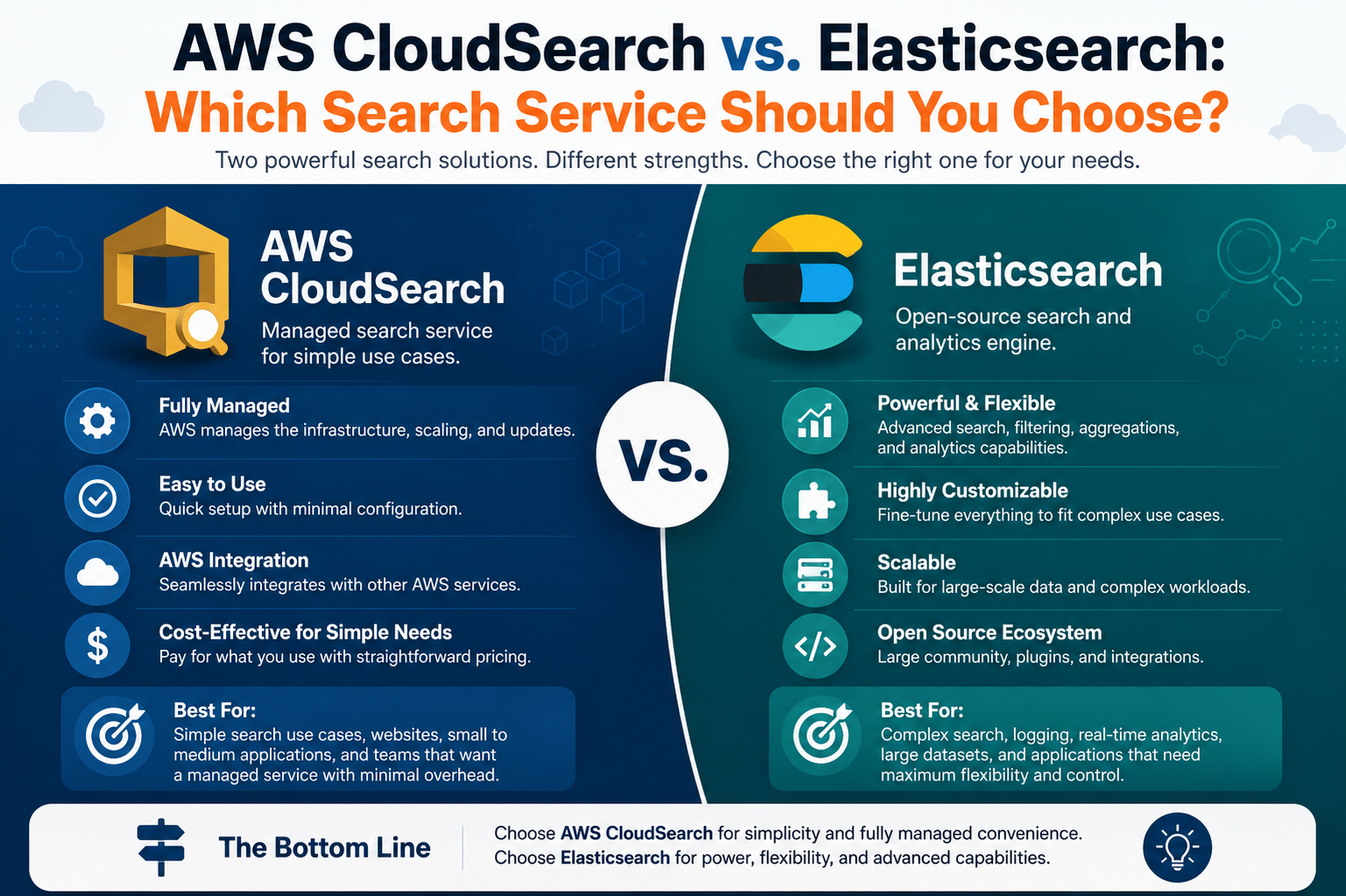
While both services provide managed search capabilities, their differences become more apparent when examined closely. CloudSearch emphasizes simplicity and ease of use, offering a streamlined experience with minimal configuration. Elasticsearch, on the other hand, focuses on flexibility and extensibility, providing a robust platform for advanced search and analytics.
In terms of setup, CloudSearch requires predefined index fields, ensuring structured data handling from the start. Elasticsearch adopts a more dynamic approach, automatically inferring data structures, which can be advantageous for rapidly changing datasets.
Customization is another major differentiator. CloudSearch offers limited control over its internal workings, making it ideal for straightforward implementations. Elasticsearch provides extensive customization options, allowing developers to fine-tune indexing, querying, and data processing to meet specific requirements.
Scalability is strong in both services, but Elasticsearch’s distributed architecture and ecosystem integrations make it more suitable for large-scale, complex systems. CloudSearch, while scalable, is more focused on delivering reliable performance for standard search applications.
When it comes to use cases, CloudSearch is often chosen for applications where search is a supporting feature rather than the core focus. It works well for websites, product catalogs, and document searches. Elasticsearch, in contrast, is frequently used in scenarios that require advanced analytics, real-time data processing, and integration with monitoring or business intelligence tools.
Security is a critical consideration for any data-driven system. Both services provide robust security features, including access control and encryption. CloudSearch integrates seamlessly with broader cloud security mechanisms, while Elasticsearch offers additional options for authentication, auditing, and fine-grained access control.
Cost considerations can also influence the decision. Pricing structures differ based on resource usage, instance types, and additional features. While CloudSearch may appear simpler to estimate, Elasticsearch’s flexibility can lead to varying costs depending on how it is configured and scaled.
Choosing the Right Service for Your Needs
Selecting between CloudSearch and Elasticsearch depends largely on your project requirements and technical priorities. If you need a quick, easy-to-deploy search solution with minimal maintenance, CloudSearch is an excellent choice. Its managed nature allows teams to implement search functionality without investing significant time in setup or ongoing management.
On the other hand, if your application demands advanced search features, real-time analytics, or integration with a broader data ecosystem, Elasticsearch offers the flexibility needed to achieve those goals. Its ability to handle complex queries, support large datasets, and provide detailed insights makes it a powerful option for data-intensive applications.
It is also important to consider the expertise of your team. CloudSearch requires less specialized knowledge, making it suitable for teams with limited experience in search technologies. Elasticsearch, while more powerful, may require a deeper understanding of its architecture and configuration to fully utilize its capabilities.
Performance requirements, data volume, and future scalability should also play a role in your decision. While both services can handle significant workloads, Elasticsearch’s architecture is often better suited for rapidly growing systems with evolving needs.
Conclusion
Search technology plays a vital role in shaping user experiences across modern applications. Delivering fast, accurate, and relevant results is no longer optional; it is a necessity for staying competitive in today’s digital landscape. AWS CloudSearch and Elasticsearch both provide powerful solutions to meet these demands, each with its own strengths and trade-offs.
CloudSearch stands out for its simplicity, ease of use, and minimal maintenance, making it ideal for straightforward search implementations. Elasticsearch, with its flexibility, scalability, and rich ecosystem, is better suited for complex applications that require advanced features and analytics.
Ultimately, the choice between the two depends on your specific use case, technical requirements, and long-term goals. By carefully evaluating these factors, you can select the solution that best aligns with your needs and ensures a seamless search experience for your users.