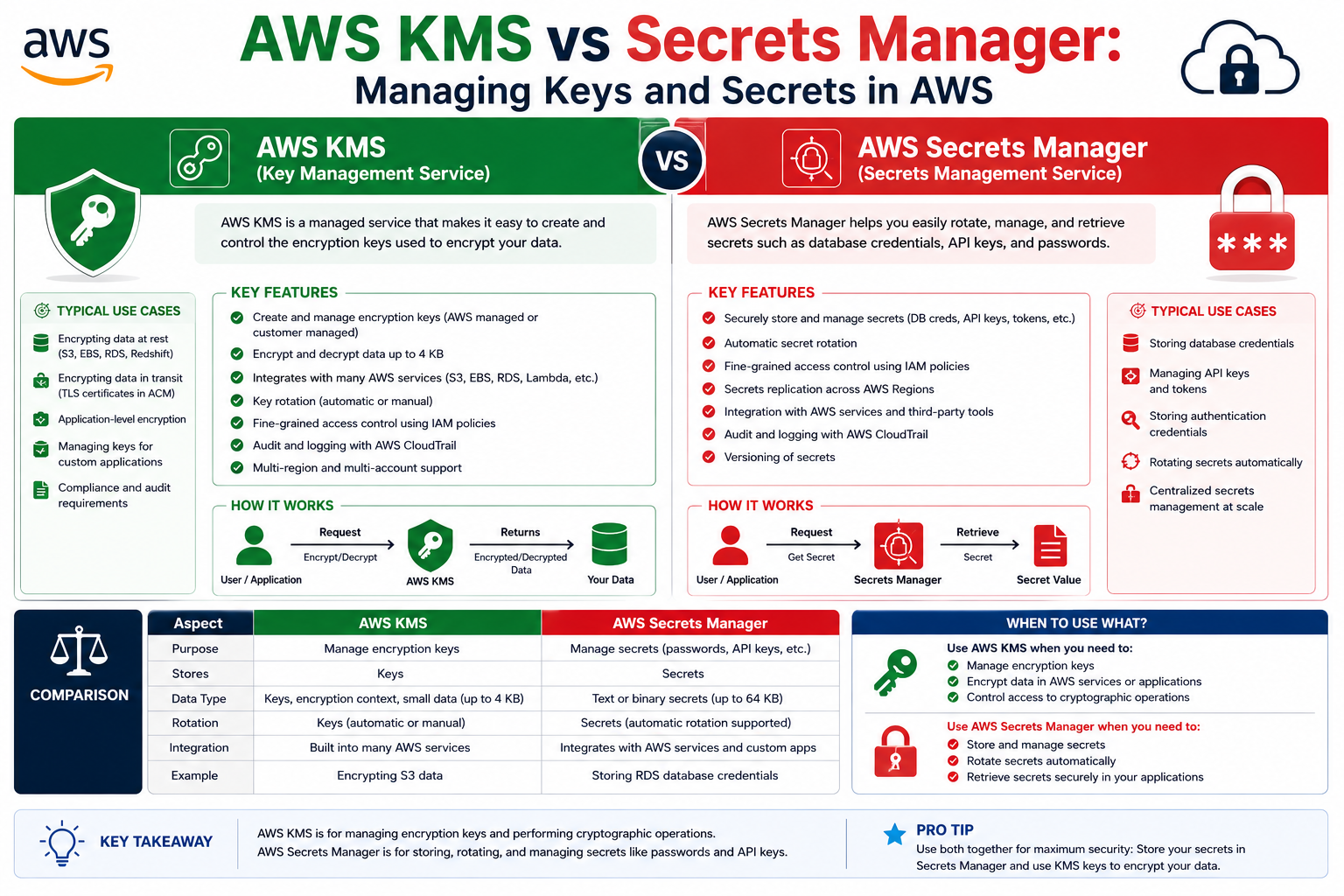
Cloud security is not only about protecting data but also about safeguarding the sensitive information that grants access to that data. Within Amazon Web Services, the concept of “secrets” goes beyond general confidentiality and focuses specifically on credentials such as passwords, tokens, and access keys. At the same time, encryption keys play an equally critical role by ensuring that stored or transmitted data remains unreadable to unauthorized users. Understanding the difference between these two protective mechanisms is essential for designing a secure cloud architecture. AWS provides dedicated services to address both needs, primarily AWS Key Management Service (KMS) and AWS Secrets Manager. While both contribute to maintaining confidentiality, they operate in fundamentally different ways and serve distinct purposes in the security ecosystem.
The foundation of modern cybersecurity is often described through the CIA triad, which stands for confidentiality, integrity, and availability. Both AWS KMS and AWS Secrets Manager are deeply aligned with the goal of confidentiality, ensuring that sensitive data and access credentials remain protected from unauthorized exposure. However, their approaches differ significantly. One focuses on encrypting and protecting data itself, while the other focuses on securely storing and managing the credentials required to access systems and services. Recognizing how these services complement each other is key to implementing a strong and resilient security strategy in the cloud.
AWS Key Management Service (KMS): Core Concept and Purpose
AWS Key Management Service is a managed service designed to create, store, and control cryptographic keys used for data encryption across AWS environments. It acts as a centralized system for handling encryption keys, allowing organizations to enforce consistent security policies while maintaining control over how data is protected. Instead of building and maintaining complex key management systems from scratch, users can rely on KMS to handle the heavy lifting, including secure key storage, access control, and integration with other AWS services.
In simple terms, AWS KMS can be thought of as the backbone of encryption in the cloud. It ensures that sensitive data is encoded in such a way that only authorized parties with the correct keys can decode it. By centralizing key management, it reduces operational complexity and minimizes the risk of mismanagement, which is a common cause of security breaches.
Data Protection Through Encryption in AWS KMS
The primary role of AWS KMS is to protect data through encryption. Encryption transforms readable data, known as plaintext, into an unreadable format called ciphertext. This transformation ensures that even if data is intercepted or accessed without authorization, it cannot be understood without the appropriate decryption key.
AWS KMS does not store the encrypted data itself. Instead, it securely manages the cryptographic keys that are used to encrypt and decrypt that data. This separation of responsibilities enhances security by ensuring that access to data and access to keys are controlled independently. Without the correct key, encrypted data remains meaningless, effectively protecting it even if it is exposed.
This approach allows organizations to store sensitive information in various AWS services while maintaining confidence that the data is protected at all times. It also enables the concept of “encryption in plain sight,” where data can reside in accessible storage systems but remains secure due to strong encryption practices.
How AWS KMS Operates in Practice
AWS KMS uses a layered encryption model commonly referred to as envelope encryption. In this model, data is encrypted using a data key, and that data key is then encrypted using a master key managed by KMS. This hierarchical structure adds an extra layer of protection and ensures that even the keys used for encryption are themselves secured.
The service relies on strong cryptographic standards, including advanced encryption algorithms, to ensure data protection. Keys are stored within highly secure hardware systems known as hardware security modules, which are designed to resist tampering and unauthorized access. These modules comply with strict security standards, ensuring that cryptographic operations are performed in a controlled and secure environment.
AWS KMS supports different types of keys, including customer-managed keys, AWS-managed keys, and AWS-owned keys. Customer-managed keys provide the highest level of control, allowing users to define policies, rotate keys, and manage access permissions. AWS-managed keys simplify the process by handling key management automatically for specific services, while AWS-owned keys are fully managed by AWS and not visible to users.
Additionally, AWS KMS integrates seamlessly with a wide range of AWS services, enabling encryption for storage, databases, and application workloads. It supports both client-side and server-side encryption, giving organizations flexibility in how they implement their security models.
Practical Use Cases of AWS KMS
AWS KMS is widely used to protect data at rest and in transit. It enables secure encryption and decryption operations, ensuring that sensitive information remains protected throughout its lifecycle. Beyond encryption, KMS also supports digital signing and verification, which are essential for ensuring data integrity and authenticity.
Organizations often use KMS to meet compliance requirements, as it provides detailed logging and auditing capabilities. By integrating with monitoring and logging services, users can track how and when keys are accessed, creating a transparent and auditable security environment. This visibility is crucial for identifying potential security threats and responding to incidents effectively.
AWS Secrets Manager: Core Concept and Purpose
AWS Secrets Manager is a specialized service designed to securely store, retrieve, and manage sensitive credentials used by applications. Unlike KMS, which focuses on encryption keys, Secrets Manager is dedicated to handling secrets such as database credentials, API keys, tokens, and other authentication details.
The service acts as a secure vault for sensitive information, ensuring that credentials are not hardcoded into applications or exposed in configuration files. By centralizing the management of secrets, it reduces the risk of accidental exposure and simplifies the process of updating and maintaining credentials.
Secrets Manager also enhances security by automating the rotation of secrets. Instead of relying on manual updates, which can be inconsistent and error-prone, the service can automatically change credentials at defined intervals. This reduces the window of opportunity for attackers and helps organizations maintain strong security hygiene.
Types of Data Protected by AWS Secrets Manager
Secrets Manager is designed to handle any information that grants access to systems or services. This includes usernames and passwords, access tokens, encryption keys used by applications, and other forms of sensitive configuration data.
The key distinction between Secrets Manager and KMS lies in what they protect. KMS safeguards the keys used for encryption, while Secrets Manager safeguards the credentials used for authentication and authorization. Both are critical, but they address different layers of the security model.
By storing secrets securely and retrieving them dynamically when needed, applications can operate without exposing sensitive information. This approach eliminates the risks associated with storing credentials in plain text and ensures that access to secrets is tightly controlled.
How AWS Secrets Manager Works
AWS Secrets Manager enables applications to access credentials securely without embedding them directly into code. When an application needs a secret, it makes a request to the service, which then provides the required information in a secure manner.
The service integrates with AWS KMS to encrypt stored secrets, ensuring that even the secrets themselves are protected at rest. This combination of secure storage and strong encryption creates a robust security framework for managing sensitive information.
Secrets Manager also supports automated workflows through event-driven mechanisms. For example, it can trigger processes to rotate credentials, update databases, or notify systems when changes occur. This automation reduces manual effort and ensures that security practices are consistently applied.
Monitoring and auditing are integral components of Secrets Manager. By integrating with logging and monitoring systems, organizations can track access to secrets, detect unusual activity, and respond to potential security incidents. This visibility enhances overall security posture and supports compliance requirements.
Practical Use Cases of AWS Secrets Manager
Secrets Manager is commonly used in application development and deployment environments where secure handling of credentials is essential. It allows developers to build applications without worrying about exposing sensitive information, as secrets are retrieved dynamically at runtime.
The service is particularly valuable in environments that require frequent credential updates, such as database systems or third-party integrations. Automated rotation ensures that credentials remain secure without disrupting application functionality.
Additionally, Secrets Manager supports cross-region replication, enabling organizations to maintain availability and resilience in the event of regional failures. This capability ensures that critical secrets remain accessible even during disruptions.
Understanding AWS Systems Manager Parameter Store
Another related service is AWS Systems Manager Parameter Store, which provides a way to store configuration data and secrets in a key-value format. While it shares some similarities with Secrets Manager, it is more general-purpose and supports a broader range of use cases, including storing application configuration values, URLs, and license keys.
Parameter Store can also integrate with AWS KMS for encryption, allowing sensitive parameters to be protected using the same key management infrastructure. Although it may not offer the same level of automation and advanced features as Secrets Manager, it remains a useful option for managing configuration data in a secure and organized manner.
Choosing Between AWS KMS and AWS Secrets Manager
Selecting the right service depends on the specific security requirement being addressed. AWS KMS is the appropriate choice when the goal is to encrypt data and manage cryptographic keys. It ensures that sensitive data remains unreadable without proper authorization and provides the foundation for secure data storage and transmission.
AWS Secrets Manager, on the other hand, is designed for managing access credentials. It ensures that secrets are stored securely, accessed only by authorized entities, and updated regularly to minimize risk.
In many cases, these services are used together rather than as alternatives. Secrets Manager relies on KMS for encryption, demonstrating how the two services complement each other. By combining secure key management with secure credential storage, organizations can build a comprehensive security architecture that addresses multiple layers of risk.
Conclusion
Effective cloud security requires a clear understanding of the tools available and how they interact. AWS Key Management Service and AWS Secrets Manager are both essential components of a secure AWS environment, each addressing a different aspect of confidentiality. KMS focuses on protecting data through encryption and managing the keys that make encryption possible, while Secrets Manager focuses on safeguarding the credentials that grant access to systems and services.
Rather than viewing these services as competing options, it is more accurate to see them as complementary solutions that work together to strengthen security. By leveraging both services appropriately, organizations can ensure that their data remains protected, their credentials remain secure, and their overall cloud infrastructure maintains a high standard of security and reliability.