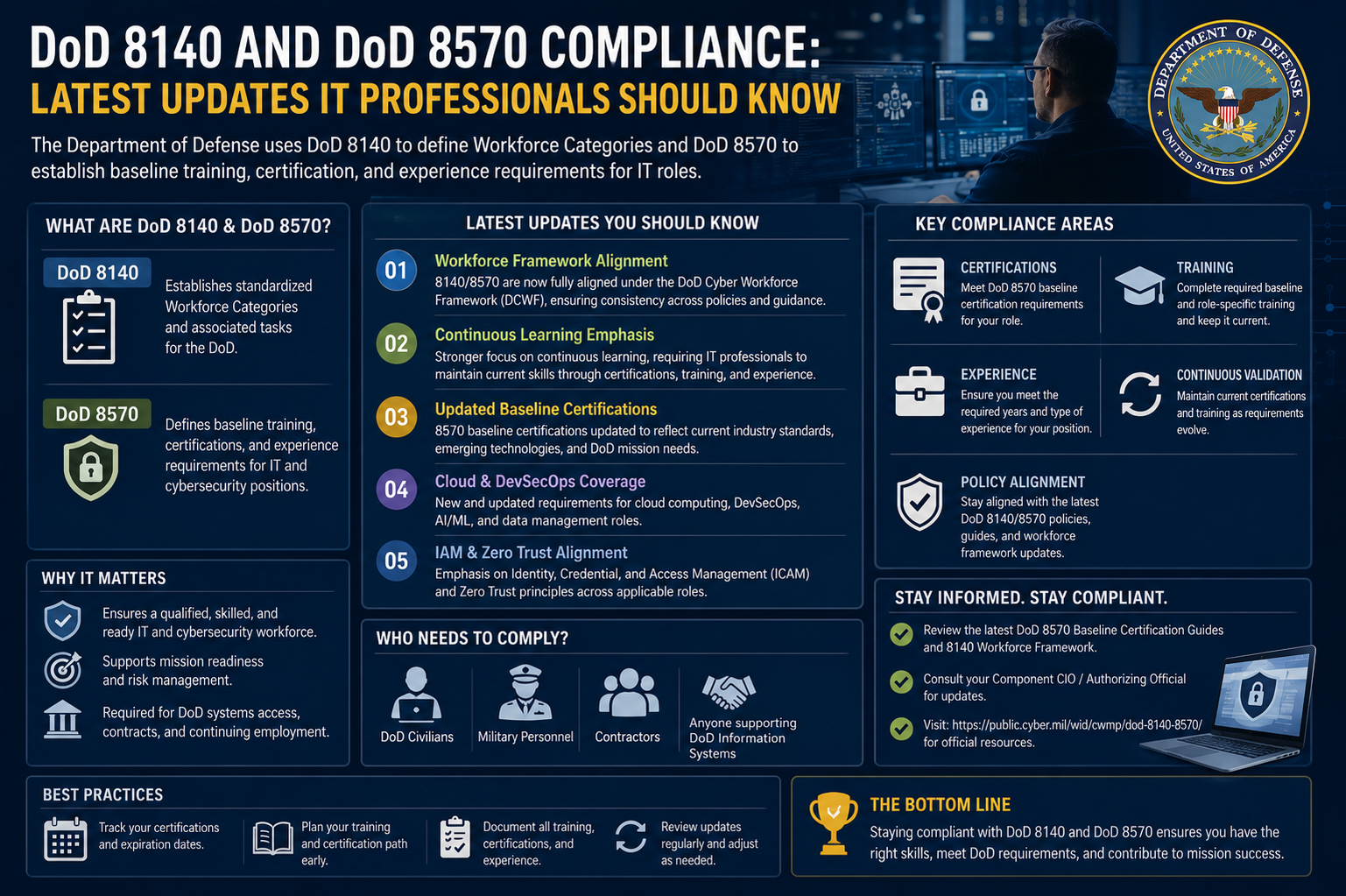
IT professionals aiming to work with the Department of Defense or government-affiliated organizations must understand the evolving compliance framework governing cybersecurity roles. The transition from DoD Directive 8570 to DoD Directive 8140 represents a major shift in how cybersecurity talent is evaluated, trained, and maintained within federal environments. While earlier frameworks relied heavily on certification-based validation, the newer approach places greater emphasis on role alignment, hands-on capability, and continuous skill development. This transformation reflects the growing complexity of modern cyber threats and the need for more adaptive workforce standards across defense-related IT positions.
Purpose and Evolution of DoD Directive 8140
DoD Directive 8140 establishes a structured framework for managing and developing the cybersecurity workforce across defense agencies and contractor environments. It builds on earlier compliance models but introduces a more dynamic structure that aligns individuals with specific cyber roles rather than generic certification categories. This approach ensures that personnel are not only certified but also functionally capable within their assigned responsibilities. The directive covers multiple cyber-related domains, including cybersecurity operations, cyber IT, cyber intelligence, cyber effects, software engineering, artificial intelligence, and data-focused roles. Each domain is further divided into proficiency levels such as foundational, intermediate, and advanced, ensuring that skill expectations match job complexity.
Workforce Categorization and Role Alignment
Under the updated compliance structure, cyber professionals are grouped into clearly defined workforce categories that reflect real-world operational functions. These categories extend beyond traditional information assurance roles and include specialized technical and analytical domains. Each position within the framework is mapped to specific knowledge, skills, and abilities required for successful performance. This structured alignment allows organizations to better identify competency gaps while ensuring that personnel are placed in roles that match their expertise. It also creates a more standardized approach to workforce planning across defense-related IT environments.
Shift from Certification-Centric to Skill-Based Evaluation
One of the most significant changes in the updated framework is the transition from certification-only validation to a more comprehensive evaluation model. Previously, compliance requirements were largely centered on obtaining specific industry certifications to meet eligibility standards. The newer model expands this by incorporating practical experience, role-specific training, and applied technical knowledge. This shift ensures that individuals are not only certified but also capable of performing job-related tasks in real operational environments. As a result, certifications remain important, but they are now part of a broader qualification system rather than the sole requirement.
Continuous Professional Development Expectations
The modern cybersecurity workforce framework introduces an ongoing development requirement that emphasizes continuous learning. IT professionals are expected to maintain and enhance their skills throughout their careers rather than relying on a single certification achievement. This includes periodic training updates, advanced technical education, and role-specific skill refreshers. The goal is to ensure that professionals remain current with evolving cyber threats, emerging technologies, and updated defense strategies. This continuous improvement model helps maintain a highly capable workforce that can respond effectively to rapidly changing security challenges.
Compliance Transition Timeline and Workforce Impact
The transition toward the updated framework includes structured compliance timelines that require organizations and professionals to meet new qualification standards within defined periods. Cybersecurity personnel are expected to align with updated requirements first, followed by broader cyber workforce categories. This phased approach allows organizations to gradually adapt their training and certification programs while ensuring minimal disruption to operational readiness. For IT professionals, this means early preparation is essential, as delays in meeting qualification standards could affect job eligibility within defense-related roles.
Certification Relevance Under the Updated Framework
Although the framework introduces broader qualification criteria, industry certifications continue to play a significant role in validating technical expertise. Certifications from recognized organizations remain highly relevant, particularly when aligned with specific job functions. Common certifications include security-focused credentials, network engineering certifications, ethical hacking qualifications, and governance and auditing certifications. However, instead of being universally required for all roles, these certifications are now mapped to specific job categories and responsibilities. This role-based mapping ensures that professionals pursue certifications that directly support their career path within the defense cyber workforce.
Integrated Training and Education Requirements
In addition to certifications, the updated system incorporates formal education and structured training programs into qualification pathways. Depending on the role, professionals may be required to complete a combination of academic education, government-approved training modules, and practical skill assessments. This integrated approach ensures a more holistic evaluation of capability, combining theoretical knowledge with applied technical performance. It also encourages professionals to pursue diverse learning pathways that strengthen both technical depth and operational readiness.
Role of Hands-On Experience in Qualification Standards
Practical experience has become a key component of workforce qualification under the updated system. IT professionals are expected to demonstrate real-world capability in addition to theoretical understanding. This includes experience with cybersecurity tools, network defense systems, threat detection mechanisms, and incident response procedures. The emphasis on hands-on skills ensures that personnel can effectively respond to live operational challenges rather than relying solely on academic or certification-based knowledge. This shift strengthens overall defense readiness by prioritizing applied expertise.
Industry Certifications Commonly Associated with Compliance Roles
A wide range of industry-recognized certifications continue to support qualification requirements under the updated framework. These certifications cover multiple areas, including cybersecurity analysis, ethical hacking, auditing, network engineering, cloud security, and risk management. While the exact requirements vary depending on role classification, these certifications remain valuable for demonstrating technical competency. They also serve as foundational elements within broader qualification pathways that combine training, education, and experience.
Career Opportunities and Salary Considerations in Government IT Roles
IT professionals pursuing roles within defense or government environments often benefit from structured career paths and competitive compensation frameworks. Salary structures are typically influenced by job classification, experience level, geographic location, and security clearance requirements. Publicly available resources provide insight into compensation ranges, pay scales, and employment benefits across federal and contractor positions. Understanding these salary structures can help professionals make informed decisions about career progression and role selection within the cybersecurity workforce.
Importance of Strategic Career Planning for IT Professionals
Navigating the evolving compliance landscape requires strategic career planning and continuous skill development. IT professionals should focus on aligning their certifications, training, and experience with specific workforce categories rather than pursuing unrelated qualifications. Building expertise in targeted domains such as cybersecurity operations, cloud infrastructure, or cyber intelligence can significantly improve career opportunities within defense-related environments. Staying informed about evolving requirements ensures long-term eligibility and career stability in government IT roles.
Adapting to the Future of Cyber Workforce Standards
The shift toward a more dynamic and skill-based cybersecurity workforce framework reflects broader changes in the technology landscape. As cyber threats become more sophisticated, workforce standards must evolve to ensure readiness and resilience. IT professionals who adapt to these changes by continuously upgrading their skills, gaining relevant certifications, and gaining practical experience will be better positioned for long-term success. This adaptive approach is essential for maintaining competitiveness in a rapidly evolving cybersecurity environment.
Role of Cyber Workforce Framework in Job Mapping
The updated cyber workforce model places strong emphasis on structured job mapping, where each role is clearly defined within a standardized framework. This approach helps organizations accurately assign responsibilities based on verified skills and competencies rather than informal job titles. It also ensures that professionals understand exactly what is expected of them at each proficiency level. By breaking down complex cyber operations into well-defined roles, the framework improves workforce efficiency and reduces ambiguity in job functions. For IT professionals, this means career progression is more transparent, as advancement is tied directly to demonstrated capability and role-specific readiness.
Impact on Hiring Standards and Contractor Requirements
Government and defense contractors are increasingly adopting stricter hiring standards aligned with the updated cyber workforce requirements. This has led to more structured evaluation processes during recruitment, where candidates are assessed not only on certifications but also on practical knowledge, role alignment, and verified experience. Employers are placing greater emphasis on whether candidates meet the specific competency requirements of a job role within the cyber framework. As a result, applicants who strategically align their certifications and training with targeted positions have a stronger advantage in competitive hiring environments. This shift is also encouraging employers to invest more in workforce development and internal training programs.
Long-Term Skill Development and Career Sustainability
The evolving cybersecurity framework promotes long-term career sustainability by encouraging continuous skill enhancement and adaptation. IT professionals are expected to stay updated with emerging technologies such as cloud security, zero trust architectures, artificial intelligence in cybersecurity, and advanced threat intelligence systems. This long-term development mindset ensures that professionals remain relevant in an industry where threats and technologies change rapidly. It also supports career resilience by allowing individuals to transition between different cyber roles as their skills expand. Over time, this creates a more flexible and future-ready workforce capable of meeting the growing demands of national cybersecurity defense.
Conclusion
Understanding the transition from earlier certification-based requirements to a more comprehensive role-based framework is essential for IT professionals seeking government or defense-related careers. The updated compliance model emphasizes continuous learning, practical expertise, and alignment with specific job functions. By focusing on skill development, maintaining relevant certifications, and gaining hands-on experience, professionals can build strong and sustainable careers within the cybersecurity workforce supporting national defense systems and critical infrastructure.