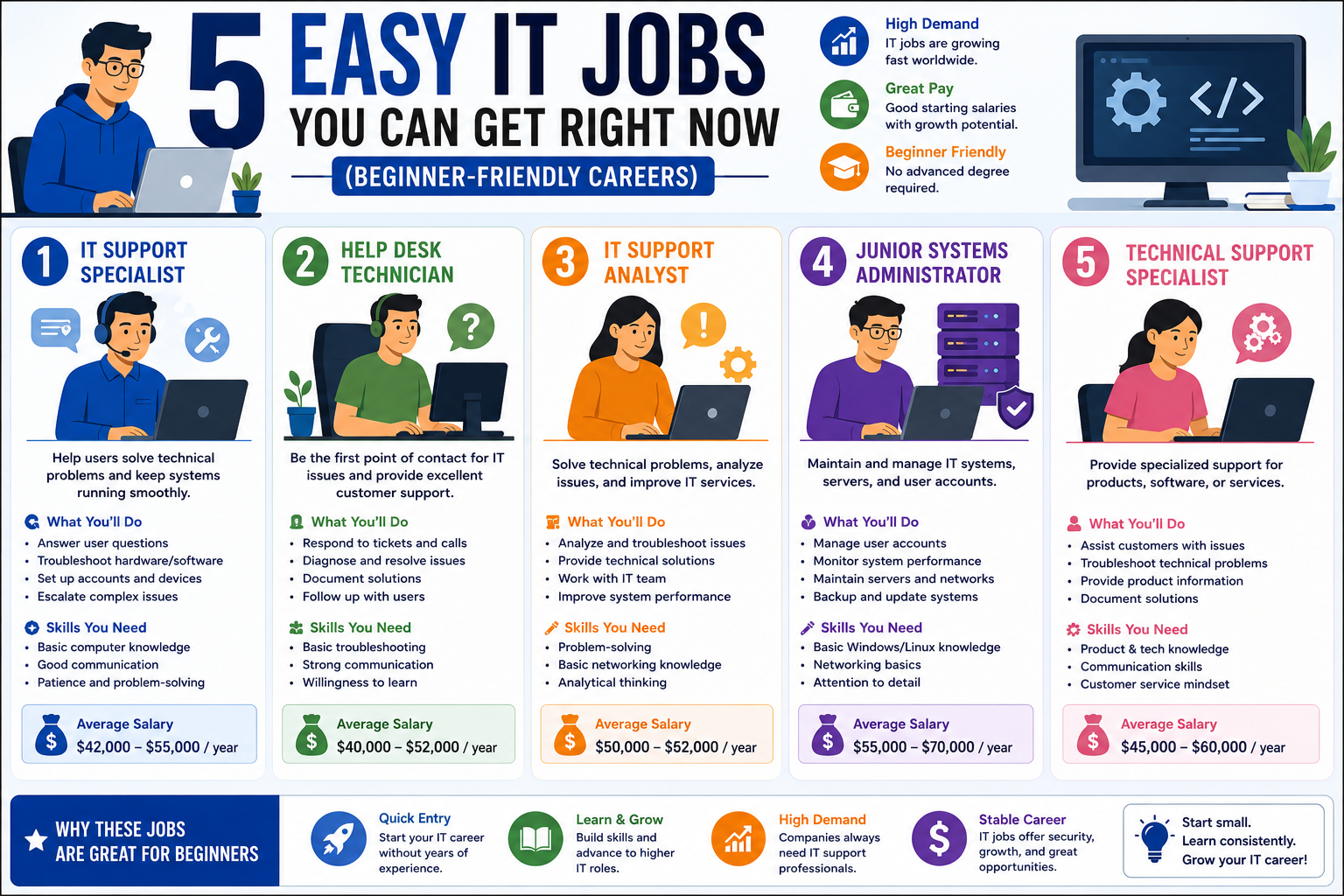
The IT industry continues to expand as more companies rely on digital systems, cloud platforms, and data-driven decision-making. For beginners and professionals looking to switch careers, there are several entry-level and mid-level roles that are relatively easier to access compared to highly specialized positions. These roles still require learning and practice, but the entry barrier is lower, making them ideal starting points for building a long-term IT career.
Understanding Why These IT Roles Are Easier to Enter
Some IT jobs are considered easier to find because they require foundational technical knowledge rather than advanced specialization. Employers often provide on-the-job training, and many of these roles focus on problem-solving, communication, and basic technical support. As organizations grow their digital infrastructure, they constantly need skilled individuals to manage systems, support users, analyze data, and maintain security. This creates consistent demand across multiple industries.
Help Desk Technician as a Strong Entry Point
A Help Desk Technician role is often the first step for many people entering the IT field. This position focuses on assisting users with technical problems related to hardware, software, and network systems. It is one of the most accessible IT jobs because companies value communication skills and basic troubleshooting ability alongside technical understanding.
In this role, you typically handle incoming requests through calls, chats, or ticket systems. You help users resolve issues such as login errors, software malfunctions, connectivity problems, and device setup challenges. The work environment can be fast-paced, but it offers a strong foundation in IT support.
A key part of this job is learning how different systems work together inside an organization. Over time, you gain exposure to various technologies, which helps build confidence and technical knowledge. This role also improves your ability to think logically under pressure while handling multiple support requests.
Another important aspect is communication. Since you deal with non-technical users, you learn how to explain technical solutions in simple terms. This skill becomes extremely valuable as you progress in your IT career.
With experience, Help Desk Technicians can move into higher positions such as system support roles, network support, or IT administration. It is often considered a launchpad for many advanced IT careers because it builds both technical and interpersonal skills at the same time.
Cloud Engineer as a High-Demand Career Path
Cloud engineering has become one of the most important fields in modern IT. Many organizations now rely on cloud infrastructure instead of traditional on-premises systems. A Cloud Engineer is responsible for designing, maintaining, and optimizing these cloud environments.
This role involves working with virtual servers, storage systems, networking configurations, and security settings within cloud platforms. Cloud Engineers ensure that applications and services run smoothly and remain accessible at all times. They also help organizations scale their infrastructure based on demand.
One of the reasons this job is in high demand is because cloud computing supports nearly every digital service today. From mobile apps to enterprise systems, cloud infrastructure plays a central role in performance and reliability.
Cloud Engineers also deal with system monitoring and troubleshooting. When issues occur, they identify the cause and apply solutions quickly to minimize downtime. This requires strong analytical thinking and attention to detail.
In addition, cloud professionals often collaborate with developers, security teams, and system administrators. This teamwork ensures that deployments and updates are completed without disrupting business operations.
Learning cloud engineering requires understanding networking concepts, virtualization, and system architecture. While it may sound advanced, many beginners enter this field by starting with basic IT knowledge and gradually building expertise.
As experience grows, Cloud Engineers can advance into senior cloud architect roles or specialize in areas such as automation, security, or infrastructure design. This career offers strong long-term growth due to the continuous expansion of cloud technologies.
Data Analyst Role Focused on Information Insights
A Data Analyst plays a crucial role in helping organizations make informed decisions. This job focuses on collecting, processing, and interpreting data to identify trends, patterns, and meaningful insights.
In many companies, large amounts of data are generated every day. A Data Analyst transforms this raw data into structured information that can be used for business strategies. This includes analyzing customer behavior, sales performance, website activity, and operational efficiency.
One of the key responsibilities is creating reports and dashboards that present data visually. These visual tools help managers and executives understand complex information quickly without needing technical knowledge.
Data Analysts often work with tools and techniques that include spreadsheets, databases, and visualization platforms. They may also use programming languages to clean and organize data for better accuracy.
This role requires strong logical thinking and problem-solving skills. Analysts must be able to identify patterns that are not immediately visible and explain their findings clearly.
Communication is also essential because Data Analysts regularly present their insights to different teams. Their work directly influences business decisions, marketing strategies, and operational improvements.
As professionals gain experience, they can move into more advanced roles such as data science, business analytics, or specialized data engineering positions. This makes data analysis a flexible and valuable career path in the IT industry.
Information Security Analyst Protecting Digital Systems
Information Security Analysts play a critical role in protecting organizations from cyber threats. As digital systems become more complex, the need for strong cybersecurity continues to grow rapidly.
This role focuses on safeguarding networks, systems, and sensitive data from unauthorized access, attacks, and breaches. Security analysts continuously monitor systems to detect unusual activity and respond quickly to potential threats.
They are responsible for implementing security measures such as firewalls, encryption systems, and access controls. These tools help prevent cyberattacks and ensure that only authorized users can access important resources.
Another important part of this job is risk assessment. Security analysts evaluate potential vulnerabilities in systems and take preventive actions before problems occur. This proactive approach helps reduce the chances of data breaches.
When security incidents do happen, analysts investigate the issue, contain the threat, and restore system safety. This requires quick thinking and strong technical knowledge.
They also create security policies and educate employees about safe digital practices. Human error is often a major cause of security issues, so awareness plays a key role in preventing attacks.
This career requires knowledge of networking, system security, and threat detection techniques. Analytical skills are extremely important because identifying unusual behavior in systems requires careful observation.
Over time, Information Security Analysts can advance into roles such as security architect, cybersecurity manager, or penetration testing specialist. This field offers strong job stability due to the increasing importance of digital protection.
Business Intelligence Developer Turning Data into Strategy
A Business Intelligence Developer focuses on building systems that help organizations understand and use their data effectively. This role combines technical skills with business understanding to create tools that support decision-making.
BI Developers design and manage data pipelines that collect and process information from different sources. This data is then transformed into reports, dashboards, and visual tools that executives use to guide business strategies.
They work closely with databases and data models to ensure that information is accurate and accessible. Their goal is to make complex datasets easy to understand for non-technical users.
This role often involves designing systems that integrate multiple data sources. These systems must be efficient, reliable, and capable of handling large amounts of information.
BI Developers also collaborate with business teams to understand their reporting needs. They translate these needs into technical solutions that provide meaningful insights.
Strong problem-solving skills are essential in this role because developers must ensure that data flows smoothly and remains consistent across systems.
As organizations become more data-driven, the demand for BI Developers continues to grow. Companies rely on them to improve efficiency, identify opportunities, and optimize performance.
With experience, professionals in this field can move into senior analytics roles, data architecture, or leadership positions that guide enterprise-level data strategies.
This career path is ideal for individuals who enjoy working with both technology and business processes, as it bridges the gap between raw data and practical decision-making.
Building a Strong Foundation for an IT Career Path
Entering the IT field becomes much easier when you focus on roles that build foundational skills. Each of these positions offers a different perspective on how technology supports business operations. Whether you start with user support, data analysis, cloud systems, security, or business intelligence, each path helps develop valuable technical and analytical abilities.
The most important factor is continuous learning. The IT industry evolves quickly, and staying updated with new tools and technologies is essential for long-term success. With consistent effort, practical experience, and skill development, these entry-level and mid-level IT roles can lead to advanced and highly rewarding career opportunities.
Conclusion
The IT industry offers a wide range of career opportunities, and many of them are more accessible than people initially assume. Roles such as Help Desk Technician, Cloud Engineer, Data Analyst, Information Security Analyst, and Business Intelligence Developer provide strong entry points for both beginners and career switchers. Each of these positions builds essential technical skills while also improving problem-solving, communication, and analytical thinking abilities.
What makes these roles especially valuable is their potential for long-term growth. Starting from basic responsibilities, professionals can gradually move into more advanced and specialized positions with experience and continuous learning. Whether it is cloud architecture, cybersecurity leadership, or data strategy, each path opens doors to high-demand and well-paying careers.
Success in IT is not only about finding the easiest job but about building a strong foundation. With the right mindset, consistent practice, and willingness to learn, these roles can become the starting point of a stable and rewarding professional journey in technology.