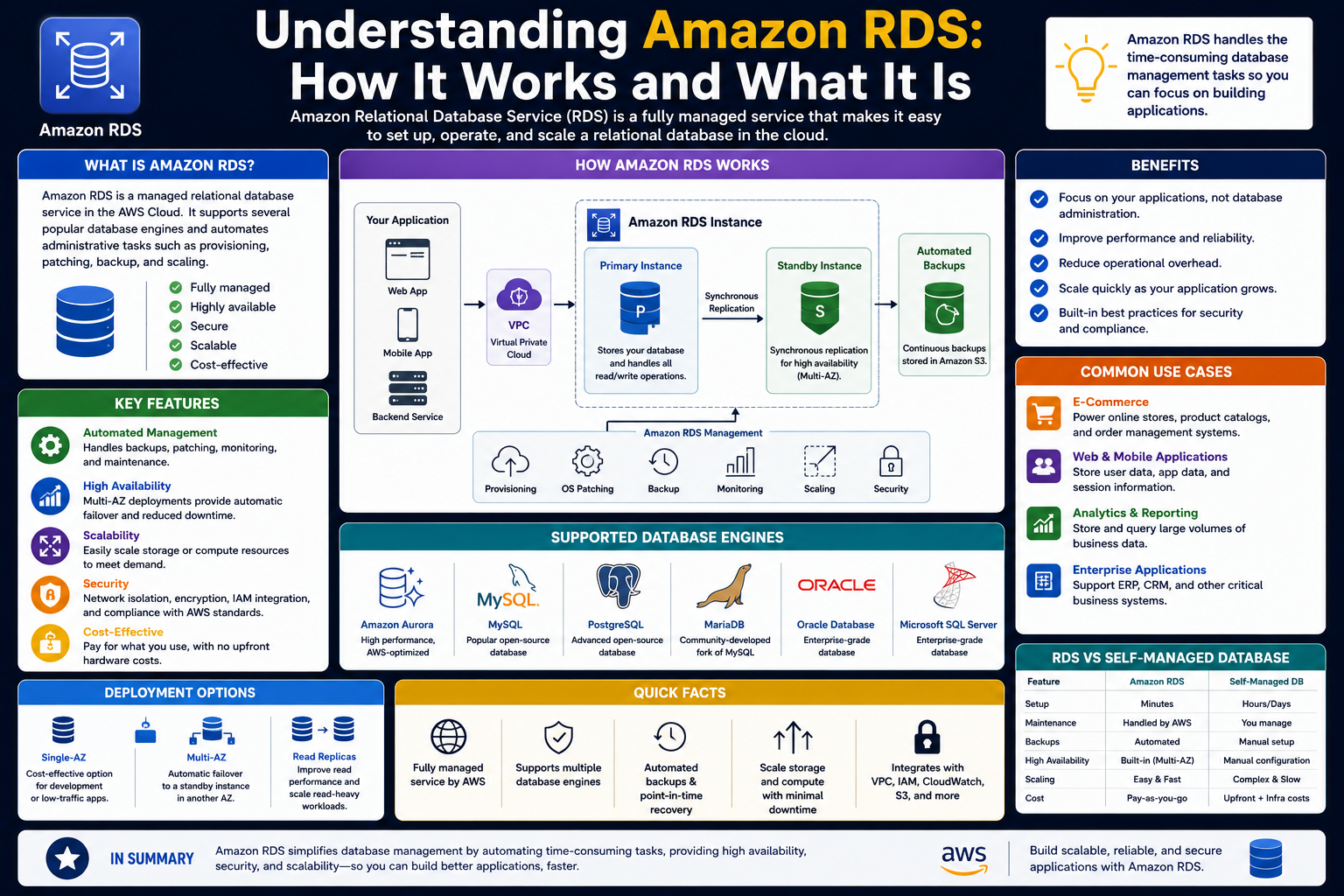
A relational database is a structured system used to store and organize data in a way that allows applications to retrieve and manage information efficiently. Instead of storing scattered files, data is arranged in tables with defined relationships. This structure makes it easier for applications to query specific information, update records, and maintain consistency across large datasets. In modern software development, relational databases are widely used because they provide reliability, structured querying, and strong data integrity. However, setting up and maintaining these systems manually can be complex, requiring continuous attention to performance, security, and backups. This challenge led to the development of managed database services that simplify operations for developers and businesses.
Introduction to Cloud-Based Database Management Services
Cloud-based database management systems are designed to remove the burden of infrastructure handling from developers. Instead of installing and configuring databases on physical servers, users rely on cloud providers to handle the technical maintenance. These services offer scalability, meaning resources can expand or shrink based on application needs. They also provide built-in features such as automatic backups, monitoring, and system updates. This allows development teams to focus more on building applications rather than managing backend infrastructure. One of the most widely used solutions in this space is a managed relational database service that supports multiple database engines and integrates seamlessly with cloud environments.
Core Concept of Amazon Relational Database Service
Amazon Relational Database Service is a managed database solution that simplifies the process of setting up, operating, and scaling relational databases. It supports popular database engines such as MySQL, PostgreSQL, MariaDB, Oracle, and SQL Server. Instead of manually configuring hardware or software environments, users can launch a database instance with predefined settings and start using it quickly. The service handles routine administrative tasks, including backups, patching, and recovery processes. This makes it highly suitable for businesses that need reliable database performance without investing significant time in infrastructure management.
Purpose and Importance of Structured Data Storage
Applications rely heavily on structured data to function effectively. Whether it is user profiles, transaction records, or product inventories, organized storage is essential for fast retrieval and accurate processing. Relational databases are particularly effective because they store data in rows and columns, allowing clear relationships between different data sets. For example, a retail application may need to connect customers with their purchase history and inventory records. A structured system ensures that these relationships remain consistent and easy to query. Without such organization, managing large volumes of data would become inefficient and error-prone.
How Managed Database Services Simplify Development
Managing a database manually involves several responsibilities such as installation, configuration, performance tuning, security setup, and backup management. These tasks require specialized knowledge and continuous monitoring. A managed service removes much of this complexity by automating these operations. Developers no longer need to worry about hardware failures or software updates. Instead, they can focus on writing application logic and improving user experience. This separation of responsibilities improves productivity and reduces operational overhead, especially for teams working on large-scale applications.
Separation of Responsibilities in System Design
Modern application design often follows the principle of separating responsibilities across different services. Instead of building a single system that handles every task, functions are distributed into specialized components. In the context of databases, this means offloading data management to a dedicated service while the application focuses on processing user requests. This separation improves efficiency, scalability, and maintainability. It also reduces the risk of system overload because each component is optimized for its specific function. As a result, applications become more stable and easier to manage over time.
Operational Efficiency in Database Management
Efficiency is a key advantage of using managed relational database services. These systems are designed to optimize performance automatically by adjusting resources based on demand. They also handle routine maintenance tasks such as software patching and system updates without interrupting application availability. This ensures that databases remain secure and up to date while minimizing downtime. Additionally, automated monitoring tools help detect performance issues early, allowing corrective actions to be taken before they affect users. This level of operational efficiency is difficult to achieve with manually managed systems.
Security and Data Protection Mechanisms
Security is a critical aspect of any database system. Managed database services provide multiple layers of protection to safeguard sensitive information. Access control mechanisms ensure that only authorized users and applications can interact with the database. Data encryption is applied both during storage and transmission to prevent unauthorized access. Network-level security settings allow administrators to define specific rules for incoming and outgoing traffic. These combined measures help protect data from external threats and internal misuse. Automated security updates further ensure that vulnerabilities are addressed promptly.
Scalability and Performance Optimization
One of the key advantages of cloud-based database systems is scalability. As application usage increases, the database can automatically adjust its resources to handle higher loads. This prevents performance degradation during peak usage periods. Similarly, when demand decreases, resources can be scaled down to optimize costs. Performance optimization techniques such as caching, indexing, and load balancing are often integrated into the system. These features ensure that data retrieval remains fast and efficient, even when handling large volumes of requests.
High Availability and System Reliability
High availability refers to a system’s ability to remain operational even when parts of the infrastructure fail. Managed database services achieve this by replicating data across multiple locations. If one instance becomes unavailable, another can take over without interrupting service. This failover mechanism ensures continuous availability of applications that depend on the database. Regular backups and automated recovery processes further enhance reliability by protecting against data loss. These features are essential for applications that require uninterrupted access to data.
Backup and Recovery Automation
Data loss can have serious consequences for any application. To prevent this, managed database systems include automated backup and recovery features. These systems regularly create copies of data and store them securely in separate locations. If data becomes corrupted or accidentally deleted, it can be restored quickly from a backup. Recovery processes are designed to minimize downtime and ensure business continuity. This automation reduces the risk associated with manual backup procedures and ensures that data integrity is consistently maintained.
Cost Efficiency in Managed Database Solutions
Cost management is an important factor when designing application infrastructure. Traditional database setups require investment in hardware, maintenance, and skilled personnel. Managed services reduce these costs by providing a pay-as-you-use model. Users only pay for the resources they consume, eliminating the need for upfront infrastructure investment. Automated scaling also helps optimize costs by adjusting resources based on demand. This makes managed database solutions suitable for both small applications and large enterprise systems.
Monitoring and Performance Insights in Managed Databases
Monitoring is a critical part of maintaining any database system, especially in environments where applications handle continuous user traffic. Managed relational database services provide built-in monitoring tools that track performance metrics such as CPU usage, memory consumption, query speed, and storage activity. These insights help developers understand how the database is performing under different workloads. When performance issues arise, alerts can be triggered automatically so that corrective actions can be taken quickly. This proactive approach ensures that potential problems are identified before they impact the end user experience, leading to more stable and reliable applications overall.
Data Migration and Easy Integration Capabilities
One of the practical advantages of managed database services is the ease of migrating existing data from traditional systems. Businesses often have large volumes of data stored in older databases, and moving this information to a cloud-based system can seem complex. However, managed services provide tools and frameworks that simplify this process, allowing smooth and secure data transfer. In addition, these databases integrate easily with other cloud services such as analytics tools, machine learning platforms, and application hosting environments. This seamless integration allows organizations to build more advanced and interconnected systems without facing compatibility challenges.
Automated Maintenance and Reduced Operational Workload
Routine database maintenance tasks such as software updates, patch management, and configuration adjustments are handled automatically in managed environments. This reduces the operational workload on development and IT teams, allowing them to focus on higher-value tasks such as improving application features and optimizing user experience. Automated maintenance also ensures that the database remains secure and up to date with the latest improvements without requiring manual intervention. This continuous maintenance model improves system reliability and reduces the risk of downtime caused by outdated software or misconfigurations.
Flexibility in Choosing Database Engines and Configurations
Managed relational database services offer flexibility by supporting multiple database engines and configuration options, allowing developers to choose the technology that best fits their application requirements. Whether an application requires high-performance transaction processing, complex query handling, or compatibility with existing systems, different database engines can be selected without changing the overall architecture. This flexibility extends to storage types, instance sizes, and performance settings, enabling fine-tuned optimization based on workload demands. As a result, developers are not locked into a single approach and can adapt their database setup as application needs evolve over time.
Conclusion
Managed relational database services represent a significant advancement in how modern applications handle data storage and management. By combining automation, scalability, security, and high availability, these systems simplify complex database operations. They allow developers to focus on building applications while the underlying infrastructure is managed efficiently in the background. This approach improves productivity, reduces operational complexity, and ensures reliable data handling for a wide range of applications.