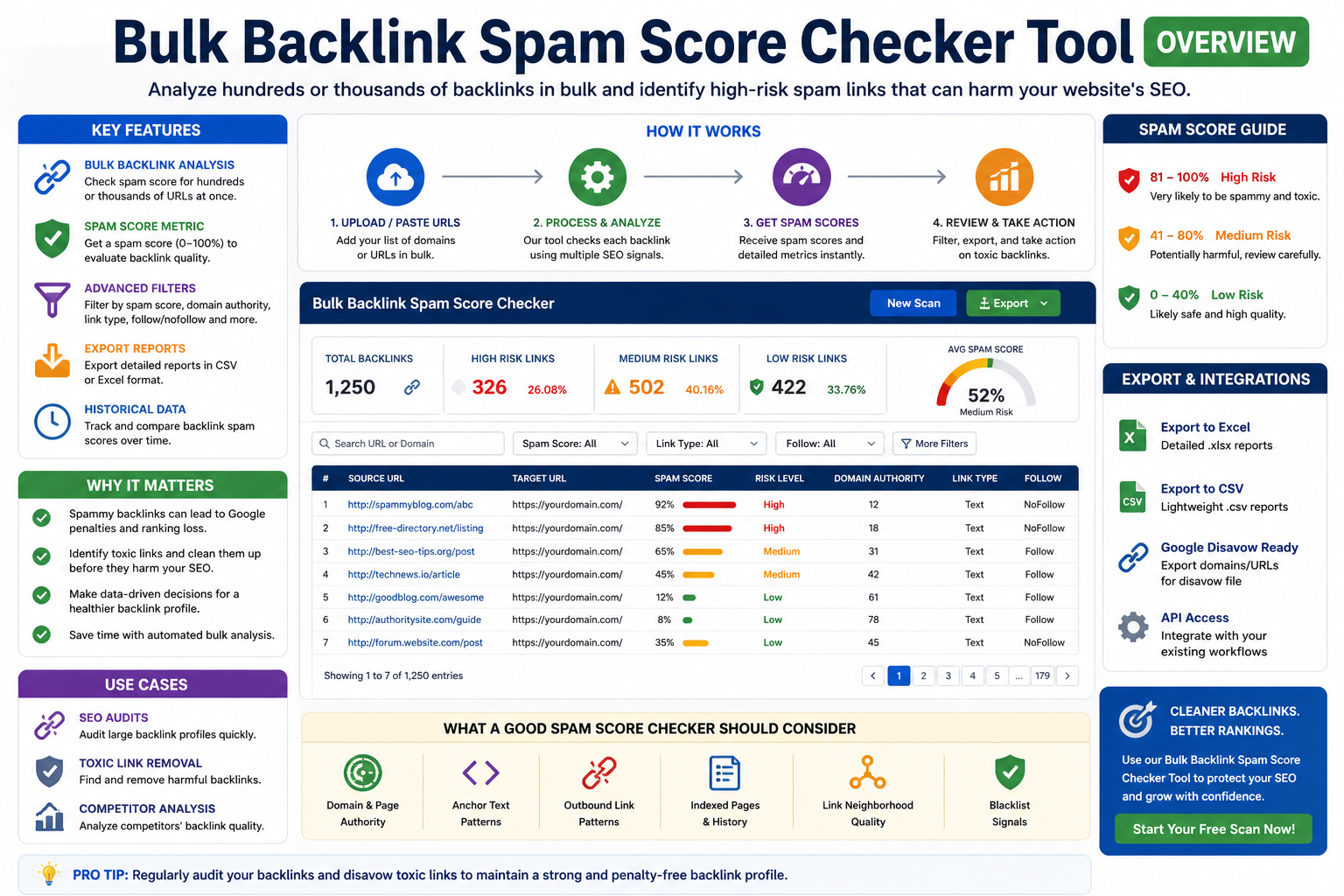
The concept of a bulk backlink spam score checker tool is designed to simplify and speed up the process of analyzing large volumes of backlinks pointing to a website. In modern search optimization practices, understanding the quality of incoming links is essential because not all backlinks contribute positively to rankings. Some links may come from low-quality or suspicious sources, which can negatively affect a site’s authority. This tool introduces a more efficient approach by allowing users to evaluate spam indicators, domain authority, and page authority in bulk instead of checking each link manually one by one.
Purpose and Importance of Spam Score Analysis
Spam score analysis plays a critical role in maintaining a healthy backlink profile. Every website accumulates backlinks over time, but not all of them are beneficial. Some may come from irrelevant or low-quality sources that trigger warning signals. A spam score is a numerical indicator that helps identify how risky or trustworthy a linking site might be. By analyzing these signals, website owners can make informed decisions about which links to keep, monitor, or disavow. This helps protect the site from potential ranking penalties and ensures long-term SEO stability.
Understanding the Spam Score Metric System
The spam score system operates on a structured scale that evaluates multiple red flags associated with a website. These signals may include unnatural linking patterns, poor content quality, or suspicious domain behavior. Each factor contributes to an overall score that reflects the likelihood of spam-like characteristics. A lower score generally indicates a safer and more trustworthy website, while a higher score suggests potential risk. This metric is especially useful when reviewing backlinks at scale because it quickly highlights domains that require closer inspection.
Challenges in Manual Backlink Evaluation
Manually checking backlinks can be extremely time-consuming, especially for websites with thousands of referring domains. Each link must be individually assessed using different tools or platforms, which slows down the entire process. In addition, switching between multiple systems increases the chance of inconsistency in evaluation. As backlink profiles grow, manual analysis becomes impractical and inefficient. This challenge created the need for an automated solution that can handle large datasets and provide consistent metrics across all links in a streamlined manner.
Introduction of Bulk Processing Approach
The bulk processing approach was developed to address the limitations of manual backlink checking. Instead of analyzing one URL at a time, this method allows users to process large lists of domains simultaneously. By inputting multiple links into a single system, users can quickly retrieve important SEO metrics for each entry. This significantly reduces the time required for backlink audits and improves productivity. Bulk analysis also ensures uniform evaluation standards, making it easier to compare link quality across an entire profile.
System Requirements and Setup Essentials
To use a bulk backlink analysis setup, certain technical requirements must be met. A working environment capable of running scripting tools is necessary, along with basic software installation. A scripting language environment is used to execute automated tasks, while additional libraries handle web interaction and data parsing. Users also need a simple text-based file to store the list of domains they want to analyze. These components work together to create a functional system capable of handling large-scale backlink evaluation tasks efficiently.
Preparing the Working Environment
Setting up the working environment involves installing the required scripting system on the computer and ensuring it runs properly. Once installed, additional modules for web automation and content parsing are added. These modules help the system interact with web-based data sources and extract relevant metrics. After the installation process, a simple test is usually performed to confirm that everything is functioning correctly. This step ensures that the environment is fully prepared before starting large-scale backlink processing.
Creating and Organizing Link Data Files
A key part of the process involves preparing a structured text file that contains all the domains to be analyzed. Each line in the file represents a single domain or URL entry. Before adding links, it is important to clean and format them properly by removing unnecessary URL components and keeping only the main domain structure. This helps improve processing accuracy and ensures consistent results. A well-organized input file makes bulk analysis smoother and reduces the chances of errors during execution.
Configuring Access Credentials for Analysis Tools
Some backlink analysis systems require user authentication to access data metrics. This involves entering valid account credentials into the configuration settings of the tool being used. These credentials allow the system to connect with external data sources and retrieve necessary information such as spam scores, domain authority, and page authority. Proper configuration is essential for the tool to function correctly and return accurate results. Without correct setup, the system may fail to retrieve or process backlink data effectively.
Running the Bulk Analysis Process
Once everything is set up, the bulk analysis process can be executed. The system reads the list of domains from the prepared file and begins processing each entry automatically. During execution, the tool collects relevant SEO metrics for every domain and compiles the results into a structured output. If temporary interruptions occur, the process continues running after minor alerts are dismissed. This automated workflow allows hundreds or even thousands of domains to be analyzed within a relatively short time period compared to manual methods.
Handling Output and Data Interpretation
After the analysis is complete, the results are saved in a text-based format that can be transferred into spreadsheet software for easier interpretation. This allows users to sort, filter, and organize backlink data according to their needs. Metrics such as spam score, domain authority, and page authority can be compared side by side to identify high-quality and low-quality links. Proper interpretation of this data is essential for making informed SEO decisions and improving overall site health.
Practical Tips for Better Accuracy and Results
To achieve more accurate results, it is recommended to run the analysis process more than once if any unclear or missing values appear. Sometimes certain entries may return incomplete data due to temporary processing issues. Re-running the tool often resolves these inconsistencies. Additionally, keeping the input file clean and properly formatted improves overall accuracy. It is also important to avoid over-reliance on automated metrics alone and always combine them with manual review for best results.
Value of Bulk Spam Score Analysis in SEO Strategy
Bulk spam score analysis provides significant value in modern SEO strategies by making backlink auditing faster and more scalable. Instead of spending hours evaluating individual links, SEO professionals can quickly identify potentially harmful domains and focus their efforts on high-impact decisions. This improves workflow efficiency and helps maintain a stronger, healthier backlink profile. While automated tools provide essential insights, they should always be used as part of a broader evaluation strategy that includes human judgment and contextual analysis.
Best Practices for Maintaining a Clean Backlink Profile
A strong backlink profile is not just about identifying spammy links but also about continuously maintaining link quality over time. Regular audits should be part of any SEO strategy so that harmful or irrelevant links can be detected early before they affect rankings. It is also important to evaluate links in context rather than relying only on numerical scores, because even a low-risk domain might be irrelevant to your niche and provide little value. Keeping a consistent review schedule, organizing backlink data properly, and combining automated insights with manual assessment ensures a more balanced and reliable approach to link management. This ongoing discipline helps preserve domain authority, improves search visibility, and supports long-term growth in organic performance.
Improving Efficiency in Large-Scale Backlink Analysis Workflows
As backlink profiles grow, efficiency becomes just as important as accuracy in SEO workflows. Handling thousands of domains requires a structured approach where data collection, processing, and review are clearly separated to avoid confusion and delays. Organizing input lists before analysis helps reduce errors, while batching results into manageable sections makes interpretation easier. It is also useful to prioritize domains based on risk level so that high-spam signals are reviewed first. Over time, refining the workflow by removing unnecessary steps and improving file organization can significantly reduce processing time. This allows SEO professionals to focus more on decision-making and strategy rather than repetitive manual tasks, ultimately leading to faster and more effective backlink management.
Advanced Filtering and Decision Making for Backlink Quality Control
Beyond basic spam score evaluation, effective backlink management requires a more advanced filtering approach to separate truly valuable links from borderline cases. Not every backlink falls clearly into “good” or “bad” categories, so additional layers of judgment are needed when reviewing bulk results. This includes comparing multiple metrics together such as spam score, domain authority, relevance to your niche, and the natural context of the linking page. Some links may show moderate risk signals but still provide value due to strong topical relevance, while others with low spam scores may still be irrelevant or low-impact. Building a structured decision-making process helps reduce guesswork and ensures that link removal or retention choices are based on consistent criteria. Over time, refining these filters improves overall backlink profile quality and makes large-scale SEO management more strategic rather than reactive.
Conclusion
The introduction of a bulk backlink spam score checking approach represents a major improvement in how backlink analysis is performed. By combining automation, structured data input, and scalable processing, it allows users to evaluate large sets of backlinks efficiently and accurately. This method reduces manual workload, enhances decision-making, and supports long-term SEO performance. When used correctly alongside careful review practices, it becomes a powerful asset for maintaining a strong and reliable link profile.