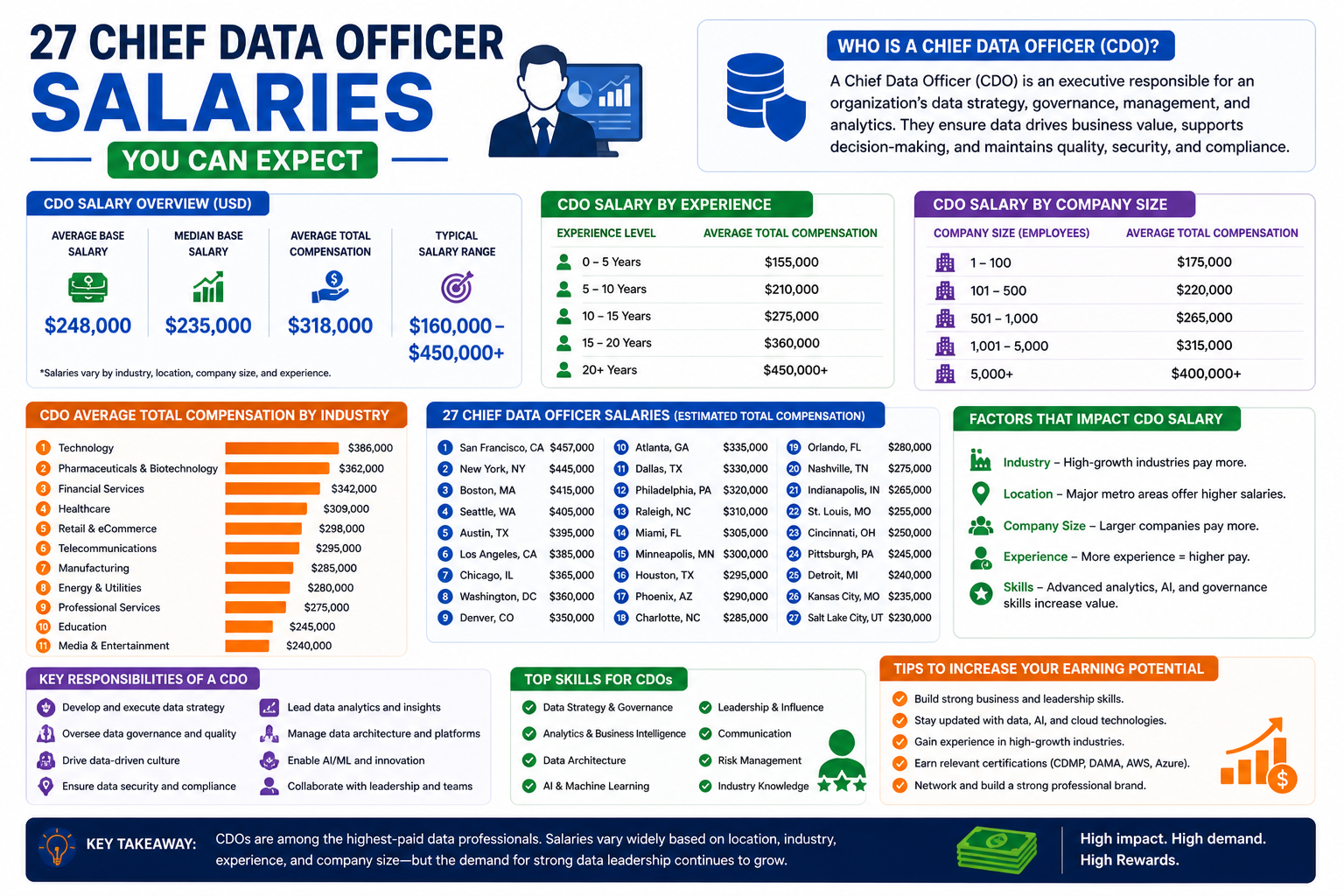
The role of the Chief Data Officer has become one of the most influential executive positions in data-driven organizations. As businesses increasingly rely on data to guide decisions, optimize operations, and create competitive advantages, the need for a dedicated leader who can manage and govern data at scale has grown significantly. The Chief Data Officer is no longer just a technical overseer but a strategic executive who connects data initiatives directly to business outcomes. This transformation has elevated the role into the upper tier of corporate leadership, where compensation reflects both responsibility and impact.
Organizations across industries now depend on structured data strategies to stay competitive. Whether it is improving customer experience, enabling predictive analytics, or ensuring compliance with complex data regulations, the Chief Data Officer plays a central role in shaping how data is collected, processed, and used. This growing dependence on data has made the position essential in both established enterprises and fast-scaling digital companies.
Understanding the Role of a Chief Data Officer
The Chief Data Officer is the executive responsible for managing an organization’s entire data ecosystem. This includes defining how data is stored, accessed, protected, and utilized across departments. The role requires balancing technical expertise with strategic business thinking, ensuring that data not only remains accurate and secure but also delivers measurable value to the organization.
Unlike traditional IT leadership roles, the Chief Data Officer operates at the intersection of technology, governance, and business strategy. This means working closely with other executives such as the Chief Technology Officer, Chief Information Officer, and Chief Executive Officer to ensure that data initiatives align with broader organizational goals. The CDO acts as a bridge between technical teams and business stakeholders, translating complex data structures into actionable insights that drive decision-making.
Data Governance and Control Frameworks
One of the core responsibilities of a Chief Data Officer is establishing and maintaining data governance frameworks. Data governance refers to the policies, standards, and processes that ensure data is accurate, consistent, and secure across the organization. Without proper governance, organizations risk data inconsistencies, compliance violations, and inefficient decision-making.
The Chief Data Officer defines how data should be classified, who can access it, and how it should be used. This includes implementing controls to ensure data integrity and creating accountability structures that prevent misuse. In highly regulated industries such as healthcare, finance, and telecommunications, data governance becomes even more critical, as organizations must comply with strict legal and regulatory requirements.
Leadership in Analytics and Business Intelligence
Another major responsibility of the Chief Data Officer is leading analytics and business intelligence initiatives. This involves transforming raw data into meaningful insights that support strategic decisions. The CDO ensures that the organization has the right tools, frameworks, and talent to analyze data effectively.
Modern enterprises rely heavily on analytics to understand customer behavior, optimize operations, and forecast future trends. The Chief Data Officer oversees the development of dashboards, reporting systems, and predictive models that help leadership teams make informed decisions. This requires a deep understanding of both statistical analysis and business strategy, ensuring that insights are not only accurate but also actionable.
Regulatory Compliance and Data Privacy Management
As data privacy regulations become more complex, the Chief Data Officer plays a crucial role in ensuring compliance. Laws related to data protection require organizations to manage personal and sensitive information responsibly. The CDO is responsible for designing systems that align with these legal frameworks while minimizing operational risk.
This includes implementing privacy-by-design principles, maintaining audit trails, and ensuring that data usage complies with industry-specific regulations. In sectors such as healthcare and finance, where data sensitivity is extremely high, the Chief Data Officer must ensure that all data processes meet strict compliance standards. Failure to do so can result in legal penalties and reputational damage, making this responsibility one of the most critical aspects of the role.
Strategic Alignment Between Data and Business Goals
A key function of the Chief Data Officer is aligning data strategy with overall business objectives. Data should not exist in isolation; instead, it should directly support growth, efficiency, and innovation. The CDO ensures that every data initiative contributes to measurable business value.
This involves collaborating with senior leadership to identify strategic priorities and then designing data systems that support those goals. Whether it is improving customer acquisition, reducing operational costs, or enabling new product development, the Chief Data Officer ensures that data plays a central role in achieving these outcomes. This strategic alignment is what distinguishes a high-impact CDO from a purely technical data manager.
Building and Leading Data Teams
The Chief Data Officer is also responsible for building and managing high-performing data teams. These teams may include data engineers, data scientists, analysts, and governance specialists. The CDO ensures that each team member understands their role in the broader data ecosystem and works collaboratively toward shared objectives.
Leadership in this context goes beyond hiring and management. It involves creating a culture of data literacy across the organization, where employees at all levels understand the importance of data-driven decision-making. The Chief Data Officer must also invest in training and development to ensure that the data team remains up to date with evolving technologies and methodologies.
Technical Skills and Modern Data Ecosystems
To be effective, a Chief Data Officer must possess strong technical knowledge of modern data platforms and tools. While the role is executive in nature, understanding how data systems operate is essential for making informed strategic decisions. Common technologies used in data environments include cloud platforms, data warehouses, and analytics tools.
Cloud-based systems have become the foundation of modern data infrastructure, enabling scalability, flexibility, and real-time processing. The Chief Data Officer must be familiar with how these systems integrate and how they can be optimized for performance and cost efficiency. Additionally, knowledge of data visualization tools and machine learning frameworks is increasingly important as organizations move toward advanced analytics and artificial intelligence.
Common Platforms and Technologies Used by CDOs
Chief Data Officers often work with a wide range of tools designed for data storage, processing, analysis, and governance. These include cloud ecosystems that support large-scale data operations, as well as specialized platforms for visualization and compliance management. Understanding how these tools interact allows the CDO to design efficient and scalable data architectures.
Data governance tools help ensure consistency and compliance, while analytics platforms enable deeper insights into business performance. Meanwhile, cloud providers offer the infrastructure needed to store and process massive datasets efficiently. A strong Chief Data Officer understands how to integrate these technologies into a unified data strategy that supports long-term organizational goals.
Overview of Chief Data Officer Compensation Trends
Compensation for Chief Data Officers is among the highest in the technology and executive leadership space. Salaries vary significantly depending on industry, company size, geographic location, and level of responsibility. Organizations that rely heavily on data for their core operations tend to offer higher compensation packages to attract experienced data leaders.
In general, Chief Data Officers working in large enterprises or technology-driven organizations receive significantly higher pay compared to those in smaller companies. Compensation also increases when the role includes broader responsibilities such as artificial intelligence strategy, revenue optimization, or enterprise-wide digital transformation.
The salary structure for this role typically includes a base salary, performance bonuses, and long-term incentives such as equity or stock options. While base salaries alone are substantial, total compensation can be significantly higher when additional benefits are included. This makes the role one of the most financially rewarding positions in executive leadership.
Early Salary Expectations and Entry into the Role
At the early stage of a Chief Data Officer’s career, compensation is generally influenced by prior experience in data leadership, analytics, or technology management. Individuals transitioning into the role often come from backgrounds such as data engineering, business intelligence, or IT leadership.
At this stage, responsibilities typically focus on establishing foundational data strategies and building initial governance structures. While the scope may be narrower compared to more experienced executives, the role still requires strong leadership and strategic thinking. Compensation reflects this balance between emerging leadership and growing organizational responsibility.
Mid-Level Executive Responsibility and Compensation Growth
As Chief Data Officers gain experience and take on larger organizational responsibilities, their compensation increases significantly. At this level, they typically oversee enterprise-wide data strategies, manage cross-functional teams, and contribute directly to executive decision-making.
Mid-level CDOs are often deeply involved in compliance management, analytics strategy, and operational optimization. Their role becomes more integrated into core business functions, and they are frequently included in executive leadership discussions. This increased influence is reflected in higher compensation and expanded decision-making authority.
Senior Executive Impact and High-Level Earnings Potential
At the most advanced level, Chief Data Officers operate as strategic executives who directly influence business growth, innovation, and long-term planning. They are often involved in board-level discussions and play a key role in shaping organizational direction.
In these positions, the CDO is responsible for large-scale initiatives such as artificial intelligence integration, enterprise data monetization, and digital transformation programs. Compensation at this level reflects not only technical expertise but also the ability to drive measurable business impact across the entire organization.
Key Factors That Influence Chief Data Officer Salary Levels
Chief Data Officer compensation is shaped by far more than job title alone. While the role sits at an executive level in most organizations, actual pay varies widely based on a combination of organizational, technical, and strategic factors. Understanding these drivers is essential for evaluating salary expectations realistically and identifying opportunities for growth. Companies are not simply paying for data knowledge—they are paying for leadership that can translate data into measurable business value.
In many cases, two Chief Data Officers with similar experience can have significantly different compensation packages depending on the environment they operate in. A CDO leading a global transformation program for a large enterprise may earn several times more than a peer managing a smaller or less data-dependent organization. This difference is not random; it reflects the scale of responsibility, complexity of systems, and expected business impact tied to the role.
Impact of Organizational Data Maturity on Compensation
One of the most important salary drivers for a Chief Data Officer is the organization’s level of data maturity. Companies that are early in their data journey often require leaders who can build data systems from the ground up. These environments typically lack structured governance, standardized analytics, or integrated platforms, which means the CDO must establish everything from foundational architecture to long-term strategy.
In such cases, compensation is often higher to attract experienced professionals capable of handling transformation challenges. Building a data ecosystem from scratch requires not only technical expertise but also strong leadership, change management skills, and the ability to influence organizational culture. These responsibilities significantly increase the value of the role.
On the other hand, organizations with mature data environments may already have established systems, governance frameworks, and analytics pipelines. In these cases, the Chief Data Officer focuses more on optimization, scaling, and innovation rather than foundational development. While still highly strategic, the scope of transformation may be narrower, which can influence compensation structures differently.
Regulatory Environment and Compliance Complexity
Another major factor affecting Chief Data Officer salaries is the level of regulatory complexity within the industry. Organizations operating in heavily regulated sectors must adhere to strict data privacy, security, and governance standards. This includes managing sensitive information, maintaining audit trails, and ensuring compliance with multiple legal frameworks across different regions.
The Chief Data Officer plays a central role in designing and enforcing systems that meet these requirements. This responsibility carries significant risk, as non-compliance can lead to financial penalties, legal consequences, and reputational damage. As a result, organizations are willing to pay a premium for leaders who can navigate these complexities effectively.
Industries such as healthcare, finance, insurance, and telecommunications tend to place especially high value on compliance expertise. In these environments, the Chief Data Officer is not only a technical leader but also a risk management authority, ensuring that data usage aligns with both internal policies and external regulations.
Technology Stack Complexity and Modern Data Architecture
The sophistication of an organization’s technology stack also plays a critical role in determining Chief Data Officer compensation. Companies that rely on modern, cloud-based, and highly distributed data architectures require leaders who understand advanced technologies and integration strategies.
As businesses transition from traditional data warehouses to real-time analytics platforms, data lakes, and AI-driven systems, the complexity of managing data increases significantly. The Chief Data Officer must ensure that these systems work seamlessly together while maintaining performance, scalability, and security.
Experience with cloud ecosystems, distributed computing, and advanced analytics platforms is highly valued in these roles. Organizations undergoing digital transformation often prioritize candidates who can lead migrations to modern data environments. This technical depth directly influences salary levels, as it enables the CDO to drive innovation and operational efficiency at scale.
Influence of Executive Visibility and Board-Level Involvement
The level of executive visibility a Chief Data Officer has within an organization is another key determinant of compensation. In some companies, the CDO operates as a functional leader reporting to other senior executives. In others, the role is elevated to a strategic position with direct access to the CEO and board of directors.
When the Chief Data Officer participates in board meetings or contributes directly to corporate strategy discussions, the role becomes significantly more influential. At this level, the CDO is not just managing data systems but actively shaping business direction, investment priorities, and long-term growth strategies.
This increased visibility and responsibility typically result in higher compensation packages. Organizations recognize that executives who influence board-level decisions are critical to overall success, and they compensate accordingly. The ability to communicate complex data insights in a way that informs executive decision-making is a highly valued skill in these environments.
Equity, Bonuses, and Total Compensation Structure
Chief Data Officer compensation is rarely limited to base salary alone. In most organizations, total compensation includes a combination of base pay, performance bonuses, equity grants, and long-term incentive plans. These additional components can significantly increase overall earnings, especially in high-growth companies or publicly traded organizations.
Performance bonuses are often tied to organizational goals such as revenue growth, operational efficiency, or successful implementation of data initiatives. When the Chief Data Officer directly contributes to these outcomes, bonus payouts can be substantial.
Equity-based compensation is particularly common in technology-driven companies and startups. In these cases, the CDO may receive stock options or restricted stock units that vest over time. If the company performs well, this equity can become a significant portion of total compensation, sometimes exceeding base salary.
Long-term incentive plans are designed to align executive performance with sustained organizational success. These structures encourage Chief Data Officers to focus not only on short-term results but also on building scalable, future-ready data ecosystems.
Industry Differences in Chief Data Officer Salaries
Industry type has a strong influence on how much a Chief Data Officer earns. Data-intensive industries such as technology, finance, healthcare, and e-commerce typically offer higher compensation due to the critical role data plays in their operations.
In technology companies, data is often at the core of product development, customer experience, and business intelligence. As a result, Chief Data Officers in these environments are deeply involved in innovation and product strategy, which increases their value.
In financial services, data is essential for risk modeling, fraud detection, regulatory reporting, and investment analysis. The complexity and sensitivity of this data make the Chief Data Officer role highly specialized and well-compensated.
Healthcare organizations also rely heavily on data for patient care, operational efficiency, and regulatory compliance. The responsibility of managing sensitive health data adds an additional layer of complexity, which is reflected in compensation structures.
Geographic and Market Demand Influences
While salary varies widely by region, the underlying driver is often market demand for data leadership talent. In regions with a high concentration of technology companies or large enterprises, competition for experienced Chief Data Officers is intense. This competition drives compensation upward as organizations compete for a limited pool of qualified candidates.
In contrast, regions with fewer large-scale data-driven organizations may offer lower base salaries but often provide other advantages such as reduced cost of living or broader executive responsibilities. In some cases, CDOs in smaller markets may have greater influence over organizational strategy due to flatter leadership structures.
Globalization has also impacted salary expectations, as companies increasingly benchmark executive compensation against international standards. This means that even organizations in smaller markets may offer competitive packages to attract top-tier data leadership talent.
The Role of Company Size and Revenue Scale
The size of an organization and its revenue scale significantly affect Chief Data Officer compensation. Large enterprises with global operations typically offer higher salaries due to the complexity and scale of their data environments. Managing data across multiple regions, systems, and regulatory frameworks requires advanced leadership capabilities.
In contrast, smaller organizations may offer lower base salaries but provide broader scope and faster career growth opportunities. In these environments, the Chief Data Officer may have greater autonomy and influence over company direction, even if financial compensation is lower.
Mid-sized companies often represent a balance between these two extremes, offering competitive compensation along with significant strategic responsibility. These organizations frequently rely on data leadership to support growth and scaling efforts, making the CDO role particularly impactful.
Strategic Value Creation and Business Impact Expectations
Ultimately, the most important factor influencing Chief Data Officer salary is the expected business impact. Organizations are increasingly viewing data not as a technical function but as a core driver of revenue, efficiency, and innovation.
A Chief Data Officer who can demonstrate clear business value—such as improving customer retention, reducing operational costs, or enabling new revenue streams—will command significantly higher compensation. The ability to connect data initiatives directly to financial outcomes is one of the most valuable skills at the executive level.
As expectations for data leadership continue to rise, the role of the Chief Data Officer is becoming more integrated into core business strategy. This evolution ensures that compensation will continue to reflect not just technical expertise, but measurable organizational impact.
How Experience Shapes Chief Data Officer Salary Growth
Experience plays a central role in determining how much a Chief Data Officer earns, but it is not measured only by the number of years worked. Instead, compensation growth is tied to the depth of leadership responsibility, the scale of data environments managed, and the level of strategic influence within the organization. As professionals progress in their careers, their role shifts from technical execution to enterprise-wide decision-making, and salary levels adjust accordingly.
At the executive level, experience is closely linked with trust and accountability. Organizations are willing to invest significantly in leaders who have demonstrated the ability to manage complex data ecosystems, lead transformation initiatives, and deliver measurable business outcomes. As responsibilities expand, so does compensation, often in substantial increments at each career stage.
Early Stage Chief Data Officer Profile and Compensation Range
At the earlier stage of a Chief Data Officer’s career, individuals typically transition into the role after gaining extensive experience in data analytics, engineering, business intelligence, or IT leadership. These professionals are often stepping into their first executive-level data leadership position.
In this stage, the focus is primarily on building foundational data strategies, establishing governance structures, and organizing data teams. The organization may still be developing its overall data maturity, which means the CDO is heavily involved in designing systems and frameworks from the ground up.
Although this stage involves significant responsibility, the scope is usually more focused compared to senior executives in mature enterprises. Compensation reflects this balance between emerging leadership and strategic contribution. Early-stage Chief Data Officers are still proving their ability to influence enterprise-wide outcomes, and salary levels are structured to reflect both potential and performance.
Mid-Level Chief Data Officer Growth and Expanding Influence
As Chief Data Officers gain more experience, their responsibilities expand significantly. At this stage, they typically oversee multiple data domains, manage cross-functional teams, and take ownership of enterprise-wide data initiatives. Their role becomes more deeply integrated into business strategy and operational planning.
Mid-level CDOs often lead efforts in data governance, compliance, analytics optimization, and platform modernization. They are also more involved in executive discussions, contributing insights that shape organizational priorities. This increased visibility within the leadership structure often leads to higher compensation.
At this level, the Chief Data Officer is expected to deliver consistent business value through data initiatives. This includes improving reporting accuracy, enabling better decision-making, and supporting revenue-generating strategies. The ability to demonstrate tangible business impact becomes a key factor in salary growth.
Senior Chief Data Officer and Enterprise-Level Responsibility
At the most advanced stage, Chief Data Officers operate as senior enterprise executives with broad organizational influence. Their responsibilities extend beyond data management to include innovation strategy, revenue optimization, and long-term digital transformation.
Senior CDOs often oversee large-scale data ecosystems that span multiple regions, business units, and technology platforms. They are responsible for ensuring that data infrastructure supports global operations while maintaining consistency, security, and scalability.
In many organizations, senior Chief Data Officers are directly involved in board-level discussions and executive decision-making processes. Their insights influence corporate strategy, investment priorities, and risk management frameworks. This level of responsibility places them among the most critical leaders in the organization.
Compensation at this stage reflects both the complexity of the role and its impact on overall business performance. Senior Chief Data Officers are often rewarded not only for operational excellence but also for their contribution to innovation and long-term growth.
Leadership Scope and Organizational Complexity
One of the most important factors influencing salary progression with experience is the size and complexity of the organization. Managing data in a small, centralized environment is very different from overseeing global, multi-cloud, multi-regulatory systems.
As Chief Data Officers move into larger enterprises, they must handle increasing complexity in data architecture, compliance requirements, and stakeholder management. This includes coordinating across multiple departments, aligning global data standards, and ensuring consistency across diverse systems.
The ability to manage complexity effectively is a major driver of compensation growth. Organizations place a premium on leaders who can simplify complex environments while maintaining performance and compliance. This skill becomes increasingly valuable as data ecosystems scale.
Strategic Influence and Executive Decision-Making Power
Experience also determines how much influence a Chief Data Officer has within executive leadership. Early in their careers, CDOs may focus primarily on operational execution and technical delivery. However, as they progress, their role becomes increasingly strategic.
Experienced Chief Data Officers are often involved in shaping business models, identifying new revenue opportunities, and guiding digital transformation initiatives. Their insights are used to inform high-level decisions that affect the entire organization.
This shift from operational leadership to strategic influence significantly impacts compensation. Executives who contribute directly to business growth and organizational direction are compensated at higher levels due to their broader impact.
Revenue Impact and Business Value Contribution
One of the clearest ways experience affects salary is through measurable business impact. Organizations increasingly evaluate Chief Data Officers based on their ability to generate value from data. This includes improving operational efficiency, reducing costs, increasing customer engagement, and enabling new revenue streams.
More experienced CDOs are typically better positioned to deliver these outcomes because they have a deeper understanding of both data systems and business operations. They can identify opportunities where data can be leveraged for competitive advantage and execute strategies that produce tangible results.
The ability to connect data initiatives directly to financial performance is one of the most important drivers of compensation growth. Senior executives who consistently demonstrate this capability are often rewarded with higher base salaries, larger bonuses, and more substantial equity packages.
Team Leadership and Organizational Development
Another key aspect of experience-based salary growth is the ability to build and lead high-performing teams. As Chief Data Officers advance in their careers, they are responsible not just for managing data systems but also for developing talent across the organization.
This includes hiring skilled data professionals, mentoring team members, and creating a culture of continuous improvement. Strong leadership in this area ensures that data initiatives are executed effectively and that the organization maintains a competitive advantage in analytics capabilities.
Experienced CDOs also play a key role in defining organizational structure for data teams. This includes establishing centers of excellence, defining roles and responsibilities, and ensuring collaboration across departments. The ability to design and lead scalable teams is a critical factor in executive compensation.
Decision Authority and Organizational Trust
As experience increases, so does the level of trust placed in the Chief Data Officer by senior leadership. Organizations are more likely to delegate significant decision-making authority to experienced executives who have a proven track record of success.
This trust translates into greater autonomy, larger budgets, and increased influence over strategic initiatives. Chief Data Officers at this level are often responsible for multi-million-dollar technology investments and enterprise-wide transformation programs.
With greater authority comes higher compensation, as organizations recognize the importance of strong leadership in managing high-impact decisions. The ability to make confident, data-driven decisions at scale is a key differentiator for senior CDOs.
Long-Term Career Progression and Executive Growth Path
Over time, the role of the Chief Data Officer can evolve even further into broader executive positions such as Chief Digital Officer, Chief Information Officer, or even Chief Executive Officer in some cases. This progression reflects the increasing importance of data-driven leadership in modern organizations.
As professionals move along this path, their compensation continues to grow in line with their expanded responsibilities and strategic influence. Experience not only increases salary potential but also opens doors to higher-level leadership opportunities across the organization.
The long-term career trajectory of a Chief Data Officer is shaped by continuous learning, adaptability, and the ability to lead transformation at scale. Those who successfully evolve with changing technology landscapes and business needs are positioned for sustained executive growth and compensation advancement.
Essential Tools That Shape Chief Data Officer Performance and Value
The effectiveness of a Chief Data Officer is closely tied to their ability to work with modern data tools and platforms. While the role is executive in nature, it requires a strong understanding of the technologies that power data collection, storage, processing, and analysis. These tools form the foundation of enterprise data ecosystems and directly influence how well a Chief Data Officer can execute strategy and deliver value.
In today’s environment, data leadership is no longer theoretical. It requires practical familiarity with cloud systems, analytics platforms, governance tools, and compliance technologies. A Chief Data Officer who understands how these systems interact can design more efficient architectures, reduce operational inefficiencies, and improve decision-making across the organization.
Data Platforms and Core Infrastructure Systems
At the core of every data-driven organization are data platforms that handle storage, processing, and scalability. These systems form the backbone of enterprise data architecture and are essential for managing large and complex datasets.
Modern cloud-based data platforms allow organizations to store vast amounts of structured and unstructured data while enabling real-time access and analytics. Chief Data Officers rely on these platforms to ensure that data is available, secure, and scalable across the organization.
In addition to storage, these systems support advanced processing capabilities that allow organizations to run complex queries, build data pipelines, and support machine learning workloads. A strong understanding of how these platforms operate enables the Chief Data Officer to make informed architectural decisions that align with business goals.
Business Intelligence and Data Visualization Tools
Business intelligence tools are essential for converting raw data into meaningful insights. These platforms allow organizations to create dashboards, reports, and visualizations that help leaders understand performance trends and make data-driven decisions.
The Chief Data Officer plays a key role in ensuring that business intelligence tools are effectively implemented across departments. This includes defining reporting standards, ensuring data accuracy, and promoting consistent use of analytics throughout the organization.
These tools help bridge the gap between technical data systems and business users. By transforming complex datasets into accessible visual insights, they enable faster and more informed decision-making at all levels of the organization.
Data Governance and Management Platforms
Data governance tools are critical for maintaining data quality, consistency, and compliance. These platforms help organizations define policies for how data should be accessed, used, and maintained across systems.
The Chief Data Officer is responsible for implementing governance frameworks that ensure data integrity and reduce risk. This includes tracking data lineage, managing metadata, and enforcing access controls across the organization.
Effective governance ensures that data remains reliable and trustworthy, which is essential for accurate analytics and regulatory compliance. Without strong governance systems in place, organizations risk inconsistencies that can lead to poor decision-making and compliance failures.
Compliance and Data Privacy Technologies
As data privacy regulations become more complex, compliance tools have become a critical part of enterprise data ecosystems. These platforms help organizations manage sensitive data, track user consent, and ensure adherence to legal requirements.
The Chief Data Officer must ensure that these systems are properly integrated into the organization’s data architecture. This includes implementing privacy controls, managing data access permissions, and ensuring compliance with global regulations.
Compliance tools also support audit processes and risk management by providing visibility into how data is used across systems. This level of transparency is essential for maintaining trust and avoiding regulatory penalties.
Cloud Ecosystems and Scalable Data Architecture
Cloud platforms are the foundation of modern data infrastructure. They enable organizations to scale operations efficiently, reduce infrastructure costs, and support real-time analytics across distributed systems.
The Chief Data Officer must understand how cloud ecosystems operate and how they integrate with other data tools. This includes managing data pipelines, optimizing storage solutions, and ensuring system reliability across different environments.
Cloud adoption also enables organizations to leverage advanced technologies such as artificial intelligence and machine learning. These capabilities allow businesses to extract deeper insights from their data and develop more predictive and automated systems.
Certifications That Strengthen Chief Data Officer Expertise
While the Chief Data Officer role is primarily executive, certifications can still play an important role in validating expertise and enhancing credibility. These certifications demonstrate knowledge in data governance, privacy, cloud architecture, and leadership.
One of the most valuable certifications focuses on data management principles, including governance, quality, and metadata management. This helps reinforce foundational knowledge that is critical for enterprise data leadership.
Privacy-focused certifications are also highly relevant, especially in industries that handle sensitive personal data. These certifications cover regulatory frameworks, compliance standards, and data protection strategies, which are essential for risk management.
Cloud certifications are increasingly important as organizations continue to migrate to cloud-based data environments. These validate the ability to design and manage scalable data systems in modern architectures.
Executive leadership programs also contribute to Chief Data Officer development by strengthening strategic thinking, financial understanding, and organizational leadership skills. These programs help prepare CDOs for board-level discussions and enterprise-wide decision-making.
Career Development and Salary Advancement Strategies
Chief Data Officers can increase their compensation by focusing on high-impact initiatives that directly contribute to business success. Leading transformation projects, such as data modernization, AI integration, or enterprise analytics expansion, significantly increases visibility and value within the organization.
Another effective strategy is developing expertise in emerging areas such as artificial intelligence governance, real-time analytics, and data ethics. These fields are becoming increasingly important as organizations rely more heavily on advanced data systems.
Demonstrating measurable business outcomes is also critical. Chief Data Officers who can clearly show how their initiatives improve revenue, reduce costs, or enhance customer experience are more likely to receive higher compensation and greater executive influence.
Continuous learning is equally important. Staying updated with evolving technologies, compliance requirements, and leadership practices ensures that Chief Data Officers remain competitive in a rapidly changing environment.
Final Conclusion
The role of the Chief Data Officer has evolved into one of the most strategically important positions in modern organizations. As businesses continue to rely on data for decision-making, innovation, and competitive advantage, the demand for strong data leadership continues to grow.
Compensation for Chief Data Officers reflects the complexity, responsibility, and impact of the role. Factors such as organizational maturity, industry regulations, technology stack, and executive influence all play a significant role in determining salary levels.
Beyond financial compensation, the Chief Data Officer position offers a unique opportunity to shape the direction of entire organizations through data-driven strategy. As the importance of data continues to rise, the value of skilled data leadership will only increase, making this one of the most influential executive roles in the modern business landscape.