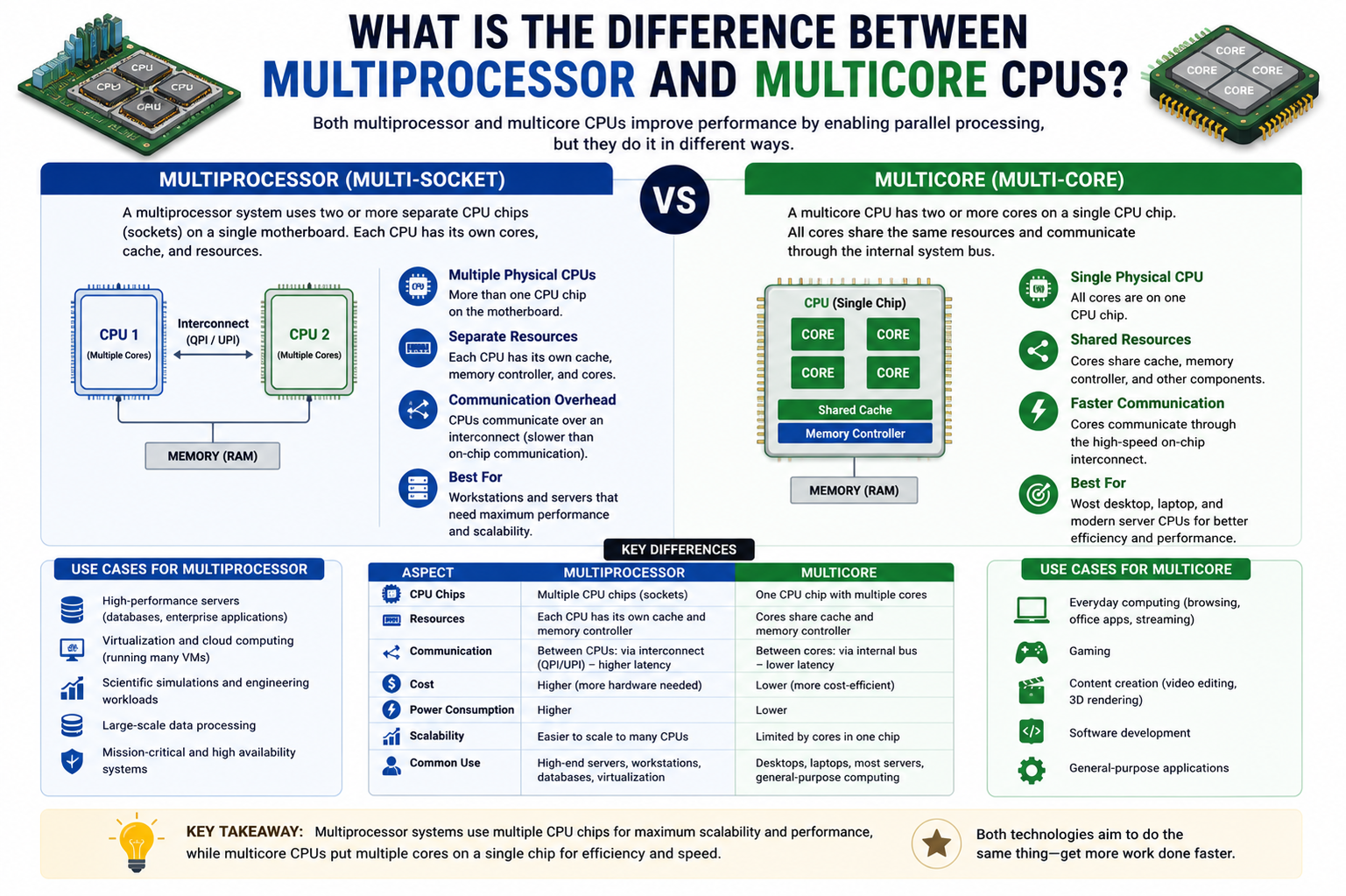
In modern computing, the architecture of a central processing unit plays a critical role in determining how efficiently a system performs tasks. Two widely used approaches to enhancing processing power are multiprocessor and multicore configurations. While both are designed to improve speed and performance, they achieve this through fundamentally different methods. A multicore CPU integrates multiple processing units within a single physical processor, whereas a multiprocessor system uses multiple separate CPUs working together. This distinction influences everything from system design and cost to performance capabilities and real-world applications. Understanding how these two architectures function helps clarify why one might be preferred over the other depending on the computing requirements.
Basic Concept of CPU Architecture
A CPU is essentially the brain of a computer, responsible for executing instructions and managing operations. Over time, the demand for faster and more efficient processing has driven innovations in CPU design. Early systems relied on single-core processors, which could handle only one task at a time. As software became more complex and multitasking became essential, engineers explored ways to improve processing capabilities without simply increasing clock speeds. This led to the development of multicore and multiprocessor systems. Both approaches aim to divide workloads into smaller tasks that can be executed simultaneously, significantly boosting overall performance and responsiveness.
What Defines a Multiprocessor System
A multiprocessor system is built around the idea of using more than one CPU within a single computer. Each processor operates independently but collaborates with others to complete tasks. These CPUs are typically connected through a shared memory system, allowing them to communicate and coordinate efficiently. In some configurations, each processor may also have its own local memory, creating a distributed memory environment. This setup is particularly useful in high-performance computing environments where massive computational workloads need to be handled simultaneously. The presence of multiple CPUs allows the system to execute several processes at the same time, making it highly effective for multitasking and multi-user scenarios.
How Multiprocessor Systems Operate
In a multiprocessor environment, tasks are distributed among different CPUs based on availability and workload. The operating system plays a crucial role in managing these resources, ensuring that each processor is utilized effectively. When a program runs, it can be divided into multiple threads, each assigned to a different CPU. This parallel processing capability enables the system to handle complex operations more efficiently than a single processor could. Communication between CPUs is essential, as they must share data and synchronize their operations to avoid conflicts. This coordination is managed through shared memory and inter-processor communication mechanisms.
Types of Multiprocessing Approaches
Multiprocessing systems can be categorized into different types based on how processors interact and share resources. One approach involves a hierarchical structure where one processor controls others, assigning tasks and managing operations. Another approach treats all processors equally, allowing them to share responsibilities and access resources uniformly. The latter method is more common in modern systems due to its efficiency and scalability. By distributing workloads evenly, the system can achieve better performance and avoid bottlenecks that might occur if one processor becomes overloaded while others remain idle.
Evolution and Use Cases of Multiprocessor Systems
Multiprocessor technology has been used for decades, particularly in environments requiring immense computational power. Early implementations were primarily found in research institutions and large organizations. Over time, advancements in hardware and software have made these systems more accessible, though they are still more common in specialized applications. Industries such as scientific research, data analysis, and large-scale simulations rely heavily on multiprocessor systems. These environments require the ability to process vast amounts of data quickly and efficiently, making multiple CPUs an ideal solution.
Understanding Multicore Processors
A multicore processor takes a different approach by integrating multiple processing cores within a single CPU. Each core functions as an independent processing unit capable of executing instructions. However, all cores share the same physical chip and often share certain resources such as cache memory. This design allows for efficient communication between cores and reduces the physical space required compared to multiple separate CPUs. Multicore processors are now standard in most computing devices, from personal computers to smartphones, due to their balance of performance, efficiency, and cost.
How Multicore CPUs Handle Tasks
In a multicore system, tasks are divided into smaller threads that can be processed simultaneously across different cores. The operating system is responsible for scheduling these threads and assigning them to available cores. This parallel execution improves performance, especially for applications designed to take advantage of multiple cores. Even when running a single application, a multicore processor can handle different aspects of the program concurrently, leading to faster execution times. Additionally, multicore CPUs can manage multiple applications at once without significant slowdowns, making them ideal for everyday computing needs.
Advantages of Multicore Design
One of the key strengths of multicore processors is their efficiency. By placing multiple cores on a single chip, manufacturers can deliver higher performance without significantly increasing power consumption. This is particularly important for portable devices where battery life is a concern. Multicore CPUs also generate less heat compared to systems with multiple separate processors, making them easier to cool and more reliable over time. Their affordability and widespread availability make them the preferred choice for most users, whether for general computing, gaming, or professional tasks.
Performance Characteristics of Multicore Systems
Multicore processors excel in scenarios where tasks can be parallelized. Applications such as video editing, gaming, and software development benefit greatly from multiple cores working simultaneously. However, not all software is optimized for multicore processing. In cases where applications rely heavily on single-thread performance, the benefits of multiple cores may be less noticeable. Despite this limitation, modern software development increasingly focuses on parallel processing, ensuring that multicore CPUs continue to deliver strong performance across a wide range of applications.
Comparing Resource Utilization
Resource management differs significantly between multiprocessor and multicore systems. In a multiprocessor setup, each CPU may have its own dedicated resources, which can improve performance but also increase complexity. In contrast, multicore processors share resources such as cache and memory bandwidth, which simplifies design but can lead to contention when multiple cores compete for the same resources. This trade-off highlights the importance of efficient resource allocation and optimization in achieving the best possible performance from either architecture.
Scalability and System Design Considerations
Scalability is another important factor when comparing these two approaches. Multiprocessor systems can be expanded by adding more CPUs, making them highly scalable for large-scale applications. However, this also increases system complexity and cost. Multicore processors, on the other hand, are limited by the number of cores that can be integrated onto a single chip. While advancements in technology continue to increase core counts, there are physical and practical limits to how many cores can be included. Despite this, multicore designs remain sufficient for most computing needs.
Cost and Accessibility Differences
Cost plays a significant role in determining which architecture is more suitable for a given application. Multiprocessor systems are generally more expensive due to the need for multiple CPUs, specialized motherboards, and additional memory. They also require more advanced cooling and power management solutions. Multicore processors are more cost-effective, as they integrate multiple cores into a single chip, reducing the need for additional hardware. This affordability has contributed to their widespread adoption in consumer devices and mainstream computing.
Energy Efficiency and Thermal Management
Energy efficiency is a critical consideration in modern computing. Multicore processors are designed to deliver high performance while minimizing power consumption. By sharing resources and operating within a single chip, they can achieve better energy efficiency compared to multiprocessor systems. Multiprocessor configurations, while powerful, consume more energy and generate more heat due to the presence of multiple CPUs. This makes them less suitable for environments where energy efficiency and thermal management are priorities.
Real-World Applications and Practical Usage
In practical terms, the choice between multiprocessor and multicore architectures depends on the intended use of the system. Multicore CPUs are ideal for everyday computing tasks, including web browsing, content creation, and gaming. They provide a balance of performance and efficiency that meets the needs of most users. Multiprocessor systems are better suited for specialized applications that require extreme computational power, such as scientific simulations, large-scale data processing, and enterprise-level operations. These systems are typically found in data centers and research facilities rather than personal devices.
Software Optimization and Compatibility
The effectiveness of either architecture depends heavily on software optimization. Applications must be designed to take advantage of multiple cores or processors to fully utilize the available hardware. Multicore processors benefit from widespread software support, as most modern applications are optimized for parallel processing. Multiprocessor systems require more specialized software to achieve optimal performance, which can limit their usability in general-purpose computing. This difference further reinforces the dominance of multicore CPUs in the consumer market.
Future Trends in CPU Development
The evolution of CPU technology continues to focus on increasing performance while improving efficiency. Multicore processors are expected to remain the dominant architecture, with ongoing advancements in core design and integration. At the same time, multiprocessor systems will continue to play a vital role in high-performance computing environments. Innovations in both areas aim to address the growing demands of modern applications, ensuring that computing systems can handle increasingly complex tasks with greater speed and efficiency.
Core-Level Parallelism and Work Distribution
In multicore processors, performance gains are largely driven by how effectively tasks are divided into parallel workloads. Each core is capable of executing its own instruction stream, which means a properly optimized application can split its operations into multiple threads and run them simultaneously. This approach is known as thread-level parallelism, and it forms the backbone of modern software performance optimization. When a program is launched, the operating system analyzes its requirements and distributes threads across available cores. This dynamic allocation ensures that no single core becomes a bottleneck while others remain idle. The result is a smoother and faster computing experience, particularly in environments where multiple applications are running at once.
Instruction Execution and Pipeline Efficiency
Modern CPUs, whether multicore or multiprocessor, rely heavily on instruction pipelines to maximize efficiency. A pipeline breaks down instruction execution into stages such as fetching, decoding, executing, and writing results. In multicore systems, each core typically has its own pipeline, allowing multiple instructions to be processed simultaneously across cores. This design significantly increases throughput. Multiprocessor systems extend this concept further by having entirely separate CPUs, each with its own pipelines and execution units. While this provides greater overall capacity, it also introduces challenges in synchronizing operations between processors, especially when tasks depend on shared data.
Memory Hierarchy and Cache Utilization
Memory access speed plays a crucial role in determining CPU performance. Both multicore and multiprocessor systems rely on a hierarchy of memory, including registers, cache levels, and main memory. Multicore processors often share certain cache levels, such as L2 or L3 cache, among cores. This shared cache facilitates faster data exchange between cores but can also lead to contention if multiple cores attempt to access the same data simultaneously. Multiprocessor systems may have separate caches for each CPU, reducing contention but increasing the complexity of maintaining data consistency across processors. Techniques such as cache coherence protocols are used to ensure that all processors have an accurate view of shared data.
Inter-Core and Inter-Processor Communication
Communication between processing units is essential for maintaining synchronization and data integrity. In multicore processors, cores communicate through shared caches and high-speed interconnects embedded within the chip. This proximity allows for rapid data transfer and low latency. In contrast, multiprocessor systems rely on external communication pathways, such as system buses or dedicated interconnect networks, to exchange information between CPUs. While these connections can be highly efficient, they are generally slower than on-chip communication. As a result, the overhead associated with inter-processor communication can impact overall system performance, particularly in workloads that require frequent data sharing.
Operating System Scheduling Strategies
The operating system is responsible for managing how tasks are assigned to cores or processors. In multicore systems, scheduling algorithms aim to distribute workloads evenly across cores while minimizing context switching and resource contention. Advanced schedulers can detect the nature of tasks and prioritize them accordingly, ensuring optimal use of available resources. In multiprocessor environments, scheduling becomes more complex due to the presence of multiple CPUs. The operating system must consider factors such as processor affinity, memory locality, and load balancing to achieve efficient performance. Proper scheduling is critical in preventing scenarios where some processors are overloaded while others remain underutilized.
Impact on Multitasking and User Experience
Both multicore and multiprocessor systems enhance multitasking capabilities, but they do so in different ways. Multicore processors allow a single CPU to handle multiple tasks simultaneously, improving responsiveness and reducing delays. This is particularly noticeable in everyday computing, where users often run several applications at once. Multiprocessor systems take multitasking a step further by enabling multiple CPUs to process independent workloads concurrently. This makes them ideal for environments where multiple users or applications require consistent performance without interference. The improved multitasking capabilities of both architectures contribute to a more seamless and efficient user experience.
Thermal Design and Power Distribution
Thermal management is a critical aspect of CPU design. Multicore processors are generally more energy-efficient because they integrate multiple cores within a single chip, allowing for better control of power distribution and heat generation. Techniques such as dynamic frequency scaling and power gating enable individual cores to reduce their power usage when idle. Multiprocessor systems, on the other hand, must manage heat across multiple CPUs, each generating its own thermal output. This requires more sophisticated cooling solutions and can increase overall power consumption. Effective thermal design ensures that CPUs operate within safe temperature limits while maintaining optimal performance.
Hardware Complexity and System Integration
The complexity of a computing system increases significantly with the number of processing units involved. Multicore processors simplify system design by consolidating multiple cores into a single chip, reducing the need for additional hardware components. This integration makes them easier to implement in a wide range of devices, from laptops to servers. Multiprocessor systems require more intricate hardware configurations, including specialized motherboards and interconnects. This added complexity can make them more challenging to design, build, and maintain. However, it also allows for greater flexibility and scalability in high-performance computing environments.
Fault Tolerance and Reliability
Reliability is an important consideration in any computing system. Multicore processors benefit from their integrated design, which reduces the number of external components that could potentially fail. However, if a critical part of the CPU fails, it can affect the entire processor. Multiprocessor systems offer a degree of fault tolerance by distributing workloads across multiple CPUs. If one processor fails, others can continue operating, allowing the system to maintain partial functionality. This redundancy is particularly valuable in mission-critical applications where downtime must be minimized.
Workload Specialization and Optimization
Different types of workloads benefit from different CPU architectures. Multicore processors are well-suited for applications that can be divided into parallel tasks, such as multimedia processing, gaming, and software development. Multiprocessor systems excel in environments where large-scale computations or multiple independent tasks must be handled simultaneously. By tailoring the architecture to the specific workload, organizations can achieve better performance and efficiency. Understanding the nature of the tasks being performed is essential in selecting the most appropriate CPU configuration.
Virtualization and Cloud Computing
Virtualization technology has become increasingly important in modern computing, allowing multiple virtual machines to run on a single physical system. Multicore processors provide the necessary performance to support virtualization by enabling multiple virtual environments to share resources efficiently. Multiprocessor systems enhance this capability by offering additional processing power, making them ideal for large-scale cloud computing infrastructures. In these environments, the ability to allocate resources dynamically and handle varying workloads is crucial for maintaining performance and reliability.
Security Considerations in CPU Design
Security is a growing concern in CPU architecture, particularly as systems become more interconnected. Multicore processors must ensure that data shared between cores remains secure and protected from unauthorized access. Techniques such as hardware-based encryption and secure enclaves are used to safeguard sensitive information. Multiprocessor systems face similar challenges but must also address the complexities of securing communication between CPUs. Ensuring data integrity and preventing vulnerabilities requires careful design and implementation at both the hardware and software levels.
Performance Bottlenecks and Limitations
Despite their advantages, both multicore and multiprocessor systems can encounter performance bottlenecks. In multicore processors, shared resources such as cache and memory bandwidth can become limiting factors when multiple cores compete for access. In multiprocessor systems, communication overhead and synchronization delays can impact performance, particularly in workloads that require frequent interaction between processors. Identifying and addressing these bottlenecks is essential for achieving optimal performance and making the most of available hardware resources.
Role in Modern Computing Ecosystems
The widespread adoption of multicore processors has transformed the computing landscape, making high-performance processing accessible to a broad range of users. From personal devices to enterprise systems, multicore CPUs provide the foundation for modern applications. Multiprocessor systems, while less common in consumer devices, play a vital role in specialized fields that demand extreme computational power. Together, these architectures form the backbone of today’s computing ecosystem, enabling everything from everyday tasks to groundbreaking scientific research.
Balancing Performance and Efficiency
Achieving the right balance between performance and efficiency is a key goal in CPU design. Multicore processors offer a practical solution for most users by delivering strong performance while maintaining energy efficiency and affordability. Multiprocessor systems provide unmatched processing power for demanding applications but come with higher costs and complexity. By understanding the strengths and limitations of each approach, users and organizations can make informed decisions that align with their specific needs and priorities.
Scalability in Expanding Workloads
As computing demands grow, the ability of a system to scale becomes increasingly important. Multicore processors scale by increasing the number of cores within a single chip, allowing more threads to run simultaneously. This form of scaling is efficient for most applications because it keeps communication fast and localized within the processor. However, there are practical limits to how many cores can be added before diminishing returns appear due to shared resource constraints. Multiprocessor systems approach scalability differently by adding entirely new CPUs to the system. This enables a much higher ceiling for expansion, making them suitable for environments where workloads can grow unpredictably and require substantial computational resources over time.
Thread Management and Concurrency Handling
Concurrency is at the heart of both multicore and multiprocessor performance. In multicore systems, threads are managed within a single CPU, and the operating system distributes them across cores to maximize efficiency. The proximity of cores allows for faster synchronization and reduced latency when threads need to share data. Multiprocessor systems handle concurrency on a broader scale, distributing threads across separate CPUs. While this increases overall processing capacity, it also introduces additional complexity in coordinating tasks and ensuring that data remains consistent across processors. Efficient thread management is essential in both architectures to prevent delays and maximize throughput.
Latency and Throughput Considerations
Latency and throughput are two key metrics used to evaluate CPU performance. Latency refers to the time it takes to complete a single task, while throughput measures how many tasks can be completed within a given period. Multicore processors generally offer lower latency for tasks that require frequent communication between threads, as cores are located on the same chip. Multiprocessor systems excel in throughput, as multiple CPUs can handle a larger number of independent tasks simultaneously. The balance between latency and throughput often determines which architecture is more suitable for a particular application.
Impact on High-Performance Applications
High-performance applications, such as scientific simulations, machine learning, and large-scale data processing, place significant demands on CPU architecture. Multicore processors provide strong performance for applications that can efficiently utilize parallel threads within a single system. However, when workloads exceed the capabilities of a single CPU, multiprocessor systems become essential. By distributing tasks across multiple CPUs, these systems can handle extremely large datasets and complex computations that would be impractical on a single processor. This makes them a cornerstone of high-performance computing environments.
Data Consistency and Synchronization Challenges
Maintaining data consistency is a critical challenge in both multicore and multiprocessor systems. When multiple cores or processors access shared data, there is a risk of conflicts or inconsistencies. Multicore processors address this through cache coherence mechanisms that ensure all cores have a consistent view of memory. Multiprocessor systems face additional challenges due to the physical separation of CPUs, requiring more sophisticated synchronization techniques. Locks, semaphores, and other concurrency control mechanisms are used to manage access to shared resources and prevent errors. These techniques, while necessary, can introduce overhead that impacts performance.
Role of Parallel Programming Models
Software development plays a crucial role in leveraging the capabilities of modern CPUs. Parallel programming models are designed to help developers create applications that can run efficiently on multicore and multiprocessor systems. These models provide frameworks for dividing tasks into smaller units that can be executed concurrently. In multicore environments, developers often focus on optimizing thread usage and minimizing resource contention. In multiprocessor systems, the emphasis shifts toward managing communication between processors and ensuring that workloads are evenly distributed. The effectiveness of these programming models directly influences the performance gains achieved from the hardware.
Hardware Interconnect Technologies
The efficiency of communication between processing units depends heavily on the interconnect technology used. Multicore processors benefit from high-speed on-chip interconnects that enable rapid data transfer between cores. These interconnects are designed to minimize latency and maximize bandwidth, ensuring that cores can collaborate effectively. Multiprocessor systems rely on external interconnects, which may include advanced networking technologies to link CPUs. While these connections can support high data transfer rates, they are generally slower than on-chip communication, making efficient interconnect design a critical factor in system performance.
Load Balancing Techniques
Load balancing ensures that all processing units are utilized effectively. In multicore systems, the operating system continuously monitors core usage and redistributes tasks to prevent any single core from becoming overloaded. This dynamic balancing helps maintain consistent performance across applications. Multiprocessor systems require more sophisticated load balancing strategies due to the presence of multiple CPUs. Factors such as memory locality and processor affinity must be considered to minimize delays and optimize resource usage. Effective load balancing is essential for achieving the full potential of both architectures.
Energy Consumption Patterns
Energy consumption is an important consideration, especially in large-scale computing environments. Multicore processors are designed to deliver high performance while maintaining relatively low power usage. Techniques such as dynamic voltage scaling allow cores to adjust their power consumption based on workload demands. Multiprocessor systems, while powerful, tend to consume more energy due to the presence of multiple CPUs and the need for additional supporting hardware. This increased energy usage can lead to higher operational costs and requires careful management to ensure efficiency.
Integration in Consumer and Enterprise Systems
Multicore processors have become the standard in consumer devices due to their balance of performance, efficiency, and cost. They are found in desktops, laptops, and mobile devices, providing the processing power needed for everyday tasks and advanced applications alike. Multiprocessor systems are more commonly used in enterprise environments, where the need for high performance and scalability outweighs concerns about cost and complexity. These systems are often deployed in servers, data centers, and specialized computing platforms that handle large-scale workloads.
Adaptability to Emerging Technologies
As new technologies emerge, CPU architectures must adapt to meet evolving demands. Multicore processors continue to evolve with improvements in core design, cache management, and energy efficiency. They are increasingly integrated with specialized processing units to enhance performance in specific tasks. Multiprocessor systems are also adapting, incorporating advanced interconnects and improved resource management techniques to handle more complex workloads. This adaptability ensures that both architectures remain relevant in a rapidly changing technological landscape.
Impact on System Reliability and Maintenance
System reliability is influenced by the complexity and design of the CPU architecture. Multicore processors, with their integrated design, are generally easier to maintain and less prone to hardware failures. Multiprocessor systems, while offering greater performance, require more careful maintenance due to their complexity. The presence of multiple CPUs and additional components increases the likelihood of hardware issues, necessitating robust monitoring and management systems. Ensuring reliability is particularly important in environments where system downtime can have significant consequences.
Balancing Hardware and Software Optimization
Achieving optimal performance requires a balance between hardware capabilities and software optimization. Multicore processors rely on well-designed software to fully utilize their cores, while multiprocessor systems depend on efficient coordination between CPUs. Developers and system administrators must work together to ensure that applications are optimized for the underlying hardware. This includes tuning performance settings, optimizing code, and managing resources effectively. The synergy between hardware and software is key to unlocking the full potential of modern CPU architectures.
Future Directions in Processing Power
The future of CPU design is shaped by the need for greater performance, efficiency, and adaptability. Multicore processors are expected to continue increasing in core count while improving energy efficiency and integration. Multiprocessor systems will remain essential for applications that require extreme computational power, with advancements in interconnect technology and resource management driving their evolution. As computing demands continue to grow, both architectures will play a vital role in meeting the challenges of modern technology, each contributing unique strengths to the overall landscape of processing power.
Real-World Deployment Across Industries
The practical use of multicore and multiprocessor architectures becomes most evident when examining how different industries deploy computing systems. Multicore processors dominate environments where efficiency, compact design, and balanced performance are required. Everyday applications such as office productivity, creative software, and interactive entertainment rely heavily on multicore CPUs to deliver smooth and responsive experiences. On the other hand, multiprocessor systems are typically deployed in sectors that demand continuous, large-scale computation. Fields such as scientific modeling, financial analysis, and advanced engineering simulations rely on multiple CPUs working together to process vast datasets. These deployments highlight how each architecture aligns with specific operational needs rather than competing directly in all scenarios.
Use in Data Centers and Enterprise Infrastructure
Data centers represent one of the most demanding computing environments, where reliability, scalability, and performance are critical. Multicore processors are widely used in servers to handle web services, databases, and virtualization tasks efficiently. Their ability to manage multiple threads within a single CPU makes them ideal for hosting applications that require consistent responsiveness. Multiprocessor systems, however, are often used in high-end enterprise servers where workloads must be distributed across multiple CPUs to ensure uninterrupted service. These systems can handle thousands of simultaneous requests, making them essential for large organizations and cloud-based platforms that require high availability and fault tolerance.
Role in Scientific and Research Computing
Scientific research often involves complex calculations that require immense processing power. Multicore processors contribute by enabling parallel computation within a single system, allowing researchers to run simulations and analyze data more quickly. However, when computational demands exceed the limits of a single CPU, multiprocessor systems become indispensable. These systems are commonly used in research institutions to perform tasks such as climate modeling, molecular simulations, and astrophysical calculations. By distributing workloads across multiple CPUs, researchers can achieve results that would otherwise take an impractical amount of time to compute.
Applications in Artificial Intelligence and Machine Learning
Artificial intelligence and machine learning workloads are highly parallel in nature, making them well-suited for both multicore and multiprocessor architectures. Multicore CPUs handle preprocessing, data management, and certain algorithmic tasks efficiently. Multiprocessor systems, particularly in large-scale AI environments, provide the additional computational power needed to train complex models on massive datasets. The combination of these architectures often forms the backbone of modern AI systems, where different components of the workload are assigned to the most appropriate processing units. This layered approach ensures optimal performance and scalability.
Performance in Gaming and Creative Workloads
In gaming and creative applications, multicore processors play a dominant role. Modern games and design software are optimized to take advantage of multiple cores, enabling smoother graphics rendering, faster load times, and improved responsiveness. Video editing, 3D rendering, and animation software also benefit from multicore architectures, as they can distribute tasks such as encoding and effects processing across multiple cores. Multiprocessor systems are less common in these areas due to their complexity and cost, but they may be used in specialized studios where extremely high rendering performance is required for large-scale projects.
Economic Considerations and Investment Decisions
Choosing between multicore and multiprocessor systems often comes down to cost and return on investment. Multicore processors offer a cost-effective solution for most users, providing strong performance without requiring significant financial investment. They are widely available and supported by a broad range of software, making them a practical choice for both individuals and businesses. Multiprocessor systems, while offering superior performance in certain scenarios, require a much higher investment in hardware, maintenance, and energy consumption. Organizations must carefully evaluate their computing needs to determine whether the benefits of a multiprocessor setup justify the associated costs.
System Design and Physical Constraints
The physical design of computing systems is heavily influenced by the chosen CPU architecture. Multicore processors allow for compact and efficient designs, as multiple cores are integrated into a single chip. This makes them ideal for devices where space and power consumption are limited. Multiprocessor systems require additional space for multiple CPUs, along with the necessary supporting hardware such as advanced cooling systems and power supplies. These requirements make them more suitable for large-scale installations rather than portable or consumer devices. The physical constraints of each architecture play a significant role in determining where and how they are used.
Cooling Solutions and Environmental Impact
Thermal management is a key factor in maintaining system performance and longevity. Multicore processors typically generate less heat due to their integrated design and efficient power usage. This allows for simpler cooling solutions, which can range from air cooling to compact liquid cooling systems. Multiprocessor systems, by contrast, generate significantly more heat due to the presence of multiple CPUs operating simultaneously. This necessitates more advanced cooling solutions, often involving complex airflow management or industrial-grade cooling systems. The environmental impact of these systems is also a consideration, as higher energy consumption leads to increased carbon emissions in large-scale deployments.
User Accessibility and Market Availability
From a user perspective, multicore processors are far more accessible. They are standard in nearly all modern computing devices and are supported by a wide range of software applications. This accessibility has made them the default choice for most users, from casual consumers to professionals. Multiprocessor systems are less accessible due to their specialized nature and higher cost. They are typically found in enterprise environments, research facilities, and other specialized settings where their capabilities can be fully utilized. This difference in accessibility reflects the distinct roles that each architecture plays in the broader computing ecosystem.
Long-Term Maintenance and Upgradability
Maintenance and upgrade considerations differ significantly between the two architectures. Multicore systems are generally easier to maintain, as they involve fewer components and simpler configurations. Upgrading a multicore system often involves replacing the CPU with a newer model that offers more cores or improved performance. Multiprocessor systems, however, require more careful planning for upgrades. Adding or replacing CPUs must be done in a way that maintains compatibility and balance within the system. This complexity can increase maintenance costs and require specialized expertise, particularly in large-scale deployments.
Balancing Simplicity and Power
One of the defining trade-offs between multicore and multiprocessor systems is the balance between simplicity and power. Multicore processors provide a streamlined solution that meets the needs of most applications without introducing unnecessary complexity. Their design allows for efficient performance in a wide range of scenarios, making them a versatile choice. Multiprocessor systems, while more complex, offer unmatched computational power for tasks that demand it. This trade-off highlights the importance of aligning system architecture with specific performance requirements rather than seeking a one-size-fits-all solution.
Final Thoughts
The distinction between multicore and multiprocessor CPUs ultimately comes down to how processing power is organized and utilized. Multicore processors integrate multiple cores within a single CPU, delivering efficient and cost-effective performance for a wide range of applications. Multiprocessor systems, by combining multiple CPUs, provide the scalability and raw power needed for the most demanding computational tasks. Each architecture has its strengths and limitations, and the choice between them depends on the intended use of the system. For most users, multicore processors offer more than enough capability to handle everyday and professional workloads. For specialized environments that require extreme performance and scalability, multiprocessor systems remain an essential solution.