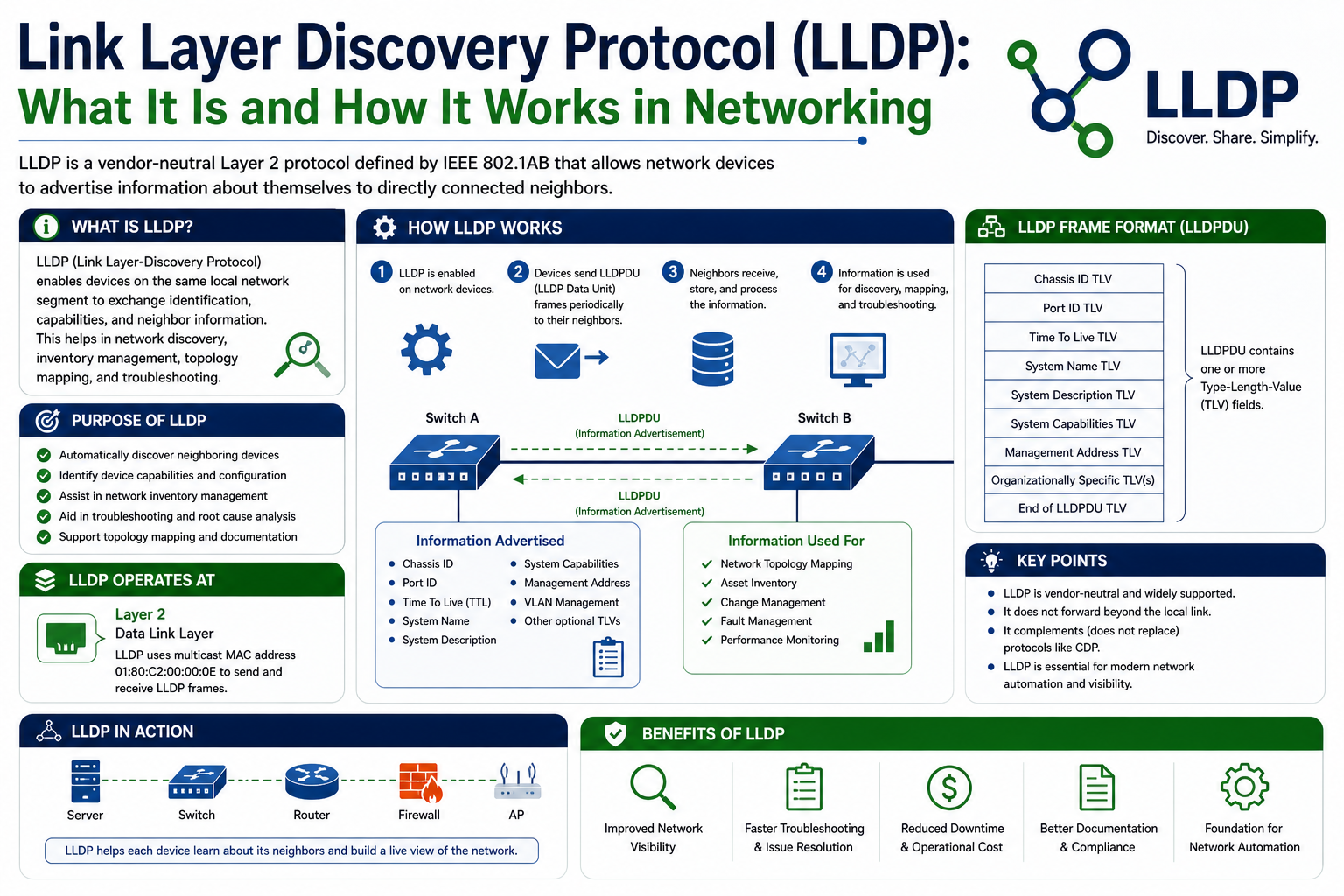
Link Layer Discovery Protocol is a standardized network communication method designed to allow directly connected devices such as switches, routers, and other infrastructure equipment to automatically share information about themselves. This shared information helps network administrators understand how devices are interconnected without manually tracing cables or inspecting hardware one by one.
Instead of relying on manual documentation or guesswork, LLDP enables devices to self-identify and announce their presence to neighbors on the same network segment. This makes network visibility far more efficient, especially in large or complex environments where multiple devices are interconnected across racks, floors, or entire buildings.
At its core, LLDP is built to simplify network discovery and improve operational awareness. It continuously exchanges structured information between devices, helping build a dynamic map of the network topology that updates automatically as changes occur.
Purpose of LLDP in Modern Networking
The main purpose of LLDP is to provide a standardized way for network devices to advertise identity and capability information to directly connected neighbors. This includes details such as device name, interface information, system description, and supported features.
In practical environments, this means a switch can instantly recognize what type of device it is connected to on each port. For example, it can identify whether the neighbor is another switch, a router, or an access point. This level of awareness helps administrators maintain control over complex infrastructures without relying solely on documentation or manual tracking.
LLDP also supports better planning and design decisions because it provides a real-time view of how the network is physically and logically structured. This becomes especially useful when scaling networks or troubleshooting unexpected connectivity issues.
How LLDP Works at the Network Level
LLDP operates by periodically sending small data packets, known as advertisements, from each enabled network interface. These packets contain structured information about the sending device and are transmitted to directly connected neighbors only.
When a device receives an LLDP advertisement, it stores the information locally in a table that can be viewed by network administrators. This information is continuously refreshed at regular intervals, ensuring that the network topology remains up to date.
Each LLDP-enabled device functions both as a sender and receiver. It broadcasts its own details while also listening for incoming advertisements from neighboring devices. This two-way communication creates a shared understanding of the network layout between all connected devices.
The data exchange is automatic and does not require manual intervention once LLDP is enabled. This makes it a low-maintenance yet highly effective protocol for network discovery.
LLDP as a Layer 2 Protocol
LLDP operates at the data link layer of the network model, which means it works independently of IP addressing. Instead of relying on network layer protocols, it communicates directly using MAC addresses.
This layer 2 operation is important because it allows LLDP to function even in situations where IP configurations are not present or not fully established. Devices can still exchange discovery information as long as they are physically connected to the same network segment.
Another advantage of operating at this layer is that LLDP traffic does not need routing. It stays within the local broadcast domain, ensuring that discovery information is only shared among directly connected neighbors.
This design makes LLDP highly efficient for mapping local network topology without introducing additional overhead on higher network layers.
Types of Information Shared Through LLDP
LLDP exchanges a wide range of information that helps describe the identity and capabilities of a device. This information is structured in specific data elements that are transmitted between neighbors.
Devices typically share identifiers such as system name and description, which help identify the manufacturer and model. Interface details are also exchanged, allowing administrators to understand which ports are connected between devices.
In addition to basic identification, LLDP can also share capability information. This includes whether a device functions as a switch, router, or access point. It may also provide details about supported features or services.
Some implementations can even include network configuration-related data such as VLAN associations or link aggregation details. This provides deeper visibility into how traffic is structured across the network.
Automatic Network Discovery Using LLDP
One of the most powerful aspects of LLDP is its ability to automatically discover network topology. As soon as devices are connected and LLDP is enabled, they begin exchanging information without requiring manual configuration.
This automatic discovery allows administrators to quickly understand how devices are physically connected. Instead of tracing cables or checking ports manually, they can view neighbor relationships directly from device interfaces.
This feature becomes especially valuable in large-scale environments where hundreds or thousands of connections exist. It reduces human error and saves significant time during network audits or expansion projects.
Because LLDP continuously updates its information, it also reflects changes in real time. If a device is moved, replaced, or disconnected, the updated topology is quickly reflected across the network.
Role of LLDP in Network Visibility
Network visibility refers to the ability to clearly understand how devices are connected and how data flows between them. LLDP plays a major role in improving this visibility by providing a structured and automated view of connections.
With LLDP enabled, administrators can see exactly which device is connected to each interface on a switch or router. This eliminates uncertainty and helps maintain accurate network documentation.
Improved visibility also supports better capacity planning. By understanding how devices are interconnected, administrators can make informed decisions about upgrades, load balancing, and redundancy.
Overall, LLDP transforms a complex physical infrastructure into a clearly mapped logical structure that is easier to manage and optimize.
LLDP in Mixed Vendor Environments
One of the key strengths of LLDP is that it is an open standard protocol. This means it is supported by multiple network equipment vendors rather than being restricted to a single manufacturer.
In environments where devices from different vendors are used together, LLDP ensures consistent discovery and communication. Devices from different manufacturers can still exchange topology information without compatibility issues.
This interoperability makes LLDP highly suitable for enterprise networks where diverse hardware is common. It eliminates dependency on proprietary protocols and allows seamless integration across the entire infrastructure.
By supporting multiple vendors, LLDP ensures that network visibility remains consistent regardless of the underlying hardware ecosystem.
Basic Structure of LLDP Operation
The operation of LLDP is based on a simple cycle of advertisement and reception. Each device periodically sends out information packets that describe its identity and capabilities.
Neighboring devices receive these packets and store them in a local database. This database is then used to display network relationships and interface mappings.
The process repeats continuously, ensuring that the information remains current. If any changes occur in the network, such as a device being added or removed, the updates are quickly reflected in the LLDP tables.
This continuous exchange creates a living map of the network that evolves automatically as the infrastructure changes.
Importance of LLDP in Network Management
From a network management perspective, LLDP significantly reduces complexity. Instead of relying on manual tracking methods, administrators can depend on automated discovery to understand network structure.
This improves accuracy and reduces the chances of configuration errors. It also simplifies documentation efforts, as the network topology can be derived directly from device data.
LLDP also supports faster onboarding of new devices. As soon as a device is connected, it becomes visible to the rest of the network, making integration smoother and more efficient.
In large environments, this level of automation is essential for maintaining control and ensuring operational stability.
Final Overview of LLDP Fundamentals
LLDP serves as a foundational protocol for network discovery and topology mapping. It provides a standardized method for devices to communicate essential identity and capability information directly to their neighbors.
By operating at the data link layer, it ensures reliable communication within local networks without relying on higher-level configurations. Its open nature allows compatibility across different vendors, making it widely applicable in modern networking environments.
Through continuous information exchange, LLDP builds an accurate and dynamic representation of network structure. This improves visibility, simplifies management, and enhances overall operational efficiency.
LLDP Protocol Architecture and Internal Working Model
The architecture of Link Layer Discovery Protocol is designed around a simple but highly effective neighbor-to-neighbor communication model. Instead of relying on a centralized controller, LLDP works in a distributed way where each device independently advertises its identity and listens to others on the same link.
Every LLDP-enabled device maintains two key internal components. The first is the transmit function, responsible for sending periodic advertisements. The second is the receive function, which listens for incoming information from directly connected neighbors. Together, these two functions create a continuous exchange of network intelligence across all active links.
This architecture ensures that every device in the network has a localized but accurate understanding of its immediate surroundings. Over time, these local views collectively form a complete picture of the entire network topology.
LLDP Frame Structure and Data Packaging
LLDP communicates using structured frames that carry organized pieces of information about a device. These frames are built using a flexible format that allows multiple types of data to be included in a single transmission.
Each LLDP frame contains a set of information blocks that describe specific attributes of the sending device. These blocks may include system identity, port identity, and capability details. The structured nature of these frames ensures that receiving devices can easily interpret and store the information.
The data is encoded in a standardized format that allows interoperability between different vendors. This ensures that devices from different manufacturers can correctly understand each other’s advertisements without requiring translation or modification.
Because LLDP frames are lightweight, they do not consume significant network bandwidth, making them suitable for continuous periodic transmission without affecting performance.
LLDP Neighbor Discovery Process
The neighbor discovery process in LLDP is continuous and automatic. Once enabled, a device immediately begins sending advertisements on all active interfaces. These advertisements are broadcast directly to neighboring devices on the same link.
When a neighboring device receives an LLDP frame, it processes the information and stores it in a local neighbor database. This database includes details such as the connected interface, the remote device identity, and the time the information was last received.
Each device maintains its own independent view of the network based on these received updates. This means there is no central dependency, and each device contributes equally to the overall discovery process.
If a device stops receiving updates from a neighbor within a defined interval, it assumes the connection has been lost and removes that entry from its database. This ensures that the topology information remains accurate and up to date.
Timers and Advertisement Intervals in LLDP
LLDP relies on timers to control how frequently information is sent and how long it is retained. These timers play a critical role in balancing network visibility with efficiency.
The advertisement interval determines how often a device sends LLDP updates to its neighbors. A shorter interval provides faster updates but increases network traffic slightly. A longer interval reduces traffic but may delay topology updates.
There is also a hold time mechanism that defines how long a device should keep neighbor information if no new updates are received. This prevents outdated or stale information from remaining in the system.
Together, these timers ensure that LLDP operates efficiently while still maintaining accurate and timely network topology information.
Type-Length-Value Structure in LLDP
LLDP uses a Type-Length-Value structure to organize the data it sends. This format allows each piece of information to be clearly defined, easily interpreted, and flexibly extended.
The “Type” field identifies what kind of information is being transmitted, such as system name or port description. The “Length” field defines the size of the data, ensuring proper parsing. The “Value” field contains the actual information being shared.
This modular design allows LLDP to be easily extended with new types of information without breaking compatibility with existing implementations. It also ensures that devices can ignore unknown fields without affecting overall communication.
This flexibility is one of the reasons LLDP is widely adopted across different networking platforms and vendors.
LLDP and Port-Level Discovery
One of the most important aspects of LLDP is its ability to operate at the port level. Each physical or logical interface on a device independently participates in the LLDP process.
This means that a single device can exchange different neighbor information on each of its ports. For example, one interface may connect to a switch while another connects to a router, and each connection will be separately identified.
Port-level discovery provides extremely detailed visibility into network structure. It allows administrators to see exactly how every connection is mapped, which is essential for troubleshooting and documentation.
This level of granularity ensures that no connection is left untracked or unidentified within the network.
LLDP Database and Information Storage
Each device that supports LLDP maintains a local database of all discovered neighbors. This database is dynamically updated as new information is received or old entries expire.
The stored data typically includes device identifiers, interface mappings, system descriptions, and capability information. This structured storage allows administrators to quickly retrieve network topology details from any device.
The database is not static; it continuously evolves as the network changes. New devices are added automatically, and disconnected devices are removed after their hold time expires.
This dynamic nature ensures that the stored information always reflects the current state of the network.
LLDP Frame Transmission Behavior
LLDP frames are transmitted in a controlled and predictable manner. Devices do not send information randomly; instead, they follow a consistent schedule defined by the configured timer settings.
Each frame is sent as a standalone advertisement that contains all relevant information about the device. These frames are transmitted over all active interfaces that have LLDP enabled.
Because LLDP operates at layer 2, these frames are not routed beyond the local network segment. This ensures that the information remains confined to directly connected devices only.
This controlled transmission behavior helps maintain network efficiency while still providing continuous discovery capabilities.
Handling Changes in Network Topology
One of the strengths of LLDP is its ability to quickly adapt to changes in network topology. When a device is added, removed, or moved, the protocol automatically detects and updates the changes.
If a new connection is established, the devices immediately begin exchanging LLDP information. This results in near-instant visibility of the new link in the neighbor database.
If a connection is removed, the absence of updates causes the corresponding entry to expire after the hold time period. This ensures that outdated connections do not remain in the system.
This automatic adaptation makes LLDP highly reliable in dynamic environments where network changes occur frequently.
Role of LLDP in Multi-VLAN Environments
LLDP is capable of functioning across multiple VLANs because it operates at the data link layer. This means that VLAN separation does not prevent devices from exchanging LLDP information.
Even if devices are logically separated into different VLANs, they can still share discovery information as long as they are physically connected. This makes LLDP particularly useful in segmented networks.
It allows administrators to understand physical connections independently of logical segmentation, providing a complete view of the infrastructure.
This dual visibility helps in diagnosing VLAN-related issues and ensures that physical and logical network structures are both clearly understood.
LLDP and Interface Identification
Interface identification is a key part of LLDP functionality. Each advertisement includes information about the sending and receiving interfaces, allowing precise mapping between devices.
This means that administrators can see exactly which port on one device is connected to which port on another device. This eliminates ambiguity in network documentation.
Accurate interface mapping is especially useful in environments with dense cabling or multiple interconnected switches.
It simplifies troubleshooting by allowing quick identification of physical connection points without manual inspection.
Final Overview of LLDP Internal Operation
The internal operation of LLDP is based on continuous, structured, and decentralized communication between directly connected devices. Each device independently sends and receives structured information while maintaining its own neighbor database.
Through its timer-based system, flexible frame structure, and port-level awareness, LLDP provides an efficient mechanism for real-time network discovery. It ensures that topology information remains accurate, up to date, and easy to interpret.
This internal design makes LLDP a reliable foundation for modern network visibility and management, especially in environments where automation and accuracy are essential.
LLDP Protocol Features and Advanced Functional Capabilities
Link Layer Discovery Protocol includes a wide range of features that make it more than just a simple neighbor discovery tool. It is designed to enhance network visibility, simplify management, and provide structured insight into how devices interact at the data link layer.
One of its most important capabilities is automatic neighbor identification. Once enabled, LLDP continuously identifies directly connected devices without requiring manual configuration or intervention. This automatic discovery reduces administrative effort and ensures that network maps remain accurate even as changes occur.
Another important feature is standardized information exchange. LLDP uses a consistent format to share device details, ensuring that all participating devices interpret information in the same way regardless of vendor or hardware type. This makes it highly effective in multi-vendor environments where interoperability is essential.
LLDP also supports extensibility, allowing additional information types to be added without breaking compatibility. This means the protocol can evolve over time while still supporting older devices and configurations.
LLDP Capabilities Advertisement and Device Roles
One of the advanced features of LLDP is its ability to advertise device capabilities. This means each device can inform its neighbors about what type of network function it performs.
For example, a device can advertise whether it operates as a switch, router, bridge, or access point. This role-based information helps administrators quickly understand the structure of the network without needing to inspect each device individually.
These capability advertisements also help in network planning and optimization. By knowing how devices are functioning within the topology, administrators can make better decisions about load distribution and redundancy design.
This feature becomes especially valuable in large-scale networks where multiple device types operate simultaneously.
LLDP Management Address and Identification Features
LLDP includes a mechanism for advertising management addresses, which are used to identify devices at a higher level. These addresses help administrators remotely access and manage network devices more efficiently.
The management address information typically includes IP addresses or other identifiers used for configuration and monitoring purposes. This allows quick association between physical devices and their management interfaces.
In addition to management addresses, LLDP also shares system identifiers such as device name and description. These identifiers help distinguish between multiple devices that may have similar hardware or configurations.
Together, these identification features provide a complete view of both physical and logical device identity within the network.
LLDP Port Description and Interface Mapping
Another important feature of LLDP is port description exchange. Each device can advertise information about its interfaces, including port names and descriptions.
This allows administrators to clearly understand which physical or logical ports are connected between devices. Instead of relying on manual labeling, LLDP provides automated interface mapping.
This feature is particularly useful in environments with complex cabling structures, where tracking connections manually would be time-consuming and error-prone.
By using port descriptions, LLDP ensures that every connection is clearly documented and easily traceable.
LLDP VLAN Awareness and Network Segmentation Support
Although LLDP operates at layer 2, it still provides useful information in environments with VLAN segmentation. It can operate across VLAN boundaries as long as devices are physically connected.
This allows LLDP to reveal physical topology even when logical segmentation is in place. For example, devices in different VLANs can still exchange discovery information if they share a physical link.
This capability is important because it separates physical connectivity from logical network design. Administrators can clearly see how devices are physically connected regardless of VLAN configuration.
This dual visibility helps in diagnosing segmentation issues and ensuring that network design aligns with actual infrastructure.
LLDP Link Aggregation Awareness
LLDP also supports link aggregation awareness, which allows devices to identify bundled interfaces that operate as a single logical connection.
In modern networks, multiple physical links are often combined to increase bandwidth and provide redundancy. LLDP helps identify these aggregated links and provides information about how they are structured.
This makes it easier to understand traffic flow and identify potential bottlenecks in aggregated connections.
It also helps ensure that link aggregation configurations are properly aligned on both ends of a connection.
LLDP Power over Ethernet (PoE) Support
Another advanced capability of LLDP is its support for Power over Ethernet information exchange. Devices can use LLDP to communicate power requirements and availability.
For example, a powered device such as an IP phone or wireless access point can request specific power levels from a switch. The switch can then allocate power accordingly based on the information received through LLDP.
This helps optimize power distribution across the network and ensures that devices receive the appropriate power levels for stable operation.
It also prevents power overload situations by enabling intelligent power negotiation between devices.
LLDP Error Detection and Network Consistency
LLDP contributes indirectly to error detection by providing consistent visibility into network topology. When discrepancies occur between expected and actual connections, LLDP helps highlight those inconsistencies.
For example, if a device is connected to an unexpected port or switch, LLDP information will reveal the mismatch. This allows administrators to quickly identify configuration errors or physical miswiring.
While LLDP itself does not actively correct errors, it provides the information needed to detect and resolve them efficiently.
This makes it a valuable tool for maintaining network consistency and integrity.
LLDP Data Synchronization and Update Mechanism
LLDP maintains data synchronization through continuous updates between devices. Each device periodically sends updated information to its neighbors to ensure that the network view remains current.
When changes occur, such as interface modifications or device replacements, the updated information is quickly propagated through LLDP advertisements.
This ensures that all connected devices maintain a synchronized understanding of the network topology.
The synchronization process is automatic and does not require manual intervention, making it highly efficient for dynamic environments.
LLDP Filtering and Control Options
LLDP provides several control options that allow administrators to fine-tune how information is shared. These options include enabling or disabling LLDP on specific interfaces or controlling what type of information is advertised.
For example, administrators can choose to restrict LLDP transmission on sensitive interfaces where limited visibility is required.
They can also control which types of data fields are included in advertisements, ensuring that only relevant information is shared.
This level of control allows organizations to balance visibility with security requirements.
LLDP Scalability in Large Networks
LLDP is highly scalable and performs well in both small and large network environments. Its lightweight design ensures that it does not consume significant resources even when deployed across hundreds or thousands of devices.
Because each device only communicates with directly connected neighbors, LLDP avoids excessive network traffic. This localized communication model ensures efficiency at scale.
As the network grows, LLDP continues to function without requiring major configuration changes, making it suitable for enterprise-level deployments.
Its scalability is one of the key reasons it is widely adopted in modern networking infrastructures.
LLDP Interoperability Across Network Vendors
A major strength of LLDP is its interoperability. Since it is an open standard protocol, it is supported by a wide range of networking vendors.
This means devices from different manufacturers can exchange information seamlessly without compatibility issues. In heterogeneous environments, this ensures consistent visibility across the entire infrastructure.
Interoperability also reduces vendor lock-in and allows organizations to build flexible network architectures using a mix of hardware solutions.
This flexibility is essential for modern enterprise networks that require adaptability and scalability.
LLDP Role in Network Automation
LLDP plays an important role in enabling network automation. By providing real-time topology information, it allows automated systems to make informed decisions about configuration and management.
Automation tools can use LLDP data to map network structures, detect changes, and adjust configurations dynamically.
This reduces the need for manual intervention and increases operational efficiency.
As networks become more complex, LLDP serves as a foundational component for intelligent automation systems.
Final Overview of LLDP Functional Strengths
The advanced capabilities of LLDP make it a powerful protocol for network discovery and management. Its features extend beyond simple neighbor identification to include capability advertisement, power management support, interface mapping, and scalability.
By combining standardized communication with flexible configuration options, LLDP provides a comprehensive view of network infrastructure.
It supports interoperability, automation, and efficient troubleshooting, making it an essential tool for modern network environments.
Overall, LLDP enhances visibility, improves control, and simplifies management across complex networking systems.
LLDP Protocol Security Considerations and Risk Awareness
Security in LLDP is an important topic because the protocol is designed for automatic information sharing between directly connected devices. While this improves visibility and management, it also introduces certain exposure considerations that network administrators must understand.
LLDP does not include built-in encryption or authentication mechanisms. This means the information it shares is transmitted in a readable format at the data link layer. However, because LLDP operates only within local network boundaries, its exposure is naturally limited to devices on the same physical segment.
The key security advantage is that LLDP traffic does not travel beyond the local network. It cannot be routed across the internet, which significantly reduces the risk of external interception.
Even with this limitation, LLDP can still reveal useful information about network infrastructure. Device names, models, and interface details can potentially be used for reconnaissance if an unauthorized device gains access to the local network.
Because of this, organizations with strict security requirements sometimes choose to disable LLDP on sensitive interfaces or restrict its operation to trusted network segments only.
LLDP Information Exposure and Network Visibility Risks
The type of information shared through LLDP can include device identity, port details, and capabilities. While this is useful for administration, it can also provide a clear map of the network structure.
If an unauthorized user gains physical access to a network port, LLDP may expose details about connected devices. This could help an attacker understand how the network is designed and identify potential targets.
However, this risk is generally limited to internal environments where physical access is already a concern. In most enterprise networks, physical and logical security controls reduce the likelihood of unauthorized access.
To mitigate exposure, administrators can selectively disable LLDP on specific ports or restrict the types of information being advertised. This allows a balance between operational visibility and security control.
LLDP and Attack Surface Considerations
LLDP slightly increases the network’s attack surface because it provides structured information to connected devices. However, it does not execute commands or allow direct control over devices.
The protocol is passive in nature, meaning it only shares information and does not accept configuration changes through its advertisements. This significantly limits its potential for exploitation.
Despite this, attackers with access to the local network could use LLDP data for mapping infrastructure. This makes it important to treat LLDP as a visibility tool rather than a security barrier.
Proper network segmentation and access control remain the primary defense mechanisms against misuse of LLDP information.
LLDP Best Practices for Secure Deployment
To safely deploy LLDP in secure environments, administrators often follow specific best practices. One common approach is enabling LLDP only on trusted interfaces, such as internal switch-to-switch links.
Another practice involves disabling LLDP on user-facing ports where end devices connect. This helps reduce unnecessary exposure of network topology information.
Administrators may also configure LLDP to limit the types of information shared. For example, certain optional data fields can be disabled if they are not required for network management.
Regular monitoring of LLDP neighbor tables is also recommended. This helps detect unexpected devices that may indicate unauthorized access or misconfigurations.
LLDP in Enterprise Security Environments
In enterprise environments, LLDP is often used alongside other monitoring and discovery tools. It is not relied upon as a security mechanism but rather as a management and visibility tool.
Security teams may integrate LLDP data into network monitoring systems to maintain awareness of device relationships. This helps identify anomalies such as unknown devices appearing on the network.
However, because LLDP is not encrypted, it is typically not used in isolation for sensitive security decisions. Instead, it supports broader network visibility strategies.
In highly regulated environments, administrators may apply stricter controls or disable LLDP entirely on critical network segments.
LLDP Troubleshooting and Problem Identification
One of the most practical uses of LLDP is troubleshooting network issues. It provides real-time information about device connections, which helps identify misconfigurations and connectivity problems.
If a device is not appearing in the expected neighbor list, it may indicate a physical disconnection or disabled interface. LLDP helps quickly narrow down such issues without requiring manual cable tracing.
It is also useful for identifying incorrect connections. For example, if a switch port is connected to an unexpected device type, LLDP will immediately reveal the mismatch.
This makes troubleshooting faster and more accurate, especially in large environments with complex cabling structures.
Common LLDP Configuration Issues
Several configuration issues can affect LLDP functionality. One common problem is LLDP being disabled on one or more interfaces. Since both ends of a connection must support LLDP for full visibility, missing configuration on either side can result in incomplete neighbor data.
Another issue is mismatched timers. If advertisement intervals or hold times are not aligned properly, neighbor information may appear outdated or inconsistent.
Incorrect interface configuration can also prevent LLDP from functioning properly. If a port is administratively shut down or misconfigured, it will not send or receive LLDP frames.
These issues are typically resolved through careful configuration review and verification of interface status.
LLDP Data Accuracy and Timing Challenges
LLDP relies on periodic updates to maintain accurate network information. However, timing plays an important role in ensuring data consistency.
If advertisement intervals are too long, updates may be delayed, resulting in slightly outdated topology views. On the other hand, very short intervals may increase unnecessary network traffic.
Hold timers must also be properly configured to ensure that stale information is removed in a timely manner. If hold times are too long, disconnected devices may still appear in neighbor tables.
Balancing these timing settings is important for maintaining both accuracy and efficiency.
LLDP in Dynamic Network Environments
Modern networks are often highly dynamic, with devices frequently being added, removed, or reconfigured. LLDP is well-suited for such environments because it continuously updates topology information in real time.
When a new device is connected, it immediately begins advertising its presence. This allows the rest of the network to quickly recognize and integrate the new device.
Similarly, when a device is removed, LLDP automatically removes it from neighbor tables after the hold time expires. This ensures that the network view always reflects the current state.
This adaptability makes LLDP especially useful in environments such as data centers and enterprise campuses.
LLDP Role in Network Documentation
LLDP plays a significant role in maintaining accurate network documentation. Instead of manually recording device connections, administrators can use LLDP data to generate real-time topology maps.
This reduces documentation errors and ensures that records remain up to date as the network evolves.
It also simplifies audits and compliance processes by providing clear visibility into network structure and device relationships.
Accurate documentation is essential for long-term network stability and operational efficiency.
LLDP Integration with Monitoring Systems
LLDP data is often integrated into network monitoring and management systems. These systems use LLDP information to build visual maps of network topology.
By analyzing LLDP data, monitoring tools can detect changes in the network and alert administrators to unexpected modifications.
This integration enhances situational awareness and supports proactive network management.
It also helps correlate network events with physical connections, making troubleshooting more efficient.
LLDP Limitations and Operational Boundaries
While LLDP is a powerful protocol, it does have limitations. It only operates between directly connected devices and cannot provide visibility beyond immediate neighbors.
It also does not provide detailed performance metrics such as bandwidth usage or latency. Its focus is strictly on discovery and identification.
Additionally, because it lacks security features like encryption or authentication, it is not suitable for secure communication purposes.
Understanding these limitations helps administrators use LLDP effectively within its intended scope.
Final Overview of LLDP in Practice
In practical network environments, LLDP serves as a foundational tool for visibility, troubleshooting, and topology discovery. It simplifies complex infrastructures by automatically mapping device relationships and providing real-time updates.
While it is not a security protocol, it plays an important role in operational awareness and network management. Its simplicity, efficiency, and vendor neutrality make it widely applicable across different network types.
When used correctly, LLDP improves efficiency, reduces manual effort, and enhances overall network reliability.
Final Conclusion
LLDP is a powerful layer 2 discovery protocol that brings clarity and structure to modern network environments. It enables automatic neighbor discovery, improves visibility, and simplifies troubleshooting across complex infrastructures.
Although it has security considerations due to its open information sharing, its scope is naturally limited to local networks, making it generally safe for most enterprise environments when properly configured.
Its real value lies in automation, simplicity, and real-time topology awareness. By providing continuous insight into how devices are connected, LLDP helps network administrators maintain efficient, stable, and well-documented networks.