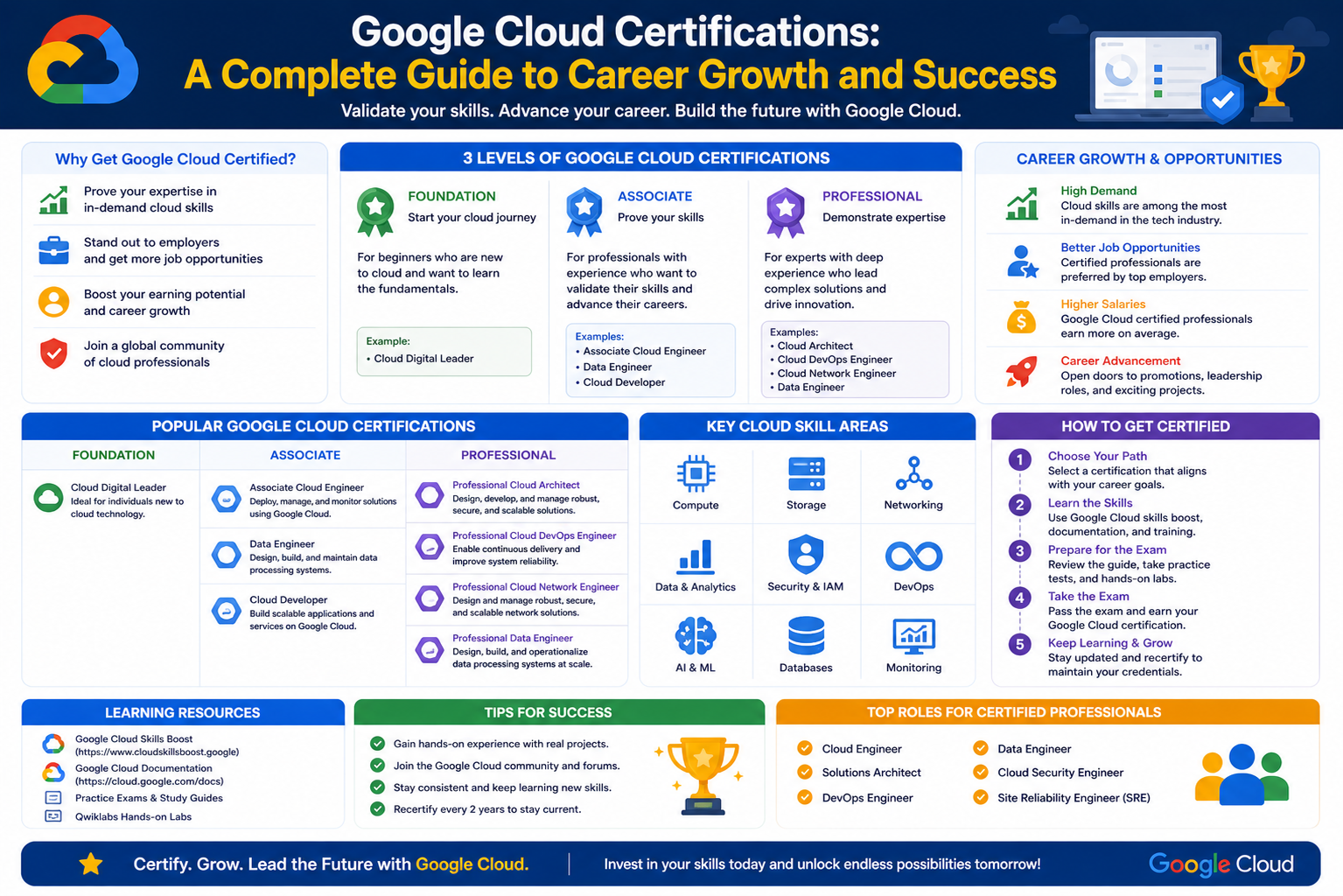
Cloud computing has become a central pillar of modern IT strategies, transforming how organizations build, deploy, and manage digital systems. Among the leading providers in this space, Google Cloud has steadily expanded its influence with a strong ecosystem that includes cloud infrastructure services and enterprise productivity tools. While competition from other major platforms is intense, Google Cloud continues to gain momentum as more businesses adopt its technologies for scalability, security, and innovation.
Understanding Google Cloud Certification Programs
Google Cloud certification programs are designed to validate skills in cloud computing, data engineering, application development, security, networking, and machine learning. These certifications serve as a structured pathway for IT professionals to demonstrate their expertise in using Google Cloud technologies effectively.
The certification framework is organized into multiple levels, starting from foundational knowledge and advancing toward specialized professional roles. Each certification is aligned with real-world job responsibilities, ensuring that certified individuals are capable of working in enterprise environments where cloud solutions are critical.
Rather than focusing on general digital marketing or non-technical Google tools, these certifications concentrate on Google Cloud Platform services and cloud-based development environments. This makes them highly relevant for cloud engineers, system architects, developers, and data specialists.
Structure of Google Cloud Certification Levels
Google Cloud certifications are broadly divided into three main categories: foundational, associate, and professional levels. Each level reflects increasing depth of knowledge and technical responsibility.
The foundational level is designed for individuals who are new to cloud computing and want to understand basic concepts such as cloud architecture, digital transformation, and Google Cloud services.
The associate level is more technical and is intended for professionals who have some hands-on experience with cloud environments. These certifications focus on operational tasks, system configuration, and basic cloud management responsibilities.
The professional level is the most advanced category and is designed for experienced IT professionals. These certifications require strong technical expertise in designing, building, securing, and optimizing cloud-based systems.
Google Cloud Digital Leader Certification Overview
The Google Cloud Digital Leader certification is an entry-level credential designed to validate foundational understanding of cloud computing and Google Cloud services. It is suitable for individuals across different business roles who want to understand how cloud technologies drive digital transformation.
This certification does not require deep technical skills. Instead, it focuses on strategic understanding and conceptual knowledge of cloud adoption. It helps professionals understand how cloud solutions can improve business operations, enhance productivity, and support innovation.
Key areas covered in this certification include understanding how cloud technologies transform business models, how data can be leveraged for decision-making, and how artificial intelligence services within Google Cloud can support innovation. It also introduces important concepts related to security, compliance, and scalability in cloud environments.
This certification is often considered a starting point for those planning to move into more technical cloud roles in the future.
Google Associate Cloud Engineer Certification Overview
The Google Associate Cloud Engineer certification is designed for individuals who are beginning their journey in cloud computing and want to develop practical, hands-on skills. It focuses on the operational side of Google Cloud Platform services and prepares professionals to work in entry-level cloud engineering roles.
This certification validates the ability to set up cloud environments, configure cloud solutions, and manage day-to-day operations within Google Cloud. It is highly practical and emphasizes real-world implementation rather than theoretical knowledge.
Candidates are expected to understand how to deploy applications, configure cloud infrastructure, and maintain system reliability. They also need to demonstrate knowledge of security practices and access control within cloud environments.
A key focus of this certification is ensuring that cloud solutions are properly configured and functioning efficiently. This includes monitoring system performance, troubleshooting issues, and ensuring smooth operation of cloud-based applications.
This certification is ideal for individuals transitioning into cloud engineering roles or IT professionals looking to strengthen their foundational cloud skills.
Google Associate Cloud Engineer Skill Coverage
The skill set assessed in this certification includes configuring cloud environments, deploying applications, and managing infrastructure components. It also involves setting up networking configurations and ensuring that cloud resources are properly allocated.
Another important aspect is managing identity and access controls. This ensures that only authorized users can access specific cloud resources, which is critical for maintaining security in enterprise environments.
The certification also evaluates the ability to monitor system performance and resolve operational issues. This helps ensure that cloud systems remain stable and efficient under varying workloads.
Google Associate Workspace Administrator Certification Overview
The Google Associate Workspace Administrator certification is focused on managing Google Workspace environments, which include widely used collaboration tools such as email services, document storage, and communication platforms.
This certification is designed for IT administrators, support specialists, and technical professionals responsible for maintaining organizational productivity tools. It ensures that individuals can effectively manage user accounts, configure services, and maintain security policies within a workplace environment.
A major focus of this certification is user and organizational management. This includes creating and managing accounts, structuring organizational units, and ensuring that employees have appropriate access to tools and resources.
Security management is also a key component, including enforcing access controls, managing authentication methods, and ensuring compliance with organizational policies. This helps protect sensitive business data and maintain operational integrity.
Google Workspace Administration Skills and Responsibilities
Professionals certified in this area are expected to handle core administrative tasks such as configuring email systems, managing shared storage environments, and supporting collaboration tools used across organizations.
They also play an important role in troubleshooting technical issues that arise within the workspace environment. This ensures minimal disruption to daily business operations and improves overall productivity.
Another important responsibility is managing endpoint devices and ensuring that security policies are applied consistently across all user devices connected to the organization’s systems.
Google Associate Data Practitioner Certification Overview
The Google Associate Data Practitioner certification is designed for professionals working with data in cloud environments. It focuses on the collection, transformation, analysis, and management of data using Google Cloud tools.
This certification is suitable for individuals involved in data engineering, analytics, or data operations. It emphasizes practical skills in handling data pipelines, processing large datasets, and generating insights from structured and unstructured data.
A key objective of this certification is to ensure that professionals can manage data workflows effectively. This includes ingesting data from multiple sources, transforming it into usable formats, and storing it securely within cloud systems.
It also focuses on data analysis and visualization, enabling professionals to extract meaningful insights that support business decision-making processes.
Core Data Handling and Pipeline Management Skills
Candidates are expected to understand how to build and maintain data pipelines that move information efficiently between systems. This includes automating workflows and ensuring that data remains accurate and consistent throughout processing stages.
Data security and governance are also essential components. Professionals must ensure that sensitive data is protected and that compliance requirements are met across all stages of data handling.
The certification also emphasizes the importance of monitoring data systems to ensure reliability and performance. This helps organizations maintain high-quality data operations at scale.
Google Professional Cloud Architect Certification Overview
The Google Professional Cloud Architect certification is one of the most advanced credentials in the Google Cloud ecosystem. It is designed for experienced IT professionals who are responsible for designing and managing secure, scalable, and highly available cloud solutions. This certification focuses on strategic architecture decisions and enterprise-level cloud system design.
This certification validates the ability to translate business requirements into technical cloud solutions. It requires professionals to understand how to design systems that are not only functional but also cost-efficient, secure, and capable of handling large-scale workloads.
A major focus of this certification is cloud architecture design. This includes selecting appropriate cloud services, designing infrastructure layouts, and ensuring that systems can scale based on demand. Professionals are expected to create solutions that remain stable under varying operational conditions.
Security and compliance are also critical areas. Candidates must demonstrate knowledge of implementing security controls, managing risk, and ensuring that cloud systems meet organizational and regulatory requirements.
Cloud Architecture Design and Planning Skills
Cloud architects are responsible for designing complete system architectures that integrate multiple Google Cloud services. This includes planning network structures, storage systems, and compute resources in a way that ensures optimal performance.
They must also consider business continuity and disaster recovery strategies. This involves designing systems that can recover quickly from failures and maintain data integrity even during unexpected disruptions.
Another key responsibility is optimizing performance and cost efficiency. Architects must balance resource usage with budget constraints while maintaining system reliability and speed.
Google Professional Cloud Developer Certification Overview
The Google Professional Cloud Developer certification is aimed at software developers who design, build, and deploy applications on Google Cloud Platform. It focuses on application development in cloud-native environments and ensures that developers can create scalable and reliable software solutions.
This certification validates the ability to build applications that are optimized for cloud infrastructure. Developers must understand how to integrate Google Cloud services into their applications to enhance performance, scalability, and reliability.
A key area of focus is application deployment. Candidates are expected to understand how to deploy applications efficiently while ensuring minimal downtime and smooth user experience.
The certification also emphasizes monitoring and performance optimization. Developers must be able to track application behavior, identify issues, and improve performance based on real-time data.
Cloud-Native Application Development Skills
Professionals in this role are expected to design applications that take full advantage of cloud environments. This includes building microservices-based architectures, using containerization, and implementing continuous integration and deployment practices.
They must also integrate cloud services such as databases, storage systems, and APIs into their applications. This ensures that applications are both functional and scalable in enterprise environments.
Security is another important aspect. Developers must ensure that applications are secure by design, including proper authentication, authorization, and data protection mechanisms.
Google Professional Data Engineer Certification Overview
The Google Professional Data Engineer certification is focused on designing and managing data processing systems. It is intended for professionals who work with large-scale data systems and machine learning workflows in cloud environments.
This certification validates the ability to design systems that collect, store, process, and analyze large volumes of data. It is highly relevant for roles in data engineering, analytics, and artificial intelligence.
A major focus is data pipeline design. Professionals must be able to build systems that efficiently move and transform data across different stages of processing.
The certification also covers machine learning integration, ensuring that candidates can deploy and manage models within cloud environments.
Data Engineering and Analytics Skills
Data engineers are responsible for building scalable data systems that support business intelligence and analytics. This includes designing data warehouses, data lakes, and real-time data processing systems.
They must also ensure that data is clean, accurate, and properly structured for analysis. This involves implementing data validation and transformation processes.
Automation plays a key role in this certification. Professionals are expected to automate data workflows to improve efficiency and reduce manual intervention.
Google Professional Cloud Security Engineer Certification Overview
The Google Professional Cloud Security Engineer certification is designed for cybersecurity professionals who secure cloud environments. It focuses on implementing security controls, managing risks, and ensuring compliance in Google Cloud systems.
This certification validates the ability to design and implement secure cloud infrastructures. Professionals must understand how to protect data, applications, and networks from potential threats.
A key area of focus is identity and access management. Candidates must ensure that only authorized users can access specific resources within the cloud environment.
The certification also covers network security, data protection, and compliance management, ensuring that cloud systems meet industry security standards.
Cloud Security Implementation Skills
Security engineers are responsible for configuring firewalls, encryption systems, and access control mechanisms. They must ensure that all cloud resources are protected from unauthorized access and cyber threats.
They also monitor cloud environments for suspicious activity and respond to security incidents. This helps maintain system integrity and prevents data breaches.
Compliance is another important responsibility. Security engineers must ensure that cloud systems follow legal and organizational security requirements.
Google Professional Cloud Network Engineer Certification Overview
The Google Professional Cloud Network Engineer certification focuses on designing and managing network architectures in Google Cloud environments. It is intended for network engineers and infrastructure specialists.
This certification validates the ability to design, implement, and manage complex network systems. Professionals must understand how to configure virtual networks and ensure secure communication between systems.
A major focus is hybrid networking, which involves connecting on-premises infrastructure with cloud environments. This ensures seamless communication between different systems.
The certification also covers network optimization, ensuring that systems are efficient, secure, and reliable.
Network Design and Connectivity Skills
Network engineers are responsible for designing virtual private clouds and configuring network services. This includes setting up routing, load balancing, and firewall rules.
They must also troubleshoot network issues and ensure that systems remain stable under heavy traffic conditions.
Security is a key aspect of network engineering, including protecting data traffic and preventing unauthorized access to network resources.
Google Professional Cloud Machine Learning Engineer Certification Overview
The Google Professional Cloud Machine Learning Engineer certification is designed for professionals who build and deploy machine learning models using Google Cloud. It focuses on AI-driven solutions and advanced data modeling techniques.
This certification validates the ability to design machine learning systems that can scale and perform efficiently in production environments.
A key focus is model development and deployment. Professionals must understand how to train models, evaluate performance, and deploy them into cloud systems.
The certification also emphasizes automation of machine learning workflows, ensuring that models can be continuously improved and monitored.
Machine Learning and AI System Skills
Machine learning engineers are responsible for building predictive models that analyze large datasets and generate insights. This includes working with structured and unstructured data.
They must also optimize models for performance, ensuring accuracy and efficiency in real-world applications.
Another important aspect is collaboration, as machine learning projects often require coordination between data engineers, developers, and business analysts.
Key Skills Across Professional Certifications
Across all professional-level certifications, there is a strong emphasis on real-world application of cloud technologies. These certifications require deep technical expertise and practical experience in designing and managing cloud systems.
Security, scalability, performance, and automation are common themes across all roles. Professionals are expected to build systems that are not only functional but also efficient and secure.
Each certification path is aligned with specific career roles, ensuring that individuals can specialize in areas such as architecture, development, data engineering, security, networking, or machine learning.
Google Certification Cost Structure Overview
Google Cloud certification costs vary depending on the level and type of certification. Foundational certifications are generally the most affordable, while professional-level certifications require a higher exam fee due to their advanced difficulty and technical depth.
The foundational-level certifications are designed to be accessible to beginners and typically have a lower cost. These exams focus on basic cloud knowledge and general understanding of Google Cloud services.
Associate-level certifications are moderately priced and are intended for individuals with some hands-on experience. These certifications test practical skills in cloud operations, data handling, and workspace administration.
Professional-level certifications are the most expensive, reflecting their advanced nature and industry recognition. These exams require strong technical expertise and real-world experience in cloud architecture, development, security, networking, or machine learning.
Additional Costs Beyond Exam Fees
While exam fees are a major part of certification costs, they are not the only expense involved. Many candidates also invest in training programs, practice exams, and study materials to prepare effectively.
Google provides a range of free learning resources, including documentation, training videos, and hands-on labs. These resources are useful for understanding concepts and practicing skills in real cloud environments.
However, many learners choose additional paid courses or structured training programs to improve their chances of passing the exam. These resources can significantly enhance understanding but should be considered part of the overall certification investment.
Time investment is another important factor. Preparing for Google Cloud certifications often requires weeks or months of study depending on experience level and chosen certification path.
Google Certification Renewal and Validity
Google Cloud certifications are not permanent and require periodic renewal to ensure that professionals stay updated with evolving technologies. This is important because cloud platforms change frequently with new features, tools, and security updates.
Foundational and associate-level certifications generally remain valid for a few years before requiring renewal. Professional-level certifications also have a limited validity period and must be renewed to maintain active status.
Renewal typically involves retaking the relevant exam to demonstrate continued proficiency. This ensures that certified professionals remain aligned with current industry standards and Google Cloud advancements.
Maintaining certification status is important for career growth, as employers often prefer candidates with up-to-date credentials that reflect current cloud technologies.
Importance of Certification Renewal in Cloud Careers
Cloud computing evolves rapidly, and new services, tools, and architectures are introduced regularly. Certification renewal ensures that professionals do not rely on outdated knowledge.
It also helps maintain credibility in the job market. Employers value professionals who demonstrate continuous learning and adaptation to new technologies.
Renewal requirements also encourage professionals to stay engaged with the Google Cloud ecosystem and keep improving their technical skills over time.
Google Cloud Certification Salary Insights
Google Cloud certifications can significantly enhance earning potential, but salaries vary based on several factors such as job role, experience, location, and industry. Certifications alone do not determine salary, but they strongly influence job opportunities and compensation levels.
Entry-level cloud professionals may start with moderate salaries, but with experience and certifications, income levels can increase significantly. Roles such as cloud engineers, data engineers, and security specialists often command higher salaries due to their technical complexity.
Experienced professionals with Google Cloud expertise in areas like data engineering or cloud architecture tend to earn higher compensation compared to general IT roles. Specialized skills such as machine learning and big data analytics are particularly in demand.
Large organizations and tech-driven companies typically offer higher salary packages for certified professionals due to the critical nature of cloud infrastructure in their operations.
Career Growth Opportunities with Google Cloud Certifications
Google Cloud certifications open doors to a wide range of career paths in the IT industry. Certified professionals can pursue roles in cloud engineering, solution architecture, application development, cybersecurity, data engineering, and machine learning.
These certifications also support career progression from entry-level IT roles to advanced technical positions. As professionals gain experience and additional certifications, they can move into senior or leadership roles.
Cloud computing is widely adopted across industries such as finance, healthcare, retail, and technology. This creates consistent demand for skilled professionals with validated cloud expertise.
Job Market Demand for Google Cloud Skills
The demand for cloud professionals continues to grow as organizations migrate to cloud-based systems. Google Cloud skills are particularly valuable in companies that rely on data-driven decision-making and scalable infrastructure.
Certified professionals are often preferred during hiring processes because certifications demonstrate verified technical skills and practical knowledge of cloud platforms.
Industries such as software development, data analytics, cybersecurity, and artificial intelligence actively seek professionals with Google Cloud expertise.
Google Cloud Certification vs AWS Certification Overview
Google Cloud and AWS certifications both validate cloud computing skills, but they differ in structure, market presence, and career pathways. AWS has a broader certification ecosystem with multiple levels and specializations, making it widely recognized across industries.
Google Cloud certifications are more focused on specific technical roles and are often aligned with modern cloud-native technologies, data engineering, and machine learning applications.
AWS certifications tend to offer a more extensive progression path, while Google Cloud certifications are highly targeted toward specialized roles in cloud architecture, data, and AI.
Choosing Between Google Cloud and AWS Certifications
The choice between Google Cloud and AWS certifications often depends on career goals and employer requirements. If a company primarily uses Google Cloud technologies, then Google certifications are more relevant.
AWS may offer broader job opportunities due to its larger market share, while Google Cloud is often preferred in organizations focusing on data analytics, machine learning, and modern cloud-native development.
Professionals may also choose to pursue both certification paths to increase versatility and job opportunities in the cloud computing industry.
Industry Demand and Market Trends
Cloud computing continues to expand across global industries, increasing demand for certified professionals. Organizations are adopting cloud-first strategies to improve scalability, reduce costs, and enhance digital transformation.
This trend has led to a growing need for professionals skilled in cloud architecture, data engineering, security, and application development.
As cloud technologies evolve, certifications remain a key way for professionals to validate their skills and stay competitive in the job market.
Skill Development Through Certification Training
Preparing for Google Cloud certifications helps professionals develop both theoretical knowledge and practical skills. Training involves working with real cloud environments, understanding system architecture, and solving technical problems.
This hands-on experience is valuable for building confidence and improving job readiness. It also helps professionals understand how cloud systems operate in real-world scenarios.
Continuous learning is an important part of cloud careers, and certification training plays a key role in skill development and professional growth.
Career Value of Google Cloud Certifications
Google Cloud certifications hold strong value in the modern IT industry because they validate practical, job-ready cloud skills. Organizations increasingly rely on cloud infrastructure for hosting applications, managing data, and running AI-driven systems, which makes certified professionals highly relevant in the job market.
These certifications are not just academic achievements; they are aligned with real-world roles such as cloud engineers, data engineers, security specialists, and solution architects. This alignment ensures that professionals can directly apply their knowledge in enterprise environments.
Employers often view certification as proof of structured learning and technical capability. While experience remains important, certifications provide an additional advantage during hiring and promotion decisions.
Role-Based Learning Approach in Google Cloud Certifications
One of the key strengths of Google Cloud certifications is their role-based structure. Each certification is designed around a specific job function rather than general theoretical knowledge.
For example, cloud architects focus on designing scalable systems, while data engineers focus on building and managing data pipelines. Security engineers specialize in protecting cloud environments, and developers focus on building cloud-native applications.
This structured approach allows professionals to choose a clear career path and develop targeted skills that match industry requirements. It also helps organizations hire individuals with precisely the expertise they need.
Industry Adoption of Google Cloud Technologies
Google Cloud adoption is growing across multiple industries including technology, finance, healthcare, retail, and education. Businesses are increasingly moving their operations to cloud platforms to improve efficiency, scalability, and cost management.
Google Cloud is widely used for data analytics, machine learning, and large-scale application hosting. Its strong integration with AI tools and data processing systems makes it especially popular among data-driven organizations.
As more companies adopt cloud-first strategies, demand for professionals skilled in Google Cloud technologies continues to rise steadily.
Impact of Cloud Skills on Career Growth
Cloud computing skills have become one of the most valuable assets in the IT job market. Professionals with Google Cloud certifications often experience faster career progression due to their ability to work on modern infrastructure systems.
These skills enable professionals to move from traditional IT roles into more advanced positions such as cloud solution architect, DevOps engineer, data platform engineer, or AI specialist.
Continuous skill development in cloud technologies also opens opportunities for leadership roles in IT strategy, system design, and digital transformation initiatives.
Google Cloud Certification Learning Experience
Preparing for Google Cloud certifications involves both theoretical study and hands-on practice. Candidates work with real cloud environments to understand how services interact and how systems are built and managed.
This practical learning experience is one of the most important aspects of certification preparation. It helps professionals understand how to solve real-world problems, optimize system performance, and manage cloud resources efficiently.
The learning process also improves problem-solving skills, critical thinking, and technical decision-making, which are essential for cloud-based roles.
Skill Development Through Hands-On Practice
Hands-on experience is a core part of Google Cloud certification preparation. Professionals are encouraged to use cloud consoles, deploy applications, configure networks, and manage data systems.
This practical exposure helps bridge the gap between theoretical knowledge and real-world application. It also builds confidence in working with complex cloud environments.
By working directly with cloud tools, learners gain a deeper understanding of system behavior, performance optimization, and troubleshooting techniques.
Long-Term Benefits of Google Cloud Certifications
Google Cloud certifications offer long-term career benefits beyond immediate job opportunities. They help professionals stay relevant in a rapidly evolving technology landscape where cloud computing is continuously advancing.
Certified individuals are better prepared to adapt to new technologies, tools, and architectural changes in the cloud ecosystem. This adaptability is crucial for long-term success in IT careers.
Certifications also support continuous professional development, encouraging individuals to keep learning and upgrading their skills as the industry evolves.
Certification as a Competitive Advantage
In a competitive job market, having a Google Cloud certification can differentiate candidates from others applying for similar roles. It demonstrates verified knowledge and a commitment to professional growth.
Employers often prioritize candidates who have certifications because it reduces training time and ensures a baseline level of technical competence.
This competitive advantage becomes even more significant in specialized roles such as data engineering, cloud architecture, and security engineering.
Integration of Cloud Skills Across IT Domains
Google Cloud skills are not limited to one specific area of IT. They integrate across multiple domains including software development, networking, cybersecurity, and data science.
For example, developers use cloud services to build scalable applications, while data engineers use cloud platforms for large-scale data processing. Security professionals ensure that cloud environments remain protected from threats.
This cross-domain integration makes cloud computing one of the most versatile and valuable skill sets in the technology industry.
Future Scope of Google Cloud Certifications
The future of cloud computing continues to expand with advancements in artificial intelligence, machine learning, automation, and big data. Google Cloud is heavily investing in these areas, making its certification paths highly future-oriented.
As businesses continue to adopt advanced cloud technologies, the demand for certified professionals is expected to increase further. Skills related to AI-driven applications, automated data systems, and cloud security will become even more important.
Professionals who invest in Google Cloud certifications position themselves for long-term career growth in emerging technology fields.
Advanced Cloud Skills and Real-World Application of Google Cloud Certifications
Google Cloud certifications are not only designed to test theoretical understanding but also to prepare professionals for real-world enterprise challenges. As organizations scale their cloud adoption, the need for advanced problem-solving, system optimization, and architecture design becomes increasingly important. This is where certified professionals play a critical role in ensuring stability, performance, and security of cloud systems.
A major strength of Google Cloud certifications is their focus on practical, job-oriented skills. Professionals are trained to work with live cloud environments, manage resources efficiently, and solve complex infrastructure problems. This makes certification holders more prepared for actual industry demands compared to purely academic learning paths.
Enterprise-Level Cloud Architecture and Optimization
At an advanced level, cloud professionals are expected to design systems that can handle large-scale enterprise workloads. This includes ensuring high availability, fault tolerance, and disaster recovery capabilities across distributed environments.
System optimization is also a key responsibility. Professionals must continuously analyze cloud resource usage and improve performance while maintaining cost efficiency. This often involves selecting the right combination of compute, storage, and networking services based on workload requirements.
Another important aspect is scalability planning. Cloud systems must be able to adapt to sudden increases in demand without performance degradation. This requires careful architecture design and monitoring strategies that ensure smooth system expansion.
Data-Driven Decision Making in Cloud Environments
Modern organizations rely heavily on data to guide business decisions, and Google Cloud plays a central role in enabling this capability. Certified professionals in data-related roles help transform raw data into meaningful insights that support strategic planning.
This involves building data pipelines that collect information from multiple sources, processing it in real time or batch formats, and preparing it for analysis. Once processed, data is used to generate dashboards, reports, and predictive models.
Machine learning and artificial intelligence further enhance this process by enabling predictive analytics and automated decision-making systems. Professionals skilled in these areas help organizations gain competitive advantages through data-driven strategies.
Security Best Practices in Cloud Environments
Security remains one of the most critical aspects of cloud computing. Google Cloud certified security engineers focus on protecting infrastructure, applications, and sensitive data from potential threats.
This includes implementing strong identity and access management systems that ensure only authorized users can access specific resources. Encryption techniques are also widely used to protect data both at rest and in transit.
Monitoring and threat detection are additional key responsibilities. Security professionals continuously analyze system behavior to identify unusual activity and respond quickly to potential security incidents.
Compliance management is also essential, especially for organizations operating in regulated industries. Professionals must ensure that cloud systems adhere to legal, regulatory, and organizational security standards.
Networking and Infrastructure Management in Google Cloud
Networking plays a fundamental role in cloud system performance and reliability. Cloud network engineers are responsible for designing and managing virtual networks that connect different services and users.
This includes configuring virtual private networks, managing routing systems, and optimizing network traffic flow. Proper network design ensures that applications communicate efficiently and securely across distributed environments.
Hybrid cloud connectivity is also an important area. Many organizations use a combination of on-premises infrastructure and cloud services, requiring seamless integration between both environments.
Network performance optimization ensures low latency, high availability, and reliable communication between cloud resources. Engineers must continuously monitor and improve network configurations to maintain system efficiency.
Automation and DevOps in Google Cloud Ecosystem
Automation has become a key component of modern cloud environments. Google Cloud professionals often use automation tools to manage infrastructure, deploy applications, and monitor system performance.
DevOps practices are widely integrated into cloud workflows, enabling continuous integration and continuous deployment processes. This helps organizations release applications faster and maintain higher quality standards.
Automation also reduces manual effort and minimizes the risk of human error. By automating repetitive tasks, professionals can focus on more strategic areas such as system design and optimization.
Infrastructure as code is another important concept, allowing cloud environments to be managed through programmable configurations rather than manual setup.
Artificial Intelligence and Machine Learning Integration
Google Cloud certifications in machine learning focus on building intelligent systems that can analyze data, recognize patterns, and make predictions. These capabilities are increasingly important in industries such as healthcare, finance, and e-commerce.
Machine learning engineers work with large datasets to train models that can solve complex problems such as fraud detection, recommendation systems, and predictive maintenance.
Google Cloud provides advanced tools that support model training, deployment, and monitoring. Certified professionals use these tools to build scalable AI solutions that operate efficiently in production environments.
Generative AI and advanced analytics are also becoming important areas, enabling organizations to create more intelligent and adaptive systems.
Continuous Learning and Evolving Cloud Ecosystem
One of the defining characteristics of cloud computing is its constant evolution. New services, tools, and technologies are regularly introduced, requiring professionals to continuously update their knowledge and skills.
Google Cloud certifications encourage this mindset of continuous learning. Professionals are expected to stay updated with platform changes and emerging technologies.
This ongoing learning process ensures that certified individuals remain relevant in a rapidly changing industry and can adapt to new challenges effectively.
Conclusion
Google Cloud certifications provide a structured and practical pathway for building expertise in cloud computing. They cover a wide range of roles including architecture, development, data engineering, security, networking, and machine learning.
These certifications not only validate technical skills but also enhance career opportunities, earning potential, and professional growth. With the increasing adoption of cloud technologies across industries, Google Cloud certifications continue to serve as a valuable asset for IT professionals aiming to build strong and future-ready careers.