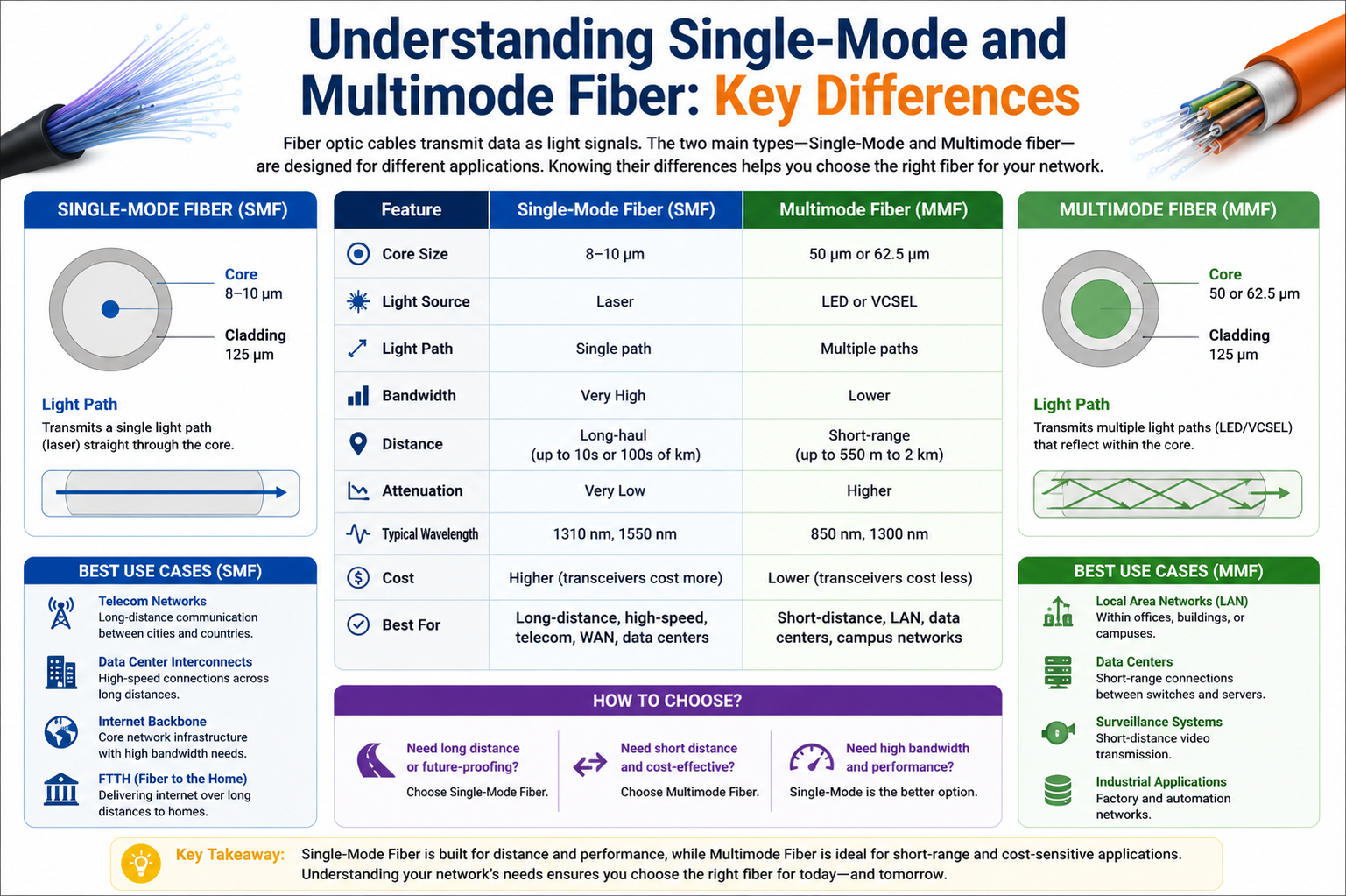
In today’s data-centric environment, selecting the right fiber optic technology plays a major role in determining how efficiently a network performs. Modern communication systems depend heavily on high-speed data transfer, and fiber optics has become the backbone of both short-range and long-range connectivity. Among the available options, single mode and multimode fiber stand out as the two primary solutions, each designed for specific use cases and performance requirements. Understanding how they differ is essential for designing reliable and scalable network infrastructures.
Fiber optic technology works by transmitting data using light signals instead of electrical impulses. This allows data to travel at extremely high speeds with minimal loss, making it ideal for everything from local office networks to global communication systems. However, the way light travels through the fiber core differs significantly between single mode and multimode types, which directly impacts their performance, cost, and application areas.
At a fundamental level, the distinction between these two fiber types lies in the structure of the core and the behavior of light within it. Single mode fiber allows only one path of light to travel through its core, while multimode fiber supports multiple light paths simultaneously. This difference may seem simple, but it has profound implications on distance capability, bandwidth efficiency, installation complexity, and overall cost.
Understanding Single Mode Fiber in Network Communication
Single mode fiber is designed to carry light directly down the fiber without allowing it to bounce or scatter across multiple paths. This creates a highly focused transmission method that minimizes signal distortion over long distances. Because the light travels in a single path, the data remains clear and stable even when transmitted across extremely long spans.
The core structure of single mode fiber is extremely small, allowing only one light mode to pass through at a time. This small core design is intentional, as it eliminates modal dispersion, which is a common issue in fiber systems where multiple light paths interfere with each other. By removing this interference, single mode fiber achieves a much cleaner and more stable signal transmission.
Another important aspect of single mode fiber is the type of light source it uses. Instead of simple light-emitting diodes, it relies on highly focused laser-based sources. These lasers produce a narrow and consistent wavelength of light, which helps maintain signal integrity over long distances. Because the light remains coherent and does not scatter, it can travel far greater distances compared to other transmission methods without requiring frequent signal boosting or regeneration.
This makes single mode fiber particularly valuable in environments where long-distance communication is required. It is commonly used in large-scale communication networks that span cities, countries, and even continents. It also forms the foundation of global internet infrastructure, where reliability and distance coverage are critical.
Despite its advanced capabilities, single mode fiber is more complex and costly to implement. The precision required for alignment and installation is significantly higher, and the supporting equipment tends to be more expensive. However, these costs are justified in scenarios where performance, distance, and stability are top priorities.
Core Structure and Transmission Behavior of Single Mode Fiber
The physical structure of single mode fiber is one of its defining characteristics. Its core is extremely thin compared to other fiber types, allowing only a single light path to pass through. This narrow structure ensures that the light signal does not reflect off the internal walls of the fiber in multiple directions, which helps maintain signal clarity.
Because there is only one transmission path, there is virtually no modal distortion. This is one of the key reasons why single mode fiber is capable of supporting high-speed communication over long distances. The signal does not degrade as quickly, and the need for repeaters or signal boosters is significantly reduced.
The behavior of light in single mode fiber is also highly controlled. Since it uses a laser-based light source, the signal remains tightly focused. This controlled transmission reduces interference and allows the fiber to maintain a consistent performance level even in demanding network environments.
Another advantage of this structure is its ability to support high bandwidth applications. Since the signal remains stable, more data can be transmitted at higher speeds without the risk of congestion or degradation. This makes single mode fiber ideal for high-performance applications such as large-scale data centers, backbone networks, and long-distance communication systems.
Advantages of Single Mode Fiber in Modern Networks
Single mode fiber offers several significant advantages that make it the preferred choice for long-distance and high-performance networking. One of its most important benefits is its exceptional transmission range. It can carry data across extremely long distances without requiring frequent signal regeneration. This makes it highly efficient for wide-area networks and intercity connections.
Another major advantage is its high bandwidth capacity. Single mode fiber supports extremely fast data transfer rates, making it suitable for modern applications that demand large volumes of data transmission. Activities such as video streaming, cloud computing, and real-time communication systems benefit greatly from this high-speed capability.
Signal quality is another area where single mode fiber excels. Because it eliminates modal dispersion, the signal remains clear and stable even over long distances. This reduces errors, improves reliability, and ensures consistent performance across the entire network.
Single mode fiber is also highly future-ready. As data demands continue to increase, its ability to handle higher speeds and larger capacities makes it a long-term solution for evolving network infrastructures. It is widely used in critical communication systems where performance cannot be compromised.
Additionally, it provides excellent resistance to signal degradation. Even in environments where long cable runs are required, the signal maintains its integrity without significant loss. This makes it ideal for applications where reliability is more important than installation simplicity or cost.
Limitations and Challenges of Single Mode Fiber
While single mode fiber offers outstanding performance, it also comes with certain limitations that must be considered. The most notable drawback is the cost associated with both installation and equipment. The lasers, transceivers, and precision components required for single mode systems are more expensive compared to multimode alternatives.
Installation complexity is another challenge. Because the fiber core is extremely small, precise alignment is necessary during installation. Even minor misalignments can affect performance, which means skilled technicians and specialized tools are required. This increases both installation time and labor costs.
The fiber itself also requires careful handling. Single mode fiber has stricter bend radius limitations, meaning it cannot be bent sharply without risking damage or performance loss. This adds another layer of complexity during installation in confined or complex environments.
Despite these challenges, single mode fiber remains the preferred choice for large-scale, high-performance networks where long-distance transmission and stability are critical requirements. Its limitations are often outweighed by its unmatched performance capabilities in such scenarios.
Understanding Multimode Fiber and Its Role in Networking
Multimode fiber operates differently from single mode fiber by allowing multiple light paths to travel through its core simultaneously. This design enables it to carry multiple signals at once, making it highly efficient for short to medium-distance communication.
The core of multimode fiber is significantly larger, which allows light to enter at different angles and follow different paths as it travels through the fiber. This creates a more flexible transmission environment but also introduces a higher level of signal dispersion over longer distances.
Unlike single mode fiber, multimode fiber typically uses LED-based light sources instead of lasers. These light sources are less focused and more cost-effective, making multimode fiber easier and cheaper to deploy in local network environments.
Because of its design, multimode fiber is primarily used in local area networks where high-speed communication is required over shorter distances. It is widely used in office buildings, campuses, and data centers where cost efficiency and ease of installation are important considerations.
Its ability to support multiple light paths simultaneously allows it to handle high data loads effectively within limited distances. However, as distance increases, signal quality begins to degrade due to modal dispersion, which limits its range compared to single mode fiber.
Structural Characteristics and Light Transmission in Multimode Fiber
The larger core size of multimode fiber allows multiple light signals to travel through it at once. These signals reflect off the internal walls of the fiber at different angles, creating multiple propagation paths. While this increases capacity for short-range communication, it also introduces potential signal overlap and distortion over longer distances.
This behavior of light within the fiber is known as modal dispersion. As different light paths travel at slightly different speeds, they can arrive at the destination at different times, causing signal overlap and reduced clarity. This is the primary reason why multimode fiber is not suitable for long-distance communication.
However, within controlled distances, multimode fiber performs extremely well. It can deliver high bandwidth and fast data transfer rates, making it ideal for internal network systems where cables do not need to extend over large geographical areas.
The use of LED light sources further contributes to its cost-effectiveness. These light sources are easier to implement and maintain, reducing overall infrastructure expenses. This makes multimode fiber a practical choice for organizations looking to balance performance and budget constraints
Single Mode vs Multimode Fiber: Performance and Distance Differences
One of the most important ways to understand the difference between single mode and multimode fiber is to focus on how each performs over distance. In practical networking environments, distance is often the deciding factor when choosing between these two technologies. While both are capable of transmitting data using light, their performance characteristics vary significantly depending on how far the signal needs to travel and how clean that signal must remain.
Single mode fiber is specifically engineered for long-distance communication. Because it allows only a single light path to travel through its core, the signal experiences very little interference or distortion. This means the data can travel extremely long distances without losing clarity. In real-world networking, this makes single mode fiber ideal for connecting cities, regions, and even countries through high-speed backbone infrastructure.
In contrast, multimode fiber is optimized for shorter distances. Since it supports multiple light paths at the same time, the signals tend to spread and reflect inside the core. Over short distances, this does not create a major issue, but as the cable length increases, the overlapping signals begin to interfere with each other. This interference leads to signal degradation, limiting how far multimode fiber can reliably transmit data.
Because of this difference, single mode fiber is often used in wide-area networks where distance is a primary challenge, while multimode fiber is commonly used in local area networks where devices are located relatively close to each other. The distance limitation is not just a minor difference; it fundamentally defines where each technology is most effective.
Bandwidth Capabilities and Data Transmission Efficiency
Bandwidth is another major factor that distinguishes single mode and multimode fiber. Bandwidth refers to the amount of data that can be transmitted over a network connection in a given period of time. In modern networking environments, higher bandwidth is essential for supporting applications such as cloud computing, video conferencing, virtualization, and large-scale data processing.
Single mode fiber offers extremely high bandwidth capacity because its signal remains stable and focused over long distances. Since only one light path is used, there is no internal interference between multiple signals. This allows data to be transmitted at very high speeds with minimal loss, even across long cable runs. The efficiency of this transmission makes single mode fiber highly suitable for backbone networks and high-performance data systems.
Multimode fiber also provides strong bandwidth performance, but its effectiveness is limited by distance. Within short-range environments, multimode fiber can support very high data rates, making it suitable for internal networking systems such as office buildings or data centers. However, as the distance increases, modal dispersion begins to reduce the effective bandwidth, lowering overall performance.
The relationship between bandwidth and distance is much more favorable in single mode fiber because the signal remains consistent regardless of how far it travels. In multimode fiber, however, bandwidth decreases as distance increases due to the interaction of multiple light paths within the core.
This difference makes single mode fiber the preferred choice for environments where both long distance and high bandwidth are required simultaneously. On the other hand, multimode fiber remains a practical and cost-efficient solution for environments where distance is limited but high-speed data transfer is still necessary.
Signal Quality, Loss, and Interference Behavior
Signal quality is a critical factor in any communication system, and fiber optic technology is no exception. In networking terms, signal quality refers to how accurately the transmitted data arrives at its destination without distortion or loss.
Single mode fiber maintains extremely high signal quality because it eliminates the possibility of multiple light paths interfering with each other. Since the light travels in a straight and focused path, the signal remains stable throughout its journey. This reduces the need for frequent signal boosting and ensures consistent performance even in large-scale network environments.
Another advantage of single mode fiber is its low attenuation. Attenuation refers to the gradual loss of signal strength as it travels through the fiber. In single mode systems, this loss is minimal, allowing data to travel long distances without significant degradation.
Multimode fiber, on the other hand, experiences higher levels of signal loss due to modal dispersion. As multiple light paths travel through the fiber, they bounce and reflect at different angles. This causes the signals to spread out over time, leading to reduced clarity and increased interference. Over longer distances, this effect becomes more pronounced, resulting in lower signal quality.
Because of this behavior, multimode fiber is generally restricted to shorter network segments where signal loss does not have enough time to significantly impact performance. Within these shorter ranges, it still provides reliable and efficient communication, but its limitations become clear as distance increases.
Installation Requirements and Practical Deployment Differences
The installation process for single mode and multimode fiber differs significantly due to their structural and operational characteristics. Single mode fiber requires a high level of precision during installation because of its extremely small core size. Even slight misalignment can affect signal transmission, which means specialized tools and trained technicians are essential.
In addition, single mode fiber often requires more careful planning during installation. The tight bend radius limitations mean that cables cannot be sharply bent or improperly routed. This requires more structured cable management systems and careful routing design to avoid performance issues.
Multimode fiber is generally much easier to install. Its larger core size makes alignment less critical, and it is more forgiving during handling and deployment. This reduces installation time and complexity, making it more suitable for environments where rapid deployment is required.
Because of its flexibility and ease of use, multimode fiber is often preferred in enterprise environments such as office buildings, universities, and internal data centers. These environments benefit from quick installation and lower setup costs, even if the network is limited to shorter distances.
Single mode fiber, while more complex to install, offers long-term advantages in scalability and performance. Once properly installed, it requires less maintenance and supports significantly higher performance levels over time.
Cost Factors and Economic Considerations in Fiber Selection
Cost plays a major role in deciding between single mode and multimode fiber, especially for large-scale network deployments. Single mode fiber is generally more expensive due to the advanced technology required for both transmission and reception of light signals. The lasers used in single mode systems are more precise and costly than the LED-based systems used in multimode fiber.
In addition to equipment costs, installation expenses for single mode fiber are also higher. The need for skilled technicians, precise alignment, and specialized tools contributes to increased labor costs. The infrastructure requirements can also be more complex, adding to the overall investment.
Multimode fiber is significantly more cost-effective in comparison. The use of simpler light sources and less stringent installation requirements makes it a more budget-friendly option. This is one of the main reasons why multimode fiber is widely used in local area networks and internal communication systems.
However, cost should always be evaluated alongside performance requirements. While multimode fiber may be cheaper initially, it may not be suitable for long-distance or high-capacity networks. In such cases, the higher investment in single mode fiber can provide better long-term value and scalability.
Environmental and Network Design Considerations
When designing a network, environmental factors also play an important role in choosing between single mode and multimode fiber. Physical distance between network points, building structure, and future scalability requirements must all be considered.
Single mode fiber is ideal for environments where infrastructure spans large geographical areas. It performs well in outdoor environments, underground installations, and inter-building connections. Its ability to maintain signal integrity over long distances makes it highly suitable for backbone networks.
Multimode fiber is better suited for controlled indoor environments where network devices are located in close proximity. It is commonly used in structured cabling systems within buildings, where distances are predictable and limited.
Network scalability is another important consideration. Single mode fiber provides greater flexibility for future expansion because it supports higher speeds and longer distances. Multimode fiber, while efficient in current deployments, may face limitations as network demands increase over time.
Light Source Technology and Transmission Behavior Differences
The type of light source used in fiber optics plays a crucial role in determining how data is transmitted. Single mode fiber uses laser-based light sources, which produce highly focused and coherent beams. This allows the signal to remain tight and controlled as it travels through the fiber core.
Multimode fiber uses LED-based light sources, which are less focused and more diffuse. This allows multiple light rays to enter the fiber at different angles, supporting multiple transmission paths simultaneously. While this increases flexibility, it also introduces more potential for signal dispersion.
The difference in light source technology directly impacts performance, cost, and application suitability. Laser-based systems offer higher precision and longer distance capabilities, while LED-based systems provide cost efficiency and ease of deployment.
Single Mode vs Multimode Fiber: Real-World Network Applications
Understanding the practical applications of single mode and multimode fiber is essential to fully grasp why both technologies exist in modern networking. Each type is designed to solve specific communication challenges, and their real-world usage reflects their strengths and limitations.
Single mode fiber is widely used in large-scale communication systems where long-distance data transmission is required. It forms the backbone of global communication networks, connecting cities, countries, and continents through high-capacity fiber routes. Because it can transmit data over extremely long distances with minimal signal loss, it is the preferred choice for telecom providers and internet infrastructure operators.
In metropolitan area networks, single mode fiber connects different data centers spread across a city. These connections require stable, high-speed communication over kilometers of distance, which multimode fiber cannot reliably support. Single mode fiber ensures that data transfer remains fast and consistent even when the physical distance between endpoints is significant.
It is also heavily used in undersea communication cables, where signals must travel across oceans. In these environments, reliability and signal integrity are critical, and single mode fiber provides the necessary performance to maintain uninterrupted global communication.
Multimode fiber, in contrast, is primarily used in localized environments where devices are relatively close together. It is commonly deployed in enterprise networks, office buildings, campuses, and data centers. In these environments, the distance between network devices is typically limited to a few hundred meters, making multimode fiber a practical and cost-efficient solution.
Within data centers, multimode fiber is used to connect servers, switches, and storage systems. These internal connections require high bandwidth but do not require long-distance transmission, making multimode fiber an ideal fit. Its ability to support high data rates over short distances ensures smooth internal communication between critical systems.
In campus networks, such as universities or corporate campuses, multimode fiber is often used to connect multiple buildings. Each building may have its own local network, and multimode fiber handles the communication between them efficiently as long as distances remain within its operational limits.
Network Architecture and Design Considerations
When designing a fiber optic network, engineers must carefully evaluate the architecture to determine whether single mode or multimode fiber is more appropriate. This decision is not based solely on performance but also on physical layout, scalability requirements, and long-term network goals.
Single mode fiber is best suited for hierarchical network architectures where core, distribution, and access layers are spread over large distances. In such designs, the core network often spans multiple locations, requiring high-capacity links that can maintain performance across long distances. Single mode fiber ensures that the backbone remains stable and scalable as the network grows.
In contrast, multimode fiber is typically used in flat or localized network architectures. In these designs, most devices are located within a confined physical space, such as a single building or a small campus. The shorter distances allow multimode fiber to deliver high performance without the need for long-range transmission capabilities.
Scalability is another key design factor. Single mode fiber offers greater long-term scalability because it supports higher bandwidth upgrades without requiring changes to the physical fiber infrastructure. This makes it a preferred choice for organizations planning future expansion.
Multimode fiber, while effective in current deployments, may require upgrades or replacement if network demands grow beyond its distance or bandwidth limitations. This makes it more suitable for environments where future expansion is limited or predictable.
Performance Behavior Under Load Conditions
Network performance under heavy data loads is another important area where single mode and multimode fiber differ significantly. As network traffic increases, the ability to maintain stable transmission becomes critical.
Single mode fiber handles high traffic loads extremely well due to its single-path transmission design. Since there is no interference between multiple light signals, data congestion is minimized. This allows for consistent performance even during peak usage periods, making it ideal for mission-critical systems and high-demand applications.
In large enterprise environments or service provider networks, traffic loads can fluctuate significantly. Single mode fiber ensures that performance remains stable even when large volumes of data are transmitted simultaneously across the network.
Multimode fiber also performs well under moderate traffic conditions, especially in localized environments. Within short distances, it can support high data rates without significant performance issues. However, as traffic increases and distances grow, the effects of modal dispersion become more noticeable.
This can lead to reduced signal clarity and potential data retransmissions, which may affect overall network efficiency. While multimode fiber is suitable for most internal applications, it is less capable of handling extremely high or unpredictable traffic loads over extended distances.
Latency and Transmission Speed Differences
Latency refers to the time it takes for data to travel from one point to another in a network. In modern applications such as cloud computing, online gaming, and real-time communication, low latency is a critical requirement.
Single mode fiber offers extremely low latency because it provides a direct and focused transmission path. Since the light signal does not bounce or scatter within the core, data can travel more efficiently and with fewer delays. This makes it highly suitable for applications where speed and responsiveness are essential.
In financial systems, for example, where transactions must be processed in milliseconds, single mode fiber is often used to ensure minimal delay between data centers. Similarly, in global communication networks, low latency helps maintain smooth and uninterrupted service.
Multimode fiber has slightly higher latency compared to single mode fiber due to the presence of multiple light paths. As signals travel through different routes within the fiber core, slight timing differences can occur. While this does not significantly impact most local network applications, it can become more noticeable in high-performance environments.
For typical office or campus networks, the latency differences are usually negligible. However, in high-frequency trading systems or real-time global communications, single mode fiber provides a clear advantage.
Scalability and Future Network Growth
Scalability is one of the most important factors in modern network planning. As data consumption continues to grow, networks must be able to adapt without requiring complete infrastructure replacement.
Single mode fiber is highly scalable because it supports future increases in bandwidth without needing physical changes to the fiber itself. Upgrading network performance often involves changing transceivers or network equipment rather than replacing the fiber cables. This makes it a long-term investment for organizations expecting significant growth.
Multimode fiber has more limited scalability due to its physical and optical characteristics. While it can support high speeds within short distances, its performance limitations become more pronounced as network demands increase. Eventually, organizations may need to transition to single mode fiber if long-term scalability is required.
Despite this limitation, multimode fiber remains a strong choice for stable, short-range networks where future growth is limited or predictable. Its lower cost and ease of deployment make it highly practical for current needs, even if long-term scalability is reduced.
Maintenance Requirements and Operational Stability
Maintenance is another important consideration when comparing fiber optic technologies. Single mode fiber generally requires less frequent maintenance once properly installed. Because it experiences lower signal degradation, there is less need for regular signal correction or troubleshooting.
However, when maintenance is required, it can be more complex due to the precision involved in single mode systems. Specialized equipment and trained technicians are often needed to diagnose and resolve issues.
Multimode fiber is easier to maintain in localized environments. Its simpler structure and shorter cable runs make troubleshooting more straightforward. However, over time, performance issues such as signal degradation may require adjustments or upgrades, especially in high-demand environments.
In general, both systems offer strong operational stability when used within their intended applications. The key difference lies in the complexity and frequency of maintenance required.
Compatibility with Networking Equipment
Compatibility with networking hardware is another factor that influences fiber selection. Single mode fiber requires laser-based transceivers that are designed for long-distance, high-precision communication. These components tend to be more expensive but offer superior performance.
Multimode fiber uses LED-based or short-range laser transceivers, which are more affordable and widely available. This makes multimode systems easier to deploy in standard enterprise environments without significant investment in specialized hardware.
The choice of equipment must always align with the type of fiber being used. Mixing incompatible components can lead to poor performance or complete communication failure. Therefore, proper planning is essential when designing fiber optic networks.
Single Mode vs Multimode Fiber: Security Considerations in Network Design
Security is a critical aspect of any modern network infrastructure, and fiber optic technology plays an important role in protecting data transmission. When comparing single mode and multimode fiber, differences in signal behavior and transmission structure directly influence how secure each system can be in real-world environments.
Single mode fiber offers a higher level of security due to the nature of its transmission method. Since it carries only one light path through a very narrow core, it is significantly more difficult to tap or intercept without detection. Any attempt to physically access the fiber or disturb the signal is more likely to cause noticeable disruption, which makes unauthorized interception easier to detect.
In high-security environments such as government networks, financial institutions, and critical infrastructure systems, this characteristic is extremely valuable. The reduced risk of signal leakage and interference makes single mode fiber a preferred choice where data confidentiality is a top priority.
Multimode fiber, while still secure in many practical applications, is slightly more vulnerable in comparison. Because it carries multiple light paths simultaneously, signal behavior is more complex within the core. Although physical tapping is still difficult, the nature of multiple light reflections makes it somewhat easier for signal disturbances to go unnoticed in certain scenarios.
However, it is important to note that both fiber types are significantly more secure than traditional copper-based communication systems. The primary difference lies in the level of resistance to sophisticated interception attempts and signal integrity monitoring.
Cost vs Performance Trade-Off in Fiber Selection
One of the most important decision-making factors in choosing between single mode and multimode fiber is the balance between cost and performance. Every network design involves trade-offs, and fiber optics is no exception.
Single mode fiber delivers superior performance in terms of distance, bandwidth, and scalability, but it comes at a higher initial cost. The equipment required for transmission and reception, including laser-based transceivers, is more expensive. Installation also requires specialized skills, which increases labor costs.
However, this higher investment often pays off in long-term efficiency. Once installed, single mode fiber supports future upgrades without requiring major infrastructure changes. This makes it cost-effective in large-scale or evolving network environments where long-term growth is expected.
Multimode fiber is much more cost-efficient in the short term. The hardware is less expensive, installation is simpler, and maintenance costs are generally lower. This makes it highly attractive for organizations with limited budgets or for networks that do not require long-distance communication.
The trade-off, however, is limited scalability. As network demands grow, multimode fiber may require replacement or supplementation with single mode infrastructure. This can lead to additional costs over time if initial planning does not account for future expansion.
Deployment Strategy in Enterprise and Data Center Environments
In enterprise environments, fiber selection is often based on a layered deployment strategy. Different parts of the network may use different types of fiber depending on their role within the overall architecture.
Single mode fiber is typically used in the backbone layer, where long-distance and high-capacity communication is required. This includes connections between buildings, data centers, or geographically separated network hubs. Its ability to maintain signal quality over long distances ensures stable core connectivity.
Within data centers and internal network zones, multimode fiber is commonly used for shorter connections between servers, switches, and storage systems. These environments prioritize high-speed communication over short distances, making multimode fiber a practical and efficient solution.
This hybrid approach allows organizations to optimize both cost and performance by using each fiber type where it performs best. It ensures that high-performance requirements are met without unnecessarily increasing infrastructure costs.
In smaller enterprise networks, multimode fiber alone may be sufficient for all internal communication needs. In larger or more complex systems, a combination of both fiber types is often implemented to achieve optimal performance.
Signal Integrity and Long-Term Reliability
Signal integrity is a key measure of how accurately data is transmitted and received over a network. Over time, maintaining strong signal integrity becomes essential for ensuring consistent network performance.
Single mode fiber excels in maintaining signal integrity over long distances. Because it eliminates modal dispersion and uses a single light path, the signal remains clean and stable throughout transmission. This reduces errors, retransmissions, and performance degradation.
This long-term reliability makes single mode fiber highly suitable for critical systems that require continuous uptime and consistent performance. Even in demanding environments, it maintains stable communication without frequent intervention.
Multimode fiber provides strong signal integrity within its operational range, but performance gradually decreases as distance increases. The presence of multiple light paths creates the possibility of signal overlap, which can reduce clarity and introduce minor distortions.
Within controlled environments such as office networks or data centers, this does not typically create major issues. However, for extended distances or high-load systems, signal integrity can become a limiting factor.
Technological Evolution and Future-Proofing Considerations
As networking technology continues to evolve, future-proofing has become an important consideration in infrastructure design. Organizations must choose technologies that can support increasing data demands over time without requiring complete system replacement.
Single mode fiber is widely regarded as the more future-proof option. Its ability to support extremely high bandwidth and long-distance communication makes it suitable for future network expansions and emerging technologies. As data consumption continues to grow, single mode fiber is expected to remain relevant for decades.
It also supports advanced transmission technologies that can further increase data capacity without changing the physical fiber infrastructure. This makes it a strong long-term investment for organizations planning large-scale digital transformation.
Multimode fiber, while highly effective in current applications, has more limited future scalability. Its performance constraints over distance and bandwidth may eventually require migration to single mode fiber in high-demand environments.
However, for stable and localized networks, multimode fiber will continue to play an important role due to its cost efficiency and ease of deployment. It remains a practical solution for many existing infrastructure designs.
Decision-Making Framework for Choosing Fiber Types
Choosing between single mode and multimode fiber requires careful evaluation of multiple factors. There is no universal solution, as the best choice depends on specific network requirements.
Distance is often the first and most important factor. If communication must occur over long distances, single mode fiber is the clear choice. If the network is confined to a limited physical area, multimode fiber may be more practical.
Bandwidth requirements also play a major role. High-performance systems that require large data throughput over time benefit from single mode fiber. Short-range systems with moderate to high bandwidth needs can effectively use multimode fiber.
Budget constraints influence many decisions as well. Multimode fiber offers a lower initial investment, making it attractive for cost-sensitive projects. Single mode fiber requires a higher upfront cost but provides better long-term value in large-scale networks.
Scalability requirements must also be considered. Networks expected to grow significantly over time are better suited to single mode fiber, while stable and fixed networks can effectively rely on multimode fiber.
Final Technical Comparison Perspective
From a technical perspective, single mode and multimode fiber represent two distinct approaches to optical communication. Single mode fiber focuses on precision, long-distance efficiency, and high scalability, while multimode fiber emphasizes simplicity, cost-effectiveness, and short-range performance.
Single mode fiber delivers superior performance in nearly all technical categories except cost and installation complexity. It is the preferred choice for backbone networks, intercity connections, and high-capacity systems.
Multimode fiber remains a strong solution for internal networking environments where distance is limited and cost efficiency is important. It continues to play a major role in enterprise networks and data center architectures.
Both technologies are essential to modern networking infrastructure, and each serves a specific purpose within the broader communication ecosystem. Their differences are not about superiority in absolute terms but about suitability for different networking scenarios.
Conclusion
The comparison between single mode and multimode fiber highlights how network design depends heavily on balancing performance, cost, distance, and scalability. Single mode fiber stands out for its ability to deliver high-speed, long-distance communication with excellent signal integrity, making it ideal for global and backbone networks. Multimode fiber, on the other hand, provides a cost-effective and efficient solution for short-range communication, particularly within enterprise and data center environments.
Understanding these differences allows network designers and engineers to make informed decisions based on real operational requirements rather than assumptions. Both fiber types remain essential components of modern communication systems, and their appropriate use ensures that networks remain efficient, scalable, and reliable.