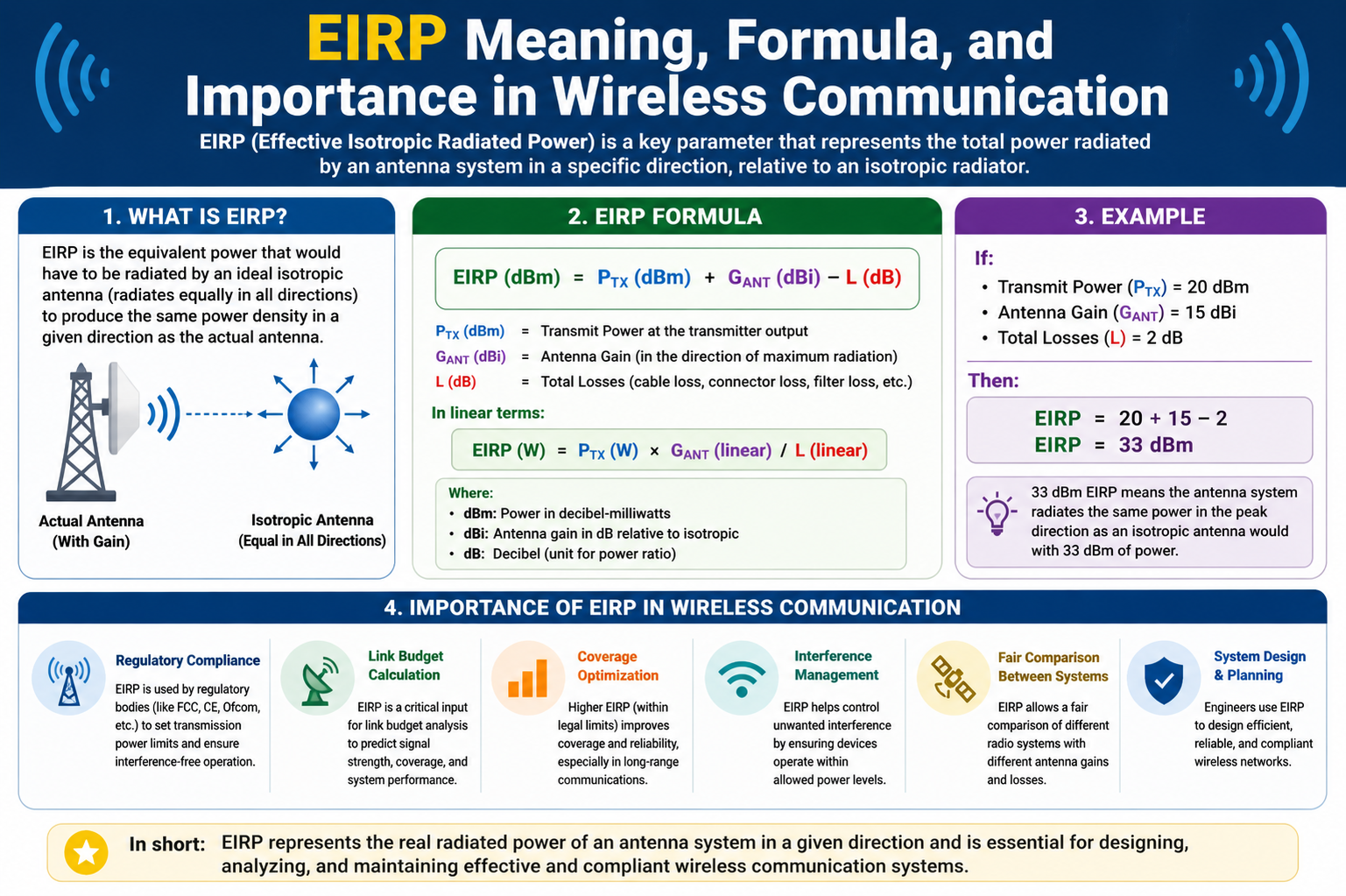
Effective Isotropic Radiated Power, commonly referred to as EIRP, is a fundamental concept in wireless communication that defines how much power an antenna effectively radiates in a specific direction. Rather than simply measuring the raw output of a transmitter, EIRP provides a more realistic view of signal strength by combining multiple factors that influence how energy is actually distributed into the environment. This makes it a far more practical metric when designing, analyzing, or optimizing wireless systems. In real-world networking scenarios, signals are not transmitted equally in all directions, and this is where EIRP becomes essential. It helps engineers and network professionals understand how much usable signal is being delivered toward a target receiver, ensuring that communication remains strong, stable, and efficient across distances.
Core Concept Behind EIRP
At its core, EIRP represents a comparison between a real antenna and an idealized isotropic antenna, which is a theoretical construct that radiates power uniformly in all directions. Since such an antenna does not exist in reality, it serves as a reference point for measuring how directional and efficient a real antenna system is. EIRP essentially answers a simple but important question: if an isotropic antenna were used instead, how much power would it need to radiate to achieve the same signal strength in a given direction as the actual antenna system? By framing the measurement this way, EIRP allows for consistent comparisons across different devices, antennas, and network configurations. This standardization is especially useful in environments where multiple wireless systems operate simultaneously and must coexist without causing excessive interference.
How EIRP Reflects Real Signal Strength
Unlike basic transmitter power, which only tells part of the story, EIRP incorporates the combined effects of antenna gain and system losses. This makes it a much more accurate indicator of the signal that actually reaches a receiver. For example, a transmitter may output a certain level of power, but if the antenna is highly directional, it can concentrate that power into a focused beam, effectively increasing the signal strength in that direction. On the other hand, losses in cables, connectors, or other components can reduce the overall power before it even reaches the antenna. EIRP captures all of these elements in a single value, giving a clear picture of the true radiated power. This is why it is widely used in wireless networking, satellite communication, and radio frequency engineering as a key performance metric.
Mathematical Representation of EIRP
EIRP is typically calculated using a straightforward formula that combines transmitter power, antenna gain, and system losses. The relationship can be expressed as:
EIRP = Transmitter Power − Losses + Antenna Gain
In this equation, transmitter power is usually measured in decibels relative to one milliwatt, antenna gain is expressed in decibels relative to an isotropic radiator, and losses are measured in decibels as well. The use of decibel units allows these values to be easily added and subtracted, simplifying calculations. Although the formula itself appears simple, each component requires careful consideration and accurate measurement. Even small errors in estimating losses or gain can lead to significant differences in the final EIRP value, which in turn can affect network performance and compliance with regulations.
Transmitter Power and Its Role
Transmitter power is the starting point for any EIRP calculation. It represents the amount of energy generated by the transmitting device before any modifications or losses occur. Higher transmitter power generally leads to a stronger signal, but it is not the only factor that determines how far or effectively the signal travels. In many cases, simply increasing transmitter power is not the best solution, as it can lead to interference with other devices and may violate regulatory limits. Instead, transmitter power must be balanced with other elements such as antenna design and placement. Understanding how transmitter power contributes to EIRP helps in making informed decisions about system configuration and performance optimization.
Antenna Gain and Directionality
Antenna gain is one of the most influential factors in determining EIRP. It describes how effectively an antenna focuses energy in a particular direction compared to an isotropic antenna. High-gain antennas do not increase the total power generated by the transmitter; instead, they concentrate that power into a narrower beam, resulting in stronger signals in specific directions. This is particularly useful in point-to-point communication systems, where signals need to travel long distances between two fixed locations. However, increased gain often comes at the cost of reduced coverage area, as the signal becomes more directional. This trade-off must be carefully managed to ensure that the network meets its coverage and performance requirements.
Impact of System Losses
System losses refer to any reduction in signal power that occurs as energy travels from the transmitter to the antenna. These losses can arise from various sources, including cables, connectors, and environmental factors. For instance, longer cables typically introduce more attenuation, reducing the amount of power that reaches the antenna. Similarly, poor-quality connectors or improper installations can lead to additional losses. While these factors may seem minor individually, their combined effect can significantly lower the overall EIRP. Minimizing system losses is therefore a critical aspect of network design, as it ensures that as much of the transmitted power as possible is effectively radiated into the environment.
Regulatory Considerations and Limits
EIRP is not just a technical measurement; it also plays a crucial role in regulatory compliance. Governments and regulatory bodies impose limits on EIRP to prevent interference between different wireless systems and to ensure fair use of the radio frequency spectrum. These limits vary depending on the frequency band, application, and geographic region. Exceeding the അനുവദable EIRP can lead to penalties, equipment confiscation, or network shutdowns. As a result, network designers must carefully calculate and monitor EIRP to ensure that their systems operate within legal boundaries. This often involves adjusting transmitter power, selecting appropriate antennas, and accounting for all potential losses in the system.
EIRP in Wireless Network Design
In wireless networking, EIRP serves as a key parameter for planning and optimizing coverage. By understanding how much power is effectively radiated in different directions, engineers can determine the placement of access points, select suitable antennas, and configure system settings to achieve the desired performance. For example, in a large office or campus environment, achieving consistent coverage requires careful balancing of EIRP across multiple access points. Too little EIRP may result in weak signals and dead zones, while too much can cause interference and reduced network efficiency. Properly managing EIRP ensures that users experience reliable connectivity and consistent performance throughout the network.
Relationship Between EIRP and Signal Coverage
Signal coverage is directly influenced by EIRP, as higher values generally allow signals to travel farther and penetrate obstacles more effectively. However, coverage is not solely determined by EIRP; environmental factors such as walls, buildings, and interference from other devices also play a significant role. Understanding the relationship between EIRP and coverage helps in predicting how signals will behave in different environments. For instance, in open outdoor areas, higher EIRP can extend coverage over long distances, while in indoor environments, obstacles may limit the effectiveness of increased power. This highlights the importance of considering both EIRP and environmental conditions when designing wireless systems.
EIRP and Interference Management
While increasing EIRP can improve signal strength and coverage, it can also lead to interference with other wireless systems operating in the same frequency band. Interference can degrade network performance, reduce data throughput, and cause connectivity issues. Managing EIRP is therefore essential for minimizing interference and ensuring efficient use of the spectrum. This often involves carefully selecting transmission channels, adjusting power levels, and using directional antennas to limit the spread of signals to unintended areas. By controlling EIRP, network designers can create systems that coexist harmoniously with other devices and networks, maintaining overall performance and reliability.
Practical Applications of EIRP
EIRP is used in a wide range of applications beyond traditional wireless networking. In satellite communication, it helps determine how much power is required to transmit signals over vast distances to orbiting satellites. In broadcasting, it ensures that radio and television signals reach their intended audiences without causing interference to other services. In point-to-point communication systems, EIRP plays a critical role in achieving reliable long-distance links. Each of these applications relies on accurate EIRP calculations to ensure that signals are transmitted effectively and efficiently, highlighting its importance across various fields of communication technology.
Challenges in Measuring and Managing EIRP
Accurately measuring and managing EIRP can be challenging, particularly in complex systems with multiple components and varying environmental conditions. Factors such as temperature, humidity, and physical obstructions can affect signal propagation and introduce variability in measurements. Additionally, estimating losses and antenna gain requires precise data and careful analysis. Despite these challenges, modern tools and techniques have made it easier to calculate and monitor EIRP, enabling more accurate and reliable network design. Continuous monitoring and adjustment are often necessary to maintain optimal performance, especially in dynamic environments where conditions can change over time.
Deeper Insight into EIRP Behavior in Real Environments
Effective Isotropic Radiated Power becomes far more meaningful when observed in real-world environments rather than theoretical setups. In practical scenarios, wireless signals rarely travel in a straight, unobstructed path. Instead, they interact with objects, surfaces, and atmospheric conditions that continuously alter their strength and direction. EIRP helps translate these complex interactions into a measurable value that reflects how much useful power is actually being delivered toward a receiver. This makes it an essential metric not just for planning but also for evaluating how a network performs under realistic conditions. By understanding how EIRP behaves in different environments, network professionals can better predict signal propagation and make informed adjustments to improve reliability and efficiency.
Signal Propagation and Environmental Influence
Signal propagation refers to how radio waves travel through space, and it is heavily influenced by environmental factors. Objects such as walls, buildings, trees, and even people can absorb, reflect, or scatter signals, causing variations in signal strength. EIRP does not eliminate these challenges, but it provides a baseline for understanding how much power is initially directed toward a given path. When signals encounter obstacles, their effective strength decreases, which may lead to reduced performance or connectivity issues. In indoor environments, materials like concrete and metal can significantly attenuate signals, while in outdoor settings, weather conditions and terrain can play a major role. By considering EIRP alongside environmental characteristics, network designers can better anticipate potential issues and implement strategies to mitigate them.
Role of Frequency in EIRP Effectiveness
Frequency plays a critical role in how EIRP translates into actual coverage and performance. Higher frequency signals tend to have shorter wavelengths, which can limit their ability to penetrate obstacles but allow for higher data rates. Lower frequency signals, on the other hand, can travel longer distances and penetrate materials more effectively, but may offer lower bandwidth. EIRP must be evaluated in the context of the operating frequency to fully understand its impact. For example, a high EIRP value at a higher frequency may still struggle to provide consistent coverage in a dense indoor environment, while a lower frequency signal with moderate EIRP might perform better. This interplay between frequency and EIRP is a key consideration in wireless system design and optimization.
Directional vs Omnidirectional Transmission
One of the most important aspects of EIRP is how it reflects the directional characteristics of an antenna. Omnidirectional antennas distribute power relatively evenly in all directions, providing broad coverage but limited range in any specific direction. Directional antennas, on the other hand, focus energy into a concentrated beam, resulting in higher EIRP in the მიმართულ of transmission. This makes them ideal for long-distance communication or targeted coverage areas. The choice between directional and omnidirectional antennas depends on the specific requirements of the network. In many cases, a combination of both types is used to achieve a balance between coverage and performance. Understanding how EIRP changes with antenna type is essential for designing efficient and effective wireless systems.
Balancing Power and Efficiency
While it might seem intuitive to maximize EIRP to achieve better performance, doing so is not always the most efficient approach. Increasing EIRP often involves raising transmitter power or using higher-gain antennas, both of which can introduce challenges such as increased interference, higher energy consumption, and potential regulatory violations. Efficient network design focuses on achieving the desired performance with the minimum necessary EIRP. This involves optimizing antenna placement, reducing system losses, and carefully selecting equipment that matches the intended application. By prioritizing efficiency over sheer power, network designers can create systems that are both effective and sustainable.
Impact of Antenna Placement and Alignment
Antenna placement and alignment have a significant impact on EIRP and overall network performance. Even a high EIRP value can be rendered ineffective if the antenna is poorly positioned or misaligned. For directional antennas, precise alignment is critical to ensure that the signal is directed toward the intended receiver. Small deviations in angle can lead to substantial reductions in signal strength at the target location. In indoor environments, placing antennas at optimal heights and avoiding obstructions can improve coverage and reduce signal degradation. Proper placement not only enhances EIRP effectiveness but also minimizes interference and improves overall network reliability.
Cable Quality and Installation Practices
The quality of cables and installation practices plays a crucial role in maintaining the integrity of EIRP. Poor-quality cables or improper installations can introduce significant losses, reducing the amount of power that reaches the antenna. Factors such as cable length, material, and connector quality all contribute to overall system performance. Using high-quality components and following best practices during installation can help minimize losses and ensure that the calculated EIRP closely matches the actual radiated power. Attention to detail in this area is often overlooked, but it can make a substantial difference in network performance and efficiency.
EIRP in High-Density Network Environments
In high-density environments such as offices, campuses, and urban areas, managing EIRP becomes even more critical. Multiple wireless networks operating in close proximity can create a complex landscape of overlapping signals and potential interference. In such scenarios, simply increasing EIRP is not a viable solution, as it can exacerbate interference issues and degrade overall performance. Instead, careful planning and coordination are required to balance EIRP levels across different access points and devices. Techniques such as power control, channel selection, and strategic antenna placement are used to optimize performance while minimizing interference. This highlights the importance of EIRP as a tool for managing not just individual networks, but entire wireless ecosystems.
Understanding Signal Reflection and Multipath Effects
Signal reflection and multipath propagation are common phenomena in wireless communication that can significantly impact EIRP effectiveness. When signals bounce off surfaces such as walls or buildings, they can take multiple paths to reach the receiver. This can result in constructive or destructive interference, leading to variations in signal strength. While EIRP provides a measure of the initial radiated power, it does not account for these complex interactions directly. However, understanding how EIRP interacts with multipath effects can help in designing systems that are more resilient to such challenges. Techniques such as diversity, advanced modulation schemes, and careful antenna placement can be used to mitigate the impact of multipath propagation.
Thermal and Hardware Limitations
Increasing EIRP often involves pushing hardware components to their limits, which can introduce thermal and reliability challenges. Transmitters operating at higher power levels generate more heat, which can affect performance and reduce the lifespan of equipment. Similarly, high-gain antennas and amplifiers must be carefully designed to handle increased power without distortion or inefficiency. These limitations highlight the importance of considering hardware capabilities when managing EIRP. Rather than simply aiming for the highest possible value, it is more effective to operate within the optimal range of the equipment, ensuring stable and reliable performance over time.
EIRP Optimization Strategies
Optimizing EIRP involves a combination of technical knowledge, practical experience, and careful planning. The goal is to achieve the best possible performance while staying within regulatory and hardware constraints. This often requires a holistic approach that considers all aspects of the system, from transmitter power and antenna design to environmental factors and user requirements. Techniques such as site surveys, simulation tools, and real-time monitoring can help identify areas for improvement and guide decision-making. By continuously refining EIRP settings and configurations, network professionals can maintain high levels of performance and adapt to changing conditions.
Integration with Modern Wireless Technologies
Modern wireless technologies rely heavily on precise control of EIRP to deliver high-speed, reliable connectivity. Advanced systems use techniques such as beamforming, multiple-input multiple-output configurations, and adaptive power control to dynamically adjust EIRP based on real-time conditions. These technologies allow networks to focus energy where it is needed most, improving efficiency and performance. As wireless systems continue to evolve, the importance of EIRP is only expected to grow. Understanding how it integrates with modern technologies is essential for staying ahead in the field of wireless communication and ensuring that networks can meet the demands of increasingly connected environments.
Advanced Role of EIRP in Network Performance Optimization
As wireless technologies evolve, the role of Effective Isotropic Radiated Power becomes increasingly tied to performance optimization rather than just basic signal measurement. Modern networks are expected to deliver consistent speed, low latency, and reliable connectivity across diverse environments, and EIRP plays a central role in achieving these goals. Instead of treating EIRP as a static value, network engineers now view it as a dynamic parameter that can be adjusted to match changing conditions. By fine-tuning EIRP, it becomes possible to balance signal strength, reduce interference, and ensure that devices maintain stable connections even in challenging scenarios. This adaptive approach is especially important in environments where user density, device types, and usage patterns vary significantly over time.
EIRP and Link Budget Analysis
A critical application of EIRP is in link budget analysis, which evaluates the viability of a communication link by accounting for all gains and losses from transmitter to receiver. EIRP serves as the starting point in this calculation, representing the effective transmitted power in the दिशा of the receiver. From there, additional factors such as path loss, receiver sensitivity, and environmental attenuation are considered to determine whether the signal will be strong enough for reliable communication. A well-calculated link budget ensures that networks are designed with sufficient margin to handle variations in conditions, such as interference or physical obstructions. Without accurate EIRP values, link budget calculations would be incomplete, leading to unreliable or inefficient network designs.
Interplay Between EIRP and Receiver Sensitivity
While EIRP defines how much power is radiated, receiver sensitivity determines how much of that power is needed for successful signal detection. These two factors work together to define the overall performance of a wireless link. A system with high EIRP but poor receiver sensitivity may still struggle to maintain reliable communication, while a system with moderate EIRP and excellent sensitivity can achieve impressive performance. Understanding this interplay allows network designers to optimize both ends of the communication link, rather than focusing solely on transmission power. By improving receiver sensitivity through better hardware or signal processing techniques, it is often possible to achieve the desired performance without significantly increasing EIRP.
EIRP in Long-Distance Communication Systems
In long-distance communication systems, EIRP becomes a determining factor in whether a signal can travel the required दूरी without degradation. Applications such as point-to-point wireless links and satellite communication rely heavily on high EIRP values to overcome path loss and maintain signal integrity. Directional antennas with high gain are commonly used in these scenarios to concentrate power and extend range. However, achieving high EIRP in long-distance systems requires careful planning, as even small misalignments or unexpected losses can have a significant impact on performance. Maintaining a clear line of sight and minimizing interference are also essential for ensuring that the benefits of high EIRP are fully realized.
Adaptive Power Control and EIRP Adjustment
Modern wireless systems often incorporate adaptive power control mechanisms that automatically adjust EIRP based on real-time conditions. These systems monitor factors such as signal quality, interference levels, and device location to determine the optimal transmission power. By dynamically adjusting EIRP, networks can maintain consistent performance while minimizing unnecessary energy consumption and interference. For example, when a device is close to an access point, the system may reduce EIRP to avoid excessive signal strength, while increasing it for devices that are farther away. This intelligent management of EIRP enhances both efficiency and user experience, making it a key feature of advanced wireless technologies.
EIRP and Spectrum Efficiency
Efficient use of the radio frequency spectrum is a major concern in modern communication systems, and EIRP plays a significant role in achieving this goal. Excessive EIRP can lead to signal spillover, where transmissions extend beyond their intended نطاق and interfere with other networks. This not only degrades performance but also reduces the overall capacity of the spectrum. By carefully controlling EIRP, it is possible to limit the نطاق of transmissions and ensure that multiple systems can operate simultaneously without conflict. This is particularly important in crowded environments where spectrum resources are limited and must be shared among many users and devices.
Impact of EIRP on Data Throughput
Data throughput, or the rate at which information is transmitted, is directly influenced by signal quality, which in turn is affected by EIRP. Higher EIRP generally leads to stronger signals, which can support higher data rates and more reliable connections. However, the relationship is not linear, as other factors such as interference, noise, and modulation schemes also play a role. Simply increasing EIRP does not guarantee improved throughput, especially in environments with high interference. Instead, achieving optimal throughput requires a balanced approach that considers all aspects of the communication system. By managing EIRP alongside other parameters, network designers can maximize data rates while maintaining stability and efficiency.
EIRP in Multi-User Environments
In networks that support multiple users, EIRP must be carefully managed to ensure fair and efficient توزيع of resources. High EIRP levels for one device can create interference that affects others, leading to reduced performance across the network. Techniques such as power control, beamforming, and scheduling are used to allocate resources in a way that balances performance for all users. By adjusting EIRP on a per-device basis, modern systems can provide consistent connectivity even in high-density environments. This level of control is essential for supporting applications that require reliable and high-speed communication, such as video streaming, online gaming, and real-time collaboration.
EIRP and Energy Efficiency Considerations
Energy efficiency is becoming an increasingly important factor in wireless network design, particularly with the growing emphasis on sustainability. EIRP has a direct impact on energy consumption, as higher transmission power requires more energy. By optimizing EIRP, it is possible to reduce power consumption without compromising performance. This involves using efficient hardware, minimizing losses, and implementing intelligent power control strategies. Energy-efficient networks not only reduce operational costs but also contribute to environmental sustainability, making EIRP optimization a key consideration in modern system design.
Integration with Beamforming Technologies
Beamforming is an advanced technique that enhances EIRP by directing signals toward specific users or devices. Instead of radiating power uniformly, beamforming systems use multiple antennas to create focused beams that dynamically adjust based on user location. This effectively increases EIRP in the desired दिशा while reducing it elsewhere, improving both signal strength and interference management. Beamforming is widely used in modern wireless standards to enhance performance in complex environments. Its integration with EIRP highlights the shift toward more intelligent and adaptive communication systems that can respond to real-time conditions.
EIRP and Quality of Service (QoS)
Quality of Service refers to the ability of a network to provide consistent and reliable performance for different types of applications. EIRP plays a role in maintaining QoS by ensuring that signals are strong enough to support required data rates and latency levels. For applications such as voice and video communication, maintaining a stable connection is critical, and EIRP adjustments can help achieve this stability. By prioritizing certain types of traffic and adjusting EIRP accordingly, networks can deliver a better user experience even under heavy load. This makes EIRP an important tool for managing performance in diverse and demanding environments.
Future Trends and EIRP Evolution
As wireless technologies continue to advance, the role of EIRP is expected to evolve further. Emerging systems are likely to rely on even more sophisticated methods for controlling and optimizing radiated power. Artificial intelligence and machine learning may be used to predict network conditions and adjust EIRP in real time, enabling more efficient and adaptive communication. Additionally, new frequency bands and technologies will introduce new challenges and opportunities for EIRP management. Staying informed about these trends is essential for understanding how EIRP will continue to shape the future of wireless communication and network performance.
EIRP and Troubleshooting Wireless Connectivity Issues
Effective Isotropic Radiated Power is not only a planning and design metric but also a powerful tool when diagnosing and resolving wireless connectivity problems. When a network experiences inconsistent performance, dropped connections, or weak coverage, EIRP becomes one of the key reference points for identifying the root cause. By understanding how much power is actually being radiated in specific directions, network professionals can determine whether the issue lies in insufficient signal strength, excessive interference, or poor system configuration. Troubleshooting with EIRP involves analyzing both the theoretical values and the real-world behavior of signals, ensuring that the network operates as intended under varying conditions.
Understanding Received Signal Strength Indicator (RSSI)
Received Signal Strength Indicator, commonly known as RSSI, complements EIRP by measuring how much signal power is actually received by a device. While EIRP focuses on transmission, RSSI reflects reception, making the two metrics closely interconnected. RSSI values are typically expressed in negative decibels, where values closer to zero indicate stronger signals. A strong EIRP does not always guarantee a strong RSSI, as environmental factors and interference can weaken the signal before it reaches the receiver. By comparing EIRP and RSSI, it becomes easier to identify discrepancies between expected and actual performance, providing valuable insights for troubleshooting and optimization.
Common Causes of Weak Wireless Performance
Wireless networks can experience performance issues due to a variety of factors, many of which are directly or indirectly related to EIRP. One common issue is insufficient signal strength, which may occur when EIRP is too low to cover the intended area. Another frequent problem is interference from other devices or networks, which can disrupt communication even when EIRP is adequate. Physical obstructions such as walls, furniture, and structural elements can also attenuate signals, reducing their effectiveness. Additionally, improper configuration of transmitter power, antenna gain, or channel selection can lead to suboptimal performance. Understanding these causes helps in systematically addressing connectivity issues and improving overall network reliability.
Diagnosing Issues Through Signal Analysis
Effective troubleshooting requires a methodical approach to signal analysis. By measuring RSSI at different locations and comparing it with expected values based on EIRP calculations, it is possible to identify areas with weak coverage or excessive interference. Sudden drops in RSSI may indicate external interference, while consistently low values could point to insufficient EIRP or high system losses. Tracking signal behavior over time can also reveal patterns that help in diagnosing intermittent issues. This analytical approach ensures that problems are addressed based on accurate data rather than assumptions, leading to more effective and lasting solutions.
Optimizing Antenna Configuration for Better Performance
Antenna configuration plays a crucial role in maximizing the effectiveness of EIRP. Adjusting the position, orientation, and type of antenna can significantly improve signal distribution and coverage. For example, repositioning an antenna to avoid obstructions or aligning a directional antenna toward the target area can enhance signal strength without increasing transmitter power. In many cases, small adjustments can lead to noticeable improvements in performance. Selecting the appropriate antenna type based on the environment and application is also essential for achieving optimal results. By fine-tuning antenna configuration, it is possible to make the most of available EIRP and improve overall network efficiency.
Adjusting Transmitter Power and Gain Settings
Fine-tuning transmitter power and antenna gain is another effective way to optimize EIRP during troubleshooting. Increasing transmitter power can help extend coverage, but it must be done carefully to avoid interference and regulatory violations. Similarly, adjusting antenna gain can improve signal focus and reach, but may reduce coverage in other directions. The key is to find a balance that meets the specific needs of the network while maintaining compliance and efficiency. Incremental adjustments and continuous monitoring are essential for achieving the desired outcome, as changes in one parameter can affect other aspects of the system.
Role of Repeaters and Signal Boosting Techniques
In situations where EIRP alone is not sufficient to provide adequate coverage, additional solutions such as repeaters and signal boosters can be used. These devices extend the reach of the network by amplifying or retransmitting signals, effectively increasing coverage without directly increasing the original EIRP. While these solutions can be highly effective, they must be deployed carefully to avoid creating additional interference or network complexity. Proper placement and configuration are critical to ensuring that repeaters enhance performance rather than degrade it. When used correctly, they can complement EIRP and provide a more robust and reliable network.
Monitoring and Maintaining Network Performance
Ongoing monitoring is essential for maintaining optimal network performance over time. EIRP values may remain constant, but environmental changes, new devices, and evolving usage patterns can impact signal behavior. Regularly measuring RSSI, analyzing performance metrics, and conducting site surveys help ensure that the network continues to meet its requirements. Proactive maintenance allows potential issues to be identified and addressed before they become significant problems. By continuously evaluating both EIRP and real-world performance, network professionals can keep systems running smoothly and efficiently.
Best Practices for Improving Signal Strength and Stability
Improving signal strength and stability requires a combination of strategies that address both EIRP and environmental factors. Using high-quality antennas and minimizing system losses can enhance the effectiveness of EIRP. Strategic placement of access points and antennas ensures better coverage and reduces dead zones. Managing interference through proper channel selection and power control helps maintain signal clarity. Conducting thorough site surveys provides valuable insights into signal behavior and guides optimization efforts. By following these best practices, it is possible to create a network that delivers consistent and reliable performance even in challenging conditions.
Ensuring Compliance While Optimizing Performance
Balancing performance with regulatory compliance is a critical aspect of managing EIRP. While increasing power can improve coverage, exceeding allowed limits can lead to serious consequences. Understanding and adhering to regulatory requirements ensures that networks operate legally and coexist with other systems. This involves not only calculating EIRP accurately but also considering factors such as antenna gain and system losses. Compliance does not have to come at the expense of performance; with careful planning and optimization, it is possible to achieve both. This balance is essential for maintaining a reliable and sustainable wireless environment.
Final Thoughts
Effective Isotropic Radiated Power stands as a cornerstone of wireless communication, bridging the gap between theoretical transmission power and real-world signal performance. It provides a comprehensive framework for understanding how signals are generated, directed, and received, making it indispensable for network design, optimization, and troubleshooting. When combined with practical tools like RSSI and supported by thoughtful configuration and monitoring, EIRP enables the creation of networks that are not only functional but highly efficient and reliable. Mastering this concept allows network professionals to deliver strong coverage, minimize interference, and maintain compliance, ensuring that wireless systems perform at their highest potential in any environment.