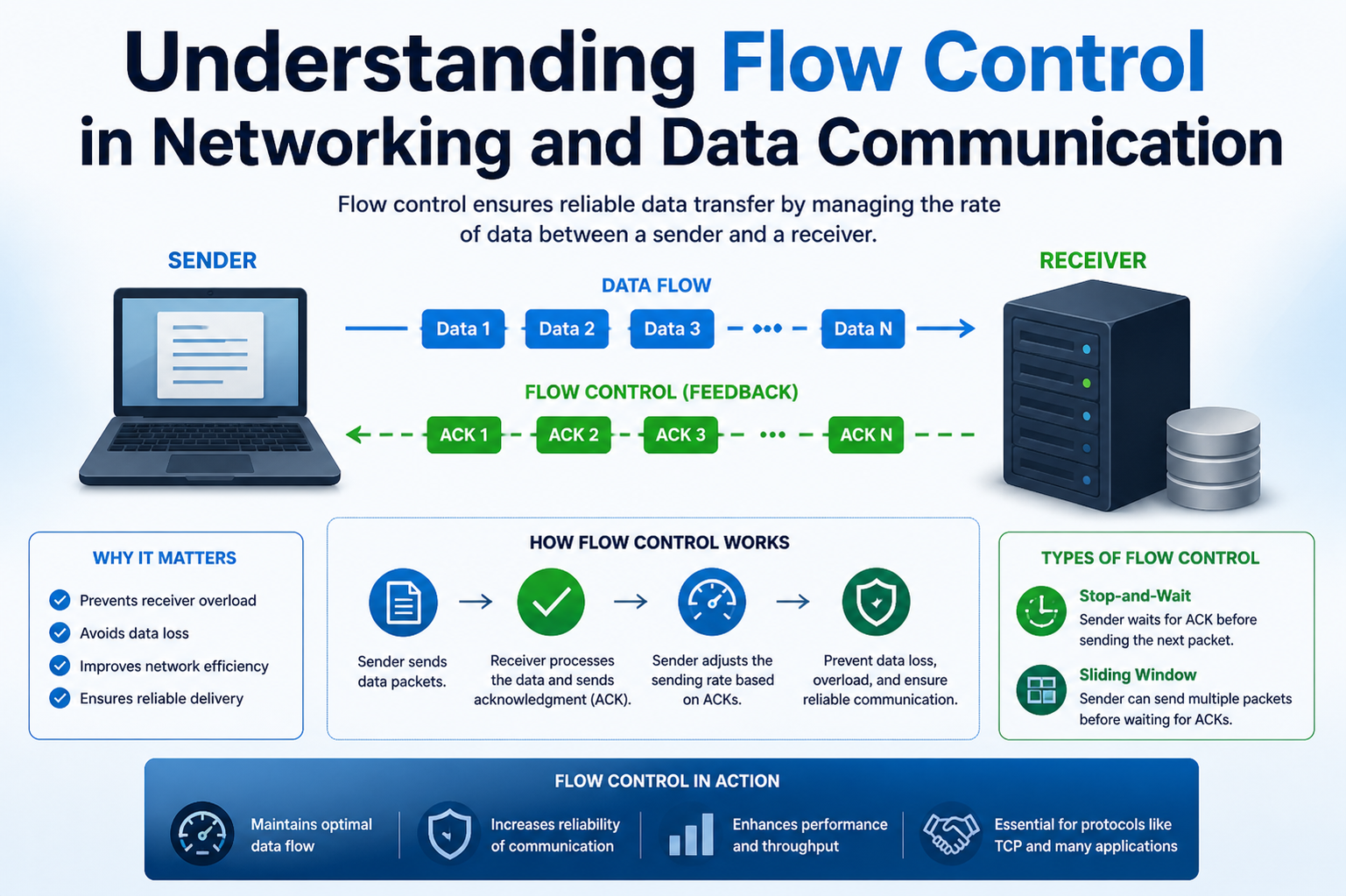
Flow control in networking refers to the set of rules, methods, and mechanisms used to regulate how data is transmitted between two devices on a network. Its primary purpose is to ensure that a sending device does not overwhelm a receiving device with more data than it can process at a given time. In simple terms, it acts like a traffic management system that balances data speed between sender and receiver so communication remains stable, efficient, and loss-free. Without flow control, high-speed senders could easily flood slower receivers, resulting in congestion, packet loss, and degraded network performance.
Why Flow Control Matters in Modern Networks
In modern IT environments, devices operate at different processing speeds, buffer capacities, and workload conditions. A high-performance server may transmit data at extremely high rates, while another device such as a storage system or edge switch may process data at a much slower rate. Flow control becomes essential in such mixed environments because it prevents data overload situations. It ensures that communication remains synchronized between devices regardless of their speed differences. This balance is critical in maintaining consistent application performance, especially in environments where real-time communication, data storage, and high-throughput applications coexist.
How Data Transmission Works Between Sender and Receiver
Data transmission in a network always involves at least two key participants: a sender and a receiver. The sender is responsible for generating and transmitting data packets, while the receiver processes and consumes those packets. In ideal conditions, both devices operate at similar speeds, allowing continuous and smooth data flow. However, in real-world scenarios, the sender often transmits data faster than the receiver can handle. This mismatch creates a need for coordination. Flow control introduces a communication feedback system where the receiver can inform the sender about its ability to accept more data, ensuring that transmission rates remain aligned with processing capacity.
Understanding Buffer Management in Networking Devices
Buffers play a crucial role in flow control. A buffer is a temporary storage area within a networking device where incoming data packets are held before being processed. When data arrives faster than it can be processed, it is stored in this buffer. If the buffer has sufficient capacity, the device can continue receiving data without interruption. However, if the buffer becomes full, new incoming packets may be dropped, leading to data loss. Flow control mechanisms are designed to monitor buffer usage and regulate traffic accordingly so that buffers operate within safe limits and do not overflow.
What Happens When Network Buffers Become Overloaded
When a buffer reaches its maximum capacity, the network device can no longer accept additional incoming packets. This situation is known as buffer overflow. Once overflow occurs, packets begin to drop, which leads to retransmissions, increased latency, and reduced overall network efficiency. In severe cases, continuous buffer overload can cause application slowdowns or even system instability. Flow control helps prevent this condition by signaling the sender to slow down or temporarily pause data transmission, allowing the receiver time to process existing data in the buffer.
Basic Principles Behind Flow Control Mechanisms
Flow control operates on a few fundamental principles that govern how data is managed across a network. The first principle is synchronization between sender and receiver, ensuring that both operate at compatible speeds. The second principle involves buffer awareness, where the receiver continuously monitors its buffer status and communicates its capacity to the sender. The third principle is adaptive transmission, where the sender adjusts its sending rate based on feedback received from the receiver. Together, these principles form a dynamic system that maintains stability even under heavy network load conditions.
Introduction to Flow Control Techniques in Ethernet Networks
In Ethernet-based networks, flow control is implemented using specific standardized techniques that ensure compatibility across different vendors and devices. These techniques are designed to manage congestion and maintain data integrity during transmission. One of the most widely used approaches is pause-based flow control, which temporarily halts data transmission when congestion is detected. Other advanced methods introduce prioritization and coordination between devices to ensure that critical traffic is delivered without interruption, even during high network utilization.
IEEE 802.3x Pause Frame Mechanism Overview
One of the most fundamental flow control methods in Ethernet networks is based on pause frames. This mechanism allows a receiving device to send a special control signal to the sender, instructing it to temporarily stop transmitting data. This pause gives the receiver time to process the data already in its buffer. Once the receiver is ready, it sends another signal allowing transmission to resume. This method is particularly useful in environments where sudden traffic bursts occur or where multiple devices share the same network segment. It helps reduce packet loss and ensures smoother traffic flow.
How Pause Frames Help Prevent Data Loss
Pause frames play an important role in protecting network stability during congestion events. When a device experiences high traffic load and its buffer is nearing capacity, it sends a pause frame to upstream devices. This frame acts as a temporary stop signal, preventing further data from arriving until the buffer has been cleared. By doing so, pause frames eliminate the risk of buffer overflow and reduce the need for retransmissions. This not only improves efficiency but also ensures that network resources are not wasted on lost or repeated data.
Limitations of Pause-Based Flow Control
While pause frames are effective in many situations, they are not without limitations. Since they operate at a basic level of data transmission control, they affect all traffic equally, regardless of priority. This means that both critical and non-critical data may be paused simultaneously, which can impact time-sensitive applications. Additionally, excessive use of pause frames can introduce delays in the network, especially if congestion occurs frequently. Despite these limitations, pause-based flow control remains a foundational mechanism in Ethernet networks due to its simplicity and reliability.
Understanding Receiver-Driven Flow Regulation
Flow control is primarily driven by the receiver in most networking scenarios. The receiver continuously monitors its ability to process incoming data and communicates this status back to the sender. If the receiver is operating within normal limits, data flows freely. However, when processing slows down or buffer usage increases, the receiver triggers control signals to slow or pause incoming traffic. This receiver-driven approach ensures that data transmission is always aligned with processing capacity, reducing the likelihood of congestion and packet loss.
Role of Transmission Speed Mismatch in Flow Control
One of the primary reasons flow control is necessary is the difference in transmission speeds between devices. Modern network interfaces can transmit data at extremely high speeds, but not all devices can process that data at the same rate. This mismatch creates a bottleneck at the receiving end. Flow control addresses this imbalance by adjusting the transmission rate dynamically. Instead of allowing uncontrolled data flow, it ensures that the sender adapts to the receiver’s limitations, maintaining overall network harmony.
Importance of Real-Time Feedback in Data Transmission
Real-time feedback is a key component of flow control systems. Without feedback, a sender would have no way of knowing whether the receiver is capable of handling incoming data. Flow control mechanisms enable continuous communication between devices, allowing them to exchange status updates about buffer availability and processing capacity. This feedback loop ensures that adjustments can be made instantly, preventing congestion before it escalates into a serious network issue.
Early Concepts Leading to Advanced Flow Control Systems
The concept of flow control has evolved significantly over time. Early networking systems relied on simple stop-and-wait techniques, where a sender would transmit a packet and wait for acknowledgment before sending the next one. While effective for low-speed networks, this approach was inefficient for modern high-speed environments. As networks grew more complex, more advanced flow control systems were developed, incorporating buffering strategies, dynamic signaling, and priority-based handling to support higher data loads and diverse application requirements.
Priority-Based Flow Control (PFC) in Modern Ethernet Networks
Priority-Based Flow Control is an advanced enhancement over traditional pause-frame mechanisms, designed to handle congestion more intelligently. Instead of pausing all traffic on a link, PFC allows network administrators to divide traffic into multiple priority classes and control each class independently. This ensures that only specific types of traffic experiencing congestion are paused, while other critical traffic continues to flow uninterrupted. In environments like data centers, where different applications compete for bandwidth, this selective control becomes essential for maintaining performance and stability.
How Traffic Prioritization Works in PFC Systems
PFC operates by assigning priority levels to different types of network traffic. These priorities are typically defined using standardized tagging methods embedded within Ethernet frames. Once traffic is categorized, the network device monitors congestion levels for each priority queue separately. If congestion occurs in a particular queue, PFC sends pause signals only for that priority level, leaving other queues unaffected. This selective approach ensures that time-sensitive applications such as storage synchronization or real-time communication are not disrupted by less critical background traffic.
Use Cases of Priority-Based Flow Control in Data Centers
In modern data center environments, PFC is widely used to support loss-sensitive applications. Storage systems, for example, require consistent and uninterrupted data flow to prevent corruption or performance degradation. Similarly, real-time analytics platforms depend on steady data streams to process information efficiently. PFC helps maintain these requirements by ensuring that high-priority traffic is protected during congestion events. It is particularly valuable in environments where multiple services share the same physical network infrastructure.
Limitations and Challenges of Priority-Based Flow Control
Although PFC provides more granular control compared to traditional pause mechanisms, it introduces additional complexity into network design and configuration. Improper configuration of priority levels can lead to unintended traffic delays or uneven bandwidth distribution. In some cases, if multiple priority queues become congested simultaneously, overall network performance can still degrade. Additionally, PFC requires careful coordination between network devices to ensure consistent behavior across the entire infrastructure.
Data Center Bridging Exchange (DCBX) and Its Role in Flow Control
Data Center Bridging Exchange is a protocol that plays a supporting role in flow control by enabling devices to automatically exchange configuration information. Rather than manually configuring flow control settings on each device, DCBX allows network components to negotiate and synchronize their capabilities. This ensures that features such as Priority-Based Flow Control are consistently implemented across all connected devices. By automating configuration exchange, DCBX reduces the risk of mismatched settings and simplifies network management.
How DCBX Improves Network Configuration Consistency
DCBX works by allowing network devices to advertise their capabilities and configuration preferences to neighboring devices. When two devices establish a connection, they exchange information about supported features such as priority levels, congestion control mechanisms, and traffic handling policies. This exchange ensures that both devices operate with compatible settings, reducing the likelihood of misconfigurations. In large-scale networks, this automated coordination is essential for maintaining consistent flow control behavior across multiple segments.
Interaction Between PFC and DCBX in Enterprise Networks
PFC and DCBX often work together to create a fully coordinated flow control environment. While PFC handles the actual traffic prioritization and congestion management, DCBX ensures that all devices involved are properly configured to support these mechanisms. Without DCBX, administrators would need to manually configure each device, increasing the risk of inconsistency. Together, these technologies create a more reliable and automated flow control system that is well-suited for complex enterprise and data center environments.
Flow Control in Relation to OSI Model Layers
Flow control mechanisms primarily operate at different layers of the OSI model depending on the technology used. Traditional Ethernet-based flow control, such as pause frames, operates at the data link layer. This allows devices to manage traffic directly between adjacent network nodes. In contrast, higher-level protocols such as TCP implement flow control at the transport layer, where end-to-end communication is managed between applications. Understanding the interaction between these layers is essential for designing efficient and scalable networks.
Difference Between Layer 2 and Layer 4 Flow Control
Layer 2 flow control focuses on direct communication between physically connected devices, using mechanisms such as pause frames and priority tagging. It is fast and efficient but limited to local network segments. Layer 4 flow control, on the other hand, is implemented by transport protocols like TCP and operates end-to-end across multiple network hops. It uses acknowledgment-based systems to regulate data flow between sender and receiver applications. While both approaches aim to prevent congestion, they operate at different scopes and serve different roles within the network stack.
How TCP Flow Control Complements Ethernet Flow Control
TCP flow control uses a sliding window mechanism to manage data transmission between endpoints. This ensures that a sender only transmits data within the receiver’s advertised window size, preventing overload at the application level. When combined with Ethernet-level flow control mechanisms, TCP provides an additional layer of protection against congestion. Ethernet flow control manages local link-level congestion, while TCP ensures end-to-end reliability. Together, they create a multi-layered approach to maintaining stable and efficient data transmission.
Role of Auto-Negotiation in Flow Control Configuration
Auto-negotiation is a key feature in Ethernet networks that allows connected devices to automatically determine optimal communication parameters. These parameters include speed, duplex mode, and flow control settings. During connection establishment, devices exchange signals to agree on compatible configurations. This process reduces the need for manual setup and ensures that both ends of a link operate under compatible conditions. When flow control is enabled during auto-negotiation, devices can automatically agree on whether to use mechanisms like pause frames.
Advantages of Auto-Negotiation in Modern Networks
One of the main advantages of auto-negotiation is its ability to simplify network configuration. In large-scale environments with numerous devices, manual configuration can be time-consuming and error-prone. Auto-negotiation reduces this complexity by automatically selecting the best available settings. It also helps prevent mismatches between connected devices, which can lead to performance issues or connectivity failures. By dynamically adjusting settings, auto-negotiation contributes to smoother and more reliable network operation.
Situations Where Manual Flow Control Configuration Is Necessary
Despite the benefits of auto-negotiation, there are situations where manual configuration is required. Some legacy devices may not fully support auto-negotiation, leading to compatibility issues. In such cases, administrators must manually configure flow control settings to ensure stable communication. Manual configuration is also useful during troubleshooting, as it allows network engineers to isolate issues related to negotiation failures. Additionally, specialized environments with strict performance requirements may require fixed configurations to maintain consistency.
Flow Control Behavior in Mixed Vendor Environments
In real-world networks, it is common to encounter equipment from multiple vendors. Each vendor may implement flow control features slightly differently, leading to potential compatibility challenges. Differences in default settings, interpretation of standards, or feature support can result in inconsistent behavior across devices. To address this, network administrators must carefully review configuration documentation and ensure that settings are aligned across all devices. Testing and validation are essential steps in ensuring smooth interoperability.
Impact of Flow Control on Network Latency
Flow control plays an important role in maintaining network stability, but it can also introduce latency under certain conditions. When devices are instructed to pause transmission, data delivery is temporarily delayed. While this delay helps prevent congestion, it can impact time-sensitive applications if it occurs frequently. Therefore, network designers must carefully balance flow control usage to avoid unnecessary performance degradation while still protecting against buffer overflow and packet loss.
Balancing Throughput and Stability in Flow Control Design
Designing an effective flow control strategy requires balancing two competing goals: maximizing throughput and maintaining stability. High throughput ensures that data is transmitted quickly across the network, while stability ensures that no data is lost or corrupted due to congestion. Flow control mechanisms help achieve this balance by dynamically adjusting transmission rates based on real-time network conditions. However, overly aggressive flow control settings can reduce throughput, while overly relaxed settings can lead to congestion.
Role of Network Buffers in High-Speed Ethernet Links
In high-speed Ethernet networks, buffers play an increasingly important role in managing data flow. As transmission speeds increase, even small delays in processing can lead to buffer buildup. Flow control mechanisms rely heavily on buffer monitoring to determine when to regulate traffic. Proper buffer sizing is critical, as undersized buffers can lead to frequent congestion events, while oversized buffers may introduce unnecessary latency. Effective flow control design requires careful tuning of buffer parameters.
Interaction Between Flow Control and Quality of Service (QoS)
Flow control and Quality of Service work together to ensure that important network traffic receives appropriate priority and bandwidth. While flow control prevents congestion at the transmission level, QoS ensures that critical applications are prioritized over less important traffic. By combining these two mechanisms, networks can maintain consistent performance even under heavy load conditions. This is especially important for applications such as voice communication, video streaming, and real-time data processing, where delays can significantly impact user experience.
Flow Control and Its Relationship with Network Congestion Management
Flow control is closely tied to the broader concept of congestion management in networking. While flow control operates at the device-to-device level to regulate transmission speed, congestion management focuses on the overall health of the network when multiple data streams compete for limited resources. In practical terms, flow control prevents individual links from becoming overloaded, while congestion control ensures that the entire network remains stable under heavy traffic conditions. Together, they form a coordinated system that prevents bottlenecks and maintains consistent performance across interconnected devices.
How Congestion Builds Up in High-Speed Networks
In modern high-speed networks, congestion can develop rapidly due to the sheer volume of data being transmitted simultaneously. Multiple devices may attempt to send large amounts of data to a single receiver, causing sudden spikes in traffic. If the receiving device or intermediate network switches are unable to process this data quickly enough, queues begin to form. These queues eventually lead to buffer saturation, packet delays, and potential packet drops. Flow control helps mitigate this buildup by regulating the rate at which data enters congested segments of the network.
The Role of Switching Devices in Flow Control Behavior
Network switches play a critical role in how flow control operates across Ethernet environments. Switches act as intermediaries between multiple devices, forwarding data based on destination addresses while also managing traffic loads. When a switch detects congestion on one of its ports, it can trigger flow control mechanisms to slow down incoming traffic. In more advanced configurations, switches can also prioritize certain types of traffic or distribute load more evenly across available paths to prevent localized congestion from affecting the entire network.
Buffer Threshold Levels and Their Importance in Flow Control
Buffer threshold levels define the points at which flow control actions are triggered within a device. These thresholds determine when a device should begin signaling congestion and requesting reduced transmission rates. If thresholds are set too low, flow control may activate too frequently, unnecessarily slowing down the network. If they are set too high, buffers may overflow before corrective actions are taken. Proper configuration of buffer thresholds is essential for achieving a balance between responsiveness and efficiency in flow control systems.
Flow Control in Full-Duplex and Half-Duplex Communication
Flow control behaves differently depending on whether a network link is operating in full-duplex or half-duplex mode. In full-duplex mode, devices can send and receive data simultaneously, which allows for more efficient communication and reduces the likelihood of collisions. Flow control in this environment focuses primarily on managing buffer capacity and preventing congestion. In half-duplex mode, where devices take turns transmitting data, flow control must also account for transmission collisions and timing conflicts, making the overall process more complex.
Impact of Flow Control on High-Performance Computing Environments
High-performance computing environments rely heavily on predictable and efficient data transfer between nodes. These systems often involve large-scale data processing tasks where multiple compute nodes exchange information continuously. Flow control is essential in these environments to ensure that no single node becomes overwhelmed by incoming data. Without proper flow control, performance bottlenecks can significantly reduce computational efficiency and increase processing time for complex workloads.
Flow Control Behavior in Storage Area Networks
Storage Area Networks require extremely reliable and lossless data transmission to ensure data integrity. In these environments, even minor packet loss can lead to significant performance degradation or data corruption. Flow control mechanisms such as Priority-Based Flow Control are commonly used to guarantee that storage traffic is treated with high priority. By controlling congestion at the link level, these mechanisms help maintain consistent and reliable access to storage resources across the network.
The Relationship Between Flow Control and Latency Sensitivity
Latency sensitivity varies depending on the type of application running on a network. Real-time applications such as voice communication, video conferencing, and live streaming are highly sensitive to delays. Flow control can both help and hinder these applications depending on how it is configured. When properly implemented, it prevents congestion that could lead to latency spikes. However, excessive flow control activity can introduce intentional delays, which may negatively impact time-sensitive communication.
Monitoring Flow Control Activity in Network Environments
Monitoring flow control activity is an essential part of network management. Network administrators use monitoring tools to observe traffic patterns, buffer utilization, and congestion events. By analyzing this data, they can determine whether flow control mechanisms are functioning correctly or need adjustment. Monitoring also helps identify recurring congestion points within the network, allowing for targeted optimization of infrastructure and configuration settings.
Key Metrics Used to Evaluate Flow Control Efficiency
Several key metrics are used to evaluate how effectively flow control is performing within a network. These include buffer occupancy levels, packet drop rates, transmission delays, and pause frame frequency. High buffer occupancy combined with frequent pause frames may indicate that a network segment is consistently under stress. Similarly, increased packet drops suggest that flow control mechanisms are not responding quickly enough to congestion conditions. These metrics provide valuable insight into overall network health.
Dynamic Adjustment of Flow Control Parameters
Modern networks often require dynamic adjustment of flow control parameters to adapt to changing traffic conditions. Static configurations may not be sufficient in environments where traffic patterns vary significantly throughout the day. Dynamic systems can adjust buffer thresholds, priority levels, and pause frame behavior in real time based on current network load. This adaptability helps maintain consistent performance even during unexpected traffic surges or workload changes.
Flow Control and Bandwidth Utilization Efficiency
Efficient bandwidth utilization is one of the primary goals of flow control. By regulating transmission rates, flow control ensures that available bandwidth is used effectively without overloading network links. When properly configured, it prevents both underutilization and overutilization of network resources. Underutilization occurs when traffic is unnecessarily delayed, while overutilization leads to congestion and packet loss. Flow control helps maintain an optimal balance between these two extremes.
Impact of Microbursts on Network Flow Control
Microbursts are sudden and extremely short spikes in network traffic that can overwhelm buffers in a very short time. These events are difficult to predict and can cause significant congestion even in well-designed networks. Flow control mechanisms are often the first line of defense against microbursts, as they can quickly respond to buffer saturation by pausing or slowing traffic. However, because microbursts occur so rapidly, traditional flow control methods may not always react fast enough to prevent temporary packet loss.
Flow Control in Virtualized Network Environments
Virtualized environments introduce additional complexity to flow control due to the abstraction of physical hardware into virtual machines and virtual switches. Multiple virtual machines may share the same physical network interface, leading to increased competition for bandwidth. Flow control in such environments must account for both physical and virtual layers of communication. Proper configuration ensures that no single virtual machine monopolizes network resources, maintaining fairness and stability across the system.
The Role of Queue Management in Flow Control Systems
Queue management is a fundamental aspect of flow control that determines how packets are organized and processed within network devices. Packets are placed into queues based on priority and processing order. When congestion occurs, flow control mechanisms help regulate the rate at which packets enter these queues. Effective queue management ensures that high-priority traffic is processed first while preventing lower-priority traffic from overwhelming the system.
Interaction Between Flow Control and Load Balancing Techniques
Load balancing distributes network traffic across multiple paths or devices to prevent any single point from becoming overloaded. Flow control complements this by managing traffic flow at the link level. While load balancing spreads traffic across the network, flow control ensures that each individual link operates within its capacity limits. Together, these mechanisms improve both scalability and reliability in large network infrastructures.
Effects of Misconfigured Flow Control on Network Stability
Incorrect flow control configuration can have serious consequences for network stability. If settings are inconsistent across devices, traffic may be paused unnecessarily or allowed to flow without restriction. This can lead to uneven performance, unexpected delays, or persistent congestion in certain areas of the network. In some cases, misconfiguration can even create feedback loops where devices continuously pause each other, severely degrading overall performance.
Importance of Standardization in Flow Control Implementation
Standardization plays a critical role in ensuring that flow control works consistently across different devices and vendors. Industry standards define how mechanisms such as pause frames and priority tagging should behave, allowing equipment from different manufacturers to interoperate correctly. Without standardization, each vendor might implement flow control differently, leading to compatibility issues and unpredictable network behavior.
Flow Control in Cloud-Based Infrastructure Systems
Cloud-based infrastructure relies heavily on distributed networking systems where multiple data centers and virtual resources communicate continuously. Flow control is essential in these environments to manage data flow between virtual machines, storage systems, and application servers. Because cloud environments are highly dynamic, flow control mechanisms must be flexible and scalable to accommodate changing workloads and resource allocation patterns.
The Growing Importance of Flow Control in Modern Networking
As networks continue to evolve toward higher speeds and greater complexity, the importance of flow control continues to increase. Modern applications demand low latency, high reliability, and consistent throughput, all of which depend on effective traffic management. Flow control remains a foundational mechanism that ensures data integrity and stability across both traditional and emerging network architectures, making it a critical component of modern IT infrastructure.
Advanced Challenges in Flow Control Deployment
Flow control may look straightforward at a conceptual level, but real-world deployment introduces a range of advanced challenges. Modern networks are highly layered, involving switches, routers, virtual machines, cloud services, and storage systems all interacting simultaneously. Each layer may handle traffic differently, which makes consistent flow control behavior difficult to achieve. Misalignment between devices can create unexpected congestion points, uneven traffic distribution, or even cascading delays where one overloaded segment affects multiple connected segments.
Complexity in Multi-Tier Network Architectures
In multi-tier architectures, data flows through multiple layers of networking equipment before reaching its destination. Each layer may apply its own buffering, queuing, and congestion management strategies. This creates complexity in how flow control signals propagate across the system. A pause triggered at one layer may not immediately reflect at another, leading to temporary inconsistencies in traffic behavior. Proper design requires careful coordination between all layers to ensure that flow control decisions remain synchronized throughout the network path.
Flow Control Interaction with Modern High-Speed Ethernet
As Ethernet speeds increase into multi-gigabit and terabit ranges, the margin for error in flow control becomes extremely small. Data is transmitted so quickly that buffers can fill almost instantly during traffic spikes. Traditional flow control methods must be carefully tuned to keep up with these speeds. Even slight misconfigurations can lead to micro-congestion events that degrade performance. High-speed environments demand more precise buffer management, faster signaling mechanisms, and tighter integration between hardware and software components.
Impact of Burst Traffic on Network Stability
Burst traffic refers to sudden surges in data transmission that occur within very short time intervals. These bursts can overwhelm network devices before flow control mechanisms have time to react. While flow control is designed to manage sustained congestion, burst traffic creates short-lived but intense pressure on buffers and queues. If not handled properly, these bursts can lead to packet loss or temporary slowdowns. Advanced network designs often include predictive and adaptive flow control techniques to handle such unpredictable traffic behavior.
Coordination Between Multiple Flow Control Mechanisms
Modern networks often use more than one flow control method simultaneously, such as pause-based control, priority-based control, and transport-layer control. While each method serves a specific purpose, they must be carefully coordinated to avoid conflicts. For example, one mechanism might pause traffic at the link layer while another continues sending data at the transport layer. Without proper coordination, this can result in inefficiencies, redundant retransmissions, or unnecessary delays. Effective network design ensures that these mechanisms complement rather than interfere with each other.
Flow Control in Software-Defined Networking Environments
Software-Defined Networking introduces a centralized approach to network management, where control logic is separated from physical hardware. In such environments, flow control becomes more programmable and dynamic. Network controllers can adjust traffic behavior in real time based on global network conditions rather than local device status alone. This allows for more intelligent congestion management, but it also increases system complexity. The central controller must continuously analyze network state and adjust flow control policies accordingly.
Role of Automation in Modern Flow Control Systems
Automation has become a critical factor in managing flow control across large-scale networks. Manual configuration is no longer practical in environments with thousands of interconnected devices. Automated systems can detect congestion patterns, adjust buffer thresholds, and modify priority settings without human intervention. This reduces operational overhead and improves response time during network stress conditions. However, automation also requires careful validation to ensure that automated decisions do not conflict with business-critical traffic requirements.
Flow Control in Edge Computing Environments
Edge computing introduces a distributed model where data processing occurs closer to the source of data generation. This reduces latency but increases the complexity of flow control, as data must be managed across many geographically distributed nodes. Each edge device may have limited processing power and buffer capacity, making them more sensitive to traffic spikes. Flow control in edge environments must be lightweight, adaptive, and capable of handling intermittent connectivity conditions while maintaining data consistency across the network.
Influence of Hardware Limitations on Flow Control Efficiency
Hardware capabilities play a significant role in how effectively flow control operates. Devices with limited buffer memory or lower processing speeds are more likely to experience congestion. In contrast, high-performance hardware can handle larger traffic volumes with fewer interruptions. However, even advanced hardware is not immune to congestion if traffic is not properly regulated. Flow control helps bridge the gap between hardware limitations and traffic demands by ensuring that data flow remains within manageable limits.
Flow Control in Virtual Machine and Containerized Systems
Virtual machines and containers share underlying physical resources, including network interfaces. This shared environment can lead to contention when multiple virtual instances attempt to transmit data simultaneously. Flow control must operate both at the physical network level and within virtualized layers to ensure fair resource allocation. Without proper flow control, one virtual instance could dominate network bandwidth, negatively impacting others running on the same host system.
Effect of Network Topology on Flow Control Behavior
Network topology has a direct influence on how flow control behaves across a system. In simple topologies, such as point-to-point connections, flow control is easier to manage because there are fewer variables involved. However, in complex topologies with multiple redundant paths, switches, and routers, flow control signals may take different routes or experience delays. This can create uneven congestion patterns that require more sophisticated management strategies to resolve effectively.
Importance of Scalability in Flow Control Design
Scalability is a key requirement for modern flow control systems. As networks grow in size and complexity, flow control mechanisms must be able to handle increasing traffic loads without degradation in performance. Scalable flow control systems are designed to operate efficiently regardless of network size, ensuring consistent behavior whether managing a small office network or a large global data center. Scalability also involves the ability to integrate new devices and technologies without disrupting existing configurations.
Real-World Implications of Flow Control Failures
When flow control fails or is improperly configured, the consequences can extend beyond simple performance issues. In critical systems such as financial networks, healthcare infrastructure, or industrial automation, even minor delays or packet losses can have serious operational impacts. Flow control failures can lead to transaction delays, data inconsistencies, or system downtime. This highlights the importance of proper design, testing, and monitoring in environments where reliability is essential.
Optimization Techniques for Flow Control Systems
Optimizing flow control involves fine-tuning multiple parameters, including buffer sizes, priority settings, and threshold values. Network administrators often use performance monitoring tools to identify bottlenecks and adjust configurations accordingly. Optimization is an ongoing process, as network conditions change over time due to evolving traffic patterns and infrastructure upgrades. Effective optimization ensures that flow control continues to perform efficiently under varying workloads.
Future Trends in Flow Control Technology
Flow control technology is continuously evolving to meet the demands of next-generation networks. Emerging trends include the use of artificial intelligence to predict congestion events before they occur, machine learning models that dynamically adjust traffic policies, and ultra-low latency hardware-based control mechanisms. These advancements aim to make flow control more proactive rather than reactive, allowing networks to adapt instantly to changing conditions without manual intervention.
Integration of Flow Control with Intelligent Network Systems
Modern networks are increasingly integrating flow control with intelligent monitoring and decision-making systems. These systems analyze traffic patterns in real time and adjust flow control parameters automatically to maintain optimal performance. By combining analytics with control mechanisms, networks can become more self-regulating and resilient. This integration represents a shift from traditional static configurations to highly adaptive and intelligent network environments.
Security Considerations in Flow Control Mechanisms
Although flow control is primarily focused on performance and stability, it also has security implications. Malicious actors could potentially exploit flow control mechanisms to disrupt network traffic by intentionally triggering congestion or pause conditions. To mitigate such risks, modern systems incorporate safeguards that prevent abuse of flow control signals. Ensuring secure implementation is essential to maintaining both performance and integrity in network operations.
Final Conclusion
Flow control is a foundational element of networking that ensures smooth, reliable, and efficient communication between devices. It manages the balance between sending and receiving speeds, prevents buffer overflow, reduces congestion, and improves overall network performance. Across all environments—from simple local networks to complex global infrastructures—flow control plays a critical role in maintaining stability. When properly designed and configured, it enables networks to handle high-speed data transmission while preserving reliability, scalability, and efficiency.