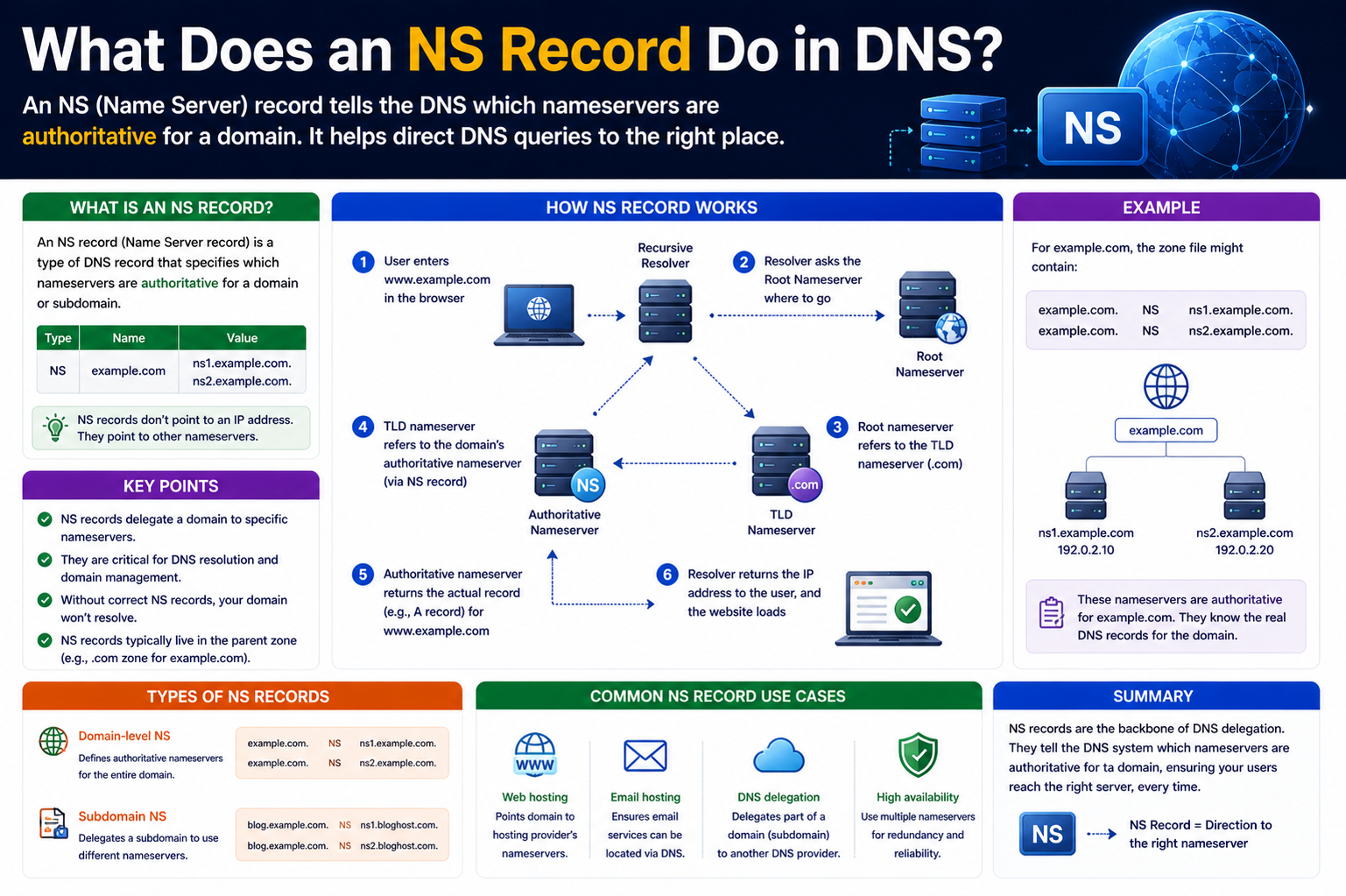
A Name Server (NS) record is one of the most essential components within the Domain Name System (DNS). It serves as a pointer that directs queries to the authoritative name servers responsible for storing all other DNS records associated with a domain. Without NS records, the DNS ecosystem would not function properly, because there would be no clear path for resolving domain-related queries. In simple terms, NS records act as guides, ensuring that when a request is made, it reaches the correct destination where accurate DNS information is stored. This foundational role makes NS records a critical part of how the internet operates behind the scenes.
Why DNS Depends on NS Records
DNS itself is often compared to a large directory that translates human-friendly names into machine-readable IP addresses. When a user enters a domain into a browser, DNS is responsible for finding the corresponding IP address so that the connection can be established. However, this process cannot even begin without NS records. They define which servers are authoritative for a domain and therefore capable of providing the correct answers. Without them, DNS queries would lack direction, leading to failed resolutions and inaccessible resources. This dependency highlights how NS records function as the backbone of DNS, enabling the entire lookup mechanism to work efficiently and reliably.
The Concept of Authoritative Name Servers
An authoritative name server is the system that holds the original DNS records for a domain. NS records point directly to these servers, making them the ultimate source of truth for any DNS query related to that domain. When a request reaches an authoritative server, it can provide definitive answers rather than cached or temporary responses. This ensures accuracy and consistency in DNS resolution. The relationship between NS records and authoritative servers is tightly linked, as the NS record essentially tells the world where to find the official data. Without this connection, there would be confusion about which server holds the correct information.
Breaking Down the Structure of NS Records
NS records consist of several key elements that define how they function. The first component is the domain name, which specifies the domain to which the record applies. The second element is the Time to Live (TTL), which determines how long the record should be cached by other servers before being refreshed. The third component is the value, which indicates the hostname of the authoritative name server. These elements work together to ensure that DNS queries are routed correctly and that responses are delivered efficiently. Understanding these components helps clarify how NS records operate within the broader DNS framework.
How Multiple NS Records Improve Reliability
It is common for a domain to have more than one NS record, and this design is intentional. Multiple records provide redundancy, ensuring that if one name server becomes unavailable, others can still respond to queries. This setup enhances both reliability and performance. When multiple NS records are present, DNS resolvers may choose different servers based on various factors, such as response time or random selection. This distribution of traffic helps prevent any single server from becoming overloaded, contributing to a more stable and resilient DNS environment.
Load Distribution Through NS Records
NS records naturally support load distribution by allowing multiple name servers to share the responsibility of handling queries. Instead of directing all traffic to a single server, DNS resolvers can spread requests across several servers listed in the NS records. This approach reduces the risk of bottlenecks and ensures that no single server bears the entire load. As a result, users experience faster response times and fewer disruptions. This built-in capability makes NS records an important factor in maintaining efficient network performance.
Failover Mechanisms and NS Records
Another advantage of having multiple NS records is the ability to handle failures gracefully. If a resolver attempts to query one name server and does not receive a response, it can move on to the next server listed in the NS records. This process continues until a response is obtained. Such failover mechanisms are crucial for maintaining uptime and ensuring that services remain accessible even when individual servers encounter issues. By providing alternative paths for resolution, NS records contribute significantly to the robustness of DNS infrastructure.
The Challenge of Discovering NS Records
A common question arises when considering how NS records are found in the first place. Since NS records themselves are part of DNS, it might seem unclear how a resolver knows where to look initially. This challenge is addressed through a hierarchical system within DNS. Instead of relying solely on domain-specific servers, the process begins with higher-level servers that guide the query to the appropriate location. This layered approach ensures that even without prior knowledge of a domain’s authoritative servers, the system can still locate the necessary NS records.
The Hierarchical Nature of DNS Resolution
DNS operates in a structured hierarchy that includes root servers, top-level domain (TLD) servers, and authoritative servers. When a query is initiated, it typically starts at the root level, where servers provide information about TLD servers. These TLD servers then supply the NS records for the requested domain. Finally, the resolver contacts the authoritative servers indicated by those NS records to obtain the desired information. This step-by-step process ensures that queries are resolved accurately, even in a vast and distributed system like the internet.
Caching and the Role of Non-Authoritative Servers
Once a DNS query is resolved, the result is often cached by intermediate servers to improve efficiency. These servers, known as non-authoritative servers, temporarily store the information so that future queries can be answered more quickly. While they can provide responses, they do not hold the original data. Instead, they rely on cached copies that expire based on the TTL value. This caching mechanism reduces the need for repeated queries to authoritative servers, speeding up the overall resolution process while still maintaining accuracy.
The Importance of TTL in NS Records
The Time to Live (TTL) value in an NS record plays a significant role in determining how long information is cached. A shorter TTL means that records are refreshed more frequently, which can be useful when changes are expected. However, it also increases the number of queries sent to authoritative servers. A longer TTL reduces query traffic but may delay the propagation of updates. Balancing these factors is important for maintaining both performance and flexibility in DNS management.
NS Records as the Foundation of DNS Infrastructure
NS records are not just another type of DNS record; they are fundamental to the entire system. They establish the framework that allows all other records to be discovered and used. Without them, there would be no clear way to locate the servers that hold critical DNS data. This foundational role underscores their importance in ensuring that internet services remain accessible and functional. By directing queries to the correct authoritative servers, NS records enable the seamless operation of DNS.
Understanding the Practical Impact of NS Records
In real-world scenarios, NS records influence how quickly and reliably users can access online resources. Properly configured NS records ensure that queries are resolved efficiently, minimizing delays and preventing downtime. Conversely, misconfigured NS records can lead to failed resolutions, making services unreachable. This practical impact highlights the need for careful management and a thorough understanding of how NS records function within the DNS ecosystem.
How NS Records Guide the Query Process
NS records play a central role in directing DNS queries through the correct path. When a user initiates a request, the system does not immediately know where the final answer resides. Instead, it relies on NS records to identify which authoritative servers should be consulted. This guidance ensures that each query moves step by step toward a reliable source of information. By acting as signposts within the DNS hierarchy, NS records eliminate guesswork and provide a structured method for resolving requests efficiently.
The Journey of a DNS Query Through NS Records
When a query is initiated, it typically begins with a local resolver that attempts to answer the request from its cache. If the information is not available, the resolver escalates the query to higher-level servers. At this stage, NS records become essential, as they inform the resolver which servers to contact next. The resolver follows these directions until it reaches an authoritative server capable of providing the final answer. This journey illustrates how NS records function as a roadmap, guiding queries through multiple layers until the correct destination is reached.
Understanding Root and TLD Server Interaction
The DNS hierarchy begins with root servers, which hold references to top-level domain (TLD) servers. These root servers do not contain detailed information about individual domains, but they know where to find the next level of authority. When a resolver queries a root server, it receives a response pointing to the appropriate TLD servers. These TLD servers then provide the NS records for the requested domain. This interaction demonstrates how NS records are distributed across different levels of the DNS hierarchy, ensuring that queries can always find their way to the correct authoritative source.
How NS Records Enable Delegation of Authority
One of the most important functions of NS records is enabling delegation. Delegation allows responsibility for a domain’s DNS records to be assigned to specific name servers. This means that control over DNS data can be distributed rather than centralized. By defining which servers are authoritative, NS records make it possible for organizations to manage their own DNS infrastructure or rely on external providers. This flexibility is a key feature of DNS, allowing it to scale across countless domains and services.
The Relationship Between NS Records and Zone Files
Zone files are the repositories that store all DNS records for a domain, including A, MX, and other record types. NS records point directly to the servers that host these zone files. When a query reaches an authoritative server, it is the zone file that provides the necessary information to resolve the request. This relationship highlights how NS records serve as the entry point to a domain’s DNS data, while zone files contain the detailed records needed to complete the resolution process.
Primary and Secondary Name Servers Explained
In many DNS setups, there are both primary and secondary name servers. The primary server is where changes to DNS records are made, while secondary servers maintain copies of the zone file for redundancy. NS records typically include both primary and secondary servers, ensuring that queries can be answered even if one server is unavailable. This arrangement enhances reliability and ensures that DNS services remain operational under various conditions. By listing multiple servers, NS records support a distributed and fault-tolerant architecture.
Consistency Across Multiple Name Servers
When multiple name servers are used, it is essential that they all provide consistent information. If different servers return conflicting data, it can lead to unpredictable behavior and resolution errors. To prevent this, synchronization mechanisms are used to keep zone files updated across all servers. NS records rely on this consistency to function effectively, as they assume that any listed server can provide accurate answers. Maintaining uniformity across name servers is therefore a critical aspect of DNS management.
How Resolvers Choose Between NS Records
When multiple NS records are available, resolvers must decide which server to query. This decision can be influenced by several factors, including response time, previous interactions, or random selection. Some resolvers may prioritize servers that have responded quickly in the past, while others may distribute queries evenly to balance the load. This selection process contributes to the efficiency and resilience of DNS, ensuring that queries are handled in a way that optimizes performance and reliability.
The Role of Glue Records in DNS Resolution
In some cases, additional information is required to resolve NS records effectively. This is where glue records come into play. Glue records provide the IP addresses of name servers when those servers are part of the same domain they serve. Without glue records, a circular dependency could occur, where the resolver needs to query a server to find its own address. By supplying this extra information, glue records ensure that the resolution process can proceed without interruption. They work alongside NS records to maintain a smooth and logical flow of queries.
Caching Behavior and Its Impact on NS Records
Caching is a fundamental feature of DNS that improves performance by storing previously resolved information. When NS records are cached, resolvers can skip certain steps in the resolution process, leading to faster responses. However, caching also introduces the possibility of outdated information being used if changes have been made to the NS records. The TTL value determines how long cached data remains valid, balancing the need for efficiency with the need for accuracy. Understanding this behavior is important for managing DNS changes effectively.
Propagation of NS Record Changes
When NS records are updated, the changes do not take effect instantly across the entire internet. Instead, they propagate gradually as caches expire and new information is retrieved. This propagation process can take time, depending on various factors such as TTL values and the behavior of different resolvers. During this period, some users may receive updated information while others continue to see the old configuration. This delay is a normal aspect of DNS operation and must be considered when making changes to NS records.
Security Considerations Related to NS Records
NS records are a critical component of DNS infrastructure, making them a potential target for malicious activity. If an attacker gains control over NS records, they can redirect traffic to unauthorized servers, leading to serious security risks. Protecting access to systems that manage NS records is therefore essential. Strong authentication measures and careful monitoring can help prevent unauthorized changes. By safeguarding NS records, organizations can maintain the integrity and reliability of their DNS services.
Operational Importance of Accurate NS Configuration
Accurate configuration of NS records is vital for ensuring that DNS queries are resolved correctly. Even small errors, such as incorrect server names or mismatched configurations, can lead to significant issues. These problems may manifest as slow responses, failed queries, or complete service outages. Careful attention to detail and thorough verification are necessary when setting up or modifying NS records. By maintaining precise configurations, administrators can ensure that DNS operates smoothly and efficiently.
How NS Records Support Scalable Internet Architecture
The internet is a vast and constantly growing network, and DNS must be able to scale accordingly. NS records contribute to this scalability by enabling distributed management of DNS data. Instead of relying on a single centralized system, DNS uses NS records to delegate authority across many servers worldwide. This distributed approach allows the system to handle a massive number of queries while maintaining performance and reliability. As a result, NS records are a key factor in supporting the continued growth and evolution of the internet.
Managing NS Records Through Registrars
NS records are not typically edited in the same place as other DNS records. Instead, they are managed through the domain registrar, which acts as the authority responsible for communicating changes to higher levels of the DNS hierarchy. When a user wants to change their authoritative name servers, they must do so within the registrar’s control panel. The registrar then updates the relevant systems so that the new NS records are recognized globally. This separation between registrar-level configuration and DNS hosting is an important distinction, as it defines where and how NS records are controlled.
The Separation Between Domain Registration and DNS Hosting
Domain registration and DNS hosting are closely related but fundamentally different processes. Registering a domain secures ownership and provides access to manage its core settings, including NS records. DNS hosting, on the other hand, is where the actual DNS records are stored and managed. NS records act as the bridge between these two layers by linking the registered domain to the servers that host its DNS data. This separation allows users to choose different providers for registration and DNS hosting, offering flexibility in how services are managed.
How DNS Providers Supply NS Values
When using a DNS hosting provider, the service typically supplies a set of name server values that must be configured at the registrar level. These values represent the authoritative servers that will handle DNS queries for the domain. Once entered correctly, they establish a connection between the domain and the provider’s infrastructure. This process is essential for ensuring that all DNS queries are directed to the correct servers. Without properly configured NS values, the domain would not resolve as expected.
Understanding the Update Process for NS Records
Updating NS records involves multiple steps that occur behind the scenes. After changes are made at the registrar, the updated information is transmitted to the appropriate systems within the DNS hierarchy. These systems then make the new NS records available to resolvers worldwide. However, this process is not instantaneous. It depends on synchronization between various servers and the expiration of cached data. Understanding this update process helps set realistic expectations when making changes to NS records.
Propagation Delays and Their Impact
Propagation delay is a common characteristic of DNS changes, including updates to NS records. When modifications are made, it can take time for the new information to spread across all DNS servers globally. During this period, some users may still be directed to the old name servers while others reach the updated ones. This inconsistency can lead to temporary differences in behavior, such as accessing outdated content or experiencing intermittent resolution issues. Recognizing and planning for propagation delays is crucial when managing DNS changes.
Common Configuration Mistakes in NS Records
Despite their importance, NS records are relatively simple to configure, which can sometimes lead to overlooked errors. Mistyped server names, missing entries, or incorrect formatting can all result in failed DNS resolution. Another common mistake is failing to update related records when changing DNS providers, leading to mismatched configurations. These errors can cause downtime or inconsistent behavior, emphasizing the need for careful attention when working with NS records. Double-checking configurations before applying changes is a best practice that can prevent many issues.
The Importance of Redundancy in NS Setup
Redundancy is a key principle in DNS design, and NS records play a central role in achieving it. By specifying multiple name servers, administrators ensure that queries can still be resolved even if one server becomes unavailable. This redundancy reduces the risk of outages and improves overall reliability. It also allows for maintenance or upgrades to be performed on individual servers without disrupting service. Implementing a robust NS configuration with multiple servers is essential for maintaining a resilient DNS infrastructure.
Monitoring and Maintaining NS Records
Regular monitoring of NS records is necessary to ensure that they continue to function as expected. This includes verifying that all listed name servers are reachable and responding correctly to queries. Monitoring tools can help detect issues such as slow response times or server outages, allowing for prompt corrective action. Maintenance activities may also involve updating configurations, adjusting TTL values, or replacing outdated servers. Consistent oversight helps maintain the reliability and performance of DNS services.
Security Risks Associated with NS Records
Because NS records determine where DNS queries are directed, they are a critical point of control within the DNS system. Unauthorized changes to NS records can redirect traffic to malicious servers, leading to data theft or service disruption. Protecting access to the registrar account and DNS management interfaces is therefore essential. Strong authentication methods and regular audits can help prevent unauthorized modifications. By prioritizing security, administrators can safeguard the integrity of their DNS infrastructure.
The Role of Access Control in DNS Management
Access control mechanisms are vital for managing who can modify NS records. Limiting access to trusted individuals reduces the risk of accidental or malicious changes. Many systems provide features such as role-based access control, allowing administrators to assign specific permissions to different users. This ensures that only authorized personnel can make critical changes to DNS configurations. Effective access control is an important aspect of maintaining a secure and stable DNS environment.
Planning Changes to NS Records Carefully
Changes to NS records should always be planned and executed with caution. Because these records are fundamental to DNS resolution, any modification can have widespread effects. It is advisable to prepare for changes by lowering TTL values in advance, allowing updates to propagate more quickly. Additionally, testing configurations in a controlled environment can help identify potential issues before they impact users. Careful planning minimizes the risk of disruptions and ensures a smoother transition when changes are made.
Testing and Verification After Updates
After updating NS records, it is important to verify that the changes have been applied correctly. This involves checking that queries are being directed to the new name servers and that those servers are responding with accurate information. Testing from multiple locations can help confirm that propagation is complete and that the configuration is functioning as intended. Verification is a critical step in ensuring that DNS services remain reliable after changes are made.
The Operational Impact of NS Record Mismanagement
Mismanagement of NS records can have significant consequences for online services. Incorrect configurations can lead to slow resolution times, inconsistent responses, or complete service outages. These issues can affect user experience and disrupt access to critical resources. In some cases, resolving such problems may require extensive troubleshooting and coordination between different systems. This highlights the importance of proper management and a thorough understanding of how NS records function within DNS.
Adapting NS Record Strategies for Different Environments
Different environments may require different approaches to managing NS records. For example, large-scale systems may use geographically distributed name servers to improve performance and resilience, while smaller setups may rely on a simpler configuration. The choice of strategy depends on factors such as traffic volume, reliability requirements, and available resources. By tailoring NS record configurations to specific needs, administrators can optimize DNS performance and ensure that services operate effectively under various conditions.
Delegating Subdomains with NS Records
NS records are not limited to directing traffic for an entire domain; they can also be used to delegate specific subdomains to different name servers. This allows portions of a domain to be managed independently, which is especially useful in complex environments where different teams or services require control over their own DNS configurations. By assigning NS records at the subdomain level, administrators can create a modular structure where responsibility is distributed without affecting the rest of the domain. This approach enhances flexibility and enables more efficient management of DNS resources.
Advanced Use Cases for NS Record Delegation
In larger infrastructures, NS record delegation becomes a powerful tool for organizing DNS responsibilities. For example, separate environments such as development, testing, and production can each have their own dedicated name servers. This separation reduces the risk of unintended changes impacting critical systems. Additionally, organizations may delegate certain subdomains to external providers for specialized services, allowing them to integrate third-party solutions without compromising control over the main domain. These advanced use cases highlight the versatility of NS records in supporting diverse operational needs.
Geographic Distribution of Name Servers
To improve performance and reliability, name servers are often distributed across multiple geographic locations. NS records make it possible to list servers in different regions, ensuring that queries can be handled by the nearest or most responsive server. This reduces latency and enhances the overall user experience. Geographic distribution also provides resilience against localized outages, as other servers can continue to operate if one region experiences issues. By leveraging this strategy, DNS systems can maintain high availability even under challenging conditions.
Anycast Networking and NS Records
Anycast is a networking technique that allows multiple servers to share the same IP address while being physically located in different places. When combined with NS records, anycast enables DNS queries to be routed to the closest available server automatically. This improves response times and balances traffic efficiently across the network. Anycast also enhances fault tolerance, as traffic can be redirected seamlessly if a server becomes unavailable. The integration of anycast with NS records represents a modern approach to optimizing DNS performance.
Scaling DNS Infrastructure with NS Records
As demand for online services grows, DNS infrastructure must scale to handle increasing volumes of queries. NS records support this scalability by allowing additional name servers to be added as needed. By distributing queries across multiple servers, the system can handle higher loads without compromising performance. This scalability is essential for maintaining reliable access to services, particularly during periods of high traffic. NS records provide the framework that enables DNS systems to expand and adapt to changing requirements.
Automation in NS Record Management
Automation plays an important role in modern DNS management, including the handling of NS records. Automated systems can update configurations, monitor performance, and respond to issues in real time. This reduces the need for manual intervention and minimizes the risk of human error. Automation also enables faster deployment of changes, making it easier to adapt to evolving needs. By incorporating automation into NS record management, organizations can achieve greater efficiency and reliability in their DNS operations.
Auditing and Compliance Considerations
Maintaining accurate and secure NS records is not only a technical requirement but also a matter of compliance in many environments. Regular audits help ensure that configurations are correct and that access controls are properly enforced. These audits may involve reviewing who has permission to modify NS records, verifying that all listed servers are authorized, and ensuring that security measures are in place. Compliance requirements often emphasize the importance of protecting critical infrastructure, and NS records are a key part of that infrastructure.
Disaster Recovery and NS Records
NS records play a vital role in disaster recovery planning. By configuring multiple name servers in different locations, organizations can ensure that DNS services remain available even during major disruptions. In the event of a failure, traffic can be redirected to functioning servers without requiring significant changes to the overall configuration. This capability is essential for maintaining continuity of service and minimizing downtime. Properly configured NS records are therefore a cornerstone of effective disaster recovery strategies.
Evolving Practices in DNS Management
DNS management practices continue to evolve as new technologies and challenges emerge. NS records remain a constant element within this changing landscape, providing the foundation for directing queries to authoritative servers. Innovations such as improved monitoring tools, enhanced security measures, and more efficient routing techniques all build upon the basic functionality of NS records. Staying informed about these developments helps administrators maintain modern and effective DNS systems.
Balancing Performance and Control
Managing NS records involves balancing performance considerations with the need for control and security. While adding more name servers can improve reliability and speed, it also introduces additional complexity. Administrators must ensure that all servers are properly configured and synchronized. At the same time, they must maintain strict control over who can make changes to NS records. Achieving this balance is key to maintaining a DNS system that is both efficient and secure.
Long-Term Maintenance of NS Records
NS records are not a one-time configuration; they require ongoing maintenance to remain effective. This includes updating server information, replacing outdated infrastructure, and adapting to changes in network requirements. Regular reviews help identify potential issues before they impact users. Long-term maintenance also involves planning for future growth and ensuring that the DNS system can continue to meet evolving demands. By treating NS records as a dynamic component of DNS, administrators can ensure sustained performance and reliability.
The Strategic Importance of NS Records
Beyond their technical function, NS records have strategic importance in how online services are delivered. They determine the pathways through which users access resources, influencing both speed and reliability. Well-designed NS configurations can enhance user experience, support scalability, and strengthen security. Conversely, poor configurations can lead to inefficiencies and vulnerabilities. Recognizing the strategic role of NS records helps organizations make informed decisions about their DNS infrastructure.
Troubleshooting NS Record Issues in DNS
Even with careful configuration, NS records can sometimes lead to unexpected issues that affect DNS resolution. Troubleshooting these problems requires a clear understanding of how NS records interact with the broader DNS system. One common symptom of NS-related issues is inconsistent resolution, where some users can access a service while others cannot. This often points to propagation delays or mismatched configurations across multiple name servers. Identifying the root cause involves checking whether all listed servers are reachable, correctly configured, and returning consistent responses. A systematic approach to troubleshooting helps isolate problems quickly and restore normal operation.
Diagnosing Resolution Failures Linked to NS Records
Resolution failures can occur when NS records are missing, incorrect, or pointing to non-functional servers. In such cases, DNS queries may fail entirely because resolvers cannot locate an authoritative source for the domain. Diagnosing this issue involves verifying that the NS records are properly set at the registrar level and that the corresponding name servers are active. It is also important to ensure that these servers are configured to respond authoritatively for the domain. By confirming each step in the resolution chain, administrators can pinpoint where the failure occurs and take corrective action.
Detecting Inconsistent Name Server Responses
When multiple name servers are listed in NS records, they must all provide identical information. If one server has outdated or incorrect data, it can cause inconsistent results depending on which server a resolver queries. This inconsistency can be difficult to detect because it may only affect a portion of users. Regular checks and synchronization processes are essential to ensure that all name servers remain aligned. Detecting and resolving discrepancies early prevents confusion and maintains the reliability of DNS responses.
Handling Timeouts and Slow Responses
Timeouts and slow responses from name servers can significantly impact DNS performance. If a resolver does not receive a timely response from one server, it will attempt to query another, which can introduce delays. These issues may be caused by network problems, overloaded servers, or misconfigurations. Monitoring response times and server health is crucial for identifying performance bottlenecks. By addressing these issues promptly, administrators can ensure that NS records continue to provide efficient query resolution.
Verifying Glue Records and Dependencies
In certain configurations, glue records are required to provide the IP addresses of name servers. If these records are missing or incorrect, resolvers may be unable to reach the intended servers, leading to resolution failures. Verifying that glue records are correctly configured and aligned with NS records is an important step in troubleshooting. Ensuring that all dependencies are properly set up helps maintain a smooth resolution process and prevents circular lookup problems.
Impact of TTL Settings on Troubleshooting
TTL values can influence how quickly changes to NS records take effect and how long issues persist. If a problem is caused by incorrect NS records, a high TTL may cause outdated information to remain cached for an extended period. This can delay the resolution of the issue even after corrections have been made. Adjusting TTL values during troubleshooting can help speed up the propagation of updates. Understanding the role of TTL in caching behavior is essential for managing and resolving DNS issues արդյունավետ.
Common Human Errors in NS Record Management
Human error is a frequent cause of NS record problems. Simple mistakes such as typographical errors, incomplete entries, or incorrect server names can disrupt DNS resolution. These errors are often preventable through careful validation and review processes. Implementing checks before applying changes and maintaining clear documentation can reduce the likelihood of mistakes. Recognizing the potential for human error and taking steps to mitigate it is an important aspect of effective DNS management.
Using Monitoring Tools for Early Detection
Monitoring tools play a key role in identifying NS record issues before they escalate into major problems. These tools can track server availability, response times, and consistency across multiple name servers. Alerts can be configured to notify administrators of anomalies, allowing for quick intervention. Continuous monitoring provides valuable insights into the health of DNS infrastructure and helps maintain optimal performance. By leveraging these tools, organizations can proactively address issues and minimize downtime.
Testing DNS Configurations in Controlled Environments
Before deploying changes to NS records, it is beneficial to test configurations in a controlled environment. This allows administrators to identify potential issues without affecting live services. Testing can include verifying that name servers respond correctly, ensuring that records are synchronized, and checking for proper resolution behavior. By validating configurations in advance, the risk of introducing errors into the production environment is significantly reduced. This practice contributes to more stable and reliable DNS operations.
Coordinating Changes Across Multiple Systems
NS record updates often involve coordination between different systems, including registrars, DNS hosting providers, and internal infrastructure. Ensuring that all components are updated consistently is essential for avoiding conflicts and inconsistencies. Clear communication and well-defined procedures help streamline this process. Coordinated efforts reduce the likelihood of errors and ensure that changes are implemented smoothly. This level of organization is particularly important in complex environments with multiple stakeholders.
Maintaining Documentation for NS Record Configurations
Accurate documentation is a valuable resource for managing NS records effectively. It provides a reference for current configurations, helping administrators understand how the system is set up. Documentation also aids in troubleshooting by offering insights into previous changes and known issues. Keeping records up to date ensures that information is readily available when needed. This practice supports better decision-making and contributes to the overall stability of DNS infrastructure.
Learning from Past Incidents and Improvements
Analyzing past incidents involving NS records can provide valuable lessons for future management. By understanding what went wrong and how issues were resolved, administrators can implement improvements to prevent similar problems. This continuous learning process helps refine DNS management practices and enhances overall reliability. Incorporating lessons learned into standard procedures ensures that the system evolves and becomes more resilient over time.
Final Thoughts
NS records are a fundamental part of the DNS ecosystem, providing the structure that allows queries to reach the correct authoritative servers. They enable delegation, support redundancy, and contribute to the scalability and resilience of internet services. From basic configurations to advanced implementations, NS records remain central to the operation of DNS. A clear understanding of their role and careful management of their configuration are essential for maintaining a reliable and efficient online presence.