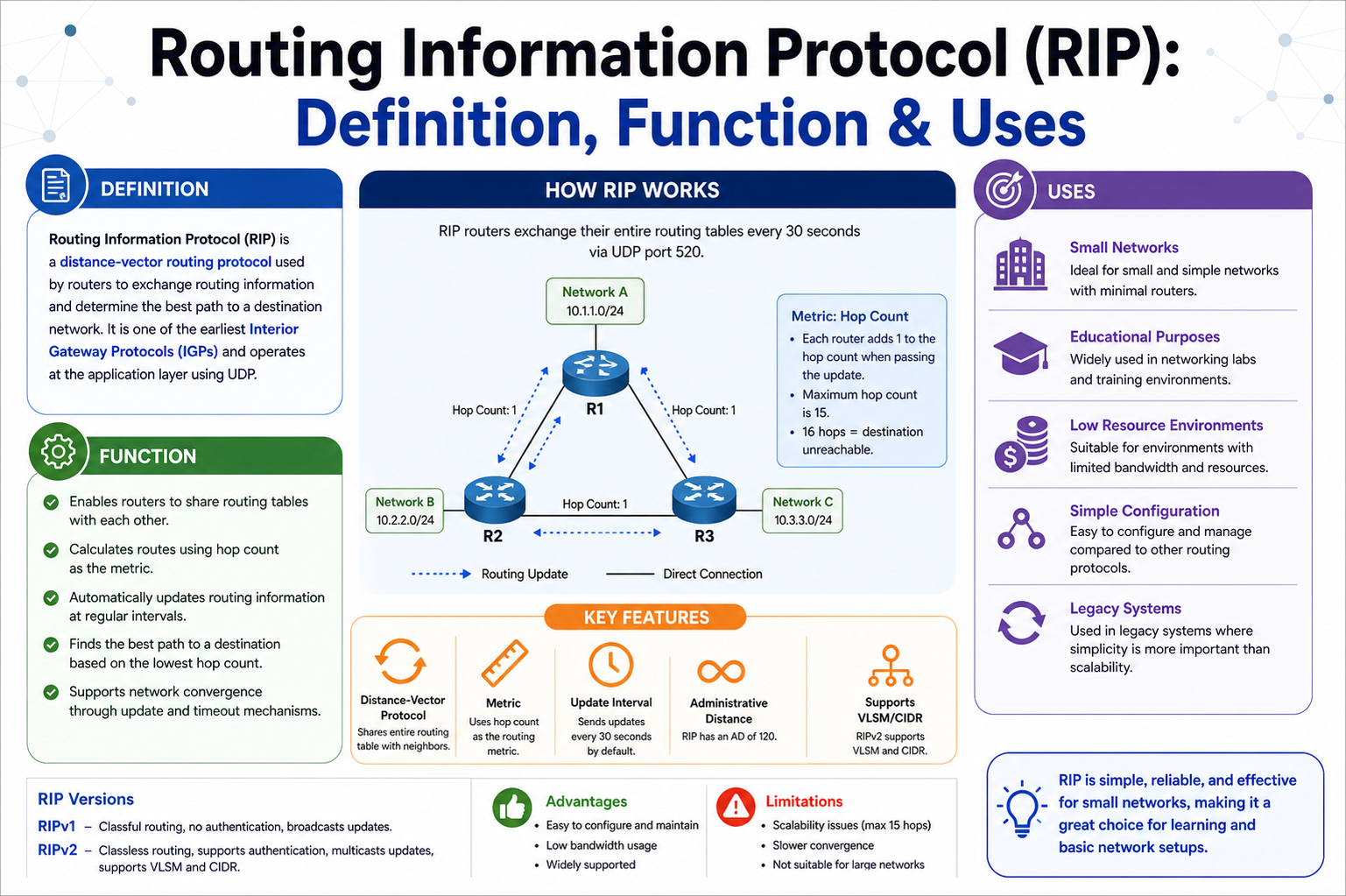
Routing Information Protocol, commonly known as RIP, is one of the earliest distance-vector routing protocols designed to help routers determine the most efficient path for sending data across interconnected networks. In simple terms, RIP allows routers to share information about network destinations and the number of hops required to reach them. A hop refers to each intermediate router a data packet passes through before reaching its final destination. The main idea behind RIP is straightforward: the path with the lowest hop count is considered the best route.
To understand RIP in a practical sense, imagine a situation where someone gives you directions to a location in an unfamiliar city. You might receive multiple possible routes, but you would naturally prefer the one with fewer stops or turns. RIP operates in a similar way by constantly evaluating available paths and selecting the shortest one based on hop count. It does not consider speed, bandwidth, or link quality, which makes it simple but limited compared to modern routing protocols.
Basic Concept of Routing Behavior in RIP
RIP functions on the principle that each router knows only about its directly connected networks at the beginning. It does not initially understand the entire network topology. Instead, routers exchange information with their neighboring routers at regular intervals. Through this continuous exchange, each router gradually builds a broader understanding of the network.
Each router maintains a routing table that stores information about reachable networks, the next hop required to reach them, and the associated hop count. As routers share updates, this table is continuously refined. If a router learns about a shorter path to a destination, it replaces the existing entry with the improved route. This ongoing process allows RIP to adapt to changes in the network, although not as quickly as more advanced protocols.
Despite its simplicity, RIP played a foundational role in the development of modern routing systems. It is still used in small or less complex networks where ease of configuration is more important than high performance or advanced optimization.
Real-World Analogy to Understand RIP Behavior
To better understand how RIP functions, imagine visiting a friend in a large apartment complex where you have never been before. You only know the building address, but not the exact apartment number or layout. Once inside, you realize that the building has confusing numbering, locked entrances, and multiple corridors.
In this scenario, routers behave similarly to someone trying to navigate that building without a map. Each router only knows its immediate neighbors but not the entire structure beyond them. RIP helps by allowing each router to share information about what it can see, gradually building a complete understanding of the building layout.
Without RIP, each router would remain isolated, unaware of distant networks. With RIP, routers communicate and exchange updates so that even distant destinations become reachable step by step. This makes RIP a foundational mechanism for enabling communication across multiple network segments.
Key Characteristics and Structure of RIP
RIP operates as a distance-vector routing protocol, meaning it determines routes based on distance measured in hops. It periodically sends updates to neighboring routers, typically at fixed time intervals. These updates include the full routing table, which contains destination networks and their associated hop counts.
Each entry in a RIP routing table includes essential details such as the destination network address, the next hop router, the metric (hop count), and a timer indicating route validity. If a route is not refreshed within a certain time period, it is considered invalid and eventually removed.
This periodic update mechanism ensures that routers remain synchronized with network changes. However, it also introduces overhead because routing tables are repeatedly shared even when no changes occur. Despite this inefficiency, the design remains simple and easy to implement, which is why RIP is still relevant in controlled environments.
Metric System and Route Selection in RIP
The most important decision-making factor in RIP is the hop count metric. Every time data passes through a router, the hop count increases by one. RIP selects the route with the lowest total hop count as the best path to a destination.
For example, if one route requires three hops and another requires five, RIP will choose the three-hop route. However, this simplicity also introduces limitations because RIP does not evaluate bandwidth, latency, or congestion levels. A shorter path may still be slower or less efficient in real-world conditions.
To prevent routing loops and incorrect path selection, RIP defines a maximum hop count of 15. Any route requiring more than 15 hops is considered unreachable. This limitation makes RIP suitable only for smaller networks where hop counts remain low.
Routing Information Base and Table Management
The Routing Information Base, often referred to as the routing table, is the core database used by RIP-enabled routers. It stores all known routes and helps determine how data packets should be forwarded.
Each time a router receives an update from a neighboring device, it compares the new information with its existing routing table. If the new route offers a lower hop count, it replaces the older entry. If a route becomes invalid or unreachable, it is removed after a certain timeout period.
This continuous update process ensures that routing decisions remain as accurate as possible within the limitations of RIP. The routing table evolves dynamically, reflecting changes in network topology as routers exchange information.
Periodic Updates and Network Communication
RIP relies heavily on periodic updates to maintain network consistency. Every router broadcasts its routing table to directly connected neighbors at regular intervals. These updates ensure that all routers gradually learn about available networks beyond their immediate connections.
When a router receives an update, it processes each entry and adjusts its own routing table accordingly. This mechanism allows RIP to spread network information step by step across multiple routers. Over time, even distant routers become aware of new destinations.
However, this periodic broadcasting can create unnecessary network traffic, especially in larger systems. Even when no changes occur, routers continue to send full updates, which reduces overall efficiency compared to more modern protocols.
Loop Prevention Techniques in RIP
One of the challenges in distance-vector protocols like RIP is the possibility of routing loops, where data packets circulate endlessly between routers. To address this issue, RIP uses several loop prevention techniques.
Split horizon is one such method, which prevents a router from advertising a route back to the same interface from which it was learned. This reduces the chance of circular routing information.
Another method is poison reverse, where a router actively marks a route as unreachable when sending it back in the direction it originated. This is done by assigning a high hop count value, signaling that the route should not be used.
Together, these techniques help stabilize the network and reduce the risk of incorrect routing decisions.
Transition from IPv4 RIP to RIPng for IPv6
RIP was originally designed for IPv4 networks, but with the introduction of IPv6, an updated version known as RIP Next Generation, or RIPng, was developed. RIPng maintains the same fundamental principles as RIP but is specifically designed to support IPv6 addressing.
While RIP focuses on IPv4 compatibility, RIPng extends support to the larger address space provided by IPv6. It operates similarly by using hop count as the metric and exchanging routing updates between routers.
However, RIPng simplifies configuration in IPv6 environments and is adapted to modern network requirements. It ensures that routers using IPv6 can still benefit from the simplicity and ease of RIP-based routing.
IPv6 Routing Behavior and Network Communication
In IPv6 networks, routers still begin with limited knowledge of the network topology. They only understand directly connected interfaces. Without a routing protocol like RIPng, a router cannot communicate with distant networks.
For example, a router may successfully communicate with a directly connected neighbor but fail to reach another router located further away through multiple hops. This limitation exists because routers do not automatically share network information.
RIPng solves this by enabling routers to advertise their connected networks to neighboring devices. As updates spread, each router gradually learns how to reach remote destinations. This process builds a complete routing view across the network.
Role of Interface Participation in RIPng
In RIPng, routing configuration is applied at the interface level. Each router interface must be explicitly enabled to participate in the routing process. Once enabled, the interface begins sending and receiving routing updates automatically.
This behavior ensures that only selected interfaces contribute to routing updates, providing better control over network design. As routers exchange information, they build a shared understanding of available paths.
Over time, RIPng allows all participating routers to maintain updated routing tables without manual configuration of each route. This automation simplifies network management, especially in environments where IPv6 is deployed across multiple segments.
Evolution and Continued Relevance of RIP
Although RIP is considered one of the oldest routing protocols, it still holds relevance in modern networking, especially in smaller or simpler network environments. Its straightforward design makes it easy to configure and understand, even for beginners in networking.
However, due to its limitations in scalability, convergence speed, and metric simplicity, RIP is often replaced by more advanced protocols in large-scale networks. Despite this, RIP and RIPng remain valuable for educational purposes and lightweight network deployments.
The transition from RIP to RIPng demonstrates how networking protocols evolve to support newer technologies while maintaining core principles of simplicity and accessibility.
Understanding RIPng Behavior in IPv6 Networks
RIP Next Generation, commonly referred to as RIPng, extends the principles of traditional RIP into IPv6 environments while preserving its simple distance-vector nature. In IPv6 networks, RIPng continues to rely on hop count as the primary metric for determining the best path between destinations. However, it adapts to the larger address space and modern protocol requirements introduced by IPv6. Instead of IPv4 broadcast methods, RIPng uses multicast communication to exchange routing information between routers efficiently.
RIPng operates by allowing each participating router interface to advertise directly connected networks to its neighbors. These advertisements include IPv6 prefixes, next-hop information, and hop counts. Over time, each router builds a complete routing table based on received updates. The core philosophy remains unchanged: the route with the lowest hop count is preferred, even though IPv6 introduces more complex addressing structures.
Unlike more advanced routing protocols, RIPng does not rely on complex topology calculations. Instead, it continues to function in a step-by-step propagation model, where routing knowledge spreads gradually across the network. This makes it easier to configure and maintain, especially in small to medium-sized IPv6 environments.
Configuration Philosophy Behind RIPng in Routers
Configuring RIPng in an IPv6 environment is fundamentally different from older RIP implementations used in IPv4. Instead of enabling the routing protocol globally and then assigning networks, RIPng is activated directly on router interfaces. This interface-based configuration model ensures that only selected network segments participate in routing updates.
When RIPng is enabled on an interface, that interface immediately begins sending and receiving routing advertisements. These updates allow routers to share information about connected IPv6 networks without requiring manual route definitions. Each interface becomes an active participant in the routing process, contributing to the overall routing topology discovery.
This design simplifies configuration in environments with multiple interconnected routers. Instead of maintaining large static routing tables, administrators only need to enable RIPng on relevant interfaces. Once activated, routers automatically handle the exchange of routing information and update their routing tables dynamically.
RIPng Packet Exchange and Communication Process
RIPng communicates using structured routing update messages that are exchanged between routers at regular intervals. These messages contain essential routing information, including IPv6 network prefixes, hop counts, and next-hop addresses. Instead of relying on broadcast transmissions, RIPng uses multicast addressing to send updates only to routers participating in the routing process.
Each router sends updates periodically, even if no network changes occur. This ensures that neighboring routers continue to confirm the availability of routes. When a router receives an update, it processes each entry and compares it with its existing routing table. If a better path is found, the routing table is updated immediately.
This continuous exchange of routing information ensures network consistency. However, it also introduces periodic overhead, as routers must repeatedly send full routing updates. Despite this inefficiency, the process remains simple and predictable, which aligns with the design philosophy of RIPng.
RIPng Timers and Route Stability Mechanism
RIPng uses several timers to maintain stability and ensure accurate routing information across the network. These timers control how often updates are sent, how long routes remain valid, and when expired routes should be removed. The most important timer is the update timer, which defines how frequently routing updates are transmitted between routers.
Another critical component is the invalid timer, which determines how long a route can remain in the routing table without receiving an update. If a route is not refreshed within the expected time, it is marked as invalid. After this, a hold-down process begins to prevent premature reuse of potentially incorrect routes.
Finally, the flush timer removes stale routes from the routing table completely. These timers work together to ensure that routing information remains consistent and outdated routes do not persist in the system. This mechanism helps maintain a stable network environment, even when topology changes occur.
Route Advertisement and IPv6 Prefix Handling
In RIPng, routing updates contain IPv6 prefixes instead of IPv4 addresses. Each advertisement includes the network prefix and the prefix length, which defines the size of the network segment. This allows routers to understand exactly which IPv6 networks are reachable through each neighbor.
When a router receives a route advertisement, it evaluates the hop count and determines whether the new route is more efficient than existing entries. If the advertised route offers a lower hop count, it replaces the current entry in the routing table. This ensures that traffic always follows the most efficient available path based on RIPng’s logic.
The use of IPv6 prefixes also makes RIPng compatible with the hierarchical structure of modern networks. It allows routers to handle large address spaces more efficiently, even though the underlying decision-making process remains simple and based on hop count.
Distance Vector Behavior in RIPng Networks
RIPng continues to follow the distance vector routing model, where each router maintains knowledge only of its neighbors and gradually learns about distant networks through updates. This means that routers do not have a complete view of the entire network topology. Instead, they rely on shared information from adjacent routers.
Each router periodically shares its routing table with neighbors, and these neighbors use the information to update their own tables. Over time, routing knowledge spreads across the network like a chain reaction. This incremental learning process defines the core behavior of distance vector protocols.
Although this method is easy to implement, it also introduces delays in convergence. When network changes occur, it may take several update cycles for all routers to reflect the new topology. Despite this delay, the simplicity of the model makes it suitable for smaller networks where rapid convergence is not critical.
Convergence Process in RIPng Networks
Convergence refers to the time it takes for all routers in a network to agree on a consistent routing state after a change occurs. In RIPng, convergence is relatively slow compared to modern routing protocols because updates are exchanged at fixed intervals and rely on hop count calculations.
When a network change occurs, such as a link failure or new connection, routers must wait for the next update cycle before learning about the change. This can temporarily result in inconsistent routing tables across the network. However, once updates propagate fully, all routers eventually reach a stable state.
The convergence process is further stabilized by loop prevention mechanisms, which ensure that incorrect routing information does not circulate indefinitely. Although slower, this predictable behavior makes RIPng easy to troubleshoot and understand in controlled environments.
RIPng Limitations in Modern IPv6 Networks
Despite its usefulness, RIPng has several limitations that restrict its use in large or complex networks. One of the primary limitations is its reliance on hop count as the only metric. This means that RIPng does not consider factors such as bandwidth, latency, or congestion when selecting routes.
Another limitation is its maximum hop count restriction. Any destination requiring more than 15 hops is considered unreachable. This makes RIPng unsuitable for large-scale networks with extended topologies.
Additionally, RIPng’s periodic update system generates unnecessary network traffic, even when no changes occur. This can lead to inefficiency in high-performance environments. These limitations highlight why RIPng is generally used only in small IPv6 networks or for educational purposes.
Troubleshooting RIPng Network Behavior
Troubleshooting RIPng involves verifying interface configuration, checking routing tables, and ensuring that routing updates are being exchanged properly. One of the first steps is to confirm that RIPng is enabled on all relevant interfaces. If an interface is not participating in RIPng, it will not send or receive routing updates.
Another important step is examining the routing table to verify that learned routes are present. If expected routes are missing, it may indicate a failure in update propagation or incorrect interface configuration.
Network administrators also check for connectivity between neighboring routers using basic connectivity tests. If routers cannot communicate directly, RIPng cannot exchange routing information. Identifying these issues early helps maintain stable routing behavior across the network.
Role of Neighbor Relationships in RIPng Operation
RIPng relies heavily on neighbor relationships between routers to function effectively. Each router must establish communication with directly connected neighbors to exchange routing updates. These relationships form the foundation of the routing process.
Once neighbor communication is established, routers begin sharing routing tables at regular intervals. Each router learns about networks beyond its immediate connections through these neighbors. Over time, this creates a chain of information flow across the entire network.
The strength of these relationships directly affects routing accuracy. If a neighbor becomes unreachable, its routes eventually expire and are removed from the routing table. This dynamic adjustment ensures that the network reflects current topology conditions.
Behavior of Equal-Cost Paths in RIPng
In some cases, RIPng may identify multiple paths to the same destination with equal hop counts. When this happens, both routes are installed in the routing table. This is known as equal-cost multipath behavior.
When multiple equal-cost paths exist, traffic can be distributed across these routes, improving overall network utilization. However, since RIPng does not consider bandwidth or performance differences, these paths are treated equally regardless of their actual efficiency.
This behavior allows basic load sharing in simple networks but lacks the intelligence found in more advanced routing protocols. Despite this limitation, it still provides a level of redundancy and fault tolerance in RIPng-based environments.
Summary of RIPng Operational Characteristics
RIPng maintains the core simplicity of traditional RIP while extending support for IPv6 networks. It relies on hop count as its primary metric, uses multicast-based updates, and operates through periodic routing exchanges between neighboring routers. Its interface-based configuration model simplifies deployment, especially in small-scale environments.
Although it lacks advanced features such as dynamic metric calculation and fast convergence, RIPng remains a useful protocol for understanding foundational routing concepts in IPv6 networking environments.
IPv6 Network Topology Behavior with RIPng
In an IPv6 environment, RIPng plays a key role in shaping how routers understand and share network topology information. Since routers initially only know about their directly connected interfaces, the overall network structure remains fragmented at the beginning. RIPng gradually resolves this limitation by allowing routers to exchange reachability information, enabling each device to build a progressively complete view of the network.
As routing updates propagate, each router learns about networks that are multiple hops away. This process is incremental, meaning that information spreads step by step rather than instantaneously. A router connected to one neighbor learns about that neighbor’s networks first, and then indirectly learns about networks further beyond through subsequent updates. This chain-like propagation defines how IPv6 routing knowledge is distributed in RIPng environments.
Because RIPng does not maintain a full topology map like link-state protocols, each router’s understanding of the network is always based on its latest received updates. This makes the system simple but also dependent on regular communication between routers to maintain accuracy.
Route Propagation and Information Sharing in RIPng
Route propagation in RIPng is based on continuous information sharing between neighboring routers. Each router periodically sends its entire routing table to adjacent devices. These updates contain IPv6 prefixes and hop count values that describe how far each destination is from the advertising router.
When a neighboring router receives this information, it evaluates each route and determines whether it offers a better path than its current entry. If the new route has a lower hop count, it replaces the existing route in the routing table. If not, it is ignored or stored as an alternative path depending on network conditions.
This propagation mechanism ensures that routing knowledge spreads gradually across the entire network. Even if a router is not directly connected to a destination, it can still learn about it through intermediate routers. Over time, this creates a complete routing picture across all participating devices.
Hop Count Behavior and Route Evaluation Logic
Hop count remains the central decision-making metric in RIPng. Every time a packet passes through a router, the hop count increases by one. This simple counting method determines the perceived distance between source and destination networks.
When a router receives multiple possible paths to the same destination, it compares hop counts and selects the route with the lowest value. If two routes have identical hop counts, both may be installed in the routing table as equal-cost paths.
However, hop count does not reflect actual network performance. A path with fewer hops may still be slower if it passes through congested or low-bandwidth links. Despite this limitation, hop count remains effective for small and predictable network environments where simplicity is more important than precision.
IPv6 Address Handling in RIPng Routing Updates
RIPng is designed specifically to handle IPv6 addressing structures, which differ significantly from IPv4. Instead of using 32-bit addresses, IPv6 uses 128-bit addresses expressed as long hexadecimal strings. RIPng simplifies this complexity by focusing on network prefixes rather than full host addresses.
Each routing update contains an IPv6 prefix and prefix length, which define the network segment being advertised. This allows routers to understand which portion of the address represents the network and which portion represents individual hosts.
When a router processes these updates, it stores only the necessary prefix information in its routing table. This reduces complexity and ensures that routing decisions are based on network-level information rather than individual host addresses.
Dynamic Learning Process in RIPng Networks
The learning process in RIPng is entirely dynamic and relies on continuous updates from neighboring routers. When a router first starts, its routing table contains only directly connected networks. It does not initially know about any remote destinations.
As updates begin to arrive, the router starts populating its routing table with new entries. Each update expands its knowledge of the network, allowing it to reach previously unknown destinations. This process continues until the router has learned about all reachable networks in the topology.
This dynamic learning approach makes RIPng easy to deploy because it does not require manual configuration of every route. However, it also means that routing information is always dependent on the latest update cycle, making the system sensitive to delays or interruptions in communication.
Route Aging and Expiration Mechanism
RIPng uses a route aging mechanism to ensure that outdated routing information does not remain in the system. Each route in the routing table is associated with a timer that tracks how long it has been since the last update was received.
If a router does not receive an update for a specific route within a defined time period, the route is marked as invalid. After this, it enters a hold-down state where it is temporarily suppressed to prevent incorrect routing decisions.
Eventually, if no updates are received, the route is completely removed from the routing table. This ensures that only active and valid routes remain in the system, preventing stale information from affecting network performance.
Impact of Network Changes on RIPng Convergence
When a network change occurs, such as a link failure or new connection, RIPng must adjust its routing tables accordingly. However, because updates are sent periodically, the system does not immediately reflect changes.
During this convergence period, routers may temporarily have inconsistent views of the network. Some routers may still use outdated routes until they receive updated information from neighbors. This delay is one of the key limitations of distance-vector protocols.
Once all updates are received and processed, the network eventually stabilizes. All routers then agree on the best available paths based on the latest information. Although convergence is slower, the process remains predictable and easy to manage.
Routing Table Synchronization Across IPv6 Routers
Routing table synchronization in RIPng occurs through repeated exchange of routing updates. Each router continuously compares received information with its local routing table and adjusts entries accordingly.
This synchronization process ensures that all routers maintain a relatively consistent view of the network over time. Even though updates are not instantaneous, repeated exchanges help align routing tables across the entire topology.
Synchronization also depends heavily on proper interface configuration. If an interface is not correctly participating in RIPng, it will not contribute to routing updates, which can lead to incomplete or inaccurate routing tables.
Equal Path Selection and Load Distribution Behavior
In RIPng, when multiple paths to the same destination have identical hop counts, the protocol allows all equal-cost routes to be installed in the routing table. This behavior provides basic load distribution across multiple paths.
Traffic can then be forwarded using any of the available equal-cost routes, depending on the router’s internal forwarding logic. This can help balance network usage across multiple links, improving overall efficiency in simple environments.
However, since RIPng does not evaluate link quality or bandwidth differences, all equal-cost paths are treated the same. This limits its ability to optimize traffic distribution in more complex or high-performance networks.
Effect of Link Failures in RIPng Networks
When a link failure occurs in a RIPng network, routers connected to that link immediately detect the loss of connectivity. However, other routers in the network only become aware of the failure when they stop receiving updates or receive updated routing information indicating the failure.
Once the failure is detected and propagated, routers update their routing tables to remove the affected route. Alternative paths, if available, are then selected based on hop count.
This recovery process is automatic but not immediate. The time required for full recovery depends on update intervals and network size. During this time, some packets may still attempt to use outdated routes before being redirected.
Scalability Constraints in RIPng Deployment
RIPng is designed with simplicity in mind, which naturally limits its scalability. As the network grows, the number of routing updates increases significantly, leading to higher bandwidth usage for control traffic.
Additionally, the hop count limitation restricts the maximum network diameter that RIPng can effectively support. Once networks exceed a certain size, routes may become unreachable simply due to hop count restrictions.
Because of these limitations, RIPng is generally used in small to moderately sized IPv6 networks where ease of configuration is more important than large-scale optimization.
Consistency of Routing Information Across Routers
Maintaining consistency of routing information is a continuous process in RIPng. Since routers rely on periodic updates, consistency is achieved over time rather than instantly.
Each router adjusts its routing table based on the most recent information received from neighbors. As updates continue to circulate, inconsistencies are gradually resolved, leading to a stable routing environment.
This method ensures eventual consistency across all routers, even though temporary differences may exist during network changes. The simplicity of this mechanism is one of the defining features of RIPng’s design philosophy.
Behavior of Neighbor Discovery in RIPng Networks
Neighbor discovery in RIPng is not automatic in the same way as in some advanced protocols. Instead, it depends on interface-level participation. Once RIPng is enabled on an interface, the router begins sending multicast updates to discover and communicate with adjacent routers.
These neighbor relationships form the foundation of routing information exchange. Each router relies on its neighbors to learn about remote networks and update its routing table accordingly.
If a neighbor becomes unreachable, the absence of updates eventually triggers route expiration and removal. This ensures that only active and reachable routers remain part of the routing process.
Stability Mechanisms in RIPng Operation
RIPng includes several stability mechanisms designed to prevent routing errors and maintain consistent network behavior. These include timers, route invalidation rules, and loop prevention techniques.
Together, these mechanisms ensure that routing information remains accurate even in the presence of network changes or temporary disruptions. While not as fast or intelligent as modern routing protocols, these stability features help maintain predictable behavior.
By combining periodic updates with simple decision-making rules, RIPng achieves a balance between ease of use and functional reliability in IPv6 environments.
Route Optimization Behavior in RIPng Networks
In RIPng-based IPv6 networks, route optimization is not based on advanced performance metrics but instead relies entirely on hop count evaluation and continuous route comparison. Each router receives multiple route advertisements from its neighbors and evaluates them using a simple decision process: the path with the lowest hop count is selected as the preferred route. This approach ensures simplicity but also limits intelligent optimization because factors such as bandwidth, delay, or congestion are not considered.
As routing updates propagate through the network, routers continuously refine their routing tables. If a newly learned route offers a shorter hop count to a destination, it replaces the existing entry. Over time, this creates a stable routing structure where all routers agree on the most efficient hop-based paths available within the topology. However, because updates occur periodically, optimization is always slightly delayed compared to real-time network conditions.
This behavior makes RIPng predictable but not adaptive in a performance-aware sense. It prioritizes ease of understanding and configuration over advanced traffic engineering capabilities, which is why it remains suitable mainly for smaller IPv6 deployments.
Interaction Between RIPng and Directly Connected Routes
In RIPng environments, directly connected routes always take precedence over learned routes. When a router interface is configured with an IPv6 address, that network is immediately installed in the routing table as a directly connected entry. These routes do not rely on RIPng updates because the router already has direct knowledge of them.
When RIPng begins operating, it complements these directly connected routes by advertising them to neighboring routers. This allows other devices in the network to learn about networks beyond their immediate reach. However, the router itself will always prefer directly connected routes over RIPng-learned routes when forwarding traffic.
This interaction ensures that local connectivity remains the most efficient path while still enabling broader network communication through RIPng. It creates a layered routing structure where direct knowledge is prioritized, and remote knowledge is gradually learned and integrated.
Behavior of Routing Updates During Network Stability
During stable network conditions, RIPng continues to send periodic updates even when no changes occur. These updates serve as confirmation messages that validate the ongoing availability of routes. Each router repeatedly advertises its routing table, reinforcing the network’s overall stability.
Even though no new information is being introduced during stable periods, these updates are essential for maintaining route freshness. They ensure that all routers remain synchronized and that outdated routes are not mistakenly retained. If a router stops receiving updates for a particular route, it assumes that the route is no longer valid and begins the expiration process.
This repetitive update mechanism provides a consistent but resource-consuming way of maintaining routing integrity. It ensures that all routers periodically reaffirm their knowledge of the network structure.
Role of Interface-Level Participation in Routing Accuracy
RIPng relies heavily on interface-level participation, meaning that routing accuracy depends on which interfaces are actively enabled for the protocol. Each interface that participates in RIPng becomes a source and receiver of routing information.
If an interface is misconfigured or not enabled for RIPng, it will not send or receive routing updates. This can lead to incomplete routing tables and unreachable destinations. Therefore, correct interface configuration is critical for maintaining routing accuracy.
Each participating interface contributes to the overall understanding of the network by advertising directly connected IPv6 prefixes. As a result, the completeness of routing knowledge in RIPng is directly tied to interface participation across all routers.
Route Advertisement Consistency Across Multiple Routers
In RIPng networks, multiple routers may advertise the same destination network. When this happens, receiving routers compare hop counts and determine the best available path. However, because different routers may advertise routes at different times, temporary inconsistencies can occur.
These inconsistencies are resolved over time as updates continue to propagate through the network. Eventually, all routers converge on a consistent set of routes based on the lowest hop counts available.
This process ensures eventual consistency but not immediate synchronization. The system gradually stabilizes as routing information spreads uniformly across all devices.
Handling of Network Redundancy in RIPng
RIPng supports basic network redundancy through equal-cost path selection. When multiple routes to the same destination have identical hop counts, all of them can be installed in the routing table. This allows traffic to be distributed across multiple paths.
This redundancy provides a level of fault tolerance because if one path becomes unavailable, traffic can still flow through alternative equal-cost routes. However, since RIPng does not evaluate link quality, all redundant paths are treated equally regardless of performance differences.
This simple redundancy mechanism improves availability but does not optimize efficiency. It ensures connectivity rather than performance-aware routing decisions.
Effect of Incremental Updates on Network Convergence
Network convergence in RIPng occurs incrementally as routing updates are exchanged between routers. Each update cycle contributes to refining the routing tables until all routers reach a consistent state.
Because updates are periodic, convergence is not immediate. Instead, it progresses in stages as information travels from one router to another. This step-by-step propagation can lead to temporary inconsistencies during network changes.
Once all updates have been fully processed, convergence is achieved, and all routers share a unified view of the network. This gradual process is a defining characteristic of distance-vector protocols like RIPng.
Route Poisoning and Failure Propagation Mechanism
When a network failure occurs in RIPng, routers begin propagating failure information through route poisoning. This involves marking the affected route with an unreachable metric, signaling to other routers that the destination is no longer valid.
As this poisoned route spreads through the network, routers update their routing tables to remove or invalidate the failed path. This prevents traffic from being sent into broken or unreachable links.
Route poisoning helps accelerate failure detection and reduces the risk of routing loops caused by outdated information. It ensures that network changes are communicated clearly, even in a simple protocol environment.
Stability of Routing Information Under Continuous Changes
In environments where network changes occur frequently, RIPng continuously adapts through repeated updates and route recalculations. However, because updates are periodic, the system may temporarily lag behind real-time conditions.
Despite this delay, RIPng maintains stability through its structured update and aging mechanisms. Routes are constantly refreshed, invalidated, or replaced based on the latest information received from neighbors.
This creates a stable but slowly adapting routing environment that prioritizes correctness over speed of reaction. While not ideal for highly dynamic networks, it performs reliably in stable or lightly changing environments.
Behavior of Multicast-Based Routing Updates in IPv6
RIPng uses multicast communication to distribute routing updates efficiently across IPv6 networks. Instead of sending updates to all devices, routers send them to a specific multicast group that includes only RIPng-enabled routers.
This reduces unnecessary network traffic and ensures that only relevant devices process routing information. Each router listens to this multicast group and responds with its own routing updates.
Multicast-based communication improves efficiency compared to traditional broadcast methods used in earlier protocols, making RIPng better suited for IPv6 environments while still maintaining simplicity.
Interaction Between RIPng and Network Topology Changes
When network topology changes occur, such as adding or removing routers, RIPng responds through its update and aging mechanisms. New routes are gradually learned, while old routes expire if they are no longer advertised.
This process allows RIPng to adapt to topology changes without requiring manual intervention. However, the adaptation is not instantaneous and depends on update intervals and timer expiration.
As a result, network topology changes are reflected in the routing table over time rather than immediately. This delay is a trade-off for simplicity and low configuration complexity.
Behavior of Hop Count Limitation in Large Networks
The hop count limitation in RIPng plays a significant role in defining its scalability boundaries. Since any route exceeding a hop count of 15 is considered unreachable, large networks may face routing limitations.
As network size increases, routes may exceed this threshold, causing certain destinations to become unreachable even if physical connectivity exists. This limitation restricts RIPng to smaller network environments.
While this constraint simplifies routing decisions, it also makes RIPng unsuitable for large-scale or complex IPv6 infrastructures where multiple routing paths and long-distance connectivity are required.
Final Conclusion
RIPng serves as a foundational routing protocol in IPv6 environments, offering a simple and predictable mechanism for route discovery and maintenance. Its reliance on hop count, periodic updates, and interface-based configuration makes it easy to deploy and understand.
Although it lacks advanced optimization and scalability features, RIPng effectively demonstrates core routing principles such as distance vector behavior, route propagation, and network convergence. It remains a useful protocol for small networks and educational environments where simplicity and clarity are more important than performance complexity.