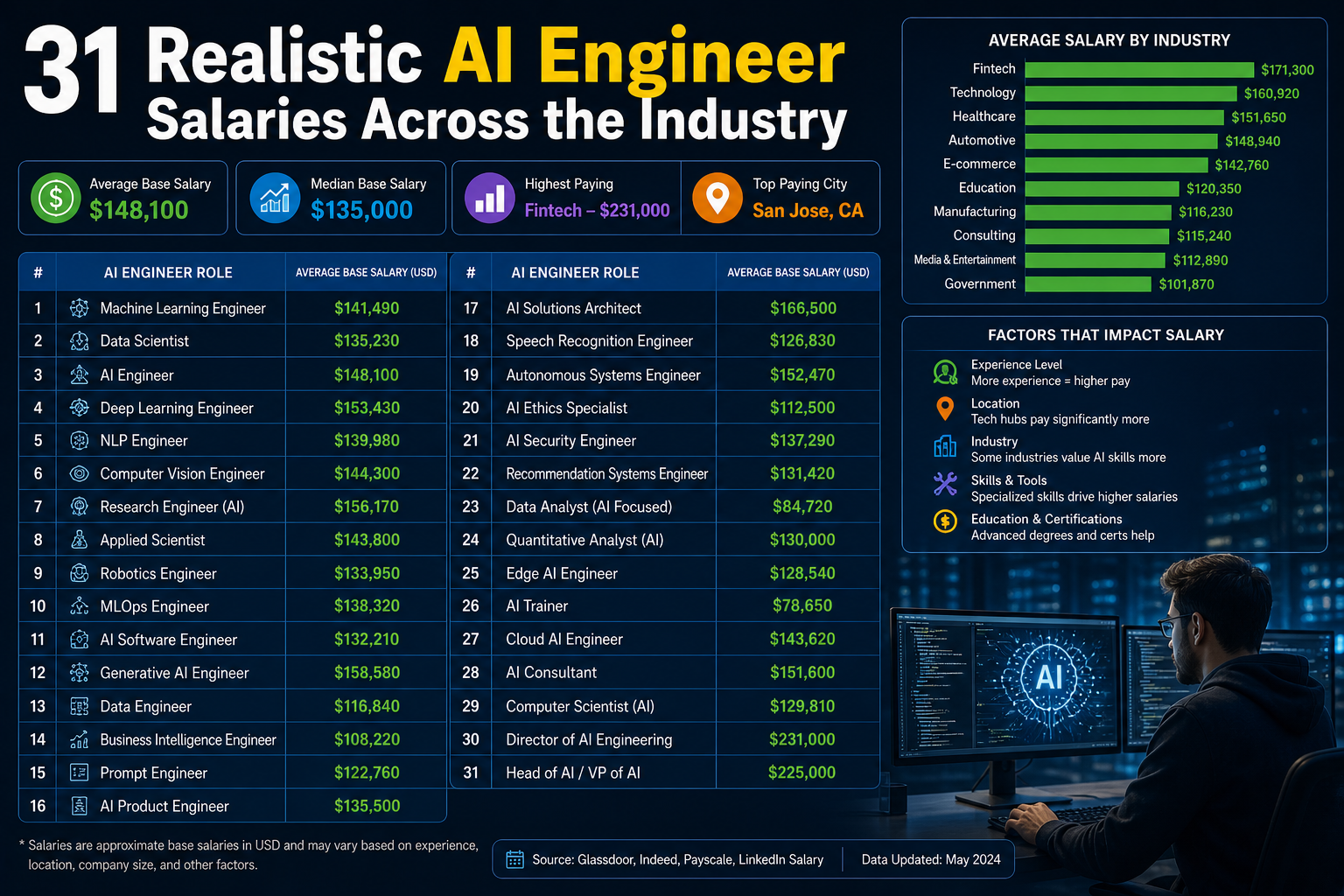
Artificial intelligence has moved far beyond experimental technology and is now deeply embedded in everyday digital systems. From recommendation engines on streaming platforms to voice assistants and autonomous systems, AI is quietly driving major innovations across industries. At the center of this transformation are AI engineers, professionals responsible for designing and deploying intelligent systems that can learn from data and make decisions.
As demand for AI-driven solutions continues to grow, companies are competing aggressively to hire skilled engineers who can build reliable and scalable machine learning systems. This demand has created one of the most competitive salary environments in the technology sector. AI engineering roles are now consistently ranked among the highest-paying jobs in software and data science fields.
Unlike traditional software roles, AI engineering requires a combination of programming expertise, mathematical understanding, and practical knowledge of machine learning systems. Because of this specialized skill set, compensation tends to be significantly higher than average tech roles, especially for engineers who can work on production-level AI systems.
However, salaries in this field are not fixed or universal. They vary widely depending on experience, technical specialization, industry demand, and the complexity of projects an engineer handles. Understanding these variations is key to evaluating what AI engineers actually earn in real-world scenarios.
What an AI Engineer Actually Does
An AI engineer is responsible for building systems that allow machines to perform tasks that normally require human intelligence. These tasks may include recognizing images, understanding natural language, predicting trends, or making automated decisions based on large datasets.
In practice, the work of an AI engineer is highly dynamic. It often begins with collecting and preparing data, which is one of the most important steps in any AI project. Clean and structured data is essential for training effective machine learning models. Engineers spend a significant portion of their time organizing datasets, handling missing values, and ensuring the data is suitable for analysis.
Once the data is ready, AI engineers design and train machine learning models. This involves selecting appropriate algorithms, adjusting parameters, and running experiments to improve accuracy. It is not a one-time task but an iterative process where models are continuously tested and refined.
After building a model, the next major responsibility is deployment. AI engineers integrate trained models into real-world applications such as websites, mobile apps, or enterprise systems. They also ensure that these models can handle real-time data and perform efficiently at scale.
Even after deployment, the job is not complete. AI systems require constant monitoring to maintain performance. Engineers evaluate model accuracy over time, retrain systems when necessary, and optimize performance based on new data patterns. This ongoing maintenance is critical in ensuring long-term reliability.
Core Skills Required for AI Engineering
AI engineering is a multidisciplinary field that requires a strong foundation in several technical areas. One of the most essential skills is programming, with Python being the most widely used language due to its simplicity and extensive machine learning libraries.
Beyond programming, a solid understanding of mathematics and statistics is crucial. Concepts such as probability, linear algebra, and calculus play a major role in designing and optimizing machine learning models. Without these foundations, it becomes difficult to understand how algorithms actually learn from data.
Machine learning knowledge is another core requirement. AI engineers must be familiar with different types of learning techniques, including supervised learning, unsupervised learning, and reinforcement learning. Each method is used for different types of problems, and choosing the right one is a key part of the job.
In addition to theoretical knowledge, practical experience with frameworks is essential. Tools like TensorFlow, PyTorch, and scikit-learn are commonly used to build and train models efficiently. These frameworks simplify complex processes and allow engineers to focus more on problem-solving rather than low-level implementation.
AI engineers also need familiarity with cloud computing platforms. Since most AI systems operate on large-scale infrastructure, knowledge of cloud environments is important for deploying and managing models effectively. Containerization tools and version control systems are also widely used to ensure smooth collaboration and deployment workflows.
Common AI Engineering Job Titles Explained
The field of AI engineering includes several job titles that may sound different but often involve overlapping responsibilities. While companies may use varying terminology, the core skill set remains largely the same.
One of the most common roles is Machine Learning Engineer. These professionals focus on designing and implementing machine learning models that can analyze data and make predictions. They often work closely with data scientists and software developers.
Another important role is Deep Learning Engineer. These engineers specialize in neural networks and advanced learning models used in applications such as image recognition, speech processing, and autonomous systems. Their work is often more computationally intensive and research-oriented.
Natural Language Processing (NLP) Engineers focus specifically on systems that understand and generate human language. This includes chatbots, translation systems, and text analysis tools. Their work is increasingly important with the rise of conversational AI technologies.
Applied AI Scientists also play a key role in bridging the gap between research and real-world applications. They focus on turning theoretical models into practical solutions that can be deployed in production environments.
Although these titles differ, they all fall under the broader category of AI engineering and share a common foundation in machine learning, data processing, and algorithm development.
How AI Engineers Fit Into Modern Industries
AI engineers are no longer limited to traditional technology companies. Their expertise is now required across a wide range of industries that rely on data-driven decision-making and automation.
In the technology sector, AI engineers build recommendation systems, search algorithms, and intelligent assistants. These systems directly influence user experience and business performance, making them highly valuable.
In finance, AI engineers develop fraud detection systems, risk assessment models, and automated trading algorithms. These applications require high accuracy and reliability, as they often deal with sensitive financial data.
Healthcare is another major industry where AI engineering plays a critical role. Engineers work on systems that assist in medical imaging analysis, disease prediction, and patient monitoring. These applications can significantly improve diagnostic accuracy and treatment outcomes.
The automotive industry also relies heavily on AI engineering for developing autonomous driving systems. These systems require complex models capable of processing real-time sensor data and making split-second decisions.
Even retail, entertainment, and logistics industries now depend on AI systems for customer personalization, inventory management, and supply chain optimization. This widespread adoption has significantly increased the demand for skilled AI engineers.
Understanding Salary Expectations at a High Level
AI engineering salaries are among the highest in the tech industry, but they are not uniform. On average, AI engineers tend to earn well into six-figure ranges, even at entry-level positions in competitive markets.
In general, early-career AI engineers can expect strong starting compensation compared to many other software roles. As experience increases, salaries grow significantly, especially for engineers who move into specialized or senior positions.
Mid-level professionals often see substantial salary growth as they gain experience in deploying real-world systems and managing complex machine learning pipelines. Senior AI engineers, particularly those working on large-scale or mission-critical systems, can command very high compensation packages.
It is also important to understand that total compensation may include bonuses, stock options, and other performance-based incentives. However, base salary remains the most consistent measure when comparing roles across different locations and companies.
The variation in salary is influenced not only by experience but also by the complexity of work and the level of responsibility assigned to the engineer.
Why AI Engineering Salaries Are Increasing Rapidly
One of the main reasons AI engineering salaries are rising is the rapid expansion of artificial intelligence across industries. As more companies integrate AI into their operations, the demand for skilled engineers continues to outpace supply.
Another factor is the complexity of the role itself. AI engineering requires a rare combination of software engineering, mathematics, and data science expertise. This makes it harder for companies to find qualified candidates, driving salaries higher.
Technological advancement also plays a role. As AI systems become more sophisticated, companies need engineers who can work with advanced models such as deep learning architectures and large-scale language models. These skills are still relatively specialized, which increases their market value.
In addition, AI is now seen as a strategic business advantage. Companies that successfully implement AI systems can improve efficiency, reduce costs, and increase revenue. As a result, they are willing to invest heavily in top engineering talent.
Key Factors That Influence AI Engineer Pay
Several important factors determine how much an AI engineer earns. Experience is one of the most significant. Engineers with more years in the field typically earn much higher salaries due to their ability to handle complex systems independently.
Specialization also plays a major role. Engineers who focus on high-demand areas such as deep learning, generative AI, or computer vision often earn more than those working in general machine learning roles.
Industry choice can significantly affect salary as well. Certain industries such as finance, healthcare, and autonomous systems tend to offer higher compensation due to the critical nature of their AI applications.
The type of projects an engineer works on also matters. Those involved in production-level systems that directly impact business outcomes are generally valued more than those working only on experimental models.
Finally, technical expertise with modern tools and frameworks can also influence pay. Engineers who are proficient in advanced machine learning platforms and cloud infrastructure are often seen as more valuable to employers.
AI Engineer Salaries Across Different U.S. Tech Hubs
AI engineer salaries vary significantly depending on location, and this is one of the strongest factors influencing total compensation. In major technology hubs where demand for AI talent is extremely high, salaries tend to rise well above national averages. These cities usually host large tech companies, startups, and research labs that compete aggressively for skilled engineers.
In regions like San Francisco, San Jose, and the broader Bay Area, AI engineers typically earn some of the highest salaries in the world. The concentration of artificial intelligence companies, venture-backed startups, and global tech giants creates a highly competitive job market. As a result, compensation packages in these areas often reflect both the cost of living and the scarcity of top-tier talent.
Seattle is another major hub where AI engineers are highly valued. With large technology employers and strong investment in cloud computing and AI infrastructure, salaries in this region remain consistently high. Engineers working here often benefit from a strong ecosystem of research-driven companies and production-scale AI systems.
New York also offers strong compensation for AI professionals, particularly in industries such as finance, media, and fintech. The demand for predictive modeling, algorithmic trading, and data-driven decision-making systems has made AI engineers essential in these sectors.
On the other hand, cities such as Austin, Denver, and Atlanta offer slightly lower salaries compared to coastal tech hubs, but they still provide strong earning potential. These cities are rapidly growing in terms of technology adoption and startup activity, which is increasing demand for AI talent at a steady pace.
In Midwest and Southern regions, salaries tend to be lower in absolute terms, but they often balance out due to reduced living costs. Cities like Cleveland, Kansas City, and Indianapolis may offer more modest compensation packages, but housing and daily expenses are significantly more affordable, which can improve overall financial comfort.
How Cost of Living Impacts AI Engineer Pay
One of the most important aspects of understanding AI engineer salaries is recognizing the relationship between income and cost of living. A higher salary in an expensive city does not always translate into greater financial freedom compared to a lower salary in a more affordable region.
In high-cost cities like San Francisco or New York, rent, transportation, and daily expenses can consume a large portion of income. Even though salaries may exceed $170,000 or more, disposable income can feel limited due to high living costs. However, these locations also offer access to top-tier companies, networking opportunities, and faster career growth.
In contrast, cities with lower costs of living allow engineers to maintain a higher quality of life on a smaller salary. Housing, food, and transportation expenses are significantly lower, which means even mid-range salaries can feel very comfortable. This is why many AI engineers are now considering remote work opportunities that allow them to earn big-city salaries while living in more affordable areas.
The rise of remote work has also started to blur geographic salary differences. Some companies adjust salaries based on location, while others offer standardized pay regardless of where the employee lives. This shift is gradually changing how compensation is structured in the AI industry.
Remote Work and Its Effect on AI Salaries
Remote work has had a major impact on AI engineering compensation trends. With many companies adopting distributed teams, engineers are no longer restricted to living in expensive tech hubs to access high-paying roles.
Some organizations still adjust salaries based on the employee’s location, but others offer location-independent pay structures. This means an AI engineer living in a lower-cost region may still earn close to what someone in a major city earns, depending on company policy.
This shift has created new opportunities for engineers worldwide, especially those outside traditional tech hubs. Skilled professionals can now access global job markets without relocating, which has increased competition but also expanded earning potential.
However, remote roles can also vary widely in compensation depending on company size, funding stage, and business model. Large tech companies often maintain structured pay bands, while startups may offer lower base salaries but compensate with equity or performance-based incentives.
Despite these variations, remote work has generally increased accessibility to high-paying AI roles and allowed engineers to optimize both income and lifestyle.
Entry-Level AI Engineer Salary Breakdown
At the beginning of their careers, AI engineers typically enter the field with strong compensation compared to many other technical roles. Even entry-level positions reflect the high demand for machine learning and data-driven skills.
Early-career engineers often focus on supporting data pipelines, assisting with model training, and working on smaller components of larger AI systems. They are usually supervised by more experienced engineers and gradually take on more responsibility as they gain experience.
At this stage, salary growth is heavily influenced by skill development. Engineers who quickly master machine learning frameworks, data processing techniques, and deployment tools tend to advance faster and receive higher compensation adjustments.
Entry-level roles also serve as a foundation for understanding real-world AI systems. Practical experience gained during this phase is often more valuable than academic knowledge alone, especially when transitioning into higher-paying roles later in the career path.
Mid-Level AI Engineer Compensation Growth
Mid-level AI engineers experience one of the most significant jumps in salary progression. At this stage, professionals typically have several years of hands-on experience building, deploying, and maintaining machine learning systems.
These engineers are expected to work more independently and often take ownership of entire components of AI projects. They may be responsible for designing models, optimizing performance, and ensuring that systems integrate smoothly with production environments.
Mid-level engineers also begin to take on mentorship roles, guiding junior engineers and contributing to team-level decision-making. This added responsibility often leads to increased compensation.
Salary growth at this level is strongly tied to the ability to solve complex problems and deliver measurable results. Engineers who can demonstrate impact through improved model performance, cost reduction, or system efficiency tend to progress faster in both role and salary.
Senior AI Engineer Salary Expectations
Senior AI engineers represent the highest tier of technical expertise within most organizations. These professionals are responsible for designing large-scale AI systems, making architectural decisions, and aligning technical solutions with business objectives.
At this level, engineers are not only expected to have deep technical knowledge but also strong leadership and communication skills. They often work closely with product managers, executives, and cross-functional teams to guide AI strategy.
Senior engineers typically work on complex systems such as large-scale recommendation engines, autonomous systems, or advanced natural language processing models. Their decisions can significantly influence company performance and long-term strategy.
Because of their high level of responsibility, senior AI engineers command some of the highest salaries in the tech industry. Compensation often reflects both technical expertise and leadership impact.
How Industry Choice Affects AI Salaries
The industry in which an AI engineer works plays a major role in determining salary levels. Some industries place a much higher financial value on AI expertise due to the critical nature of their operations.
The technology sector remains one of the highest-paying industries, particularly for companies focused on cloud computing, artificial intelligence platforms, and large-scale software systems. These organizations rely heavily on AI engineers to build core products.
The finance industry also offers extremely competitive salaries. AI engineers in this sector work on fraud detection, risk modeling, algorithmic trading, and financial forecasting systems. The financial impact of these models often justifies higher compensation.
Healthcare is another growing field for AI engineering. Engineers working in this industry develop systems for diagnostics, medical imaging, and patient data analysis. While salaries are competitive, they are often balanced by regulatory complexity and ethical considerations.
The defense and aerospace industries also invest heavily in AI talent. Engineers in these sectors may work on autonomous systems, surveillance technologies, and predictive defense models, often resulting in high compensation due to the sensitivity and complexity of the work.
Specialization and Its Impact on Earnings
Specialization is one of the most powerful drivers of salary growth in AI engineering. While general machine learning skills are valuable, deep expertise in specific areas can significantly increase earning potential.
Engineers specializing in deep learning often work with neural networks used in complex applications such as image recognition, speech processing, and generative AI systems. These roles tend to be highly technical and well-compensated.
Natural language processing specialists are also in high demand due to the growth of conversational AI systems, chatbots, and language models. As businesses increasingly rely on automated communication tools, NLP expertise has become extremely valuable.
Computer vision engineers focus on systems that interpret visual data, including facial recognition, object detection, and autonomous navigation. These skills are widely used in industries such as automotive, security, and retail.
More recently, specialization in generative AI and large language models has become one of the most lucrative areas in the field. Engineers with expertise in these systems are often among the highest paid due to rapid industry adoption.
Final Salary Trends Overview
Across all regions, industries, and experience levels, AI engineering remains one of the most financially rewarding career paths in technology. Salaries are influenced by a combination of technical skill, real-world experience, and the ability to deliver measurable business impact.
While location and industry set the baseline for compensation, specialization and hands-on expertise often determine how far an engineer can progress within salary ranges. As AI continues to evolve, demand for skilled professionals is expected to remain strong, further shaping salary trends in the coming years.
Career Progression Path of an AI Engineer
The career path of an AI engineer is typically structured but highly flexible depending on skills, specialization, and industry exposure. Unlike some traditional engineering roles, AI engineering evolves rapidly because the field itself is still expanding and changing. This creates multiple opportunities for engineers to move upward or laterally into more specialized roles.
Most professionals begin their journey in entry-level positions where the focus is on learning core machine learning concepts, working with datasets, and assisting in model development. At this stage, the emphasis is on building strong technical foundations rather than taking ownership of complex systems.
As engineers gain experience, they transition into mid-level roles where they begin to independently design and implement machine learning models. This is the stage where real impact becomes visible, as engineers contribute directly to product features, optimization, and system performance improvements.
Eventually, experienced professionals move into senior-level positions where they are responsible for architectural decisions, project leadership, and strategic AI implementation. At this point, the role is not just technical but also involves collaboration with business leaders to align AI systems with organizational goals.
Beyond senior roles, some engineers transition into specialized or leadership positions such as AI architect, machine learning lead, or technical manager. These roles focus more on guiding teams, designing large-scale systems, and shaping long-term AI strategies.
There is also a growing trend of AI engineers moving into research-oriented positions, particularly in organizations that focus on advanced machine learning, generative models, and artificial general intelligence research. These roles often require deep academic knowledge and strong mathematical expertise.
The Role of Specialization in Salary Growth
Specialization plays a major role in determining how quickly an AI engineer’s salary grows. While general machine learning knowledge is important, deep expertise in specific domains can significantly increase earning potential and career opportunities.
One of the most valuable specializations today is deep learning, which focuses on neural networks capable of handling complex data such as images, audio, and text. Engineers in this area often work on high-impact systems like recommendation engines and autonomous technologies.
Another highly sought-after specialization is natural language processing. With the rise of conversational AI, chatbots, and large language models, companies are investing heavily in engineers who can build systems that understand and generate human language effectively.
Computer vision is another important area of specialization. Engineers in this field work with visual data, enabling machines to interpret images and videos. Applications include facial recognition, medical imaging, surveillance systems, and autonomous vehicles.
Generative AI has recently become one of the fastest-growing and highest-paying specializations. Engineers working in this space develop models that can create text, images, audio, and even code, making it one of the most innovative areas in artificial intelligence.
Reinforcement learning is also a niche but valuable specialization, particularly in robotics, gaming, and decision-making systems. Although fewer roles exist in this area, they often come with strong compensation due to the complexity involved.
Industry-Specific Salary Differences
Different industries value AI engineers differently based on how critical artificial intelligence is to their operations. This leads to significant variations in salary even among engineers with similar skills and experience.
The technology industry remains the dominant employer of AI engineers. Companies in this sector rely heavily on machine learning systems for search engines, recommendation algorithms, cloud services, and digital platforms. As a result, salaries are often highly competitive.
The financial sector is another major employer of AI engineers. Banks, investment firms, and fintech companies use AI for fraud detection, algorithmic trading, credit scoring, and risk management. Because these systems directly impact financial outcomes, compensation is often higher than average.
Healthcare organizations are increasingly adopting AI for diagnostics, patient monitoring, and predictive healthcare systems. While salaries in this industry are competitive, they are sometimes influenced by regulatory requirements and longer development cycles.
The automotive industry offers high-paying opportunities for engineers working on autonomous driving systems and advanced driver assistance technologies. These systems require highly complex models that process real-time sensor data.
Defense and aerospace sectors also provide strong compensation packages due to the sensitive nature of the work. AI engineers in these industries often work on surveillance systems, simulation models, and strategic decision-making technologies.
Retail, logistics, and media industries also employ AI engineers, although compensation in these fields may vary depending on company size and AI maturity level.
Tools That Shape an AI Engineer’s Career Value
The tools an AI engineer masters can significantly influence both productivity and salary growth. Employers place high value on engineers who are proficient with modern machine learning frameworks and scalable deployment systems.
Python remains the most important programming language in AI engineering due to its simplicity and strong ecosystem. Most machine learning libraries and frameworks are built around Python, making it essential for almost all AI roles.
Machine learning frameworks such as TensorFlow and PyTorch are widely used for building and training models. Engineers who are proficient in both frameworks are often more competitive in the job market.
Scikit-learn is commonly used for traditional machine learning tasks such as classification, regression, and clustering. It is especially popular in early-stage model development and prototyping.
For natural language processing tasks, tools like Hugging Face Transformers and spaCy are essential. These libraries allow engineers to work with large language models and advanced text processing systems.
In computer vision, OpenCV remains one of the most widely used libraries for image processing and analysis. It is commonly used in applications involving object detection and image recognition.
Cloud platforms also play a major role in modern AI engineering. Services like AWS, Google Cloud, and Microsoft Azure provide infrastructure for training and deploying machine learning models at scale.
DevOps tools such as Docker and Kubernetes are essential for deploying AI systems reliably. These tools ensure that models can be moved between environments without compatibility issues.
Experiment tracking tools like MLflow and Weights & Biases help engineers monitor model performance and manage multiple iterations during development.
Certifications and Their Impact on Salary
While certifications are not mandatory in AI engineering, they can significantly improve job prospects and salary potential. They demonstrate validated expertise in specific tools, platforms, or methodologies.
Cloud certifications are among the most valuable in the AI field. Certifications from major providers like AWS, Google Cloud, and Microsoft Azure are highly respected because many AI systems are deployed in cloud environments.
Machine learning-specific certifications also carry strong value. These certifications typically focus on model building, data processing, and deployment strategies, which are essential skills for AI engineers.
Framework-based certifications, such as those focused on TensorFlow or PyTorch, help engineers demonstrate practical experience with widely used deep learning tools.
General data science certifications can also be useful, especially for engineers transitioning into AI from related fields. These certifications often cover statistical analysis, data manipulation, and basic machine learning concepts.
In addition to technical certifications, management-focused credentials can help engineers move into leadership roles. These certifications are useful for those aiming to become AI project managers or technical leads.
How Experience Level Shapes Career Growth
Experience remains one of the strongest determinants of salary progression in AI engineering. As engineers gain more hands-on exposure to real-world systems, their ability to solve complex problems improves significantly.
Early-career engineers focus primarily on learning and supporting existing projects. Their work is often guided by senior team members, and their responsibilities are limited to specific components of larger systems.
As engineers move into mid-level roles, they begin to take ownership of entire projects or system components. They are expected to work independently and contribute directly to product development and system optimization.
Senior engineers are responsible for high-level decision-making, system architecture, and cross-team collaboration. Their role often involves ensuring that AI systems align with business objectives and perform reliably at scale.
Experience also influences negotiation power. Engineers with proven track records of successful project delivery are more likely to secure higher salaries and better compensation packages.
The Importance of MLOps in Modern AI Careers
MLOps, or machine learning operations, has become one of the most important areas in AI engineering. It focuses on the deployment, monitoring, and maintenance of machine learning models in production environments.
Engineers who understand MLOps are highly valuable because they can bridge the gap between model development and real-world application. This includes ensuring that models remain accurate, scalable, and efficient after deployment.
MLOps involves working with CI/CD pipelines, model versioning, automated retraining systems, and monitoring tools. Engineers with these skills are often more competitive in the job market.
Companies increasingly prefer engineers who can manage the full lifecycle of an AI system rather than just building models in isolation. This has made MLOps expertise a strong factor in salary growth.
AI Engineer Salary Growth Potential Over Time
Salary growth in AI engineering is generally strong compared to many other technical fields. Engineers who continuously upgrade their skills and adapt to new technologies tend to experience steady income increases over time.
The most significant jumps in salary often occur when engineers transition from mid-level to senior roles. This is typically when they begin leading projects and making architectural decisions.
Additional salary increases can come from switching companies, especially in competitive tech markets where demand for experienced AI engineers is high.
Specialization in emerging technologies also plays a major role in long-term salary growth. Engineers who stay ahead of industry trends often find themselves in high-demand roles with premium compensation.
Advanced Strategies to Increase AI Engineer Salary
AI engineering is one of those fields where salary growth is not only tied to experience but also to strategic career decisions. Engineers who actively plan their career path often earn significantly more than those who simply rely on time-based progression.
One of the most effective strategies is developing deep expertise in high-demand areas. Fields such as generative AI, large language models, and autonomous systems are evolving rapidly, and companies are willing to pay a premium for engineers who can contribute meaningfully in these domains.
Another powerful approach is gaining strong production-level experience. Many engineers can build models in experimental environments, but fewer can successfully deploy and maintain them at scale. Those who understand system reliability, performance optimization, and real-world deployment challenges are highly valued.
Taking ownership of impactful projects is also a key factor. Engineers who work on systems that directly influence revenue, customer experience, or operational efficiency tend to receive faster promotions and higher compensation increases.
Building a strong portfolio of real-world achievements can also significantly influence salary negotiations. Employers are more likely to offer competitive compensation to engineers who can clearly demonstrate measurable impact from past projects.
Negotiation Tactics for Higher Compensation
Salary negotiation plays a crucial role in maximizing earnings as an AI engineer. Even small improvements in negotiation outcomes can lead to significant long-term financial differences.
One important strategy is understanding market value before entering negotiations. Engineers who research salary ranges across industries, roles, and locations are better equipped to justify their compensation expectations.
Another effective tactic is highlighting measurable impact rather than just responsibilities. Employers respond more strongly to achievements such as improved model accuracy, reduced processing time, or cost savings achieved through AI systems.
Timing also matters in negotiations. Engineers often secure better offers when switching companies, as external moves tend to come with more aggressive compensation packages compared to internal raises.
In addition, having multiple job offers can significantly strengthen negotiation power. When employers know that a candidate has competing opportunities, they are more likely to increase their offer.
Soft skills such as communication and confidence also play a role. Being able to clearly articulate technical contributions in business terms makes engineers more persuasive during salary discussions.
The Role of Open Source and Research Contributions
Open source contributions and research work can have a strong influence on an AI engineer’s career trajectory and earning potential. These activities help engineers build credibility beyond their immediate job roles.
Contributing to open source AI frameworks or libraries allows engineers to demonstrate technical expertise to a global audience. It also helps them gain visibility within the AI community, which can lead to job opportunities and higher-paying roles.
Publishing research papers or technical articles can further enhance professional reputation. Engineers who contribute to advancements in machine learning theory or applied AI systems are often seen as thought leaders in the field.
Participation in conferences, workshops, or AI competitions also strengthens a professional profile. These experiences showcase problem-solving ability and technical depth, both of which are highly valued by employers.
In many cases, engineers with strong public portfolios receive better job offers, even if their formal work experience is similar to others in the field.
Future Trends Impacting AI Engineer Salaries
The future of AI engineering is expected to have a direct impact on salary structures and career opportunities. As artificial intelligence continues to evolve, new areas of specialization and demand are emerging rapidly.
One major trend is the rise of large-scale foundation models. These models require significant computational resources and advanced engineering skills, increasing demand for engineers who can work with distributed systems and high-performance computing.
Another important trend is the expansion of AI into everyday business operations. More companies are integrating AI into customer service, marketing, logistics, and internal decision-making systems. This widespread adoption is increasing the need for skilled engineers across industries.
The growth of responsible AI is also shaping future roles. Engineers who understand fairness, transparency, and ethical AI design are becoming increasingly valuable as regulations and public scrutiny increase.
Automation of machine learning processes is another emerging trend. Tools that simplify model building are evolving, but they also increase demand for engineers who can manage end-to-end systems rather than just building models.
Edge AI and real-time processing systems are also gaining importance. These systems require engineers who can optimize models for low-latency environments such as mobile devices, IoT systems, and autonomous machines.
As these trends continue, the demand for highly skilled AI engineers is expected to remain strong, which will likely keep salaries competitive across the industry.
Common Career Mistakes That Limit Salary Growth
While AI engineering offers strong earning potential, certain mistakes can slow down salary progression significantly.
One common mistake is staying too long in roles without growth opportunities. Engineers who remain in the same position without expanding their responsibilities often experience slower salary increases.
Another issue is focusing only on theoretical knowledge without gaining practical experience. Employers place high value on engineers who can deploy and maintain real systems, not just those who understand algorithms.
Avoiding specialization can also limit earning potential. Generalists may have broader skills, but specialists in high-demand areas often command higher salaries.
Neglecting communication and collaboration skills is another mistake. AI engineers frequently work with cross-functional teams, and those who cannot clearly explain technical concepts may face slower career advancement.
Failing to keep up with new tools and technologies can also impact salary growth. The AI field evolves quickly, and outdated skills can reduce competitiveness in the job market.
Long-Term Career Paths Beyond AI Engineering
AI engineering can also serve as a foundation for several advanced career paths. Many professionals eventually move into roles that extend beyond traditional engineering responsibilities.
One common path is becoming an AI architect. In this role, engineers focus on designing large-scale AI systems and ensuring that different components work together efficiently.
Another option is transitioning into machine learning leadership or engineering management. These roles involve managing teams, overseeing projects, and aligning technical work with business strategy.
Some engineers move into research scientist roles, particularly in organizations that focus on advanced machine learning, deep learning, and artificial intelligence theory. These positions often require strong mathematical and academic backgrounds.
Others choose entrepreneurial paths, using their AI expertise to build startups or develop AI-driven products. This path can offer significant financial upside but also involves higher risk.
Consulting is another option, where experienced AI engineers provide expertise to multiple companies on a project basis. This can be highly lucrative, especially for specialists in niche areas.
Final Conclusion
AI engineering stands out as one of the most rewarding and fast-growing careers in the modern technology landscape. Salaries are consistently high due to strong demand, limited supply of skilled professionals, and the increasing importance of artificial intelligence across industries.
Earning potential in this field is influenced by multiple factors, including experience, specialization, industry, and technical expertise. Engineers who continuously upgrade their skills and adapt to new technologies are best positioned for long-term financial growth.
While location and company type still matter, the most significant drivers of salary growth are hands-on experience, deep specialization, and the ability to deliver real-world impact through AI systems.
As artificial intelligence continues to expand into new areas of business and society, the value of skilled AI engineers is expected to rise further, making this one of the most promising career paths in technology today.