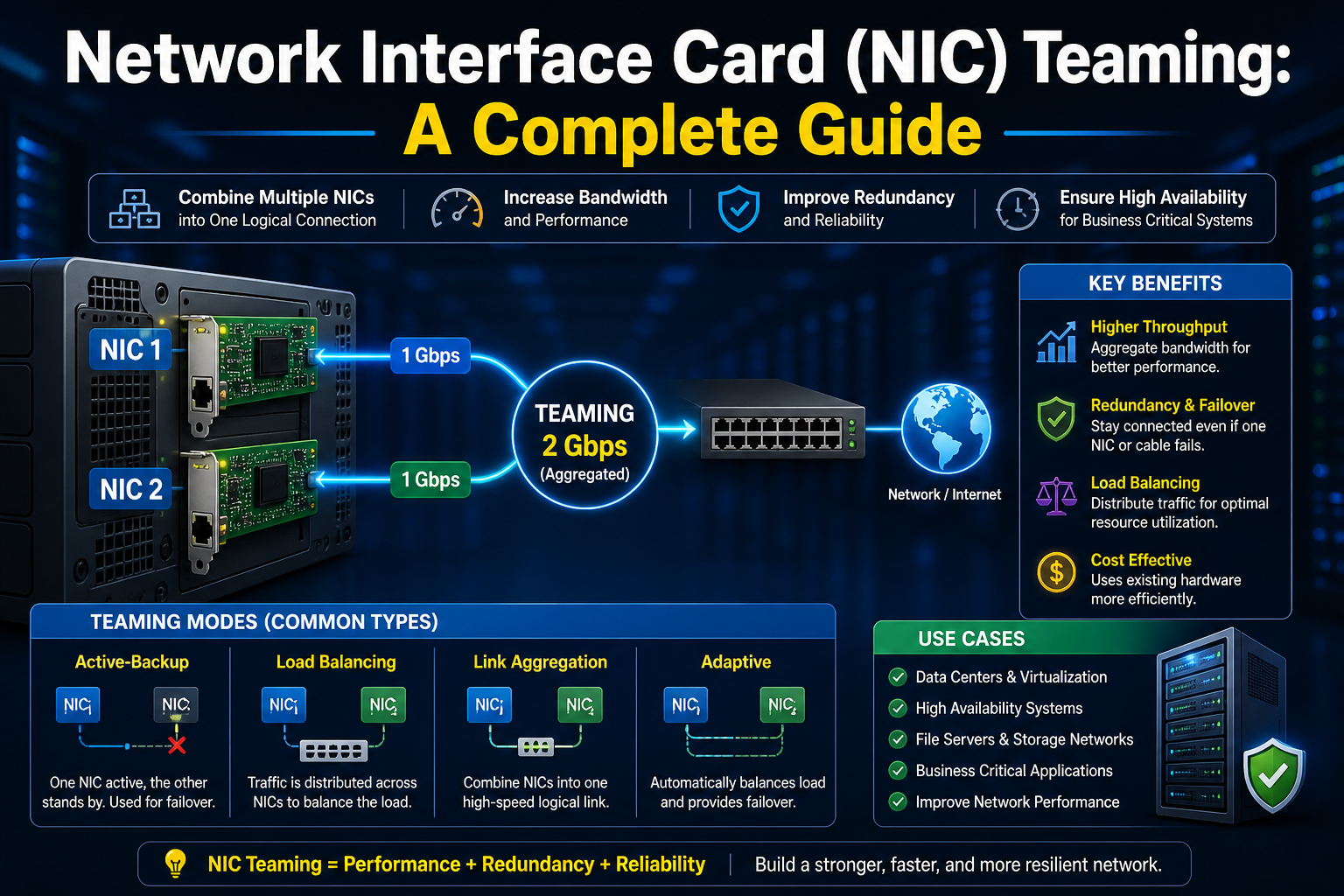
NIC Teaming is a networking technique used in modern IT infrastructures to improve both performance and reliability by combining multiple network interface cards into a single logical unit. In simple terms, instead of relying on just one network card inside a server or computer, multiple NICs are grouped together so they function as one coordinated connection. This approach is widely used in enterprise environments where network uptime and speed are critical for daily operations. As organizations depend more on data-driven systems, cloud applications, and continuous online services, the demand for stable and high-speed connectivity has increased significantly, making NIC teaming an important part of network design.
Core Concept of Network Interface Card Teaming
At its core, NIC teaming is based on the idea of resource aggregation. Each network interface card installed in a system acts as a communication channel between the device and the network. When these channels are combined, they create a single logical interface that can handle traffic more efficiently than a single NIC alone. The operating system treats this group of physical NICs as one unified connection, even though multiple hardware components are actively working behind the scenes. This abstraction allows network traffic to be distributed intelligently, ensuring that no single interface becomes a bottleneck while also providing backup support if one of the interfaces stops working.
Why Organizations Use NIC Teaming
Organizations adopt NIC teaming primarily to solve three major challenges in networking: limited bandwidth, reliability concerns, and system downtime. In high-traffic environments such as data centers, even a small network delay can impact applications, user experience, and business operations. By combining multiple NICs, the available bandwidth increases, allowing more data to flow simultaneously. At the same time, redundancy ensures that if one network card fails, the others continue handling traffic without interruption. This reduces dependency on a single hardware component and significantly improves the resilience of the entire system.
Key Advantages in Enterprise Environments
One of the most important benefits of NIC teaming is increased network throughput. When multiple NICs work together, they collectively handle more data than a single interface could manage alone. This is especially useful for servers running virtualization, database management, or large-scale web applications. Another major advantage is fault tolerance, which ensures continuous connectivity even during hardware failures. If one NIC becomes unavailable due to a fault or maintenance issue, the remaining NICs automatically take over its workload. Additionally, NIC teaming supports better load distribution, allowing traffic to be shared across all available interfaces instead of overloading one connection.
How NIC Teaming Improves Network Stability
Network stability is a critical requirement in enterprise systems, and NIC teaming plays a major role in achieving it. Instead of relying on a single connection path, the system uses multiple pathways simultaneously. This reduces the risk of downtime caused by hardware failure or unexpected disruptions. In practical terms, this means that even if a cable is disconnected or a network card malfunctions, the system remains online and operational. The transition between active and backup connections happens automatically, without requiring manual intervention, ensuring seamless continuity of services.
Basic Architectural Overview of NIC Teaming
The architecture of NIC teaming involves three main components working together: physical network interfaces, a logical team interface, and the operating system’s networking layer. The physical NICs are the actual hardware components installed in the system. These are grouped into a team, which is then represented as a single logical interface to the operating system. This logical interface is what applications and services interact with, meaning they are unaware of the multiple physical connections working behind the scenes. The operating system manages how traffic is distributed across the NICs based on predefined rules, ensuring efficient utilization of resources.
Role of the Operating System in NIC Teaming
The operating system plays a central role in managing NIC teaming. It is responsible for grouping the network interfaces, controlling traffic distribution, and monitoring the health of each NIC. Once a team is created, the OS assigns it a single IP address, making it appear as one network connection to external systems. It also continuously checks the status of each NIC in the team. If one interface fails or becomes unstable, the operating system automatically redirects traffic to the remaining active interfaces. This intelligent management ensures that the system remains stable and responsive even under changing network conditions.
Importance of Redundancy in Network Design
Redundancy is one of the foundational principles behind NIC teaming. In traditional single-NIC setups, the failure of a network card can result in complete network downtime. This can disrupt services, cause data loss, and negatively impact business operations. NIC teaming eliminates this single point of failure by introducing multiple network paths. These redundant paths ensure that there is always an alternative route available for data transmission. As a result, systems become more resilient, and the risk of unexpected outages is significantly reduced.
Bandwidth Enhancement Through Multiple Interfaces
One of the most noticeable improvements offered by NIC teaming is enhanced bandwidth. When multiple NICs are combined, the total available bandwidth increases, allowing the system to handle larger volumes of network traffic. This does not necessarily mean that a single data stream becomes faster, but rather that multiple data streams can be processed simultaneously without congestion. This is particularly beneficial in environments where multiple users or applications are accessing the network at the same time, such as virtualized servers or enterprise application platforms.
Traffic Distribution in Teamed Networks
NIC teaming uses intelligent traffic distribution techniques to ensure that network load is shared efficiently. Instead of sending all traffic through a single NIC, the system divides the workload across all available interfaces. This balancing act helps prevent congestion and improves overall performance. Different methods can be used to determine how traffic is distributed, often based on factors like source and destination addresses or transport-level information. The goal is to ensure that no single interface becomes overloaded while others remain underutilized.
Enterprise Use Cases of NIC Teaming
In enterprise environments, NIC teaming is commonly used in servers that host critical applications, virtualization platforms, and storage systems. These systems require high availability and consistent performance, making NIC teaming an ideal solution. Data centers, in particular, rely heavily on this technology to maintain continuous service delivery. Even in cases where hardware failures occur, services remain uninterrupted due to the redundancy built into the network design. This makes NIC teaming an essential component in modern IT infrastructure planning.
Foundation for High Availability Systems
High availability systems are designed to remain operational with minimal downtime, even in the event of hardware or software failures. NIC teaming contributes directly to this goal by ensuring that network connectivity is always maintained. Since network access is a critical part of most applications, having multiple NICs working together significantly increases system reliability. This foundation allows businesses to build more robust infrastructures that can handle unexpected disruptions without affecting end users.
Relationship Between NIC Teaming and Network Efficiency
Network efficiency is improved through better utilization of available hardware resources. Instead of relying on a single NIC that may become a bottleneck under heavy traffic, NIC teaming spreads the workload across multiple interfaces. This ensures that no single component is overwhelmed while others remain idle. The result is a more balanced and efficient network environment where hardware resources are fully utilized, and performance is optimized across all active connections.
Evolution of NIC Teaming in Modern Systems
Over time, NIC teaming has evolved from a specialized enterprise feature to a widely supported networking capability in most modern operating systems. Earlier implementations required complex configuration and vendor-specific tools, but today it is more integrated and user-friendly. Many server operating systems now include built-in support for creating and managing NIC teams. This evolution reflects the growing importance of network reliability and performance in today’s digital infrastructure, where downtime and slow connectivity are no longer acceptable.
Advanced Concepts in NIC Teaming Configuration
NIC Teaming becomes significantly more powerful when its advanced configuration options are understood and applied correctly. Beyond simply combining multiple network interface cards, modern systems allow administrators to define how those interfaces behave under different traffic conditions. These configurations determine how efficiently the network resources are utilized and how resilient the system remains during failures. Advanced NIC teaming is not just about adding bandwidth; it is about intelligently managing data flow, optimizing performance, and ensuring consistent service delivery across all connected systems.
Switch-Independent NIC Teaming Explained
Switch-independent NIC teaming is a configuration where the teamed network interfaces do not require special coordination from the network switch. In this setup, each NIC operates independently at the switch level, while the operating system manages traffic distribution internally. This approach provides flexibility because it can be implemented without requiring advanced switch configurations or specialized hardware support. It is commonly used in environments where network infrastructure is already in place and administrators want to improve reliability without modifying switch settings. The key advantage of this mode is its simplicity and ease of deployment, making it suitable for general-purpose server environments.
Switch-Dependent NIC Teaming Explained
Switch-dependent NIC teaming, on the other hand, requires coordination between the server and the network switch. In this configuration, the switch is aware that multiple physical connections belong to a single logical group. This allows for more advanced features such as Link Aggregation Control Protocol behavior and improved traffic management at the hardware level. Because both the switch and the server work together, this setup can deliver higher efficiency and more consistent performance. However, it requires compatible hardware and proper configuration on both ends, making it more suitable for controlled enterprise environments such as data centers.
Understanding Link Aggregation in Networking
Link aggregation is a foundational concept behind NIC teaming. It refers to the process of combining multiple physical network links into a single logical link. This logical link is treated as one high-capacity connection, even though it is made up of multiple physical pathways. The main purpose of link aggregation is to increase throughput and provide redundancy. When implemented correctly, it allows multiple data streams to be transmitted simultaneously while maintaining a stable and reliable connection. This concept is widely used in enterprise networking because it significantly enhances both performance and fault tolerance.
Role of Logical Interfaces in NIC Teaming
When multiple NICs are combined into a team, the operating system creates a logical interface that represents the entire group. This logical interface acts as the communication point for all network traffic. Applications and services do not interact directly with individual NICs; instead, they communicate through this unified interface. This abstraction simplifies network management and ensures that changes in physical hardware do not affect application-level connectivity. The logical interface is assigned a single IP address, which further reinforces the idea that the system is operating as one cohesive network unit.
Traffic Flow Mechanisms in Teamed NICs
Traffic flow in NIC teaming is controlled through intelligent distribution mechanisms. When data is sent or received, the system determines which physical NIC should handle the traffic based on predefined rules. These rules may consider factors such as source and destination IP addresses, port numbers, or protocol types. By analyzing these parameters, the system ensures that traffic is evenly distributed across available interfaces. This prevents congestion on any single NIC and improves overall network efficiency. The flow of traffic is continuously adjusted based on current network conditions.
Load Distribution Principles in Network Interfaces
Load distribution is one of the most important aspects of NIC teaming. It ensures that no single network interface becomes overloaded while others remain underutilized. The system continuously evaluates the amount of traffic passing through each NIC and adjusts routing decisions accordingly. In some configurations, load distribution is static, while in others it is dynamic and adapts in real time. Dynamic load distribution is more efficient in environments with unpredictable traffic patterns because it can respond to changes instantly and maintain optimal performance.
Importance of Redundancy in Teamed Networks
Redundancy is a core principle of NIC teaming and plays a critical role in maintaining network availability. In a single-NIC setup, any hardware failure can lead to a complete loss of connectivity. However, in a teamed configuration, multiple NICs ensure that there is always an alternative path for data transmission. If one NIC fails, the remaining interfaces automatically take over the workload without requiring manual intervention. This seamless failover capability is essential in environments where downtime is not acceptable, such as financial systems, cloud services, and enterprise applications.
Failover Behavior in NIC Teaming Systems
Failover behavior refers to the system’s ability to switch traffic from a failed network interface to an operational one. This process happens automatically and is designed to be transparent to users and applications. When a NIC stops responding or experiences a fault, the system detects the issue and reroutes traffic to the remaining active interfaces. The speed and efficiency of this failover process depend on the configuration and the underlying hardware. Properly configured systems can switch over almost instantly, ensuring uninterrupted connectivity.
Active-Active and Active-Passive Configurations
NIC teaming supports different operational modes, including active-active and active-passive configurations. In an active-active setup, all NICs in the team are actively handling network traffic at the same time. This maximizes bandwidth utilization and ensures balanced load distribution. In contrast, an active-passive configuration designates one NIC as the primary interface while others remain on standby. The passive interfaces only become active if the primary NIC fails. Each configuration has its own advantages, with active-active focusing on performance and active-passive prioritizing simplicity and stability.
Dynamic Load-Based NIC Teaming
Dynamic load-based teaming is an advanced method where traffic distribution is continuously adjusted based on real-time network conditions. Instead of relying on fixed rules, the system monitors the performance of each NIC and assigns traffic accordingly. If one interface becomes heavily loaded, the system shifts new traffic to less utilized NICs. This adaptive approach ensures optimal performance even in highly variable network environments. It is particularly useful in modern data centers where workloads can change rapidly.
Role of MAC Address and IP-Based Distribution
Different algorithms are used to determine how traffic is distributed across NICs. MAC address-based distribution uses hardware addresses to create routing decisions, ensuring consistent traffic flow between specific devices. IP-based distribution uses source and destination IP addresses to determine how packets are assigned to different interfaces. These methods help maintain session consistency, meaning that traffic from a specific communication session is often routed through the same NIC. This improves stability and reduces the likelihood of packet reordering issues.
Transport Layer Influence in NIC Teaming
Some NIC teaming configurations take transport layer information into account when distributing traffic. This includes details such as TCP and UDP port numbers. By analyzing transport layer data, the system can make more precise decisions about how to distribute traffic. This is especially useful in environments where multiple applications are running simultaneously and require separate network handling. Transport-based distribution helps improve efficiency by ensuring that related data flows remain consistent across the same interface.
Introduction to LACP in NIC Teaming
Link Aggregation Control Protocol is a widely used standard that allows network devices to automatically manage link aggregation. It enables switches and servers to negotiate and maintain aggregated links without manual configuration for each connection. LACP ensures that all participating interfaces are properly synchronized and capable of handling traffic as a unified group. This improves both reliability and performance while reducing configuration complexity in large-scale networks.
Importance of Consistent Network Behavior
Consistency in network behavior is critical for applications that depend on stable connections. NIC teaming helps achieve this consistency by ensuring that traffic is distributed according to predictable rules. Even when multiple interfaces are active, the system maintains a stable connection profile for each communication session. This prevents issues such as packet loss, session drops, or uneven performance, which can negatively impact application behavior.
Foundation for Scalable Network Infrastructure
NIC teaming also plays a key role in building scalable network infrastructures. As organizations grow, their network demands increase significantly. Instead of replacing existing hardware, NIC teaming allows administrators to scale performance by simply adding more network interfaces to a team. This makes it a cost-effective solution for improving network capacity without major infrastructure changes. It provides a flexible foundation that can adapt to increasing demands over time.
Transition Toward Intelligent Network Management
Modern NIC teaming is evolving toward more intelligent and automated network management systems. Instead of relying solely on static configurations, newer implementations use adaptive algorithms that respond to real-time network conditions. This shift reflects the growing complexity of enterprise networks and the need for smarter traffic management solutions. As a result, NIC teaming is no longer just a hardware optimization technique but a key component of intelligent infrastructure design.
Load Balancing Algorithms in NIC Teaming
Load balancing algorithms are the core intelligence behind NIC Teaming, determining how network traffic is distributed across multiple network interface cards. These algorithms decide which NIC handles which portion of data, ensuring that no single interface becomes overloaded while others remain idle. In enterprise environments, selecting the right load balancing method is crucial because different applications generate different traffic patterns. Some systems produce many small requests, while others transfer large continuous streams of data. The algorithm chosen directly impacts performance, stability, and efficiency of the entire network setup.
Dynamic Load Distribution Method
Dynamic load distribution is an advanced approach where traffic allocation is continuously adjusted based on real-time network conditions. Instead of relying on fixed rules, the system monitors traffic flow and automatically shifts workloads to the least congested NIC. This ensures that all network interfaces are utilized efficiently. When one NIC becomes heavily loaded, new traffic is redirected to other available interfaces. This method is especially useful in environments where traffic patterns change frequently, such as virtualized servers, cloud applications, and high-traffic enterprise systems. It helps maintain smooth performance even under unpredictable workloads.
Transport Port-Based Distribution Strategy
Transport port-based distribution uses TCP and UDP port information to make routing decisions. Each network packet contains port details that identify the type of service or application generating the traffic. The system uses this information to create a routing pattern, ensuring that packets belonging to the same session follow a consistent path. This improves connection stability and reduces the risk of packet reordering. It is particularly useful in environments where multiple applications are running simultaneously, as it helps maintain separation and consistency between different types of network traffic.
IP Address-Based Load Balancing Approach
IP address-based load balancing relies on the source and destination IP addresses of network packets. The system creates a hash based on these addresses and assigns traffic to specific NICs accordingly. This ensures that communication between the same source and destination pair consistently uses the same network interface. It helps improve session stability and reduces overhead caused by switching interfaces mid-communication. This method is commonly used in server environments where predictable and consistent routing behavior is required for application performance and reliability.
MAC Address-Based Traffic Distribution
MAC address-based distribution uses hardware-level addressing to determine how traffic is allocated across NICs. Since MAC addresses are unique identifiers assigned to network interfaces, they provide a stable basis for routing decisions. The system creates a mapping between source and destination MAC addresses and assigns traffic accordingly. This approach ensures consistent behavior at the data link layer and is often used in environments where low-level network control is important. It provides a simple yet effective method of distributing traffic without relying heavily on higher-layer protocols.
Role of Hashing in Load Balancing
Hashing plays a central role in NIC Teaming load balancing techniques. A hash function takes input data such as IP addresses, MAC addresses, or port numbers and converts it into a fixed value. This value is then used to determine which NIC should handle the traffic. The advantage of hashing is that it produces consistent results for the same input, ensuring that similar traffic flows are always routed through the same interface. This helps maintain session consistency while distributing overall network load across multiple NICs.
Understanding Active-Active Teaming Mode
Active-active teaming mode allows all network interfaces in the team to actively participate in handling traffic at the same time. This configuration maximizes performance by utilizing the full capacity of all available NICs. Instead of keeping some interfaces idle, the system distributes traffic evenly across all active connections. This improves bandwidth utilization and reduces congestion. Active-active mode is commonly used in high-performance environments such as data centers and virtualization platforms where maximum throughput is required.
Active-Passive Teaming Configuration
Active-passive configuration operates differently by designating one NIC as the primary active interface while keeping others in standby mode. The standby NICs do not handle traffic unless the active interface fails. When a failure occurs, one of the passive NICs immediately takes over, ensuring uninterrupted connectivity. This setup prioritizes stability and simplicity over maximum performance. It is often used in environments where reliability is more important than bandwidth, such as critical application servers or systems requiring strict uptime guarantees.
Hyper-V Port-Based NIC Teaming
Hyper-V port-based teaming is specifically designed for virtualization environments. It distributes network traffic based on virtual switch ports assigned to virtual machines. Each virtual machine is treated as a separate network entity, and traffic is assigned to NICs accordingly. This ensures that virtual workloads are balanced effectively across physical network interfaces. It improves performance in virtualized infrastructures by preventing bottlenecks and ensuring that virtual machines receive stable and consistent network connectivity.
Understanding Link Aggregation Control Protocol Behavior
Link Aggregation Control Protocol behavior allows network devices to dynamically manage aggregated links between switches and servers. It ensures that all participating network interfaces are properly synchronized and functioning as part of a single logical group. LACP continuously monitors link health and automatically adjusts configurations if a link becomes unavailable. This reduces manual configuration effort and improves network reliability by ensuring that all active connections are properly maintained and balanced.
Failover Mechanisms in NIC Teaming
Failover mechanisms ensure that network connectivity is maintained even when one or more NICs fail. When a failure is detected, traffic is immediately rerouted to the remaining active interfaces. This process is automatic and typically occurs within milliseconds, making it nearly invisible to users and applications. Failover mechanisms are essential in maintaining high availability in enterprise systems. They eliminate single points of failure and ensure continuous network operations under all conditions.
Traffic Redistribution After NIC Failure
When a NIC fails, the system must quickly redistribute traffic among the remaining interfaces. This redistribution process involves recalculating load balancing decisions and updating routing tables to reflect the new network structure. The system ensures that no active session is interrupted during this transition. Instead, ongoing communication continues through alternative NICs without requiring reconnection. This seamless transition is one of the key strengths of NIC Teaming in maintaining service continuity.
Importance of Redundant Network Paths
Redundant network paths are essential for ensuring continuous communication between systems. NIC Teaming creates multiple physical paths for data transmission, reducing dependency on any single connection. If one path becomes unavailable, others remain operational and take over the workload. This redundancy is critical in environments where network downtime can result in financial loss, service disruption, or data inconsistency. It provides a safety layer that enhances the overall resilience of network infrastructure.
Bandwidth Optimization Through Distribution Techniques
Bandwidth optimization is achieved by distributing traffic evenly across all available NICs. Instead of allowing one interface to become saturated, NIC Teaming ensures that all interfaces contribute to data transmission. This balanced approach improves overall throughput and reduces latency. It also allows systems to handle larger volumes of traffic without performance degradation. Bandwidth optimization is particularly important in environments with high data transfer requirements such as backup systems and cloud storage platforms.
Impact of Traffic Patterns on Team Performance
The effectiveness of NIC Teaming depends heavily on traffic patterns. Different applications generate different types of network load. Some produce steady streams of data, while others generate bursts of small packets. Load balancing algorithms must adapt to these patterns to maintain efficiency. Poorly matched configurations can lead to uneven distribution and reduced performance. Understanding traffic behavior is therefore essential for optimizing NIC Teaming setups in real-world environments.
Scalability Considerations in NIC Teaming
NIC Teaming provides a scalable approach to network design. As network demands increase, additional NICs can be added to existing teams to expand capacity. This scalability allows organizations to grow their infrastructure without redesigning their entire network architecture. It offers a flexible solution that adapts to changing requirements over time. Scalability is particularly valuable in cloud computing and enterprise environments where workloads can grow rapidly.
Performance Monitoring in Teamed Networks
Monitoring performance is essential to ensure that NIC Teaming configurations operate efficiently. Key metrics such as bandwidth usage, packet loss, latency, and interface utilization must be continuously observed. Monitoring tools help administrators identify bottlenecks and optimize configurations. By analyzing performance data, adjustments can be made to load balancing algorithms or failover settings to improve overall efficiency. Continuous monitoring ensures that the network remains stable and responsive under varying conditions.
Evolving Role of NIC Teaming in Modern Infrastructure
NIC Teaming has evolved from a basic redundancy technique into a sophisticated network optimization strategy. Modern implementations focus not only on improving bandwidth and reliability but also on intelligent traffic management and automation. As networks become more complex, NIC Teaming continues to play a vital role in ensuring performance, stability, and scalability. It remains a foundational technology in enterprise networking and is essential for supporting modern digital infrastructures.
Monitoring NIC Team Performance in Real Environments
Monitoring NIC Teaming is essential to ensure that the configuration continues to deliver expected performance and reliability. In real-world enterprise systems, network conditions are constantly changing due to user activity, application demands, and infrastructure load. Without proper monitoring, issues like uneven traffic distribution, interface bottlenecks, or silent failures can go unnoticed. Administrators typically track key performance indicators such as bandwidth utilization, packet loss, latency, and interface health. These metrics help identify whether the NIC team is operating efficiently or requires adjustment to maintain optimal network performance.
Importance of Bandwidth Utilization Tracking
Bandwidth utilization is one of the most important metrics in NIC Teaming environments. It indicates how much network capacity is being used at any given time. By analyzing this data, administrators can determine whether traffic is evenly distributed across all NICs or if certain interfaces are handling more load than others. Uneven utilization may indicate misconfigured load balancing algorithms or unexpected traffic patterns. Proper monitoring ensures that no single NIC becomes a bottleneck while others remain underused, allowing the full capacity of the network infrastructure to be leveraged effectively.
Packet Loss and Its Impact on Team Efficiency
Packet loss occurs when network packets fail to reach their destination, often due to congestion, hardware issues, or faulty configurations. In NIC Teaming setups, packet loss can significantly impact performance because it may indicate that one or more NICs are malfunctioning or overloaded. Continuous packet loss monitoring helps administrators detect early signs of instability. If a specific interface consistently drops packets, it may need to be removed from the team or replaced. Maintaining low packet loss is critical for ensuring smooth and reliable communication across networked systems.
Latency Monitoring in Teamed Networks
Latency refers to the time it takes for data to travel from source to destination. In NIC Teaming environments, latency can be affected by how traffic is distributed across multiple interfaces. If load balancing is not optimized, some NICs may experience higher delays than others. Monitoring latency helps ensure that traffic is being routed efficiently and that no unnecessary delays are introduced. In high-performance systems such as virtualization platforms or database servers, even small increases in latency can impact application responsiveness and user experience.
CPU Utilization in NIC Teaming Operations
Although NIC Teaming primarily focuses on network interfaces, it also has an impact on CPU usage. The operating system must continuously manage traffic distribution, monitor interface health, and handle failover events. This processing requires CPU resources. In poorly optimized configurations, CPU overhead can become noticeable and affect overall system performance. Monitoring CPU utilization helps ensure that NIC Teaming processes are not consuming excessive system resources. Efficient configurations minimize CPU load while maintaining high network performance.
Tools Used for NIC Team Monitoring
Various tools are available to monitor NIC Teaming performance, ranging from built-in operating system utilities to advanced third-party solutions. Operating systems often provide basic monitoring features that display interface status, traffic statistics, and error logs. In addition, enterprise-grade monitoring platforms offer more detailed insights, including real-time analytics, historical performance data, and predictive alerts. These tools help administrators visualize network behavior and identify potential issues before they impact system performance. Effective monitoring tools are essential for managing large-scale network environments.
Alert Systems for Network Failures
Alert systems play a critical role in NIC Teaming management by notifying administrators of potential issues. These alerts can be triggered by events such as NIC failure, high packet loss, abnormal latency, or interface disconnection. When properly configured, alerts ensure that problems are detected immediately rather than discovered after service disruption occurs. Early detection allows for faster response times and reduces the risk of extended downtime. In enterprise environments, automated alerts are often integrated with centralized monitoring dashboards for real-time visibility.
Troubleshooting NIC Teaming Issues
Troubleshooting NIC Teaming involves systematically identifying and resolving issues that affect network performance or stability. The process typically begins with checking physical connections to ensure that all cables and hardware components are properly connected. Next, administrators verify driver compatibility to ensure that all NICs are using updated and supported drivers. If issues persist, switch configurations are examined to confirm compatibility with the selected teaming mode. Finally, load balancing settings are reviewed to ensure that traffic distribution aligns with network requirements.
Role of Physical Connectivity in Network Stability
Physical connectivity is the foundation of any NIC Teaming setup. Even the most advanced configurations cannot function properly if cables are damaged or improperly connected. Loose connections, faulty cables, or defective ports can lead to intermittent connectivity issues and performance degradation. Ensuring proper physical installation and regular inspection of network hardware is a basic but essential step in maintaining a stable NIC Teaming environment. Without reliable physical connections, higher-level configurations become ineffective.
Driver Compatibility and System Performance
Network interface drivers play a crucial role in NIC Teaming performance. Drivers act as communication bridges between hardware and the operating system. Outdated or incompatible drivers can cause instability, reduced performance, or even complete failure of teaming configurations. Ensuring that all NICs are running the latest supported drivers is essential for maintaining system reliability. In enterprise environments, driver updates are typically tested before deployment to prevent compatibility issues that could disrupt network operations.
Switch Configuration Verification
In switch-dependent NIC Teaming setups, switch configuration is a critical factor. The network switch must be properly configured to support link aggregation and coordinated traffic handling. Misconfigured switches can lead to packet loss, traffic loops, or inconsistent performance. Administrators must ensure that switch ports are correctly grouped and that protocols like link aggregation are properly enabled. Regular verification of switch settings helps maintain alignment between server configurations and network infrastructure.
Load Balancing Optimization Techniques
Optimizing load balancing is essential for achieving maximum efficiency in NIC Teaming environments. This involves selecting the most appropriate algorithm based on traffic patterns and application requirements. Some environments benefit from IP-based distribution, while others perform better with port-based or dynamic methods. Optimization also includes monitoring real-time performance and adjusting configurations as needed. Proper load balancing ensures that all NICs are utilized effectively, preventing congestion and improving overall network throughput.
Importance of Proactive Network Maintenance
Proactive maintenance is essential for keeping NIC Teaming systems running smoothly. Instead of reacting to failures, administrators regularly monitor performance, update drivers, review configurations, and test failover scenarios. This proactive approach reduces the likelihood of unexpected downtime and ensures consistent network performance. Maintenance also includes reviewing traffic patterns and making adjustments as system demands evolve. In enterprise environments, proactive maintenance is a key strategy for ensuring long-term network stability.
Testing Failover Scenarios for Reliability
Testing failover scenarios is an important part of validating NIC Teaming configurations. By simulating NIC failures, administrators can verify that traffic is properly redirected to backup interfaces. These tests ensure that redundancy mechanisms are functioning correctly and that there are no unexpected interruptions during real failures. Regular failover testing builds confidence in the system’s reliability and helps identify weaknesses before they affect production environments.
Documentation and Configuration Management
Proper documentation is essential for managing NIC Teaming setups effectively. Detailed records of configurations, hardware specifications, load balancing settings, and network diagrams help administrators understand system behavior and troubleshoot issues more efficiently. Documentation also supports future upgrades and expansions by providing a clear reference point. In large environments, configuration management becomes critical for maintaining consistency across multiple systems and preventing configuration drift.
Common Issues in NIC Teaming Environments
Common issues in NIC Teaming include uneven traffic distribution, misconfigured switches, driver incompatibility, and hardware failures. These problems can lead to reduced performance or connectivity disruptions. Identifying these issues early through monitoring and diagnostics is essential for maintaining system stability. Many of these problems can be prevented through proper planning, regular updates, and adherence to best practices in network configuration.
Best Practices for Long-Term Stability
Long-term stability in NIC Teaming environments is achieved through consistent application of best practices. Using compatible hardware, maintaining updated drivers, properly configuring load balancing algorithms, and regularly testing failover systems are all essential steps. Additionally, continuous monitoring and proactive maintenance ensure that the system adapts to changing network demands. Following these practices helps organizations maintain reliable, high-performance network infrastructure over time.
Final Conclusion
NIC Teaming has become a fundamental component of modern network design, providing both performance improvements and high availability. By combining multiple network interfaces into a single logical system, organizations can achieve greater bandwidth, improved reliability, and seamless failover capabilities. Its role in enterprise environments continues to grow as networks become more complex and demand for uninterrupted connectivity increases. Proper implementation, monitoring, and optimization of NIC Teaming ensure that it delivers maximum value in supporting critical digital infrastructure.