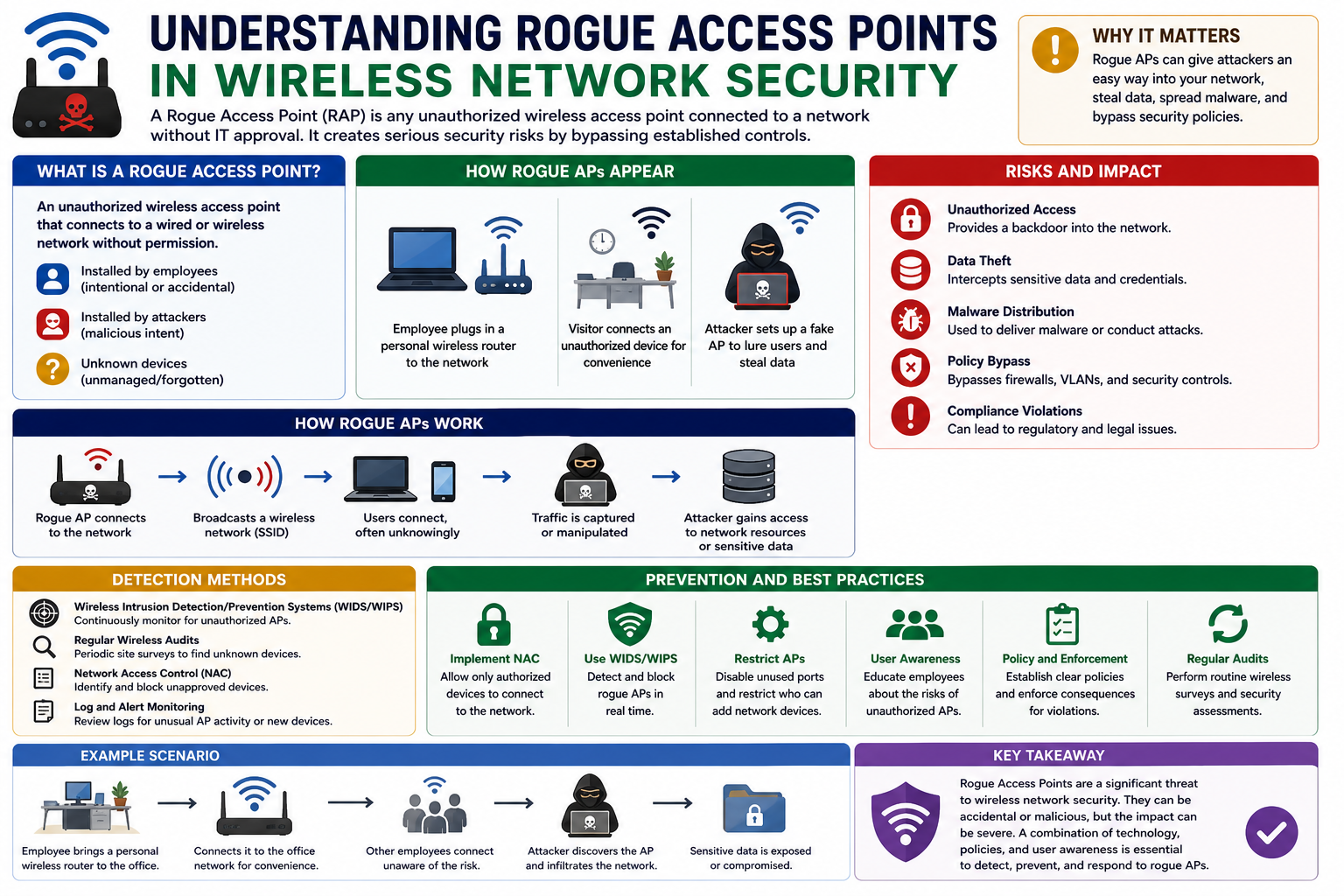
A rogue access point is an unauthorized wireless access point that is connected to a network without the permission or knowledge of the network administrator. It creates a hidden entry point into a secure environment and can expose sensitive data, systems, and users to serious security threats. These access points are often introduced either accidentally by internal users or intentionally by attackers who aim to exploit network weaknesses. In both cases, the presence of a rogue access point undermines the security framework of an organization and creates opportunities for unauthorized access, data theft, and cyberattacks. Understanding this concept is important because wireless networks are widely used in businesses, homes, and public spaces, making them frequent targets for such threats.
A rogue access point does not follow the security policies or configurations set by the organization’s IT team. It bypasses authentication systems, firewall rules, and monitoring tools, which makes it extremely dangerous. Even a small unauthorized device connected to a corporate network can act as a gateway for attackers to move deeper into internal systems. This is why cybersecurity professionals consider rogue access points one of the most critical wireless security risks in modern networking environments.
Basic Understanding of Rogue Access Point Behavior
In simple terms, a rogue access point behaves like a normal Wi-Fi router but operates outside the control of the organization. It can be connected by plugging a personal router into an office network or by an attacker placing a hidden device near a building to mimic legitimate Wi-Fi services. Once active, it broadcasts wireless signals that nearby devices can detect and connect to, often without the user realizing that it is unauthorized.
The danger lies in its ability to blend in with legitimate network infrastructure. Many users do not verify whether a Wi-Fi connection is officially approved, especially in busy environments like offices, cafés, or public spaces. Attackers take advantage of this behavior by naming rogue networks similarly to trusted ones, increasing the chances of users connecting to them unknowingly. Once connected, attackers can monitor, intercept, or manipulate the data being transmitted over the network.
Categories of Rogue Access Points in Network Environments
Rogue access points are generally classified into different types based on how they appear and operate within or around a network. One category includes unauthorized devices installed by internal users without approval. For example, an employee may connect a personal router to an office network to improve connectivity or bypass restrictions. While this may seem harmless, it creates a hidden entry point that bypasses corporate security controls.
Another category includes impersonating access points that mimic legitimate network names. These are more dangerous because they are designed to deceive users into connecting. The attacker sets up a network with a name similar to a trusted Wi-Fi connection, making it difficult for users to distinguish between the real and fake network. Once a user connects, all their internet traffic can be monitored or redirected.
A third category includes maliciously deployed rogue access points used by attackers to actively infiltrate networks. These are strategically placed in or near target environments to capture sensitive data, intercept communications, or launch further attacks. Unlike accidental rogue devices, these are fully intentional and designed for exploitation.
Security Risks and Network Exposure Caused by Rogue Access Points
The presence of rogue access points introduces several serious security risks. One of the most critical risks is the creation of a hidden backdoor into a secure network. Since these devices bypass official security measures, attackers can use them to gain access to internal systems without being detected immediately. This can lead to unauthorized data access, system compromise, and even full network control in severe cases.
Another major risk is data interception. When users connect to a rogue access point, all their data passes through the attacker’s device. This allows attackers to capture sensitive information such as login credentials, financial details, emails, and internal communications. In many cases, users are unaware that their data is being stolen because the connection appears normal and functional.
Rogue access points also increase the risk of malware distribution. Attackers can inject malicious software into data streams or redirect users to fake websites designed to steal information or infect devices. Over time, this can compromise not just individual devices but entire organizational networks, leading to widespread security breaches and operational disruption.
Understanding Unauthorized Access Points in Organizational Networks
Unauthorized rogue access points are among the most common forms of wireless security threats in modern network environments. These occur when a device is connected to a secure network without approval from the IT or security team. In most cases, they are introduced by internal users who are unaware of the risks or who intentionally try to bypass network restrictions. For example, an employee might connect a personal wireless router to an office network to improve signal coverage or enable personal device access. While the intention may not be malicious, the result is the creation of an uncontrolled access point that operates outside security policies.
These unauthorized devices are particularly dangerous because they expand the attack surface of a network. Every additional connection point increases the chances of intrusion, misconfiguration, or exploitation. Since these access points are not registered in network monitoring systems, they often go unnoticed for long periods, allowing potential attackers to exploit them silently.
How Unauthorized Access Points Create Hidden Backdoors
One of the most significant risks of unauthorized rogue access points is their ability to create hidden backdoors into secure environments. A backdoor is an alternate pathway that bypasses normal authentication and security controls. When an unauthorized access point is connected to a trusted internal network, it effectively opens a second, uncontrolled entry point.
Attackers can exploit this by connecting to the rogue device remotely or by physically being near its wireless range. Once access is gained, they may move laterally within the network, accessing sensitive systems, databases, and internal resources. This movement often goes undetected because traffic through rogue devices may not pass through standard security monitoring tools.
Even if the device is installed without malicious intent, its presence still weakens the overall security posture of the organization. It can disrupt network segmentation, interfere with firewall rules, and create unpredictable traffic flows that are difficult to track and control.
Detection Mechanisms and Network Monitoring Challenges
Modern networks use various tools to detect unauthorized access points, but identifying them is not always straightforward. Intrusion Detection Systems (IDS) and Intrusion Prevention Systems (IPS) are commonly used to monitor suspicious activity and flag unknown devices connected to the network. Wireless LAN controllers also play a role by scanning for unknown wireless signals and comparing them against a list of approved devices.
However, detection becomes challenging in large and complex environments where multiple wireless devices are present. Some rogue access points operate on different channels or mimic legitimate network configurations, making them harder to distinguish. In some cases, they may even use encryption settings similar to the authorized network, further complicating identification.
Network administrators must rely on continuous monitoring, regular audits, and automated alerts to identify anomalies. Even then, there is always a delay between detection and mitigation, which attackers can exploit during the window of opportunity.
Security Weaknesses Created by Internal Misconfigurations
Unauthorized access points often arise due to poor network governance or lack of awareness among employees. In many organizations, users are not fully trained on the risks of connecting personal devices to corporate infrastructure. As a result, they may unknowingly introduce security weaknesses into the system.
For instance, connecting a personal router to an office switch can disable certain security policies or create parallel networks that bypass authentication controls. This can lead to inconsistent network behavior, IP conflicts, and exposure of sensitive internal resources to external threats.
Additionally, these misconfigurations can interfere with enterprise-level security systems such as network access control (NAC) solutions. When an unauthorized device is introduced, it may not comply with authentication requirements, leading to gaps in enforcement and potential exploitation opportunities.
Role of Wireless Network Controllers in Containment
Wireless network controllers play an important role in managing and mitigating unauthorized access points. These systems are designed to detect, classify, and sometimes neutralize rogue devices. When an unauthorized access point is identified, the controller can take actions such as alerting administrators, blocking the device, or isolating it from the network.
Containment techniques may also include preventing wireless clients from connecting to suspicious networks or restricting communication between rogue devices and internal systems. This helps reduce the risk of data leakage and unauthorized access.
However, containment is not always perfect. Some advanced rogue devices may operate outside the visibility range of controllers or use techniques to evade detection. This is why layered security approaches are essential, combining monitoring tools, policy enforcement, and user education.
Impact of Unauthorized Access Points on Network Performance
Beyond security risks, unauthorized access points can also negatively impact network performance. When multiple uncontrolled devices operate within the same environment, they can create interference with legitimate wireless signals. This leads to reduced bandwidth, slower connection speeds, and inconsistent network behavior.
In addition, rogue devices may cause IP address conflicts or routing issues that disrupt normal communication between systems. These technical problems can affect productivity and create operational instability within organizations.
Over time, unmanaged wireless interference can degrade the overall reliability of the network infrastructure, making it more difficult for administrators to maintain stable and secure connectivity.
Growing Importance of Awareness and Prevention
As wireless networks continue to expand, awareness about unauthorized access points becomes increasingly important. Many organizations are now focusing on employee training programs to educate users about the risks of connecting unauthorized devices. Preventive policies are also being enforced to restrict the use of personal networking equipment within secure environments.
By combining awareness, monitoring, and enforcement, organizations can significantly reduce the risks associated with unauthorized rogue access points. However, complete elimination of the threat requires continuous vigilance and proactive security management.
Understanding Impersonating Access Points in Wireless Networks
Impersonating rogue access points represent a more advanced and dangerous category of wireless threats because they are specifically designed to deceive users. Instead of simply existing as unauthorized devices, these access points actively mimic legitimate networks by copying their Service Set Identifier (SSID), security settings, and sometimes even login portals. The goal is to trick users into believing they are connecting to a trusted network when in reality they are connecting to an attacker-controlled system.
This type of attack is particularly effective in environments where users frequently connect to public or semi-public Wi-Fi networks, such as offices, airports, cafés, and hotels. Since most users do not verify network authenticity, impersonating access points can easily capture traffic from unsuspecting victims. Once a device connects, the attacker gains a position between the user and the internet, allowing full visibility into data transmission.
How SSID Cloning Enables Network Deception
One of the core techniques used in impersonating rogue access points is SSID cloning. SSID refers to the name of a wireless network that appears in the list of available Wi-Fi connections. Attackers replicate the exact or nearly identical SSID of a legitimate network to confuse users.
For example, if a real network is named “Office_WiFi,” an attacker may create a fake network with the same name or a slightly modified version such as “Office-WiFi” or “Office_WiFi_Free.” Users often select the strongest signal or the first recognizable name without verifying its authenticity, making it easy for them to connect to the wrong network.
Once connected, the attacker can control the routing of traffic, redirect users to fake websites, or silently monitor all communication. In many cases, users remain unaware that they are on a malicious network because everything appears normal at first glance.
Man-in-the-Middle Attacks Through Rogue Access Points
Impersonating rogue access points are commonly used to perform man-in-the-middle (MITM) attacks. In this type of attack, the rogue device positions itself between the user and the actual internet destination. All data passes through the attacker before reaching its intended target.
This positioning allows attackers to intercept sensitive information such as usernames, passwords, banking details, and personal messages. Even if encryption is present, attackers can still capture metadata or attempt to exploit weak encryption configurations.
In more advanced scenarios, attackers may downgrade secure connections or redirect users to fake login pages that resemble legitimate services. When users enter their credentials, the information is captured and stored by the attacker. This makes MITM attacks one of the most dangerous outcomes of impersonating rogue access points.
y=f(x)y = f(x)y=f(x)
Although this expression is mathematical in nature, the concept of interception in rogue access point attacks can be understood as controlling the “function” of data flow between sender and receiver. By inserting themselves into this flow, attackers manipulate how information is transmitted and received.
Credential Theft and Session Hijacking Risks
One of the most severe consequences of impersonating rogue access points is credential theft. When users log into email accounts, banking platforms, or corporate systems through a fake network, their credentials are transmitted through the attacker’s system. This allows immediate capture of sensitive login information.
In addition to credentials, attackers can also perform session hijacking. This occurs when an attacker steals session tokens that keep users logged into websites or applications. With these tokens, attackers can impersonate the user without needing their password, gaining full access to active sessions.
This type of exploitation is especially dangerous in corporate environments where employees access internal dashboards, cloud services, or confidential data systems. A single compromised session can lead to widespread organizational damage.
Hidden Traffic Manipulation and Data Injection Techniques
Impersonating rogue access points are not limited to passive data collection. Attackers can actively manipulate the data being transmitted. This includes injecting malicious scripts into web pages, altering downloaded files, or redirecting users to harmful websites without their knowledge.
For example, a user attempting to access a legitimate website may be silently redirected to a phishing page that closely resembles the original. Similarly, software downloads can be modified to include malware or spyware components. These manipulations occur in real time, making detection extremely difficult for the average user.
Because the attack happens at the network level, traditional antivirus tools may not always detect the threat until damage has already occurred.
Exploiting Trust in Familiar Network Environments
One of the main reasons impersonating rogue access points are effective is because they exploit human trust. Users naturally trust familiar network names, especially in places they visit frequently. Attackers take advantage of this behavior by placing fake networks in high-traffic areas where users expect connectivity.
In some cases, attackers may even enhance credibility by using signage, fake login portals, or captive portals that resemble official network authentication pages. This psychological manipulation increases the likelihood of user interaction and successful compromise.
The effectiveness of these attacks highlights the importance of verifying network authenticity before connecting, especially in environments where multiple similar networks are visible.
Advanced Techniques Used in Stealth Rogue Access Point Attacks
Modern attackers often use portable and compact devices to deploy rogue access points discreetly. These devices can be hidden in backpacks, vehicles, or even small electronic enclosures. Once activated, they can scan for nearby devices and automatically attempt to lure them into connecting.
Some advanced setups are capable of automatically disconnecting users from legitimate networks and forcing them to reconnect to the rogue access point. This technique, known as deauthentication attack, increases the success rate of impersonation by disrupting normal connectivity.
These systems may also adapt dynamically, changing SSIDs or signal strength to appear more legitimate. This level of sophistication makes detection and prevention more challenging for both users and security systems.
Understanding Intentional Rogue Access Point Attacks
A rogue access point attack becomes significantly more dangerous when it is created with malicious intent rather than by accident. In these cases, attackers deliberately set up fake or unauthorized wireless networks to steal data, spy on users, or gain access to sensitive systems. Unlike accidental rogue devices installed by unaware users, these attacks are carefully planned and designed to exploit human behavior and network weaknesses.
These malicious actors often study target environments before deploying their rogue access points. They choose locations where people frequently rely on Wi-Fi connectivity, such as public spaces, corporate buildings, hotels, or transportation hubs. By placing a deceptive access point nearby, they increase the likelihood that users will connect without suspicion.
Once a user connects, the attacker gains control over the traffic flow, allowing them to monitor communications, capture credentials, and manipulate data in real time. This makes rogue AP attacks a serious cybersecurity threat in both public and private environments.
Stand-Alone Rogue Access Point Attacks in Public Networks
Stand-alone rogue access points are commonly used in public Wi-Fi attack scenarios. In these cases, attackers create a completely fake wireless network that appears legitimate to users. They often copy the name (SSID) of popular or trusted networks, especially those found in cafés, shopping centers, and airports.
When users connect to these fake networks, they are often presented with a login page that looks authentic. This page may ask for personal details, email credentials, or even payment information under the pretense of network access. In reality, all entered data is captured by the attacker.
These attacks do not always provide real internet access. Instead, their primary purpose is data harvesting. The attacker may remain passive, simply collecting information, or actively engage in phishing activities to trick users into revealing sensitive credentials. Because users expect open or paid Wi-Fi in public areas, they are more likely to trust these fake networks.
Pass-Through and Man-in-the-Middle Rogue Attacks
A more advanced form of rogue AP attack is the pass-through or man-in-the-middle (MITM) attack. In this scenario, the attacker does not block internet access entirely. Instead, they allow users to connect to the internet while secretly routing all traffic through their own system.
This creates a hidden interception point where every request and response passes through the attacker’s device. Unlike simple fake networks, these attacks are much harder to detect because users continue to receive normal internet access while their data is being monitored.
Sensitive information such as passwords, banking details, emails, and private communications can be captured without the user noticing. Attackers may also modify unencrypted data, inject malicious content, or redirect users to fraudulent websites.
The strength of this attack lies in its invisibility. Since everything appears to function normally, users rarely suspect that their data is being compromised.
PV=nRTPV = nRTPV=nRT
PPP
VVV
nnn
TTT
This equation represents a system where pressure, volume, and temperature are interdependent. Similarly, in a rogue AP attack, network behavior is manipulated so that data flow is influenced by an external “pressure point,” which is the attacker’s device controlling communication pathways.
Tools and Techniques Used by Attackers in the Wild
Modern rogue access point attacks often rely on lightweight and portable hardware. Attackers can use small routers, mobile hotspots, or even specialized wireless devices that fit in a backpack. These devices can be configured quickly and deployed in seconds, making them ideal for stealth attacks.
Some attackers use automated software that scans nearby networks and clones their settings instantly. Others use signal amplification techniques to make their rogue network appear stronger than legitimate ones, increasing the chance of users connecting to it.
Advanced attackers may also use deauthentication techniques to disconnect users from real networks. This forces devices to search for alternative connections, which often leads them to the attacker’s fake network. This combination of disruption and deception makes the attack highly effective.
Real-World Risks and Consequences of Rogue AP Attacks
The consequences of rogue access point attacks can be severe for both individuals and organizations. For individuals, the biggest risk is identity theft. Attackers can steal login credentials, financial details, and personal information, which can later be used for fraud or unauthorized transactions.
For organizations, the risks are even greater. A single compromised connection can expose internal systems, confidential files, and corporate communications. Attackers may gain access to sensitive business data, intellectual property, or employee records.
In some cases, rogue AP attacks can also lead to long-term infiltration. Attackers may maintain persistent access to a network, quietly monitoring activity over time without being detected. This type of stealth intrusion can cause significant financial and reputational damage when eventually discovered.
Importance of Prevention and Defensive Awareness
Preventing rogue access point attacks requires a combination of technology and user awareness. Security systems such as intrusion detection tools, wireless monitoring systems, and network access control mechanisms play a crucial role in identifying suspicious activity.
However, human awareness is equally important. Users should be cautious when connecting to unknown networks and verify network authenticity whenever possible. Avoiding sensitive transactions on public or unsecured Wi-Fi networks can significantly reduce exposure to attacks.
Organizations should also implement strict wireless policies, regular network audits, and continuous monitoring to detect unauthorized devices early. By combining technical defenses with informed user behavior, the risks associated with rogue access point attacks can be greatly minimized.
Enterprise-Level Detection and Monitoring of Rogue Access Points
In modern organizations, detecting rogue access points requires a layered and continuous monitoring approach. Enterprises cannot rely on a single security tool because wireless threats can appear in many forms and often mimic legitimate infrastructure. Instead, they deploy dedicated wireless intrusion detection systems that constantly scan radio frequencies to identify unknown or suspicious access points operating within or near the network environment.
These systems compare detected wireless signals against a database of approved devices. When an unknown access point is discovered, it is flagged for investigation. This allows security teams to quickly determine whether the device is malicious, misconfigured, or simply an unauthorized user device. Continuous monitoring is essential because rogue access points can appear temporarily and disappear quickly, making them difficult to track without real-time observation.
In addition, enterprise networks often use centralized controllers that manage all authorized wireless access points. These controllers maintain strict control over network behavior and can immediately detect anomalies such as duplicate SSIDs, unusual signal strength patterns, or unauthorized connection attempts.
Wireless Intrusion Detection and Prevention Systems in Action
Wireless intrusion detection systems and wireless intrusion prevention systems play a major role in controlling rogue access point threats. Detection systems focus on identifying suspicious activity, while prevention systems actively respond to threats by blocking or isolating them.
When a rogue access point is detected, the system may automatically alert administrators, disconnect connected devices, or mark the access point as malicious. In more advanced setups, prevention systems can send deauthentication signals to force clients to disconnect from the rogue network. This helps protect users from unknowingly remaining connected to a dangerous access point.
These systems are especially important in large environments such as corporate campuses, universities, and government facilities where multiple wireless devices operate simultaneously. Without automated detection and response, rogue access points could remain active for long periods without being noticed.
Network Access Control and Device Authentication Strategies
Network access control systems add another layer of protection by ensuring that only approved devices can connect to the network. When a device attempts to join, it must pass authentication checks that verify its identity, compliance status, and security posture.
If an unauthorized access point is connected, network access control systems can automatically restrict its communication or prevent it from accessing sensitive network resources. This reduces the risk of rogue devices creating hidden entry points into secure systems.
Authentication strategies may include device certificates, MAC address filtering, and user-based authentication mechanisms. While no single method is completely foolproof, combining multiple authentication layers significantly reduces the likelihood of unauthorized access point deployment.
Organizational Policies and Employee Awareness Programs
Technology alone is not enough to prevent rogue access point threats. Organizational policies and employee awareness play a critical role in maintaining network security. Many rogue access points are introduced unintentionally by employees who are unaware of security risks.
To address this, organizations implement strict policies that prohibit the use of personal routers or unauthorized wireless devices within corporate environments. Employees are trained to understand how such devices can compromise security and create vulnerabilities.
Awareness programs also teach users how to identify suspicious networks, avoid connecting to unknown Wi-Fi sources, and report unusual network behavior to IT teams. By educating users, organizations reduce the likelihood of accidental security breaches caused by rogue devices.
Physical Security Measures and Network Protection Layers
Physical security is another important aspect of preventing rogue access point attacks. Even the most advanced network security systems can be bypassed if an attacker gains physical access to network infrastructure.
Secure environments restrict access to network ports, server rooms, and wireless infrastructure equipment. Network ports may be disabled or secured using protective locks to prevent unauthorized device connections. Surveillance systems and access logs are also used to monitor physical access to sensitive areas.
These physical security measures ensure that attackers cannot easily install rogue access points inside secure facilities. By combining physical and digital protection, organizations create a more resilient defense against wireless threats.
Advanced Defense Strategies Against Rogue Access Point Attacks
As rogue access point attacks become more sophisticated, organizations must adopt advanced defense strategies that go beyond basic monitoring and detection. One important strategy is the use of behavioral analysis, which studies normal network activity patterns and identifies deviations that may indicate malicious behavior.
For example, if a device suddenly begins broadcasting a new wireless network or shows unusual traffic patterns, it may be flagged for further investigation. Behavioral analysis helps detect threats that may not match known signatures or predefined rules, making it effective against evolving attack methods.
Another advanced strategy involves real-time threat intelligence integration. This allows security systems to stay updated with the latest attack techniques and known malicious identifiers. By continuously updating detection rules, organizations can respond more effectively to emerging rogue access point tactics.
Encryption and Secure Communication Practices
Strong encryption plays a critical role in reducing the impact of rogue access point attacks. Even if a user connects to a malicious network, encrypted communication ensures that intercepted data remains unreadable to attackers.
Secure protocols such as HTTPS and encrypted VPN tunnels create a protective layer between users and external systems. This means that sensitive data such as passwords, financial information, and personal communications are significantly harder to exploit even if intercepted.
However, encryption alone is not a complete solution. Attackers may still perform traffic analysis or redirect users to fake login pages. This is why encryption must be combined with other security measures such as authentication verification and network monitoring.
User Behavior and Safe Connectivity Practices
Human behavior remains one of the most important factors in preventing rogue access point attacks. Users should be cautious when connecting to wireless networks, especially in public environments. Connecting only to known and verified networks reduces the risk of accidental exposure to malicious access points.
It is also important to avoid performing sensitive activities such as online banking or entering login credentials on unsecured or unfamiliar networks. Even if a network appears legitimate, there is always a possibility that it has been compromised or spoofed.
Users should also pay attention to system warnings about insecure connections or untrusted networks. These alerts are designed to provide early warning signs of potential security risks and should not be ignored.
Future Evolution of Rogue Access Point Threats
Rogue access point attacks are expected to become more advanced as wireless technology continues to evolve. With the rise of Internet of Things devices, smart environments, and expanded wireless connectivity, the number of potential attack surfaces is increasing rapidly.
Future attacks may involve more automated systems capable of dynamically adapting to network defenses. Artificial intelligence may also be used by attackers to optimize rogue access point placement, signal strength, and deception techniques.
At the same time, defensive technologies are also evolving. Machine learning-based detection systems and advanced network analytics are being developed to identify threats more quickly and accurately. This ongoing competition between attackers and defenders will continue to shape the future of wireless security.
Conclusion
Rogue access points represent a serious and evolving cybersecurity threat that affects both individuals and organizations. They can appear as unauthorized devices, impersonated networks, or fully malicious attack systems designed to intercept sensitive data. Regardless of their form, their impact on security can be severe if not properly managed.
Effective defense requires a combination of technology, policy enforcement, user awareness, and continuous monitoring. Security systems must be capable of detecting unknown devices, responding to threats in real time, and enforcing strict access controls. At the same time, users must remain cautious and informed about the risks of connecting to unfamiliar wireless networks.
By combining these approaches, it becomes possible to significantly reduce the risks associated with rogue access point attacks and maintain a more secure wireless environment in both personal and enterprise settings.