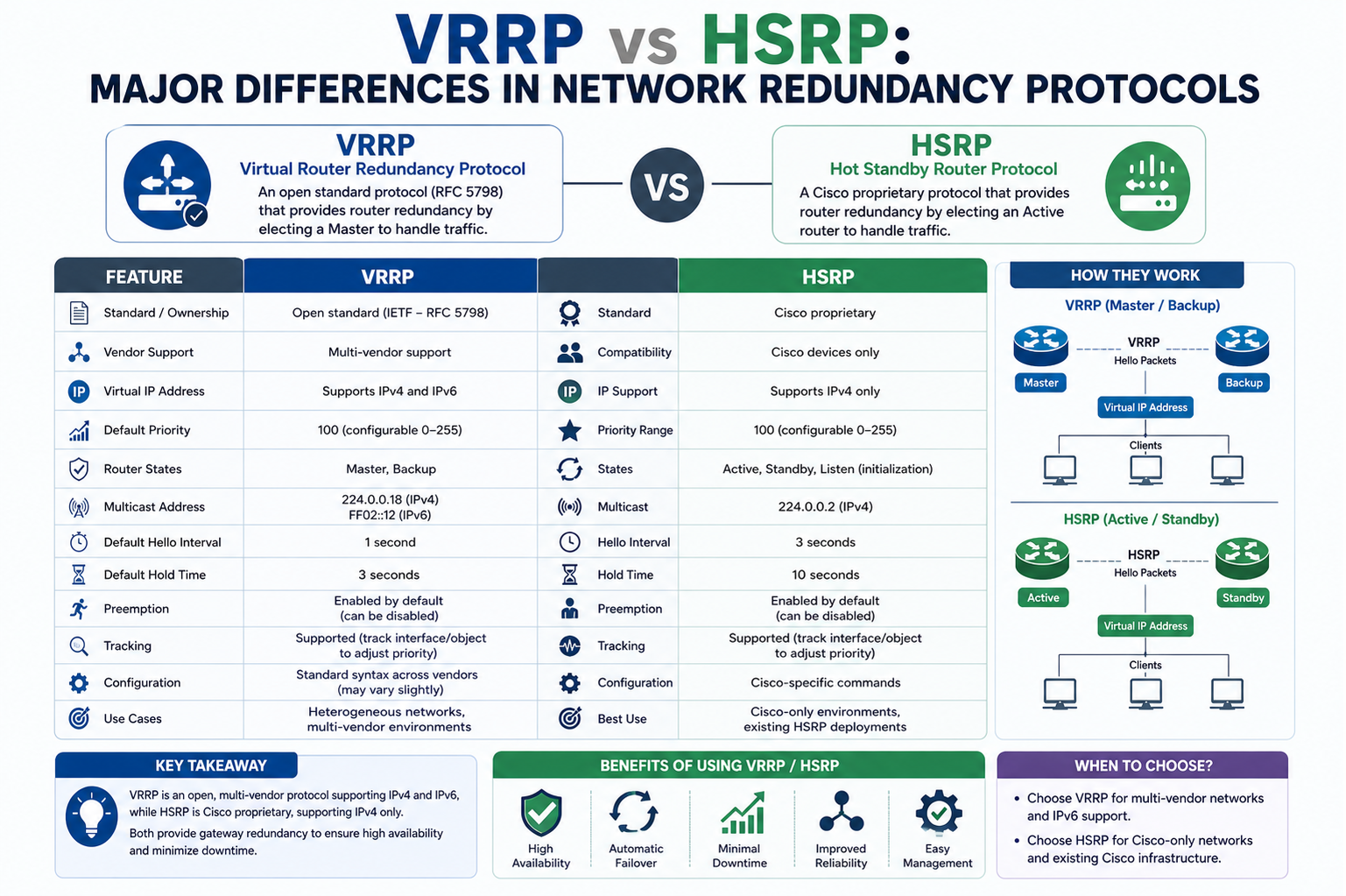
In modern networking environments, maintaining continuous connectivity is no longer optional but a fundamental requirement. Organizations depend heavily on uninterrupted access to internal systems, cloud services, and the internet. To support this level of reliability, redundancy mechanisms are introduced at critical points in the network, especially at the gateway level. Two widely used technologies that serve this purpose are VRRP and HSRP. Both are designed to ensure that if one router fails, another can immediately take over without causing noticeable disruption to users. Although they achieve similar goals, their design philosophy, implementation approach, and vendor dependency differ significantly. Understanding these differences is essential for building stable and resilient network infrastructures.
Why Network Redundancy Protocols Matter
Network devices such as routers represent single points of failure in many traditional architectures. If a default gateway goes down, all connected devices lose external connectivity, even if the rest of the network remains fully operational. This creates downtime that can impact business operations, user productivity, and service availability. Redundancy protocols address this issue by allowing multiple routers to work together as a unified system. Instead of relying on a single device, traffic can automatically switch to a backup router when the primary device becomes unavailable. This ensures that end users experience minimal or no interruption during hardware failures or maintenance events.
Understanding VRRP (Virtual Router Redundancy Protocol)
VRRP, known as Virtual Router Redundancy Protocol, is an industry-standard solution designed to provide default gateway redundancy across multiple routers. Its open-standard nature means it can be implemented across different vendors, making it flexible in multi-vendor environments. The core idea behind VRRP is the creation of a virtual router identity that hosts use as their default gateway. This virtual identity includes a shared IP address that represents the gateway for all devices in the network segment. Behind this virtual identity, multiple physical routers participate in a redundancy group to ensure continuity.
In a typical VRRP setup, one router is elected as the primary or master device, while others remain in standby mode. The master router actively handles traffic directed to the virtual IP address. If this router fails or becomes unreachable, one of the standby routers automatically takes over the role without requiring manual intervention. This transition is designed to be fast enough that users experience only a brief or unnoticeable disruption in connectivity.
How VRRP Operates in a Network Environment
VRRP functions through continuous communication between routers within the same redundancy group. These routers exchange periodic multicast messages known as advertisements. These messages serve as health checks, allowing each device to confirm whether the master router is still operational. If standby routers stop receiving these advertisements within a defined interval, they assume that the master has failed.
When this failure is detected, the highest priority standby router immediately assumes the role of the master. It begins responding to requests sent to the virtual IP address, effectively taking over gateway responsibilities. From the perspective of connected devices, the change is seamless because the virtual IP remains unchanged. The network devices continue forwarding traffic without needing to update their configurations or routing tables.
VRRP also relies on the concept of a virtual MAC address associated with the virtual IP. This allows devices on the network to resolve the gateway consistently through ARP requests. When the active router changes, the new master announces the same virtual MAC, ensuring continuity in traffic forwarding.
VRRP Role in Gateway Redundancy and Failover
The primary role of VRRP is to ensure that the default gateway remains available even during hardware failure or planned maintenance. Since all devices on a subnet depend on the gateway to communicate outside their local network, maintaining its availability is critical. VRRP achieves this by abstracting the gateway into a logical entity rather than tying it to a single physical router.
In addition to failover capability, VRRP also supports priority-based control. Each router is assigned a priority value that influences which device becomes the master. The highest priority router typically assumes control unless it is unavailable. This allows network administrators to design predictable failover hierarchies and control which devices handle traffic under normal conditions.
Advantages of VRRP in Enterprise Networks
VRRP provides several important benefits, particularly in environments that require flexibility and vendor independence. Since it is an open standard, it can be deployed across routers from different manufacturers, making it suitable for heterogeneous network infrastructures. This reduces dependency on a single vendor ecosystem and allows organizations more freedom in hardware selection.
Another key advantage is high availability. VRRP ensures that network downtime is minimized by quickly transferring gateway responsibilities to a backup router when needed. This improves user experience and reduces operational risk in environments where uptime is critical.
VRRP also supports efficient utilization of network resources. In some configurations, it can be designed to allow traffic distribution across multiple routers, improving bandwidth usage and performance under load. This capability becomes particularly useful in environments where network traffic is heavy or continuously increasing.
Limitations and Design Considerations of VRRP
Despite its strengths, VRRP does come with certain limitations that must be considered during network design. One of the primary requirements is that all participating routers must exist within the same local network segment. This means they must be connected to the same subnet as the devices they serve. While this ensures fast failover, it also limits flexibility in geographically distributed networks.
Another consideration is that VRRP requires careful configuration of priority values and timers to ensure smooth failover behavior. Improper tuning can lead to delays or instability during transitions between master and standby routers. Additionally, although VRRP can support load distribution in some implementations, it is not inherently designed for advanced load balancing scenarios.
Understanding HSRP (Hot Standby Router Protocol)
HSRP, known as Hot Standby Router Protocol, is a proprietary redundancy solution developed by Cisco. Unlike VRRP, it is not an open standard and is primarily intended for use within Cisco-based network environments. The protocol is designed to provide high availability for default gateways by allowing multiple routers to operate in an active-standby configuration.
In HSRP, routers are grouped together to form a redundancy set. One router is designated as the active device, while others remain in standby mode. The active router is responsible for forwarding traffic sent to a shared virtual gateway address. If the active router fails, a standby router immediately takes over this role, ensuring continuity in network connectivity.
How HSRP Functions in Cisco-Based Networks
HSRP operates using periodic hello messages exchanged between routers within the same group. These messages allow each router to monitor the status of its peers. The routers also use priority values to determine which device should assume the active role. The router with the highest priority becomes active by default, while others remain on standby.
When the active router stops sending hello messages, the standby router with the next highest priority becomes active. This transition is designed to be fast and transparent to end users, ensuring minimal disruption in network services. The virtual IP address used by HSRP remains constant, allowing devices to maintain their default gateway configuration without changes.
HSRP also uses a virtual MAC address to ensure consistent communication at the data link layer. This allows network devices to continue sending traffic to the same gateway address even when the active router changes.
HSRP Role in Router Failover Mechanisms
The primary purpose of HSRP is to enhance network reliability by providing seamless failover capabilities in Cisco environments. It ensures that even if a critical router fails, another device can immediately take over without requiring manual intervention. This reduces downtime and improves service continuity.
HSRP is particularly useful in enterprise environments where Cisco hardware is already standardized. It integrates deeply with Cisco network architectures and provides predictable behavior in controlled environments. However, its design is primarily focused on failover rather than advanced traffic distribution strategies.
Advantages of HSRP in Controlled Environments
HSRP offers strong stability and reliability in Cisco-exclusive environments. Because it is developed by Cisco, it is highly optimized for Cisco devices, ensuring smooth integration and consistent performance. This makes it a preferred choice for organizations that have standardized their infrastructure on Cisco hardware.
Another advantage is simplicity in operation. HSRP is relatively straightforward to configure and manage within Cisco networks. It provides clear active and standby roles, making it easier for administrators to predict and control network behavior.
HSRP also ensures fast failover, which is essential in environments where downtime must be minimized. Its design allows standby routers to quickly assume the active role, maintaining continuity in gateway services.
Limitations and Operational Constraints of HSRP
Despite its reliability, HSRP has certain limitations. One of the most significant is its proprietary nature, which restricts its use to Cisco devices only. This can be a disadvantage in multi-vendor environments where flexibility is required.
Another limitation is that HSRP does not inherently support true load balancing in the same way that some other redundancy protocols do. While traffic sharing can be configured, it is not as dynamic or efficient as more advanced solutions designed specifically for load distribution.
Additionally, because HSRP is tightly integrated into Cisco ecosystems, it may not be suitable for organizations seeking vendor-neutral networking strategies or those planning to diversify their hardware infrastructure.
VRRP Architecture and Design Principles
VRRP is built around a logical abstraction of a router rather than depending on a single physical device. This design allows multiple routers to function collectively as one virtual gateway. The key idea is that hosts in a network do not interact directly with physical routers; instead, they interact with a virtual IP address that represents the entire redundancy group. This abstraction layer is what enables seamless failover when a device failure occurs.
Each VRRP group consists of one master router and one or more backup routers. The master router actively forwards traffic, while backup routers remain in listening mode, constantly monitoring the status of the master. The design ensures that only one router is responsible for forwarding traffic at any given time, preventing conflicts or duplicate responses on the network. This structured hierarchy is essential for maintaining stability and avoiding routing loops or inconsistencies.
The election process in VRRP is based on priority values assigned to each router. The router with the highest priority becomes the master. If priorities are equal, the router with the highest IP address takes precedence. This deterministic approach ensures predictable behavior, which is critical in enterprise environments where network roles must remain consistent and controllable.
VRRP Master Election and Failover Behavior
The master election process in VRRP is not static; it can change dynamically based on network conditions. When a higher-priority router becomes available, it can preempt the current master and take over its role. This behavior ensures that the most capable router is always handling traffic, improving performance and reliability.
Failover in VRRP is triggered when backup routers stop receiving advertisements from the master. These advertisements act as heartbeat signals exchanged at regular intervals. If a backup router does not receive these signals within a defined timeout period, it assumes that the master has failed. At that point, an election process begins, and a new master is selected immediately.
This transition is designed to be fast enough that end users rarely notice any disruption. The virtual IP address remains unchanged, which means devices connected to the network continue using the same gateway without needing reconfiguration. This stability is one of the core strengths of VRRP and a major reason for its widespread adoption in multi-vendor environments.
VRRP Virtual MAC Address and Traffic Handling
One of the critical mechanisms behind VRRP is the use of a virtual MAC address. This MAC address is associated with the virtual IP and is shared among all routers in the redundancy group. When a master router is active, it responds to ARP requests using this virtual MAC address, ensuring that all devices send traffic consistently to the same logical gateway.
When a failover occurs, the new master immediately begins using the same virtual MAC address. This prevents the need for ARP table updates on client devices, which significantly reduces convergence time. Without this mechanism, devices would need to rediscover the gateway’s MAC address after every failover, causing delays and potential packet loss.
The consistency provided by the virtual MAC system ensures smooth traffic flow even during transitions. From the perspective of end devices, the gateway appears unchanged, even though a completely different physical router may now be handling traffic.
VRRP Timers and Convergence Optimization
VRRP relies heavily on timers to manage failover behavior and ensure synchronization between routers. The advertisement interval defines how often the master sends heartbeat messages. The default values are designed to balance network overhead and failover speed. Shorter intervals allow faster detection of failures but increase control traffic, while longer intervals reduce overhead but may delay failover.
Backup routers use a skew time calculation to determine when to transition into the master role. This ensures that multiple routers do not attempt to become master at the same time. The structured timing mechanism prevents instability and ensures a clean and orderly transition during failures.
Network administrators can adjust these timers based on the criticality of the network. In high-availability environments such as financial systems or data centers, faster convergence is often prioritized. In less critical environments, default settings may be sufficient to maintain stability without excessive overhead.
VRRP Load Distribution Concepts and Behavior
Although VRRP is primarily designed for redundancy, it can also be configured to support limited load distribution. This is achieved by creating multiple VRRP groups within the same network segment. Each group can have a different master router, allowing traffic to be distributed across multiple devices.
In this setup, different virtual IP addresses are assigned to different VRRP groups. Hosts can then be configured to use different gateways, effectively splitting traffic between routers. However, this method is not dynamic load balancing in the strict sense, as it relies on static configuration rather than real-time traffic optimization.
This approach can still be useful in environments where traffic needs to be distributed for performance reasons, but it requires careful planning. Misconfiguration can lead to uneven load distribution or failover complications, especially if one router becomes overloaded while another remains underutilized.
HSRP Architecture and Operational Structure
HSRP follows a similar architectural concept but is tightly integrated into Cisco’s ecosystem. Like VRRP, it creates a virtual gateway that hosts use as their default route. However, the underlying implementation differs in terms of control mechanisms and operational behavior.
In HSRP, routers are grouped into standby sets, with one router designated as active and others as standby. The active router handles all traffic directed to the virtual IP address. Standby routers continuously monitor the active device through hello messages exchanged at regular intervals.
The structure is more rigid compared to VRRP, as HSRP is designed specifically for Cisco environments. This allows for deeper integration with Cisco routing features, but it limits flexibility in heterogeneous networks where multiple vendors are involved.
HSRP Active and Standby Roles in Detail
The active router in HSRP is responsible for forwarding all packets sent to the virtual gateway. It also periodically sends hello packets to inform standby routers that it is functioning correctly. If these hello packets stop arriving, standby routers initiate a failover process.
Standby routers remain passive but ready to take over at any moment. They continuously listen for hello messages and maintain awareness of the active router’s status. When a failure is detected, the standby router with the highest priority becomes active and assumes control of traffic forwarding.
This role-based system ensures that only one router is actively handling traffic at any given time, preventing conflicts and ensuring stable network operation. The transition between active and standby roles is designed to be rapid, minimizing downtime for connected devices.
HSRP Priority System and Preemption Behavior
HSRP uses a priority-based system to determine which router becomes active. Each router is assigned a priority value, and the highest value determines the active device. If priorities are equal, the router with the highest IP address is selected.
HSRP also supports a feature known as preemption. This allows a higher-priority router to take over the active role when it becomes available, even if another router is already active. This ensures that the most preferred router is always handling traffic when operational.
However, preemption must be carefully configured, as it can cause frequent role changes if not properly managed. In stable environments, administrators may disable preemption to avoid unnecessary failover events.
HSRP Hello Mechanism and Failure Detection
HSRP relies on hello packets to maintain communication between routers. These packets are sent at regular intervals and serve as indicators of router health. If standby routers do not receive hello packets within a specified hold time, they assume that the active router has failed.
Once failure is detected, a new active router is elected based on priority values. The transition is designed to be fast, ensuring minimal disruption to network traffic. The virtual IP address remains unchanged, allowing connected devices to continue using the same gateway without reconfiguration.
This mechanism ensures continuity in network services, but it is dependent on proper timer configuration. Incorrect settings can lead to delayed failover or unnecessary role changes.
HSRP Virtual Gateway Behavior and Consistency
HSRP maintains a single virtual IP address that represents the default gateway for all devices in the network. This ensures that client devices do not need to maintain multiple gateway entries or update configurations during failover events.
The active router responds to ARP requests using a virtual MAC address associated with the group. When a failover occurs, the new active router adopts the same virtual MAC address, ensuring that traffic continues to flow without interruption.
This consistent behavior is essential for maintaining application stability, especially in environments where continuous connectivity is critical. It reduces the need for manual intervention and simplifies network design.
HSRP Operational Strengths in Cisco Networks
HSRP is highly optimized for Cisco environments, which allows it to integrate seamlessly with other Cisco networking technologies. This includes advanced routing features, security policies, and management tools. The protocol is designed to deliver predictable behavior within controlled infrastructures.
Its simplicity in configuration and strong integration with Cisco hardware makes it a preferred choice in enterprise networks that rely exclusively on Cisco devices. It provides reliable failover behavior and ensures that gateway redundancy is maintained with minimal complexity.
HSRP Operational Limitations and Design Constraints
Despite its strengths, HSRP is limited by its proprietary nature. It cannot be used in non-Cisco environments, which restricts flexibility in mixed-vendor networks. This can be a disadvantage for organizations that prefer open standards or multi-vendor strategies.
Another limitation is its focus on failover rather than dynamic load balancing. While traffic sharing can be achieved through manual configuration, it is not as efficient or flexible as modern load distribution techniques. This makes it less suitable for high-performance environments that require advanced traffic optimization.
VRRP Deployment Strategies in Real-World Networks
Deploying VRRP in production environments requires careful planning to ensure stability, efficiency, and fast failover performance. The first step in any deployment is identifying critical network segments where gateway redundancy is essential. These are typically core distribution layers or edge networks where client devices depend on a single default gateway for external connectivity. Once these segments are identified, VRRP groups are configured to provide logical gateway redundancy across multiple routers.
In most enterprise designs, VRRP is implemented at the distribution layer, where multiple Layer 3 devices connect to access switches. This allows end devices to use a virtual IP address as their default gateway while the underlying physical routers share responsibility for traffic forwarding. The design ensures that even if one distribution router fails, another can immediately take over without affecting connected users.
A key part of VRRP deployment is ensuring proper synchronization between routers. All devices in a VRRP group must share consistent configurations, including VLAN assignments, routing policies, and interface settings. Any mismatch can lead to unexpected behavior during failover events, potentially causing traffic disruption or routing inconsistencies.
VRRP Priority Tuning and Stability Optimization
VRRP priority settings play a major role in determining how routers behave during normal operation and failure conditions. By carefully assigning priority values, network administrators can control which router acts as the master under normal circumstances. This allows high-performance devices to handle primary traffic loads while lower-capacity devices remain on standby.
In advanced deployments, priority values are dynamically adjusted using tracking mechanisms. For example, if a router detects that its uplink interface is experiencing issues, its priority can automatically decrease. This causes another router in the group to take over as master, even if the original router is still operational. This intelligent failover behavior improves overall network resilience by avoiding partial failures that could degrade performance.
Stability optimization also involves tuning advertisement intervals and hold timers. These parameters determine how quickly routers detect failures and initiate failover. Shorter timers provide faster convergence but increase control traffic, while longer timers reduce overhead but may delay failover. The optimal configuration depends on the sensitivity of the application environment and the acceptable level of downtime.
VRRP in High-Availability Enterprise Architectures
In large-scale enterprise networks, VRRP is often used as part of a broader high-availability strategy. It is commonly combined with link aggregation, dynamic routing protocols, and redundant physical paths to eliminate single points of failure. This layered approach ensures that even if multiple components fail simultaneously, network connectivity is preserved.
VRRP also integrates well with routing protocols such as OSPF or EIGRP. In such designs, routers participating in VRRP can also exchange routing information dynamically. This ensures that not only gateway redundancy is maintained but also optimal routing paths are preserved across the network.
In data center environments, VRRP may be used alongside virtualization platforms and software-defined networking systems. This allows virtual machines and containerized workloads to maintain consistent gateway access even when underlying physical infrastructure changes or fails.
VRRP Security Considerations and Best Practices
Although VRRP is primarily focused on availability, security considerations are equally important during deployment. One potential risk is unauthorized devices joining the VRRP group and attempting to influence the master election process. To prevent this, authentication mechanisms can be enabled to ensure that only trusted routers participate in the redundancy group.
Authentication can be configured using simple password-based methods or more secure cryptographic techniques, depending on the implementation. This helps protect the network from spoofing attacks where malicious devices attempt to impersonate legitimate routers.
Another best practice is to isolate VRRP traffic within controlled network segments. Since VRRP uses multicast communication, proper network segmentation ensures that advertisements are not exposed to unnecessary devices. This reduces the risk of interception and improves overall network efficiency.
VRRP Performance Considerations in Large Networks
As networks scale, VRRP performance becomes increasingly important. In environments with many VRRP groups, control traffic can accumulate and place additional load on network devices. To manage this, administrators often design hierarchical VRRP deployments where redundancy is distributed across multiple layers.
Load distribution across VRRP groups can also help improve performance. By assigning different virtual gateways to different routers, traffic can be spread more evenly across available resources. This reduces congestion and prevents any single device from becoming a bottleneck.
Another performance consideration is convergence time. In large networks, ensuring fast and predictable failover requires careful tuning of timers and priorities. Without proper optimization, failover events can introduce temporary instability, especially in environments with high traffic volumes.
HSRP Deployment in Cisco-Centric Environments
HSRP deployment is typically found in environments where Cisco hardware dominates the network infrastructure. Because it is a Cisco proprietary protocol, its configuration and behavior are tightly integrated with Cisco IOS and related operating systems. This allows for consistent performance and predictable failover behavior across Cisco devices.
In a typical HSRP deployment, routers are configured at the gateway layer of a network segment. One router is designated as active, while others remain on standby. These roles are established through priority values and maintained through continuous hello messaging.
HSRP is often deployed in enterprise branch networks, campus environments, and data centers where Cisco hardware is standardized. Its simplicity and reliability make it a preferred choice for organizations that prioritize stability over multi-vendor flexibility.
HSRP Priority Management and Traffic Control
HSRP priority settings are central to controlling which router becomes active. Administrators can assign higher priority values to routers with better performance or more reliable connectivity. This ensures that the most capable device handles traffic under normal conditions.
In addition to static priority configuration, HSRP supports interface tracking. This feature allows routers to adjust their priority based on the status of specific interfaces. For example, if an uplink fails, the router’s priority can be automatically reduced, triggering a failover to a standby device.
This dynamic adjustment mechanism improves network resilience by ensuring that routers with degraded connectivity do not continue to handle critical traffic. It also helps maintain optimal routing paths across the network.
HSRP Role of Hello and Hold Timers in Stability
HSRP relies heavily on hello and hold timers to maintain synchronization between active and standby routers. Hello packets are sent periodically by the active router to indicate that it is functioning correctly. Standby routers use these packets to monitor the health of the active device.
If hello packets are not received within the hold time, standby routers assume that the active router has failed and initiate a failover process. The timing of these intervals directly impacts how quickly failover occurs.
Fine-tuning these timers is important in environments where low latency and high availability are required. However, overly aggressive timer settings can lead to false failovers, especially in networks with occasional packet loss or congestion.
HSRP in Redundant Network Topologies
HSRP is commonly used in redundant network topologies where dual routers are deployed for gateway resilience. In these designs, both routers are connected to the same LAN segment and share a virtual IP address. End devices use this virtual IP as their default gateway, ensuring consistency regardless of which router is active.
This topology is particularly effective in campus networks where uptime is critical. If one router fails or undergoes maintenance, the standby router immediately assumes control, ensuring uninterrupted connectivity for users and applications.
HSRP can also be integrated into more complex topologies involving multiple VLANs and segmented network architectures. Each VLAN can have its own HSRP group, allowing for distributed gateway redundancy across the network.
Comparing VRRP and HSRP Operational Behavior
While both VRRP and HSRP serve the same fundamental purpose, their operational behavior differs in subtle but important ways. VRRP is more flexible due to its open-standard nature, making it suitable for diverse network environments. HSRP, on the other hand, is optimized for Cisco ecosystems and provides tighter integration with Cisco-specific features.
VRRP typically uses a single virtual router identity shared among devices, while HSRP relies on clearly defined active and standby roles. This difference affects how failover and load distribution are handled in each protocol.
In terms of scalability, VRRP often offers greater flexibility in multi-vendor environments, while HSRP provides more predictable performance in Cisco-only networks. These differences influence how each protocol is selected and deployed in real-world scenarios.
Operational Efficiency and Network Design Impact
Both VRRP and HSRP significantly impact how networks are designed and managed. They reduce the risk of downtime by ensuring that gateway redundancy is always available. This allows network architects to build more resilient infrastructures without relying on manual intervention during failures.
Operational efficiency improves because failover processes are automated and transparent to end users. Applications continue functioning normally even when underlying network devices change. This reduces support overhead and improves overall service reliability.
As networks continue to evolve, redundancy protocols like VRRP and HSRP remain foundational components of enterprise architecture. They enable stable, scalable, and fault-tolerant designs that support modern digital workloads.
GLBP as an Extension of Cisco Redundancy Concepts
Within Cisco networking environments, redundancy does not stop at HSRP. Another important protocol known as GLBP (Gateway Load Balancing Protocol) extends the idea of gateway resilience by introducing more advanced traffic distribution capabilities. While HSRP focuses primarily on failover with a clear active and standby model, GLBP adds a layer of intelligence by allowing multiple routers to actively participate in forwarding traffic at the same time.
GLBP works by maintaining a single virtual IP address, similar to VRRP, but it differs in how it handles MAC address responses. Instead of relying on one active router, GLBP assigns different virtual MAC addresses to multiple routers within the same group. When clients send ARP requests for the default gateway, GLBP responds with different MAC addresses in a controlled manner, effectively distributing traffic across multiple routers. This approach provides both redundancy and load balancing without requiring multiple gateway configurations on end devices.
This design makes GLBP particularly useful in environments where traffic volume is high and evenly distributed utilization of network resources is required. However, like HSRP, it remains a Cisco proprietary solution and is not available in multi-vendor environments.
VRRP vs HSRP in Terms of Flexibility and Compatibility
One of the most significant differences between VRRP and HSRP lies in their compatibility scope. VRRP is an open standard protocol, which means it can be implemented across different networking vendors. This makes it highly suitable for heterogeneous environments where organizations use equipment from multiple manufacturers. It provides flexibility in design and avoids vendor lock-in, which is a major advantage for large enterprises and service providers.
HSRP, on the other hand, is strictly limited to Cisco devices. While this limitation may seem restrictive, it also allows for deeper optimization within Cisco ecosystems. The protocol is tightly integrated with Cisco IOS features, making it highly reliable in standardized infrastructures. Organizations that are fully committed to Cisco hardware often prefer HSRP because of its consistency and predictable behavior.
This difference in compatibility directly influences network design decisions. In environments where vendor diversity is important, VRRP becomes the natural choice. In contrast, Cisco-dedicated infrastructures benefit more from HSRP due to its seamless integration.
Failover Performance Comparison Between VRRP and HSRP
Both VRRP and HSRP are designed to provide fast failover, but their internal mechanisms differ slightly in execution. VRRP relies on multicast advertisements and priority-based election to determine the active router. When the master router fails, standby routers quickly detect the absence of advertisements and initiate a new election process.
HSRP uses hello packets and hold timers to achieve a similar result. When the active router stops sending hello messages, standby routers detect the failure and take over the active role based on priority values. In both cases, the transition is designed to be rapid enough to avoid noticeable downtime for end users.
In practical scenarios, both protocols can achieve sub-second to a few seconds of failover time depending on configuration. The difference in performance is often negligible when properly tuned. However, VRRP’s open design allows for more flexible tuning across different vendor platforms, while HSRP is optimized specifically for Cisco hardware behavior.
Load Balancing Capabilities in VRRP and HSRP
Load balancing is another area where VRRP and HSRP differ significantly. VRRP primarily focuses on redundancy, but it can be configured to support load distribution through multiple VRRP groups. Each group can have a different master router, allowing traffic to be distributed across multiple devices. This method, while effective, is static and requires manual configuration.
HSRP does not natively provide true load balancing. Instead, it supports a limited form of load sharing where different groups of hosts can be assigned different gateway routers. However, this approach can create inefficiencies if one router fails, as only a subset of hosts will be affected while others remain operational.
To address this limitation, Cisco introduced GLBP, which provides dynamic load balancing alongside redundancy. GLBP intelligently distributes ARP responses to balance traffic across multiple routers without requiring manual host configuration.
Network Design Implications of VRRP and HSRP
When designing networks, the choice between VRRP and HSRP has a direct impact on architecture and scalability. VRRP’s open-standard nature makes it ideal for multi-vendor environments, cloud-based infrastructures, and hybrid networks. It allows engineers to design flexible systems without being tied to a specific vendor ecosystem.
HSRP is more suited for controlled enterprise environments where Cisco hardware is standardized across the network. Its predictable behavior simplifies troubleshooting and configuration, which is beneficial in large-scale Cisco deployments.
In both cases, redundancy protocols influence how routing layers are structured. They are typically deployed at the distribution layer in hierarchical network models, ensuring that end devices always have access to a reliable gateway regardless of underlying hardware failures.
Reliability and Fault Tolerance in Production Networks
The primary goal of both VRRP and HSRP is to enhance reliability through fault tolerance. In production environments, even a few seconds of downtime can lead to significant disruptions. These protocols ensure that such downtime is minimized by automating the failover process.
Fault tolerance is achieved by continuously monitoring router health and maintaining standby devices ready for immediate activation. This eliminates the need for manual intervention during failures, which significantly reduces recovery time.
Both protocols also improve overall network resilience by eliminating single points of failure at the gateway level. This is especially important in environments such as data centers, financial institutions, and enterprise campuses where uptime is critical.
Administrative Control and Configuration Complexity
From an administrative perspective, VRRP and HSRP differ in complexity and control options. VRRP provides a more standardized configuration approach that works consistently across different vendors. This simplifies deployment in mixed environments but may limit vendor-specific optimizations.
HSRP offers deeper integration with Cisco devices, allowing administrators to leverage advanced features such as interface tracking, priority tuning, and tight coupling with Cisco routing protocols. However, this also means that configuration is more Cisco-specific and less transferable to other platforms.
In both cases, proper configuration is essential to ensure stable operation. Misconfigured priorities, timers, or interfaces can lead to unexpected failover behavior or even network instability.
Choosing Between VRRP and HSRP in Real Deployments
The decision between VRRP and HSRP ultimately depends on the network environment and long-term infrastructure strategy. VRRP is the preferred choice for organizations that value flexibility, interoperability, and vendor independence. It fits well in environments where different types of hardware coexist and where standardization across vendors is important.
HSRP is best suited for organizations that are fully committed to Cisco ecosystems. Its tight integration, predictable behavior, and optimized performance make it a strong choice for Cisco-centric infrastructures.
In many cases, the decision is not about performance differences but about ecosystem alignment. Both protocols are highly capable of providing reliable gateway redundancy when properly implemented.
Final Conclusion
At a fundamental level, VRRP and HSRP solve the same problem: ensuring continuous availability of the default gateway. They achieve this through different architectural philosophies, but both are highly effective in preventing network downtime caused by router failures.
VRRP emphasizes openness, flexibility, and cross-vendor compatibility, making it ideal for diverse network environments. HSRP emphasizes integration, predictability, and Cisco optimization, making it ideal for standardized enterprise deployments.
In modern network engineering, both protocols remain essential tools for building resilient infrastructures. Their continued use highlights the importance of redundancy at the gateway level and the critical role these mechanisms play in maintaining uninterrupted connectivity across complex network systems.