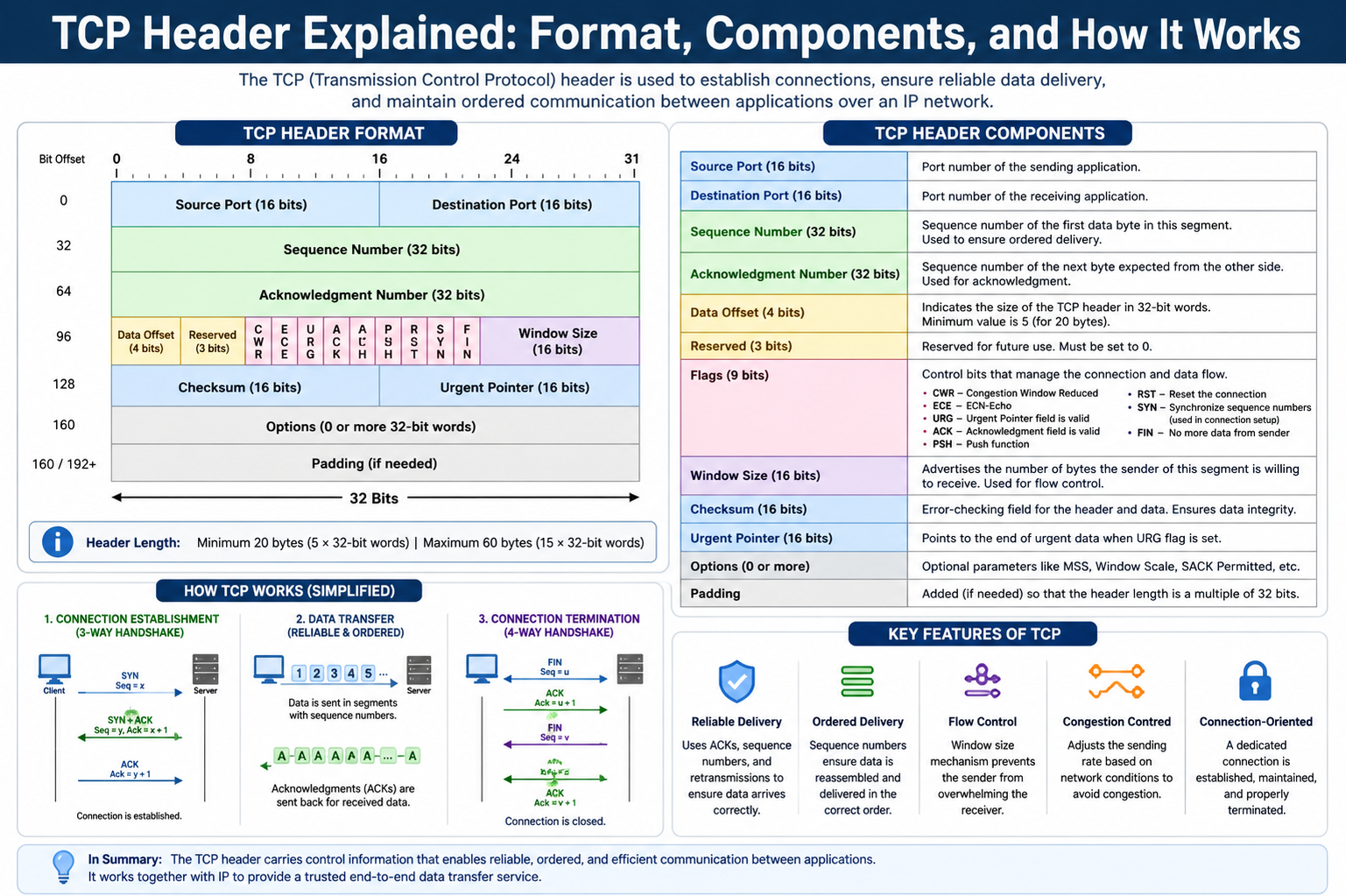
The Transmission Control Protocol (TCP) header is a core structural element of every TCP packet that travels across a network. It carries essential control information that enables devices to communicate reliably over the internet. Every time data is sent from one system to another, it is broken into smaller segments, and each of those segments includes a TCP header at the beginning. This header acts like a control guide, instructing how the data should be delivered, verified, and reassembled at the destination.
In modern networking systems, communication is not just about sending data but ensuring that it reaches correctly, completely, and in the right order. The TCP header plays a central role in achieving this reliability. Without it, data transmission would become chaotic, with missing packets, duplicate information, or incorrect sequencing. The header ensures that both sender and receiver remain synchronized throughout the communication process, maintaining a structured flow of information across complex network paths.
The TCP header exists as part of the TCP/IP protocol suite, which forms the foundation of internet communication. It is positioned at the beginning of a TCP segment and is followed by the actual payload data. Each field inside the header has a specific function, and together they form a complete system for managing communication between devices. These fields are carefully designed to handle addressing, sequencing, flow control, error detection, and connection management.
The importance of the TCP header becomes even more evident when considering how data travels across multiple routers, switches, and networks before reaching its destination. Each intermediate device relies on header information to forward the packet correctly. This makes the TCP header not just a simple structure but a critical part of global digital communication.
Understanding the Structure and Function of TCP Header Fields
The TCP header is made up of multiple fields, each responsible for a specific task in the communication process. These fields work together to ensure smooth and reliable data transmission between devices. At the core, the header contains addressing information, sequencing details, control mechanisms, and error-checking components.
The first essential fields are the source port and destination port. These fields identify the sending and receiving applications. Every application running on a device is assigned a unique port number, and these numbers ensure that data is delivered to the correct service. For example, web traffic, email communication, and file transfers all use different ports, allowing multiple services to operate simultaneously without confusion.
Another critical component is the sequence number field. This field assigns a unique number to each segment of data being transmitted. Since large data is divided into smaller packets, sequence numbers ensure that these packets are reassembled in the correct order at the destination. Without this mechanism, data would arrive scrambled, making it unreadable or unusable.
Closely related to this is the acknowledgment number field. This field is used by the receiving device to confirm which data segments have been successfully received. It plays a key role in reliability, as it allows the sender to know whether it needs to retransmit any missing or corrupted packets. This continuous exchange of acknowledgment ensures that no data is lost during transmission.
The data offset field defines the size of the TCP header itself. This information is necessary for the receiving system to determine where the actual data begins after the header ends. Since the header may include optional fields, its size can vary, and this field helps maintain proper interpretation of the packet structure.
There is also a reserved section in the header, which is kept for future use. This part is currently set to zero but may be utilized in future protocol enhancements. It reflects the flexibility and scalability built into TCP design, allowing it to evolve with advancing network technologies.
Control Mechanisms and Flow Regulation in TCP Header
One of the most powerful aspects of the TCP header is its control system, which ensures proper management of data flow and connection behavior. This is achieved through a set of control flags that act like signals guiding the communication process. These flags determine how a connection is established, maintained, and terminated.
For instance, certain flags are used to initiate a connection between two devices, while others are used to close it once communication is complete. Some flags indicate urgent data that must be processed immediately, while others help manage synchronization between sender and receiver. These control signals make TCP a highly flexible and reliable protocol capable of adapting to different communication needs.
Another important field is the window size. This field controls how much data can be sent before receiving an acknowledgment. It plays a major role in flow control, ensuring that the sender does not overwhelm the receiver with too much data at once. By regulating the amount of in-transit data, the window size helps prevent network congestion and improves overall efficiency.
The urgent pointer field is another specialized component used when certain data needs priority handling. It marks the end of urgent data within a segment, allowing the receiver to process critical information first. This ensures that time-sensitive data is not delayed behind normal traffic, maintaining responsiveness in important applications.
Together, these control and flow management features make TCP highly reliable in unpredictable network environments. They allow the protocol to adjust dynamically based on network conditions, device capacity, and application requirements.
Error Detection, Options, and Advanced Header Capabilities
The TCP header also includes mechanisms for ensuring data integrity and enhancing functionality. One of the most important fields for this purpose is the checksum. This field is used to detect errors in the transmitted data. When a packet is created, a checksum value is calculated based on its contents. At the receiving end, the same calculation is performed, and if the values do not match, the packet is considered corrupted and discarded. This ensures that only accurate and complete data is processed.
In addition to error detection, the TCP header includes an options field that provides extra functionality when needed. These options are not always present but can be included to enhance performance or add advanced features. Examples include timestamp information, maximum segment size negotiation, and selective acknowledgment capabilities. These options allow TCP to adapt to modern high-speed and high-volume networks.
The flexibility of the options field is one of the reasons TCP remains widely used across the internet. It allows continuous improvement without changing the core structure of the protocol. This adaptability ensures that TCP remains compatible with both older systems and modern networking technologies.
The combination of checksum validation and optional enhancements ensures that TCP is not only reliable but also scalable and efficient. It can handle simple communication tasks as well as complex, high-performance data transfers across global networks.
Deep Dive into the TCP Header Architecture
The TCP header is not a random collection of fields but a carefully engineered structure designed to manage end-to-end communication across unreliable networks. Every bit inside it has a purpose, and together they form a system that allows devices to exchange data with precision and control. When a TCP segment is created, the header is attached at the beginning of the packet, and it remains the primary source of instructions for how that data should behave during transmission. This structure ensures that even if the underlying network is unstable, the communication remains consistent and recoverable.
The design of the TCP header is based on modular fields, each handling a specific responsibility. These responsibilities include identifying communication endpoints, maintaining sequence integrity, controlling data flow, detecting errors, and enabling optional enhancements. Because of this layered design, TCP can operate efficiently across different network conditions, from small local networks to large-scale global infrastructures.
Role of Source and Destination Ports in Communication Flow
The source port and destination port fields are fundamental to how TCP directs traffic between applications. A single device may run multiple applications simultaneously, such as a browser, email client, or file transfer service. Each of these applications uses a unique port number to distinguish its communication stream. The source port identifies the sending application, while the destination port identifies the receiving application.
This port-based system ensures that data does not get mixed between different services. For example, web traffic does not interfere with email traffic, even if both are active at the same time. The operating system uses these port numbers to route incoming packets to the correct application process. Without this mechanism, multitasking over networks would not be possible, and data delivery would become chaotic and unreliable.
Sequence Numbers and the Ordering of Data Segments
One of the most important features of the TCP header is the sequence number field. Since large messages are divided into smaller segments before transmission, there must be a way to reassemble them correctly at the destination. The sequence number provides this structure by assigning a unique identifier to each byte or segment of data.
When packets arrive at the receiver, they may not arrive in the same order in which they were sent due to varying network paths and delays. The sequence number allows the receiver to reconstruct the original message accurately, regardless of arrival order. This ensures that applications receive data in a logical and usable format, preserving the integrity of communication.
Sequence numbers also play a critical role in retransmission. If a packet is lost or damaged, the missing sequence number helps the sender identify exactly which data needs to be resent, improving efficiency and reducing unnecessary duplication.
Acknowledgment Numbers and Reliable Delivery Assurance
The acknowledgment number works closely with the sequence number to create a reliable communication loop. Whenever a receiver successfully obtains data, it sends back an acknowledgment indicating the next expected sequence number. This confirms that all previous data has been received correctly.
This mechanism forms the foundation of TCP reliability. If the sender does not receive an acknowledgment within a certain time frame, it assumes the packet was lost and retransmits it. This continuous feedback loop ensures that no data is permanently lost during transmission, even in unstable network conditions.
Acknowledgment numbers also help regulate data flow, preventing congestion and ensuring that both sender and receiver remain synchronized throughout the session.
Control Flags and Connection Management Behavior
The TCP header includes a set of control flags that define how a connection behaves at different stages. These flags act like command signals that guide the lifecycle of a TCP connection. Common flags include SYN for initiating a connection, ACK for acknowledgment, FIN for terminating a connection, and RST for resetting a connection when errors occur.
Other flags manage data priority and synchronization. For example, PSH ensures that data is pushed immediately to the receiving application, while URG indicates urgent data that should be prioritized. These flags allow TCP to adapt dynamically based on communication needs, ensuring both flexibility and control.
The combination of these flags enables the famous TCP three-way handshake process, which establishes a stable and synchronized connection before data transfer begins.
Window Size and Flow Control Mechanism
The window size field plays a critical role in controlling how much data can be sent before requiring acknowledgment. This mechanism prevents network congestion by ensuring that the sender does not overwhelm the receiver with more data than it can process at one time.
Flow control is essential in maintaining stability in high-speed networks where data transmission can occur faster than processing capabilities. The receiver dynamically adjusts the window size based on available buffer space, allowing smooth communication even under varying load conditions.
This adaptive behavior ensures efficient use of bandwidth while avoiding packet loss caused by buffer overflow or network saturation.
Checksum and Data Integrity Verification
The checksum field provides a built-in error detection mechanism that ensures data integrity during transmission. Before sending a packet, the sender calculates a checksum value based on the contents of the header and data. When the packet reaches the destination, the receiver recalculates the checksum and compares it to the original value.
If the values match, the packet is considered valid. If they do not match, it indicates that the data was corrupted during transmission, and the packet is discarded. The sender is then responsible for retransmitting the missing or corrupted data.
This simple yet powerful mechanism ensures that only accurate data is delivered to applications, protecting against network noise, interference, or hardware issues.
TCP Options Field and Protocol Extensibility
The options field in the TCP header allows the protocol to extend its capabilities without changing its core structure. This field is optional and only included when additional functionality is required. It supports advanced features such as maximum segment size negotiation, selective acknowledgment, and timestamping.
Maximum segment size helps optimize performance by determining the largest amount of data that can be transmitted in a single packet. Selective acknowledgment improves efficiency by allowing the receiver to acknowledge non-contiguous data blocks, reducing unnecessary retransmissions. Timestamping helps measure round-trip time and improves congestion control mechanisms.
This extensibility ensures that TCP remains relevant in modern high-performance networks while maintaining backward compatibility with older systems.
TCP Header in Connection Establishment Process
The TCP header plays a central role during the connection establishment phase, commonly known as the three-way handshake. This process begins when a client sends a SYN packet to initiate communication. The server responds with a SYN-ACK packet, acknowledging the request and signaling readiness. Finally, the client sends an ACK packet to confirm the connection.
Each of these steps relies heavily on TCP header fields such as sequence numbers, acknowledgment numbers, and control flags. This structured exchange ensures that both devices are synchronized before any actual data transfer begins, preventing miscommunication and data loss.
The handshake process demonstrates how the TCP header is not just a static structure but an active participant in managing communication lifecycles.
Packet Transmission Lifecycle and Header Interaction
Once a connection is established, the TCP header continues to guide the entire transmission process. Each data segment carries its own header, ensuring that every packet is individually managed and tracked. As packets move through routers and switches, the header information is used to route them efficiently toward their destination.
At the receiving end, the TCP header helps reconstruct the original message by organizing packets based on sequence numbers, verifying integrity through checksums, and confirming receipt through acknowledgment numbers. This lifecycle repeats continuously until all data is successfully delivered.
The coordination between sender and receiver, facilitated by the TCP header, ensures a seamless and reliable communication experience even across complex and congested networks.
Error Handling and Reliability Mechanisms in TCP Header
The TCP header is designed with strong reliability mechanisms that ensure data is not only delivered but also verified and corrected when needed. One of the most critical aspects of this reliability is its ability to detect, manage, and recover from transmission errors. Since network communication often passes through multiple routers, switches, and unpredictable paths, data corruption or loss can occur at any stage. The TCP header addresses these issues through structured control fields and continuous feedback between sender and receiver.
Error handling begins with the checksum field, but reliability goes far beyond simple detection. TCP uses a combination of sequencing, acknowledgments, retransmissions, and flow adjustments to maintain data accuracy. When a segment is found to be missing or corrupted, the protocol does not simply ignore it. Instead, it actively initiates recovery by requesting retransmission. This self-correcting behavior is one of the reasons TCP is considered a highly dependable transport protocol.
The retransmission process is tightly connected with sequence numbers and acknowledgment numbers. If the sender does not receive confirmation for a specific sequence number within a certain time period, it assumes that the packet was lost. It then retransmits only the missing segment rather than resending the entire data stream. This selective recovery improves efficiency and reduces unnecessary network load.
Connection Lifecycle Control Using TCP Header Fields
The TCP header is deeply involved in managing the full lifecycle of a connection, from establishment to termination. This lifecycle is not a single event but a structured sequence of states controlled by header flags and sequence tracking. Every stage of communication depends on precise coordination between both ends of the connection.
During connection initiation, synchronization flags ensure that both devices agree on starting parameters such as initial sequence numbers. This synchronization is essential because TCP relies on accurate sequencing to maintain order. Once both sides are aligned, the connection transitions into an established state where data transfer can begin safely.
Throughout the active communication phase, the TCP header continuously monitors and adjusts the connection. Acknowledgment numbers confirm receipt of data, while window size values adjust the flow based on receiver capacity. If congestion or delay occurs, TCP adapts dynamically by slowing down transmission or adjusting packet sizes. This adaptability ensures that communication remains stable even under varying network conditions.
When communication is complete, the termination process begins. Control flags signal the end of data transfer, and both sides acknowledge closure in a structured sequence. This ensures that no data is left unprocessed and that system resources are released properly. Without this structured termination, connections could remain half-open, leading to resource leaks and communication errors.
Flow Control and Network Efficiency Management
Flow control is one of the most important functions of the TCP header because it directly impacts network performance and stability. Without proper flow control, a fast sender could overwhelm a slower receiver, causing packet loss, buffering issues, and congestion collapse. The window size field in the TCP header solves this problem by regulating the amount of data that can be sent before receiving acknowledgment.
The window size is not fixed; it changes dynamically based on the receiver’s processing capability and buffer availability. When the receiver is under heavy load, it reduces the window size, signaling the sender to slow down. When conditions improve, it increases the window size to allow faster transmission. This dynamic adjustment ensures that both ends operate efficiently without overloading the network.
Flow control also interacts with congestion control mechanisms at the network level. If packet loss or delays are detected, TCP reduces transmission speed proactively to prevent further congestion. This coordination between flow control and congestion control is essential for maintaining smooth data delivery across large-scale networks like the internet.
Data Integrity Assurance and Verification Process
Ensuring data integrity is a core responsibility of the TCP header. While checksum provides basic error detection, TCP relies on a broader verification process that includes sequencing and acknowledgment tracking. Every segment is checked not only for corruption but also for correctness in order and completeness.
When a packet arrives at the destination, it is validated against its checksum value. If the packet passes this check, it is then placed in the correct order based on its sequence number. If any gap is detected in the sequence, TCP immediately identifies missing segments and triggers retransmission requests. This ensures that the final reconstructed data is identical to what was originally sent.
Acknowledgment numbers further strengthen integrity by confirming successful delivery. The receiver does not simply accept data passively; it actively communicates its state back to the sender. This continuous validation loop ensures that both sides remain synchronized and that no data is silently lost or corrupted during transmission.
The combination of checksum validation, sequencing, and acknowledgment feedback creates a multi-layered integrity system that is highly resistant to errors and network instability.
TCP Header Behavior in Congested Network Environments
Network congestion is a common challenge in data communication, especially in high-traffic environments. The TCP header plays a crucial role in detecting and responding to congestion conditions. When congestion occurs, packets may be delayed, lost, or arrive out of order. TCP responds to these issues using adaptive control mechanisms embedded within its header structure.
One of the key responses to congestion is reducing the transmission rate. The window size field is adjusted to limit the number of packets sent without acknowledgment. This helps reduce network load and gives routers and intermediate devices time to process existing traffic.
Additionally, retransmission timers are adjusted based on network conditions. If delays increase, TCP waits longer before assuming packet loss, preventing unnecessary retransmissions. This intelligent timing adjustment helps maintain efficiency while avoiding overload.
The control flags in the TCP header also assist in managing congestion scenarios. For example, certain flags can pause data transmission or reset connections when severe issues are detected. This ensures that the system remains stable even under extreme network stress.
Through these mechanisms, the TCP header acts as a dynamic controller that continuously monitors and adapts to network conditions, ensuring smooth communication even in congested environments.
Packet Sequencing and Reassembly Process at Receiver End
At the receiving end, the TCP header plays a critical role in reconstructing the original message from multiple segments. Since data is transmitted in small packets, they may arrive in different orders due to varying network paths. The sequence number field ensures that each packet can be placed in its correct position during reassembly.
When packets arrive, the receiver checks their sequence numbers and organizes them accordingly. If a packet arrives out of order, it is temporarily stored until missing packets are received. This buffering process ensures that the final output remains consistent with the original data structure.
If any packets are missing, the acknowledgment system triggers retransmission requests. The sender then resends only the missing segments, allowing the receiver to complete the sequence without restarting the entire transmission. This targeted recovery mechanism significantly improves efficiency and reduces unnecessary data transfer.
Once all packets are received and properly ordered, they are combined to reconstruct the original message. This process happens seamlessly in the background, ensuring that applications receive complete and accurate data without manual intervention.
Adaptive Nature of TCP Header in Real-World Networks
One of the most powerful characteristics of the TCP header is its adaptability. Unlike static communication systems, TCP continuously adjusts its behavior based on network feedback. This adaptability is achieved through real-time updates in acknowledgment numbers, window size adjustments, and retransmission control.
In real-world networks, conditions are constantly changing. Latency may increase due to distance, bandwidth may fluctuate due to traffic, and packet loss may occur due to hardware limitations. The TCP header responds to all these changes dynamically, ensuring stable communication regardless of environmental conditions.
This adaptive nature allows TCP to function effectively across diverse systems, from high-speed fiber networks to mobile wireless connections. It ensures that users experience consistent performance even when underlying network conditions are unpredictable.
Advanced TCP Header Operations and Real-Time Network Behavior
The TCP header continues to play an active role even in advanced networking scenarios where performance, security, and large-scale data transfer are critical. Modern internet systems handle massive volumes of traffic every second, and the TCP header ensures that each connection remains stable despite this complexity. It does not simply manage basic delivery but also adapts to advanced operational challenges such as high latency, packet congestion, and dynamic routing changes.
In high-performance networks, the TCP header works alongside system-level optimizations to maintain efficiency. Devices constantly exchange header information to adjust transmission rates, manage buffers, and prevent overload situations. This continuous exchange creates a feedback-driven communication loop where both sender and receiver are always aware of current network conditions.
One of the most important aspects of this behavior is how TCP handles variability in transmission paths. Since data packets may take different routes across the internet, the TCP header ensures that all segments are still correctly identified, verified, and assembled at the destination. This flexibility allows TCP to function reliably even in highly distributed and unpredictable environments.
Real-Time Synchronization Between Sender and Receiver
Synchronization is a fundamental requirement for reliable TCP communication, and the TCP header ensures that both ends of a connection remain aligned throughout the entire session. This synchronization begins during connection establishment and continues until the connection is terminated.
Each packet sent from the sender contains sequence numbers that act as reference points for the receiver. The receiver uses these values to track exactly which data has arrived and which is still pending. In return, acknowledgment numbers provide continuous feedback to the sender, confirming successful delivery and guiding the next transmission step.
This real-time synchronization prevents duplication, loss, and misordering of data. Even if packets are delayed or arrive out of sequence, the TCP header ensures they are correctly reorganized before being passed to the application layer. This makes communication reliable even over unstable or congested networks.
The synchronization process is also adaptive. If network conditions change, such as increased latency or reduced bandwidth, the TCP header adjusts timing and flow control parameters dynamically. This ensures that both sender and receiver remain in balance without overwhelming each other.
TCP Header Role in High-Latency and Long-Distance Communication
Long-distance communication introduces additional challenges such as higher latency, packet delay variation, and potential routing inefficiencies. The TCP header is specifically designed to handle these conditions through intelligent timing and acknowledgment mechanisms.
In high-latency environments, acknowledgment delays are expected, so TCP does not immediately assume packet loss. Instead, it uses adaptive timers that adjust based on observed network behavior. This prevents unnecessary retransmissions, which could otherwise increase congestion and reduce performance.
The window size field also plays a significant role in long-distance communication. By controlling how much data can be sent before waiting for acknowledgment, TCP ensures that the network is not overloaded with unacknowledged packets. This balance is crucial for maintaining stability over long transmission paths.
Additionally, sequence tracking ensures that even if packets take different routes across global networks, they can still be accurately reassembled at the destination. This makes TCP highly effective for international communication systems, cloud infrastructure, and distributed applications.
Security Aspects Embedded in TCP Header Behavior
While the TCP header is primarily designed for communication reliability, it also contributes indirectly to network security. By enforcing structured communication rules, it reduces the chances of data corruption, unauthorized manipulation, and transmission errors.
The acknowledgment system ensures that only verified data is accepted, which helps detect anomalies in communication patterns. If unexpected sequence numbers or missing acknowledgments occur, it may indicate network issues or potential malicious interference. In such cases, TCP can reset or terminate the connection using control flags.
The checksum field also acts as a basic integrity safeguard by ensuring that data has not been altered during transmission. Although it is not a full security mechanism, it provides an important layer of validation that helps detect tampering or corruption.
Control flags further contribute to secure communication management by allowing controlled connection termination and reset mechanisms. These features help prevent unstable or suspicious connections from persisting in the network.
Performance Optimization Through TCP Header Fields
The TCP header is not only about reliability but also about optimizing performance across different network conditions. Every field contributes in some way to balancing speed, accuracy, and resource usage.
The window size field is particularly important for performance tuning. By dynamically adjusting the amount of data in transit, it helps maximize throughput without overwhelming the receiver. This ensures that high-speed networks can operate efficiently while still maintaining stability.
Sequence and acknowledgment mechanisms reduce unnecessary retransmissions, improving overall efficiency. Instead of resending entire data streams, TCP only retransmits missing or corrupted segments. This selective recovery significantly reduces bandwidth usage.
Options within the TCP header also allow performance enhancements such as larger segment sizes and improved acknowledgment strategies. These optional features enable TCP to scale effectively for modern high-bandwidth applications like streaming, cloud computing, and large file transfers.
Together, these optimization features ensure that TCP remains efficient even under heavy network loads and complex communication scenarios.
TCP Header in Modern Internet Infrastructure
In today’s internet architecture, the TCP header is a foundational component that supports nearly all forms of digital communication. From web browsing and video streaming to cloud services and online gaming, TCP ensures that data is transmitted reliably across global networks.
Routers and intermediate devices rely on TCP header information to forward packets correctly. Sequence numbers, port numbers, and control flags guide the entire journey of data from source to destination. Without this structured information, modern internet systems would not be able to function efficiently.
Cloud computing environments particularly depend on TCP header mechanisms for data synchronization between distributed servers. Large-scale applications use TCP to ensure consistency and reliability across multiple data centers located in different parts of the world.
Even mobile networks rely on TCP header behavior to manage fluctuating signal strength and varying bandwidth conditions. The adaptive nature of TCP ensures that users experience stable connections even when network conditions change rapidly.
Importance of TCP Header in Modern Networking Applications
In modern networking environments, the TCP header acts as a critical coordination layer that enables seamless communication between billions of connected devices. It supports a wide range of applications, including web services, cloud computing, database synchronization, video conferencing, and real-time communication systems. Every time data is exchanged over the internet, the TCP header ensures that it is properly structured, delivered, and verified without requiring manual intervention. Its ability to manage reliability, ordering, and flow control makes it indispensable for maintaining consistent performance across diverse and large-scale network infrastructures.
Final Conclusion
The TCP header represents a highly organized system that manages every aspect of reliable data communication. It coordinates addressing, sequencing, flow control, error detection, synchronization, and performance optimization in a unified structure. Each field contributes to maintaining stability and accuracy across complex and unpredictable networks.
By continuously adapting to network conditions and providing real-time feedback between sender and receiver, the TCP header ensures that data transmission remains consistent and dependable. It forms the backbone of modern internet communication, supporting everything from simple messaging to large-scale distributed systems.
With its combination of reliability, flexibility, and efficiency, the TCP header remains one of the most essential components in networking technology, enabling seamless digital communication across the world.