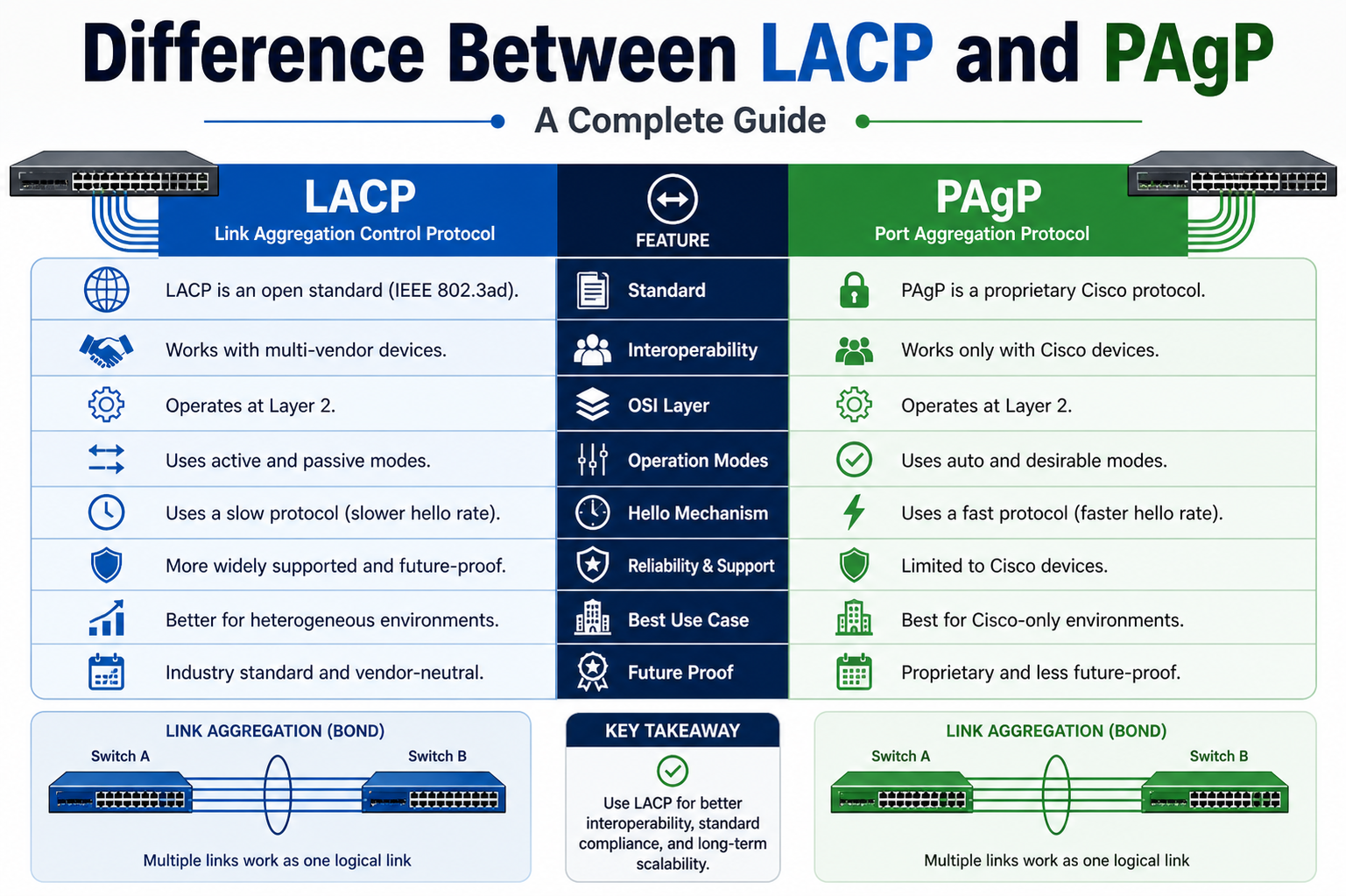
Link aggregation is a networking method that combines multiple physical Ethernet connections into one logical link. This technique improves bandwidth, enhances performance, and provides redundancy in case one connection fails. Two major protocols used for this purpose are Link Aggregation Control Protocol (LACP) and Port Aggregation Protocol (PAgP). Both protocols achieve similar goals, but they differ in compatibility, design approach, and flexibility in real-world networking environments.
Understanding the Importance of Link Aggregation
Link aggregation became essential as network traffic grew and single links were no longer sufficient for performance and reliability demands. By bundling multiple physical connections into a single logical channel, networks can significantly increase throughput and maintain stability during link failures.
This method allows traffic to be distributed across multiple active links instead of relying on one path. For example, combining four 1 Gbps links can theoretically provide up to 4 Gbps of total bandwidth, depending on how traffic is balanced. It also ensures uninterrupted connectivity because if one link fails, the remaining links continue carrying traffic without downtime.
Another important advantage is load balancing. Traffic distribution across multiple links helps avoid congestion and improves overall efficiency. However, for proper aggregation, all links in the group must generally have the same speed and configuration to ensure stability and predictable performance.
Overview of PAgP and LACP Protocols
Port Aggregation Protocol (PAgP) is a Cisco-developed proprietary protocol designed to automate EtherChannel creation between Cisco devices. It simplifies configuration by allowing switches to automatically negotiate and form aggregated links without manual setup of each interface.
PAgP verifies compatibility between devices before forming the channel, ensuring that only supported interfaces are grouped together. However, because it is proprietary, PAgP only works with Cisco devices or hardware licensed by Cisco, limiting its use in mixed-vendor environments.
In contrast, Link Aggregation Control Protocol (LACP) is an open standard defined by the IEEE under IEEE 802.3ad and later refined as IEEE 802.1AX. It is designed to work across different vendors, making it a universal solution for link aggregation.
LACP allows devices from different manufacturers to participate in the same link aggregation group, which makes it highly suitable for modern enterprise networks. Cisco devices support both LACP and PAgP, but LACP is preferred when interoperability is required.
Although both protocols can exist in the same network, they cannot be used together within a single aggregation group. Each group must use either LACP or PAgP exclusively.
Key Differences in Operation and Functionality
The most important difference between LACP and PAgP is their standardization. PAgP is Cisco-specific and works only in Cisco environments, while LACP is an industry standard supported by nearly all major networking vendors.
This difference directly affects flexibility. PAgP is simple and efficient in Cisco-only networks, but LACP is more adaptable in mixed environments where devices from different manufacturers must communicate and work together.
Another key difference is how link negotiation occurs. LACP uses Protocol Data Units (PDUs) to exchange information between devices. It operates in two modes: active and passive. In active mode, a device initiates negotiation by sending LACP packets. In passive mode, a device waits for incoming requests but does not initiate communication. For aggregation to succeed, at least one side must be in active mode.
If both sides are set to passive mode, the link aggregation process will not start.
PAgP uses a similar concept but with different terminology. It operates in desirable and auto modes. In desirable mode, a device actively initiates negotiation to form an EtherChannel. In auto mode, it waits for requests but does not initiate communication. If both ends are set to auto mode, the channel will not form, which is similar to LACP’s passive-passive limitation.
Although both protocols function similarly at a conceptual level, LACP provides more standardized behavior across different vendors, making it more suitable for complex and diverse network environments.
Cross-Stack Support and Network Flexibility
One of the most important advantages of LACP is its support for cross-stack link aggregation. This allows links from multiple physical switches to be combined into a single logical group. This feature improves redundancy because if one switch fails, traffic can continue flowing through other switches in the stack.
Cross-stack aggregation also improves scalability and simplifies network design, especially in large enterprise and data center environments where high availability is essential.
PAgP does not support cross-stack aggregation. It is limited to Cisco-specific implementations and typically works within a single switch or Cisco stack environment. This limitation reduces flexibility in modern networks that require multi-device redundancy and vendor diversity.
Because LACP supports both cross-vendor compatibility and cross-stack configurations, it has become the preferred choice in most modern enterprise and cloud-based infrastructures where reliability and scalability are critical.
Historical Development of Link Aggregation Protocols
The development of link aggregation protocols began as network demands increased during the growth of Ethernet-based infrastructures. Early networking systems relied on single physical links, which quickly became a bottleneck as traffic volumes increased. Vendors started creating proprietary solutions to address bandwidth limitations and improve redundancy. Cisco introduced Port Aggregation Protocol (PAgP) as one of the earliest automated solutions for grouping Ethernet links into a single logical channel. This allowed Cisco devices to dynamically form EtherChannels without requiring extensive manual configuration, which was a major improvement in network management at the time.
As networking environments expanded beyond single-vendor ecosystems, the need for a standardized approach became evident. Different vendors had their own proprietary aggregation methods, which created compatibility issues in mixed environments. To solve this problem, the IEEE developed a universal standard for link aggregation, which later became known as Link Aggregation Control Protocol (LACP). Initially introduced under IEEE 802.3ad and later refined into IEEE 802.1AX, LACP provided a vendor-neutral solution that enabled interoperability across different networking equipment manufacturers. This shift marked a significant evolution in how modern networks are designed and managed, moving from isolated ecosystems to more open and flexible architectures.
Architecture and Working Principle of PAgP
PAgP is designed to simplify the creation and management of EtherChannel connections within Cisco environments. It works by continuously exchanging PAgP packets between devices to verify compatibility before forming an aggregated link. This ensures that both ends of the connection support the same parameters, such as speed, duplex mode, and VLAN configuration, before traffic is allowed to pass through the bundled interface.
The protocol operates at Layer 2 of the OSI model and is tightly integrated into Cisco’s switching architecture. When two Cisco switches attempt to form an EtherChannel, PAgP evaluates the configuration on both sides and determines whether aggregation is possible. If the settings match and both devices are properly configured, the protocol automatically bundles the interfaces into a single logical link.
PAgP is highly efficient in environments where all devices belong to the Cisco ecosystem. However, its proprietary nature means it cannot communicate with non-Cisco devices. This limitation restricts its usage in heterogeneous networks, where equipment from multiple vendors is commonly deployed.
Architecture and Working Principle of LACP
LACP follows a more open and standardized design compared to PAgP. It operates using a structured exchange of Link Aggregation Control Protocol Data Units (LACPDUs), which are small control messages used to negotiate and maintain link aggregation between devices. Each device participating in LACP is assigned a system identifier and port key, which helps determine compatibility and grouping.
LACP allows dynamic negotiation of link aggregation, making it more flexible in real-world deployments. Devices continuously exchange LACPDUs to monitor the status of each link within the aggregation group. If a link fails, LACP automatically removes it from the group and redistributes traffic across the remaining active links, ensuring uninterrupted communication.
Unlike PAgP, LACP is designed to function in multi-vendor environments. This makes it suitable for large-scale enterprise networks, data centers, and service provider infrastructures where equipment diversity is common. Its ability to maintain consistent behavior across different hardware platforms is one of the main reasons it has become the industry standard for link aggregation.
Protocol Compatibility and Interoperability Differences
One of the most significant differences between LACP and PAgP is their level of interoperability. PAgP is strictly limited to Cisco devices or Cisco-licensed hardware, which means it cannot operate in environments where non-Cisco equipment is present. This creates a closed ecosystem that is easier to manage but less flexible in modern networking scenarios.
LACP, on the other hand, is designed for universal compatibility. Because it is an IEEE standard, it is supported by almost all major networking vendors, including Cisco, Juniper, HP, and others. This allows network administrators to build aggregated links across different hardware platforms without compatibility concerns.
In practical terms, this means that LACP enables more scalable and adaptable network designs. Organizations that use multiple vendors can still implement high-performance link aggregation without being locked into a single vendor ecosystem. PAgP, while efficient in Cisco-only networks, does not offer this level of flexibility.
This difference in interoperability has become increasingly important as enterprises adopt hybrid networking strategies that involve cloud integration, multi-vendor data centers, and distributed network infrastructures.
Configuration Flexibility in Network Environments
LACP provides greater configuration flexibility compared to PAgP, especially in modern enterprise networks where scalability and adaptability are essential. Since LACP is an IEEE standard, it allows network administrators to configure link aggregation across devices from different vendors without worrying about compatibility issues. This makes it highly suitable for environments where networking equipment is not limited to a single manufacturer.
LACP also supports both static and dynamic negotiation, giving administrators more control over how links are formed and maintained. Dynamic negotiation allows devices to automatically detect and form aggregation groups based on compatible settings, reducing manual configuration effort and minimizing human error. This automated behavior is especially useful in large-scale networks where manual configuration of each link would be time-consuming and prone to mistakes.
PAgP, while simpler in Cisco-only environments, offers less flexibility in heterogeneous setups. It is tightly integrated into Cisco’s ecosystem, meaning configuration is straightforward but limited to Cisco devices. In such environments, PAgP can quickly form EtherChannels without complex settings, but this simplicity comes at the cost of reduced adaptability in mixed-vendor infrastructures.
Link Negotiation Behavior and Modes
Both LACP and PAgP use negotiation mechanisms to determine whether links can be bundled into a single logical channel, but they implement this process differently.
LACP uses two primary modes: active and passive. In active mode, a device actively initiates the negotiation process by sending LACP Data Units to the connected device. In passive mode, a device does not initiate communication but responds when it receives LACP packets. For a successful link aggregation to form, at least one side must be configured in active mode. If both devices are set to passive mode, no negotiation occurs, and the aggregation group is not formed.
This dual-mode system gives administrators control over how aggressively devices attempt to form link aggregation groups. Active mode ensures faster detection and formation, while passive mode provides a more controlled environment where devices only respond when necessary.
PAgP operates using desirable and auto modes. In desirable mode, a device actively attempts to form an EtherChannel by sending PAgP messages to the remote device. In auto mode, the device waits for incoming requests but does not initiate negotiation on its own. If both ends of a connection are set to auto mode, no EtherChannel will be formed, as neither device initiates the process.
While both protocols share similar concepts, LACP is more standardized and predictable across different vendors, making it more suitable for complex and large-scale network designs.
Performance and Load Distribution Mechanisms
Both LACP and PAgP are designed to improve network performance by distributing traffic across multiple physical links, but they do not actually increase the speed of individual links. Instead, they improve overall throughput by balancing traffic across available paths.
LACP uses hashing algorithms to determine how traffic is distributed across aggregated links. These algorithms may consider factors such as source and destination MAC addresses, IP addresses, or even TCP/UDP port numbers. The goal is to ensure that traffic is evenly distributed while maintaining session consistency, so packets belonging to the same communication flow follow the same path.
PAgP also uses load balancing techniques, but its implementation is more closely tied to Cisco’s proprietary switching architecture. It provides efficient traffic distribution within Cisco networks, but it lacks the cross-vendor optimization features that LACP offers.
In terms of performance, both protocols are capable of delivering similar results when properly configured. However, LACP tends to perform more consistently in diverse environments due to its standardized behavior and broader vendor support.
Scalability in Enterprise Network Design
Scalability is a critical factor when designing modern networks, especially in enterprise and data center environments. LACP offers significant advantages in this area due to its ability to operate across multiple vendors and support complex network topologies.
Large networks often require aggregation groups that span multiple switches, racks, or even geographic locations. LACP supports these configurations through features like multi-chassis link aggregation and cross-stack operation, which allow multiple physical devices to act as a single logical aggregation system. This greatly enhances redundancy and simplifies network management at scale.
PAgP, however, is limited in scalability because it does not support cross-vendor or cross-stack aggregation. It is primarily designed for simpler, Cisco-centric environments where network growth is controlled within a single ecosystem. While it works efficiently in small to medium-sized Cisco networks, it is less suitable for large, distributed infrastructures.
As organizations continue to expand their networks and adopt hybrid infrastructures, scalability becomes a deciding factor in choosing between LACP and PAgP. LACP’s flexibility makes it the preferred choice for future-ready network designs that require seamless expansion and integration across multiple platforms.
Redundancy and Fault Tolerance Capabilities
One of the most important goals of link aggregation is to improve redundancy, and both LACP and PAgP achieve this by ensuring that traffic can continue flowing even if one or more physical links fail. When multiple links are bundled together into a single logical interface, the system automatically redistributes traffic across the remaining active links if a failure occurs. This prevents network downtime and ensures continuous connectivity for users and applications.
LACP provides a more advanced and standardized approach to fault tolerance. It continuously monitors the status of all links in the aggregation group using LACP Data Units. If a link becomes unstable or fails completely, LACP quickly removes it from the active bundle and recalculates traffic distribution across the remaining links. This dynamic adjustment happens automatically, without requiring manual intervention from network administrators.
PAgP also provides redundancy within Cisco environments by monitoring link health and removing failed interfaces from the EtherChannel. However, its functionality is limited to Cisco devices, meaning redundancy is restricted within a single-vendor ecosystem. While it performs well in Cisco-based networks, it does not offer the same level of flexibility in mixed environments where multiple vendors are involved.
In both protocols, redundancy is achieved without disrupting active sessions, which is critical for maintaining stable network performance in enterprise systems.
Network Management and Administrative Complexity
From a network management perspective, both LACP and PAgP simplify the process of configuring multiple physical links by treating them as a single logical interface. This reduces administrative overhead and makes network configurations easier to manage compared to configuring each interface individually.
LACP, however, provides additional advantages in terms of automation and standardization. Because it is vendor-neutral, administrators can apply consistent configurations across different devices and platforms. This reduces complexity in large-scale environments where multiple vendors are used. It also makes troubleshooting easier because LACP behavior is predictable and well-documented across different systems.
PAgP, while simpler in Cisco-only environments, can become restrictive when network infrastructure expands beyond Cisco devices. Administrators must ensure that all devices support PAgP, which limits flexibility and increases dependency on a single vendor. In smaller or fully Cisco-based networks, this may not be an issue, but in larger, evolving infrastructures, it can become a limitation.
Overall, LACP reduces long-term management complexity by supporting standardized configurations across diverse environments.
Use Cases in Modern Network Architectures
LACP and PAgP are both used in enterprise networking, but their ideal use cases differ significantly based on infrastructure design and vendor selection.
PAgP is best suited for Cisco-only environments where all switching equipment comes from Cisco or Cisco-approved vendors. In such cases, it provides a simple and efficient way to create EtherChannels without requiring complex configuration. It is often found in legacy Cisco networks or smaller organizations that have standardized their infrastructure on Cisco hardware.
LACP, on the other hand, is widely used in modern enterprise, cloud, and data center environments. Its ability to function across multiple vendors makes it ideal for hybrid infrastructures where flexibility and scalability are essential. It is commonly deployed in large data centers, service provider networks, and multi-cloud architectures where network devices from different manufacturers must work together seamlessly.
LACP is also the preferred choice for environments that require cross-stack or multi-chassis link aggregation. These advanced configurations allow multiple physical switches to operate as a single logical system, significantly improving redundancy and performance at scale.
As networks continue to evolve toward open standards and multi-vendor integration, LACP has become the dominant protocol for link aggregation in modern architectures.
Real-World Deployment Considerations
In practical network environments, the choice between LACP and PAgP is rarely based only on technical similarities or differences. Instead, it is heavily influenced by infrastructure design, vendor strategy, scalability requirements, and long-term network evolution. Modern enterprises typically prioritize flexibility and interoperability, which naturally leads to wider adoption of LACP. However, many existing Cisco-based networks still rely on PAgP, especially where infrastructure has been stable and vendor lock-in is not a concern.
In real deployments, LACP is often preferred in environments where network equipment is sourced from multiple vendors or where future expansion is expected. Data centers, cloud infrastructures, and hybrid enterprise networks commonly use LACP because it ensures seamless integration between different hardware platforms. This becomes especially important in environments where organizations are migrating workloads between on-premises systems and cloud platforms, requiring consistent and standardized link aggregation behavior.
PAgP, on the other hand, is still found in traditional Cisco-only enterprise networks. These environments often value simplicity and tight integration with Cisco tools and management systems. Since PAgP is designed specifically for Cisco hardware, it can provide a straightforward configuration experience with minimal compatibility concerns as long as the entire infrastructure remains within the Cisco ecosystem.
However, as organizations grow and adopt multi-vendor strategies, reliance on PAgP can become limiting, requiring migration toward LACP-based designs.
Troubleshooting and Operational Behavior
From a troubleshooting perspective, both LACP and PAgP introduce additional complexity compared to using single physical links, but they also provide diagnostic advantages by offering visibility into link status and aggregation health.
LACP provides detailed operational feedback through periodic exchange of LACPDUs. These messages help network administrators identify issues such as misconfigured ports, mismatched settings, or failed links within an aggregation group. Because LACP is standardized, troubleshooting procedures are consistent across different vendors, making it easier for engineers to diagnose problems in heterogeneous environments.
Common LACP issues include mismatched active/passive configurations, inconsistent interface settings, or failure to properly negotiate aggregation due to incompatible parameters. However, the protocol’s standardized behavior makes these issues relatively predictable and easier to resolve using well-established troubleshooting steps.
PAgP also provides diagnostic capabilities within Cisco environments, but its visibility and debugging tools are specific to Cisco operating systems. While this can be advantageous in purely Cisco-based networks, it becomes a limitation when engineers need to apply knowledge across different vendor platforms.
In addition, PAgP troubleshooting is often tied closely to Cisco-specific commands and configurations, which reduces portability of skills in mixed environments.
Overall, LACP offers more universally consistent troubleshooting behavior, while PAgP is more specialized and limited to Cisco ecosystems.
Security and Stability Considerations
Link aggregation protocols also play an indirect role in network stability and security by controlling how links are grouped and verified before becoming active. Both LACP and PAgP help ensure that only properly configured and compatible interfaces are allowed to participate in an aggregation group, reducing the risk of misconfigurations that could lead to network loops or instability.
LACP includes mechanisms to prevent unauthorized or misconfigured devices from joining an aggregation group. Since it relies on standardized negotiation, any device attempting to join must properly respond to LACPDU exchanges. If the configuration does not match, the link is simply not added to the group, maintaining network stability.
PAgP provides similar safeguards within Cisco environments, ensuring that only compatible Cisco devices participate in EtherChannel formation. However, its proprietary nature means that security and validation mechanisms are confined to Cisco implementations.
Neither protocol is primarily designed as a security feature, but both contribute to network stability by ensuring controlled and verified link aggregation. In enterprise environments, this controlled behavior is critical for preventing accidental misconfigurations that could disrupt network operations.
Performance Optimization and Traffic Engineering
Both LACP and PAgP rely on underlying load-balancing mechanisms to distribute traffic across aggregated links. However, they do not increase the speed of individual links; instead, they improve total throughput by efficiently distributing traffic flows.
LACP provides more flexibility in traffic distribution because it allows different hashing algorithms to be used based on network design and vendor implementation. These algorithms may consider MAC addresses, IP addresses, or even transport-layer information to ensure even distribution of traffic while maintaining session consistency.
This flexibility allows network engineers to optimize performance based on application requirements. For example, in environments with high-volume east-west traffic such as data centers, LACP can be tuned to distribute workloads more evenly across available links, reducing congestion and improving overall efficiency.
PAgP also supports load balancing, but its behavior is more closely tied to Cisco’s internal switching logic. While it performs well in Cisco environments, it does not offer the same level of customization or cross-platform optimization as LACP.
In high-performance environments, especially those involving virtualization, cloud computing, or large-scale distributed systems, LACP’s flexibility provides a clear advantage.
Evolution of Network Standards and Industry Trends
The networking industry has gradually shifted from proprietary protocols toward open standards, and this evolution has significantly influenced the adoption of link aggregation technologies. LACP represents this shift by providing a standardized, vendor-neutral solution that aligns with modern networking principles.
As organizations adopt software-defined networking (SDN), cloud-native architectures, and multi-cloud strategies, the need for interoperability has become more critical than ever. LACP fits naturally into this model because it does not restrict network design to a single vendor ecosystem.
PAgP, while still functional, is increasingly seen as a legacy protocol in modern network design. Its use is largely limited to environments that have not yet transitioned to multi-vendor or cloud-integrated infrastructures. Over time, many organizations that originally relied on PAgP have migrated to LACP to improve scalability and reduce vendor dependency.
This industry trend strongly indicates that LACP will continue to dominate as the primary link aggregation standard in future network architectures.
Advanced Deployment Scenarios in Enterprise Networks
In large-scale enterprise networks, link aggregation is not only used for increasing bandwidth but also for building highly resilient and scalable architectures. LACP plays a central role in such environments because it supports complex topologies involving multiple switches, redundant paths, and distributed traffic flows. This makes it highly suitable for core networks, distribution layers, and data center spine-leaf architectures where uptime and performance are critical.
LACP’s ability to dynamically adjust to changes in network topology makes it especially valuable in environments where devices are frequently added, removed, or replaced. For example, in virtualized infrastructures where servers may migrate between physical hosts, LACP ensures that network connectivity remains stable without requiring manual reconfiguration. This adaptability is one of the reasons it is widely used in modern cloud and virtualization platforms.
PAgP, while efficient in simpler Cisco-based deployments, is less suitable for such dynamic environments. It is typically used in more static network designs where topology changes are minimal and controlled. In environments where Cisco hardware dominates and network design is relatively fixed, PAgP can still provide reliable performance without additional complexity.
However, as networks become more dynamic and software-driven, LACP’s adaptability makes it the preferred protocol for modern enterprise deployments.
Vendor Ecosystem Influence on Protocol Selection
The choice between LACP and PAgP is often influenced by the vendor ecosystem within an organization. Cisco environments naturally support both protocols, but most modern Cisco deployments still favor LACP due to its interoperability benefits. This allows organizations to integrate Cisco devices with equipment from other vendors without redesigning the entire network architecture.
In contrast, PAgP locks organizations into a Cisco-only environment. While this can simplify management in fully standardized Cisco networks, it reduces flexibility when integrating new technologies or migrating to hybrid infrastructures. As IT strategies evolve toward multi-cloud and hybrid environments, vendor lock-in becomes a significant limitation.
LACP eliminates this dependency by functioning consistently across different hardware platforms. Whether the network includes Cisco, Juniper, HP, or other vendors, LACP ensures that link aggregation behaves predictably and reliably. This vendor neutrality is one of the strongest reasons behind its widespread adoption.
Maintenance, Upgrades, and Lifecycle Management
From a lifecycle management perspective, LACP provides clear advantages during network upgrades and maintenance operations. Because it supports dynamic link negotiation, administrators can add or remove links from an aggregation group without shutting down the entire connection. This allows for seamless upgrades, hardware replacements, and maintenance activities with minimal service disruption.
For example, when upgrading a switch or replacing a faulty cable, LACP automatically redistributes traffic across remaining active links while the change is being made. Once the new link is added, it is automatically integrated into the aggregation group without requiring manual reconfiguration.
PAgP also supports some level of dynamic behavior within Cisco environments, but its flexibility is more limited compared to LACP. Maintenance operations in PAgP-based networks may require more careful planning, especially when dealing with larger or more complex Cisco-only infrastructures.
In modern IT environments where uptime is critical, the ability to perform non-disruptive maintenance is a major advantage, making LACP more suitable for continuous operation models.
Industry Adoption and Future Direction
The networking industry has clearly shifted toward open standards, and LACP is a direct reflection of this trend. Most modern enterprise architectures, cloud providers, and data center designs rely on LACP as the default link aggregation protocol due to its interoperability and scalability.
PAgP, while still supported in Cisco environments, is increasingly considered a legacy protocol. Its usage is gradually declining as organizations modernize their infrastructure and move toward vendor-neutral designs. Cisco itself supports LACP, which further reinforces its position as the preferred standard in new deployments.
As technologies such as SDN (Software Defined Networking), network virtualization, and cloud-native infrastructure continue to evolve, the need for standardized, flexible protocols becomes even more important. LACP aligns well with these future technologies, ensuring long-term compatibility and adaptability.
PAgP, in contrast, is unlikely to see significant expansion beyond existing Cisco-based networks. Its role will likely remain limited to maintaining legacy systems rather than driving new network innovation.
Operational Efficiency in High-Traffic Networks
In high-traffic enterprise environments, operational efficiency becomes one of the most critical factors when choosing a link aggregation protocol. LACP is widely preferred in such scenarios because it is designed to handle continuous traffic fluctuations and dynamically adapt to changing network conditions. It constantly monitors all active links within the aggregation group and ensures that traffic is distributed in a balanced manner. This continuous monitoring helps maintain stable performance even during peak usage periods when network demand is extremely high.
LACP also reduces the risk of bottlenecks by intelligently distributing traffic flows across multiple physical links. While it does not increase the speed of individual links, it ensures that available bandwidth is utilized efficiently. This becomes especially important in environments such as data centers, cloud platforms, and large enterprise backbones where heavy east-west and north-south traffic flows are common.
PAgP also provides load balancing capabilities within Cisco environments, but its optimization is more limited compared to LACP. Since it is restricted to Cisco devices, its performance tuning options are tied closely to Cisco’s internal architecture. In environments where all devices are Cisco-based, it performs efficiently, but it lacks the broader adaptability that LACP offers in mixed or evolving infrastructures.
Behavior During Network Failures and Recovery
One of the most important aspects of link aggregation is how quickly and effectively the system responds to failures. LACP is designed with fast failure detection mechanisms that allow it to quickly identify broken or unstable links. When a failure occurs, LACP immediately removes the affected link from the aggregation group and redistributes traffic across the remaining active links. This process happens automatically and is generally seamless to end users.
In addition, LACP continuously attempts to re-establish failed links. Once a failed link becomes available again, it is automatically re-added to the aggregation group after successful negotiation. This self-healing behavior significantly reduces downtime and improves overall network resilience.
PAgP also provides failover capabilities within Cisco environments. It detects failed links and removes them from the EtherChannel, allowing traffic to continue through remaining active links. However, its recovery process is more limited compared to LACP in terms of flexibility and multi-vendor integration. Since it operates only within Cisco ecosystems, recovery behavior is predictable but not adaptable beyond Cisco infrastructure boundaries.
Protocol Intelligence and Decision-Making Mechanisms
LACP incorporates a higher level of intelligence in how it evaluates and manages link aggregation groups. Each device participating in LACP exchanges structured control information that helps determine whether a link should be included in the aggregation group. This includes system identifiers, port priorities, and operational states. Based on this information, LACP can make informed decisions about which links should be active and which should remain standby.
This intelligent decision-making allows LACP to maintain optimal performance even in complex network environments. It ensures that only compatible and properly configured links are used, reducing the chances of misconfiguration and instability.
PAgP also performs compatibility checks before forming an EtherChannel, but its decision-making process is more tightly controlled within Cisco’s proprietary framework. While this makes it efficient in Cisco-only networks, it reduces flexibility in environments that require broader interoperability or advanced multi-vendor coordination.
Integration with Modern Networking Technologies
Modern networking technologies such as virtualization, cloud computing, and software-defined networking (SDN) rely heavily on flexible and standardized protocols. LACP integrates seamlessly into these environments because it is based on open standards and widely supported across different platforms.
In virtualized environments, where virtual machines may move between physical hosts, LACP ensures that network connectivity remains stable without requiring manual intervention. It also supports integration with virtual switches and hypervisors, making it a key component in modern data center designs.
In contrast, PAgP has limited integration with non-Cisco virtualization platforms and cloud-native technologies. While it works effectively within Cisco-based virtual environments, it does not offer the same level of cross-platform compatibility or extensibility as LACP.
As networking continues to shift toward automation and orchestration, LACP’s compatibility with modern tools and frameworks makes it far more relevant for future-ready infrastructures.
Conclusion
LACP and PAgP both serve the essential role of combining multiple physical network links into a single logical connection to improve performance, redundancy, and reliability. However, their differences in design, compatibility, scalability, and operational flexibility clearly define their appropriate use cases.
PAgP is a Cisco-proprietary protocol best suited for traditional Cisco-only environments where simplicity and tight integration with Cisco hardware are the primary requirements. It performs well in stable, controlled networks but lacks flexibility in multi-vendor or rapidly evolving infrastructures.
LACP, in contrast, is an IEEE-standard protocol designed for universal compatibility and modern network scalability. It supports dynamic negotiation, cross-vendor interoperability, cross-stack configurations, and seamless integration with cloud and virtualization technologies. These capabilities make it the preferred choice for enterprise networks, data centers, and hybrid cloud environments.
In today’s rapidly evolving networking landscape, LACP stands out as the more future-proof solution. While PAgP still has relevance in legacy Cisco deployments, LACP has become the global standard for link aggregation due to its flexibility, reliability, and widespread industry adoption.