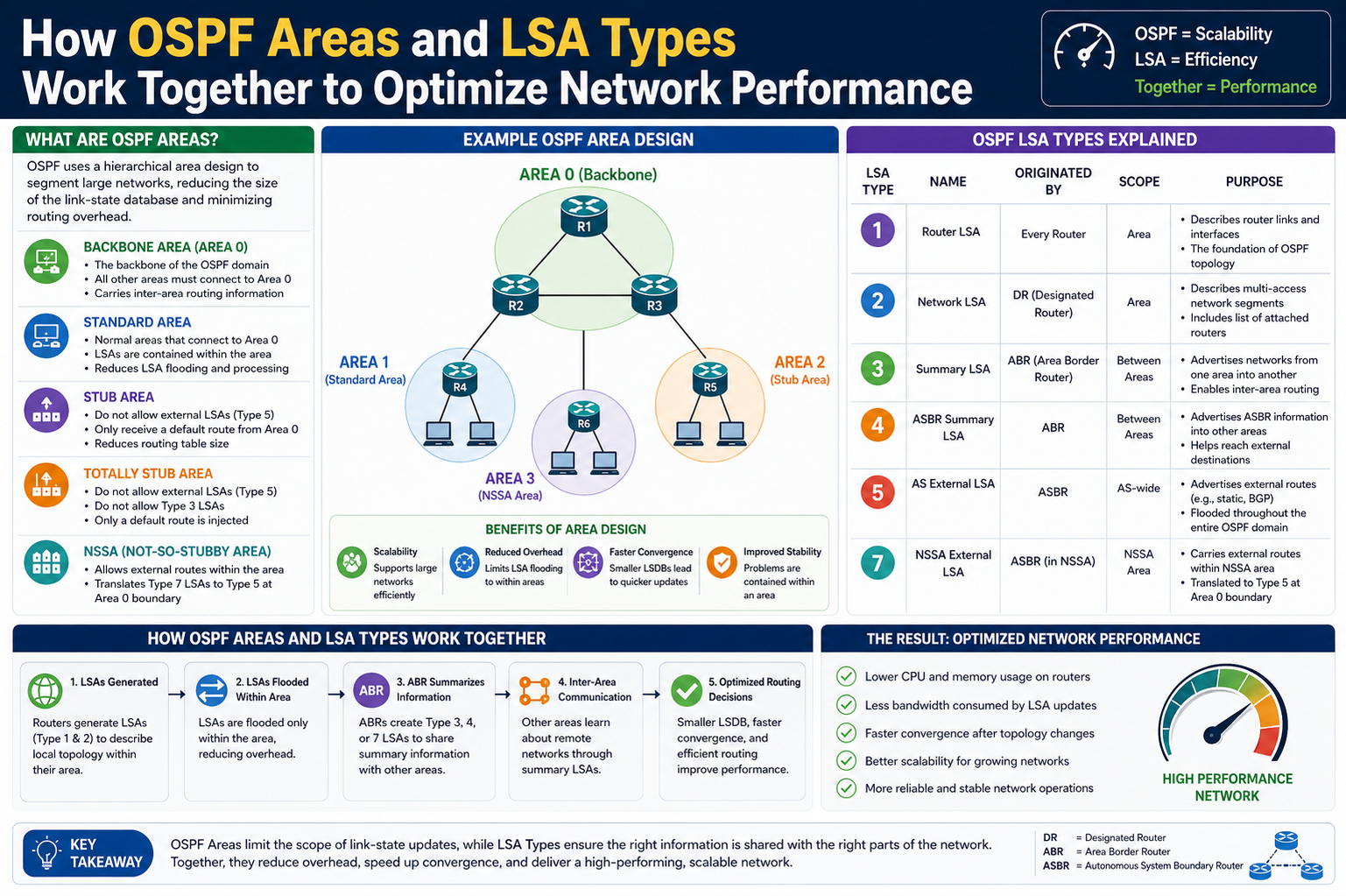
OSPF, or Open Shortest Path First, is a dynamic routing protocol designed to help routers determine the most efficient path for sending data across a network. Unlike simpler routing methods that repeatedly share entire routing tables with neighbors, OSPF focuses on building a detailed understanding of the network topology and only sharing necessary updates when changes occur. This makes it far more scalable and efficient, especially in large enterprise environments where constant routing updates could otherwise consume significant bandwidth and processing power.
At its core, OSPF works by allowing routers to exchange information about network links and their status. Each router builds a complete map of the network based on these updates and then uses an algorithm to calculate the shortest and most efficient paths for data transmission. This approach ensures that traffic is always routed intelligently, avoiding unnecessary delays and congestion.
One of the most important concepts in OSPF is the division of networks into areas. These areas are not physical divisions but logical groupings that help organize routers and reduce the complexity of routing calculations. By breaking a large network into smaller sections, OSPF ensures that each router does not need to maintain a full view of the entire network, which significantly improves performance and scalability.
Why OSPF Uses Areas Instead of a Single Large Network View
In traditional distance-vector protocols, routers frequently exchange full routing tables with their neighbors. While this method is simple, it quickly becomes inefficient as networks grow larger. Every update consumes bandwidth, and every router must process large amounts of repetitive information. This can lead to congestion and slower network performance.
OSPF solves this problem by introducing the concept of areas. Instead of treating the entire network as one large entity, OSPF divides it into smaller, manageable sections. Each area contains a group of routers, links, and networks that share the same area identifier. Within an area, routers only need to maintain information about that specific section of the network rather than the entire topology.
This reduction in scope dramatically decreases the size of routing tables and the amount of processing required. Routers no longer waste resources analyzing irrelevant network paths outside their assigned area. Instead, they focus only on local topology while relying on summarized information to communicate with other areas.
The use of areas also improves stability. When a change occurs within one area, such as a link going down, the update is mostly contained within that area. This prevents unnecessary recalculations across the entire network and reduces the impact of topology changes.
How OSPF Organizes Networks into Logical Areas
Each OSPF area acts as a self-contained unit within the larger network structure. Routers within the same area exchange detailed routing information, allowing them to maintain an accurate view of local connections. However, when information needs to be shared between different areas, it is summarized to reduce complexity.
This hierarchical structure is one of the key reasons OSPF is highly scalable. Large networks can be divided into multiple areas, each handling its own internal routing while still being connected through special routers responsible for inter-area communication. These routers ensure that data can still flow across the entire network even though detailed topology information is not shared globally.
By limiting detailed routing information to smaller segments, OSPF reduces overhead and improves convergence time. When a change occurs, routers can quickly update their local area without requiring a full recalculation of the entire network structure.
The Backbone Area and Its Importance in OSPF Design
At the center of every OSPF network is a special area known as the backbone area. This is commonly referred to as Area Zero. The backbone area serves as the central point through which all other areas must communicate. It acts as a core transport structure that connects all other OSPF areas together.
Every multi-area OSPF network must have a backbone area. Even if a network starts small, the backbone is still established as the primary area. As the network grows and more areas are added, all inter-area traffic must pass through this central backbone. This ensures a consistent and organized flow of routing information.
The backbone area plays a crucial role in maintaining efficiency. Without it, each area would need to maintain direct connections with every other area, creating unnecessary complexity. Instead, the backbone simplifies communication by acting as a central hub.
Routers that connect the backbone area to other areas are known as Area Border Routers. These routers are responsible for summarizing routing information and passing it between areas. They ensure that only essential information is shared, which helps keep routing tables smaller and more manageable.
Standard Areas and Their Function in Network Structure
Standard areas are the default type of OSPF areas used in most network designs. These areas allow full routing information to be shared within the area and summarized information to be exchanged between areas. They provide a balanced approach that supports both detailed local routing and efficient inter-area communication.
Within a standard area, routers maintain a complete understanding of all network routes inside that specific area. They also receive summarized route information from other areas through Area Border Routers. This combination ensures that routers can make informed decisions without being overwhelmed by unnecessary external details.
Standard areas are commonly used in environments where full routing visibility is required within a section of the network. They are flexible and can support a wide range of configurations, making them suitable for most general-purpose networking scenarios.
One of the key advantages of standard areas is their ability to support route summarization. This means that instead of sending every individual route to other areas, routers can combine multiple routes into a single summarized entry. This reduces the size of routing tables and improves overall network efficiency.
Introduction to Stub Areas and Their Purpose in OSPF Optimization
As networks grow larger, not all areas require full routing information from external sources. In some cases, it is more efficient to limit the amount of routing data that enters an area. This is where stub areas become useful.
A stub area is designed to reduce routing complexity by blocking certain types of external routing information. Instead of receiving multiple external routes from outside the OSPF network, routers within a stub area rely on a default route to reach external destinations.
This approach significantly reduces the size of routing tables within the area. Since routers no longer need to store detailed external route information, they can operate more efficiently with fewer resources.
Stub areas are particularly useful in branch networks or smaller network segments where external routing complexity is not necessary. By limiting external route propagation, they improve performance and simplify routing decisions.
When external routes are blocked, a default route is automatically used to forward traffic outside the area. This ensures that communication with external networks is still possible without requiring detailed route knowledge.
How Stub Areas Simplify Routing Decisions
Stub areas work by filtering out specific types of routing information that are not essential for internal operations. Instead of processing multiple external routes, routers inside a stub area rely on a simplified routing table.
This reduction in information helps improve convergence speed, as routers have fewer routes to calculate and maintain. It also reduces memory usage, making stub areas ideal for devices with limited resources.
By using a default route as the primary exit point for external traffic, stub areas eliminate the need for complex route selection processes. This ensures that all external traffic follows a predictable and efficient path.
Stub areas are a foundational concept in OSPF optimization, demonstrating how limiting information can actually improve overall network performance rather than reduce functionality.
Totally Stubby Areas and Their Strict Filtering Approach
Totally stubby areas take the idea of routing simplification even further than standard stub areas. While a regular stub area blocks most external routes and still allows some summarized inter-area information, a totally stubby area goes a step deeper by restricting even more routing details. The goal is to make the routing table as small and efficient as possible, especially in environments where simplicity and performance are more important than detailed route visibility.
In a totally stubby area, routers do not receive external routes at all, and they also do not receive detailed inter-area summaries. Instead, almost all traffic destined for outside the area is handled through a single default route. This means routers inside the area do not need to maintain large or complex routing tables, which significantly reduces processing overhead.
This design is especially useful in small branch networks or remote locations where routers only need to know how to reach the rest of the network, not the detailed structure beyond their local area. By limiting the information that enters the area, totally stubby areas reduce memory usage and improve routing efficiency.
The simplicity of totally stubby areas also improves stability. Since routers are not constantly processing multiple external route changes, the likelihood of frequent recalculations is reduced. This leads to a more predictable and stable network environment.
How Totally Stubby Areas Improve Network Performance
The main advantage of totally stubby areas is the reduction of routing complexity. When a router only needs to maintain a default route for external communication, it spends less time processing updates and more time forwarding traffic efficiently.
This streamlined approach helps especially in large networks where routing updates from external systems can become overwhelming. By blocking these updates entirely, totally stubby areas ensure that internal routing remains fast and consistent.
Another benefit is improved scalability. As networks grow, the number of external routes can increase dramatically. Without filtering mechanisms like totally stubby areas, routers in smaller segments would still need to process all of this information. By eliminating unnecessary route propagation, totally stubby areas allow networks to scale without overloading smaller devices.
However, this design also comes with trade-offs. Since detailed external routes are not available, routers inside a totally stubby area have less visibility into external network paths. They rely entirely on default routing decisions, which may not always provide the most optimized path for every situation. Despite this limitation, the simplicity and efficiency gains often outweigh the disadvantages in suitable environments.
Not-So-Stubby Areas and Their Flexible Design
Not-so-stubby areas introduce flexibility into OSPF’s otherwise strict area design. While stub and totally stubby areas are focused on restricting external routing information, not-so-stubby areas allow limited external route injection under controlled conditions.
These areas are particularly useful when a network needs to connect with external routing protocols, but still wants to maintain the benefits of a stub-like structure internally. In other words, they provide a controlled way to introduce external routes without fully opening up the area to all external routing complexity.
In a not-so-stubby area, external routes are not directly injected in their original form. Instead, they are converted into a special type of LSA that is allowed within the area. This allows the area to maintain its internal efficiency while still being aware of external destinations.
This design is commonly used in situations where a branch network needs limited access to external systems but still wants to avoid the full complexity of external routing tables.
Why Not-So-Stubby Areas Are Important in Real Networks
In real-world network environments, strict limitations can sometimes be too restrictive. Many organizations need a balance between efficiency and flexibility. Not-so-stubby areas provide that balance by allowing controlled external route access.
For example, if a network is connected to another organization using a different routing protocol, those external routes still need to be reachable. However, fully exposing the internal OSPF network to all external routes would create unnecessary complexity. Not-so-stubby areas solve this problem by translating external routing information into a format that fits within OSPF rules.
This approach ensures that routers inside the area remain efficient while still being able to communicate with external networks. It is a practical solution for hybrid network environments where multiple routing protocols coexist.
The ability to filter and transform external routes also improves security and control. Network administrators can decide exactly which external routes are allowed into the area, reducing the risk of unwanted routing information affecting internal operations.
Understanding Link State Advertisements in OSPF
Link State Advertisements, commonly known as LSAs, are the foundation of how OSPF routers communicate with each other. Instead of exchanging full routing tables, routers share LSAs to describe the state of the network. These LSAs contain information about routers, links, networks, and routing changes.
Each LSA type serves a specific purpose, helping OSPF maintain an accurate and efficient map of the network. By using different LSA types, OSPF ensures that only relevant information is shared with the appropriate routers.
LSAs are continuously updated whenever changes occur in the network. This allows routers to quickly adapt to failures, new connections, or topology changes. Once a router receives LSA information, it updates its local database and recalculates the best routes using the shortest path algorithm.
This mechanism ensures that all routers within an OSPF network remain synchronized and have a consistent view of the network topology.
LSA Type 1: Router LSA and Its Role in Local Areas
Router LSAs are generated by every router within an OSPF area. These LSAs describe the router’s directly connected links and its relationships with neighboring routers. They are only shared within the same area and are not passed between different areas.
When a router joins an OSPF network, it immediately begins generating Router LSAs to inform other routers about its presence and connections. These LSAs help build a complete picture of the local area topology.
Each Router LSA includes detailed information about interfaces, link costs, and neighbor relationships. This allows routers within the same area to calculate the most efficient paths for data transmission.
Since Router LSAs are limited to a single area, they help keep routing information localized and reduce unnecessary network traffic between areas.
LSA Type 2: Network LSA and Designated Router Function
Network LSAs are created by a designated router on multi-access networks such as Ethernet segments. When multiple routers are connected to the same network, it would be inefficient for all of them to form direct relationships with each other. Instead, one router is elected as the designated router to represent the network segment.
The designated router generates a Network LSA that describes all routers connected to that segment. This simplifies communication by reducing the number of neighbor relationships required.
Without this mechanism, each router would need to maintain individual connections with every other router on the same network, leading to excessive overhead and complexity.
Network LSAs help streamline this process by centralizing the representation of the network segment, making OSPF more scalable and efficient in shared environments.
LSA Type 3: Summary LSA and Inter-Area Communication
Summary LSAs are used to share routing information between different OSPF areas. These LSAs are generated by Area Border Routers, which act as intermediaries between areas.
Instead of sending full routing details from one area to another, Summary LSAs provide a simplified version of the routing information. This process is known as route summarization.
By summarizing routes, OSPF reduces the amount of information that needs to be processed by routers in other areas. This helps keep routing tables smaller and improves overall network performance.
Summary LSAs play a crucial role in maintaining the hierarchical structure of OSPF networks, ensuring that each area remains efficient while still being connected to the rest of the network.
LSA Type 4: ASBR Location Information
Type 4 LSAs provide information about the location of Autonomous System Boundary Routers. These routers are responsible for redistributing external routing information into the OSPF domain.
When external routes are introduced into OSPF, other routers need to know how to reach the source of those routes. Type 4 LSAs provide this information by describing the location of the ASBR within the network.
This ensures that routers can correctly forward traffic to external destinations without needing to maintain full external routing details.
Type 4 LSAs are essential for maintaining connectivity between OSPF and external routing systems, ensuring that external routes are properly integrated into the network structure.
Totally Stubby Areas and Their Strict Filtering Approach
Totally stubby areas take the idea of routing simplification even further than standard stub areas. While a regular stub area blocks most external routes and still allows some summarized inter-area information, a totally stubby area goes a step deeper by restricting even more routing details. The goal is to make the routing table as small and efficient as possible, especially in environments where simplicity and performance are more important than detailed route visibility.
In a totally stubby area, routers do not receive external routes at all, and they also do not receive detailed inter-area summaries. Instead, almost all traffic destined for outside the area is handled through a single default route. This means routers inside the area do not need to maintain large or complex routing tables, which significantly reduces processing overhead.
This design is especially useful in small branch networks or remote locations where routers only need to know how to reach the rest of the network, not the detailed structure beyond their local area. By limiting the information that enters the area, totally stubby areas reduce memory usage and improve routing efficiency.
The simplicity of totally stubby areas also improves stability. Since routers are not constantly processing multiple external route changes, the likelihood of frequent recalculations is reduced. This leads to a more predictable and stable network environment.
How Totally Stubby Areas Improve Network Performance
The main advantage of totally stubby areas is the reduction of routing complexity. When a router only needs to maintain a default route for external communication, it spends less time processing updates and more time forwarding traffic efficiently.
This streamlined approach helps especially in large networks where routing updates from external systems can become overwhelming. By blocking these updates entirely, totally stubby areas ensure that internal routing remains fast and consistent.
Another benefit is improved scalability. As networks grow, the number of external routes can increase dramatically. Without filtering mechanisms like totally stubby areas, routers in smaller segments would still need to process all of this information. By eliminating unnecessary route propagation, totally stubby areas allow networks to scale without overloading smaller devices.
However, this design also comes with trade-offs. Since detailed external routes are not available, routers inside a totally stubby area have less visibility into external network paths. They rely entirely on default routing decisions, which may not always provide the most optimized path for every situation. Despite this limitation, the simplicity and efficiency gains often outweigh the disadvantages in suitable environments.
Not-So-Stubby Areas and Their Flexible Design
Not-so-stubby areas introduce flexibility into OSPF’s otherwise strict area design. While stub and totally stubby areas are focused on restricting external routing information, not-so-stubby areas allow limited external route injection under controlled conditions.
These areas are particularly useful when a network needs to connect with external routing protocols, but still wants to maintain the benefits of a stub-like structure internally. In other words, they provide a controlled way to introduce external routes without fully opening up the area to all external routing complexity.
In a not-so-stubby area, external routes are not directly injected in their original form. Instead, they are converted into a special type of LSA that is allowed within the area. This allows the area to maintain its internal efficiency while still being aware of external destinations.
This design is commonly used in situations where a branch network needs limited access to external systems but still wants to avoid the full complexity of external routing tables.
Why Not-So-Stubby Areas Are Important in Real Networks
In real-world network environments, strict limitations can sometimes be too restrictive. Many organizations need a balance between efficiency and flexibility. Not-so-stubby areas provide that balance by allowing controlled external route access.
For example, if a network is connected to another organization using a different routing protocol, those external routes still need to be reachable. However, fully exposing the internal OSPF network to all external routes would create unnecessary complexity. Not-so-stubby areas solve this problem by translating external routing information into a format that fits within OSPF rules.
This approach ensures that routers inside the area remain efficient while still being able to communicate with external networks. It is a practical solution for hybrid network environments where multiple routing protocols coexist.
The ability to filter and transform external routes also improves security and control. Network administrators can decide exactly which external routes are allowed into the area, reducing the risk of unwanted routing information affecting internal operations.
Understanding Link State Advertisements in OSPF
Link State Advertisements, commonly known as LSAs, are the foundation of how OSPF routers communicate with each other. Instead of exchanging full routing tables, routers share LSAs to describe the state of the network. These LSAs contain information about routers, links, networks, and routing changes.
Each LSA type serves a specific purpose, helping OSPF maintain an accurate and efficient map of the network. By using different LSA types, OSPF ensures that only relevant information is shared with the appropriate routers.
LSAs are continuously updated whenever changes occur in the network. This allows routers to quickly adapt to failures, new connections, or topology changes. Once a router receives LSA information, it updates its local database and recalculates the best routes using the shortest path algorithm.
This mechanism ensures that all routers within an OSPF network remain synchronized and have a consistent view of the network topology.
LSA Type 1: Router LSA and Its Role in Local Areas
Router LSAs are generated by every router within an OSPF area. These LSAs describe the router’s directly connected links and its relationships with neighboring routers. They are only shared within the same area and are not passed between different areas.
When a router joins an OSPF network, it immediately begins generating Router LSAs to inform other routers about its presence and connections. These LSAs help build a complete picture of the local area topology.
Each Router LSA includes detailed information about interfaces, link costs, and neighbor relationships. This allows routers within the same area to calculate the most efficient paths for data transmission.
Since Router LSAs are limited to a single area, they help keep routing information localized and reduce unnecessary network traffic between areas.
LSA Type 2: Network LSA and Designated Router Function
Network LSAs are created by a designated router on multi-access networks such as Ethernet segments. When multiple routers are connected to the same network, it would be inefficient for all of them to form direct relationships with each other. Instead, one router is elected as the designated router to represent the network segment.
The designated router generates a Network LSA that describes all routers connected to that segment. This simplifies communication by reducing the number of neighbor relationships required.
Without this mechanism, each router would need to maintain individual connections with every other router on the same network, leading to excessive overhead and complexity.
Network LSAs help streamline this process by centralizing the representation of the network segment, making OSPF more scalable and efficient in shared environments.
LSA Type 3: Summary LSA and Inter-Area Communication
Summary LSAs are used to share routing information between different OSPF areas. These LSAs are generated by Area Border Routers, which act as intermediaries between areas.
Instead of sending full routing details from one area to another, Summary LSAs provide a simplified version of the routing information. This process is known as route summarization.
By summarizing routes, OSPF reduces the amount of information that needs to be processed by routers in other areas. This helps keep routing tables smaller and improves overall network performance.
Summary LSAs play a crucial role in maintaining the hierarchical structure of OSPF networks, ensuring that each area remains efficient while still being connected to the rest of the network.
LSA Type 4: ASBR Location Information
Type 4 LSAs provide information about the location of Autonomous System Boundary Routers. These routers are responsible for redistributing external routing information into the OSPF domain.
When external routes are introduced into OSPF, other routers need to know how to reach the source of those routes. Type 4 LSAs provide this information by describing the location of the ASBR within the network.
This ensures that routers can correctly forward traffic to external destinations without needing to maintain full external routing details.
Type 4 LSAs are essential for maintaining connectivity between OSPF and external routing systems, ensuring that external routes are properly integrated into the network structure.
LSA Type 5: External LSA and Routes From Outside the OSPF Domain
External LSAs are used when routes originate from outside the OSPF routing process and are injected into it through redistribution. These routes typically come from other routing protocols or external networks that are not originally part of OSPF. Once introduced, they are distributed across OSPF areas so that internal routers can reach external destinations.
Type 5 LSAs are generated by Autonomous System Boundary Routers, which act as the gateway between OSPF and external routing systems. These routers take external routing information and advertise it inside the OSPF domain so that all relevant routers can learn about outside networks.
Unlike internal LSAs that stay within an area, Type 5 LSAs are flooded throughout the entire OSPF domain, except in specific restricted areas like stub and totally stubby areas. This widespread distribution ensures that all routers that are allowed to see external routes have consistent information.
Type 5 LSAs carry important details such as the external network destination and the cost required to reach it. This allows routers to compare external paths and choose the most efficient exit point from the OSPF domain.
However, because external routes can significantly increase routing table size, they are often controlled or restricted using special area types to maintain efficiency.
LSA Type 7: NSSA External LSA and Controlled External Routing
Type 7 LSAs are specifically used in Not-So-Stubby Areas to handle external routing information in a controlled way. Since stub areas normally block external LSAs, NSSAs introduce Type 7 LSAs as a workaround to allow limited external route injection.
When external routes enter an NSSA, they are not immediately converted into Type 5 LSAs. Instead, they are translated into Type 7 LSAs, which behave like temporary internal representations of external routes within that area.
These Type 7 LSAs are only valid inside the NSSA itself. They are not directly propagated to other areas in their original form. Instead, when they reach an Area Border Router, they are converted into Type 5 LSAs before being distributed to the rest of the OSPF network.
This conversion process allows NSSAs to maintain the efficiency benefits of stub-like behavior while still supporting controlled external routing. It creates a balance between strict filtering and necessary connectivity.
Type 7 LSAs are especially useful in environments where a branch or isolated area needs limited external connectivity without exposing the entire network to external route complexity.
How OSPF Areas Control LSA Distribution
The relationship between OSPF areas and LSA types is central to how OSPF maintains both scalability and efficiency. Each area type determines which LSAs are allowed, filtered, or modified before being processed.
Standard areas allow most LSA types, including internal, summary, and external information. This provides full visibility of both internal and external routing paths, making them suitable for core or backbone-connected environments.
Stub areas block external LSAs, reducing routing table size by replacing external routes with a default route. This limits complexity while still allowing internal and inter-area communication.
Totally stubby areas go further by also reducing inter-area summaries, keeping routing tables even smaller and more predictable. They rely heavily on default routing for external access.
Not-so-stubby areas allow external routing in a controlled form using Type 7 LSAs, ensuring that external connectivity exists without breaking the efficiency rules of stub-like behavior.
These area-based restrictions directly influence how LSAs are processed, filtered, or translated as they move through the network. This layered control system is what makes OSPF both powerful and scalable.
How Area Border Routers and ASBRs Manage LSAs
Area Border Routers play a key role in connecting different OSPF areas. They are responsible for summarizing routing information and converting LSAs as they move between areas. When LSAs pass through an ABR, they are often simplified to reduce unnecessary detail.
For example, Type 1 LSAs inside an area may be converted into Type 3 summary LSAs when moving into another area. This ensures that only relevant routing information is shared across boundaries.
Autonomous System Boundary Routers handle a different responsibility. They introduce external routes into OSPF and generate Type 5 LSAs. In NSSA environments, they also handle the conversion of Type 7 LSAs into Type 5 LSAs before distributing them further.
Together, ABRs and ASBRs act as translation points within OSPF, ensuring that routing information is properly adapted depending on where it is going.
How LSAs and OSPF Areas Work Together in Real Networks
In real-world networks, OSPF areas and LSA types operate as a tightly integrated system. Areas define the boundaries of information visibility, while LSAs define how that information is communicated.
Inside a single area, routers rely heavily on Type 1 and Type 2 LSAs to build a complete local topology map. This allows them to calculate the best internal routes efficiently.
When communication is needed between areas, Type 3 LSAs summarize routing information so that other areas do not need full internal details. This reduces complexity and keeps routing tables manageable.
External connectivity is controlled using Type 5 LSAs, which are carefully distributed or blocked depending on area type. In restricted environments, Type 7 LSAs provide a controlled method for handling external routes without breaking area rules.
This layered structure ensures that OSPF remains scalable even in very large networks. Each layer has a clear responsibility, and LSAs are filtered or transformed as needed to match the requirements of that layer.
Final though
The combination of OSPF areas and LSA types creates a structured hierarchy that balances performance, scalability, and control. Areas reduce the size of routing domains, while LSAs ensure accurate and efficient communication between routers.
By dividing networks into logical sections and controlling how information flows between them, OSPF prevents unnecessary overload and keeps routing decisions fast and reliable.
Each LSA type has a specific purpose, and each area type defines how those LSAs are treated. This interaction is what allows OSPF to function efficiently even in complex enterprise environments with thousands of routes and multiple interconnected networks.