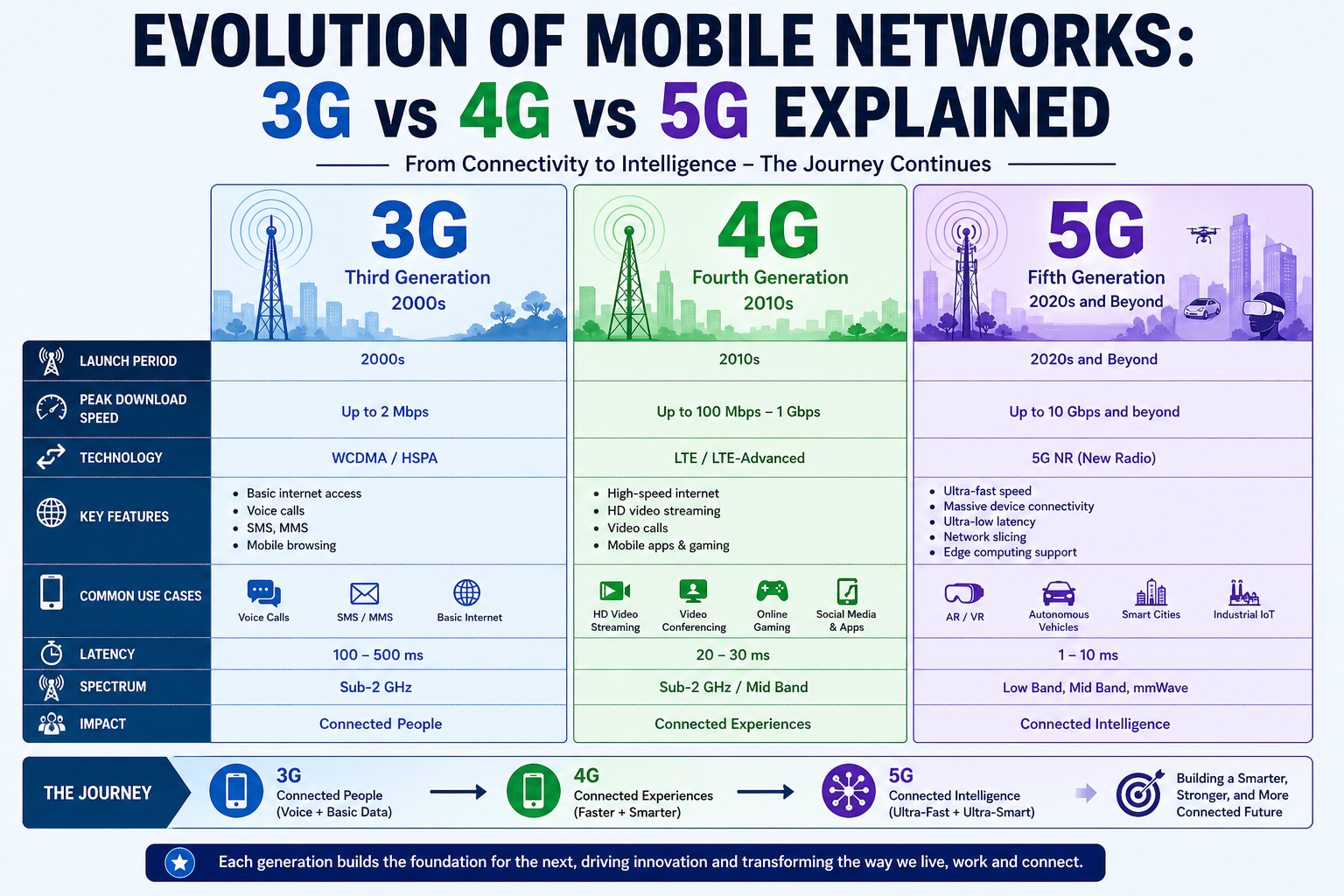
Wireless communication has evolved into one of the most influential technologies shaping modern life. What once required wired connections and stationary devices has transformed into a fully mobile experience where communication, entertainment, work, and commerce happen instantly through handheld devices. This transformation did not occur suddenly but through gradual advancements in mobile network generations. Each stage of development introduced improvements in speed, reliability, and usability, enabling new digital experiences that were previously impossible. The journey from early mobile systems to advanced high-speed connectivity reflects a continuous effort to meet the growing demand for faster and more efficient data transmission across the world. Today’s mobile networks are the result of decades of research, experimentation, and innovation aimed at making global communication seamless and accessible.
Understanding the Meaning of Mobile Generations
In mobile technology, the term generation refers to a major stage in the evolution of cellular networks. Each generation represents a significant upgrade in how data is transmitted, processed, and delivered to users. These generations are typically labeled numerically, with each new level offering improvements over its predecessor. The concept is not limited to speed alone; it also includes enhancements in network capacity, security, efficiency, and support for new applications. As user expectations grew, networks had to evolve to support more complex services such as internet browsing, video streaming, and real-time communication. The generational shift in wireless technology highlights how communication systems adapt over time to meet increasing digital demands and technological innovation.
Early Foundations of Mobile Connectivity
The earliest forms of mobile communication were primarily focused on voice transmission. These systems were large, limited in capacity, and relied heavily on analog signals. They allowed basic wireless communication but lacked the flexibility and efficiency needed for data services. Despite their limitations, these early systems laid the groundwork for future advancements by introducing the idea of mobile connectivity. Over time, engineers recognized the need for more efficient systems capable of handling growing communication demands. This realization led to the development of digital mobile technologies, which marked a significant shift from simple voice communication to more advanced and structured data handling systems.
The Shift Toward Digital Communication Systems
As technology advanced, the limitations of analog systems became more apparent, especially in terms of quality, security, and capacity. This led to the transition toward digital communication, which allowed information to be converted into digital signals for transmission. Digital systems improved clarity, reduced interference, and increased the number of users that could be supported simultaneously. This shift was essential for enabling more advanced services beyond voice calls, including text messaging and early forms of mobile data exchange. It also laid the foundation for future network generations that would eventually support full internet access on mobile devices. The move to digital communication marked a turning point in the evolution of wireless technology.
Development of Early Data-Enabled Networks
With the introduction of digital systems, mobile networks began to support limited data services. These early data-enabled systems were still relatively slow and restricted in functionality, but they represented an important step toward modern mobile internet. Users could perform basic tasks such as sending emails or accessing simple web pages, although performance was often inconsistent. Despite these challenges, the introduction of mobile data services changed user expectations and created demand for faster and more reliable connectivity. This period highlighted the growing importance of internet access on mobile devices and set the stage for more advanced generations of wireless networks.
Emergence of Third Generation Mobile Technology
The introduction of third generation mobile networks marked a major breakthrough in wireless communication. It was designed to significantly improve data transmission speeds and enable a wider range of services. Unlike previous systems that focused mainly on voice and basic messaging, this new generation made mobile internet a practical reality for everyday users. It allowed people to access websites, send multimedia messages, and use early forms of mobile applications. This development played a crucial role in transforming mobile phones from simple communication tools into multifunctional devices capable of supporting a wide range of digital activities.
Mobile Internet Becomes a Practical Reality
With the arrival of third generation networks, mobile internet usage became more widespread and accessible. Users were no longer restricted to desktops or wired connections for online access. Instead, they could browse the internet, check emails, and interact with online services directly from their mobile devices. Although speeds were not as fast as modern standards, the experience was revolutionary at the time. It introduced the concept of constant connectivity, where users could stay online while moving. This shift significantly changed how people interacted with technology and created new opportunities for mobile applications and digital services.
Technical Foundations of Third Generation Networks
Third generation systems were built on advanced digital technologies designed to improve data transfer efficiency. These networks utilized specialized communication protocols that allowed better handling of simultaneous users and higher data volumes. Frequency ranges were carefully allocated to balance coverage and performance, ensuring that users in different regions could access services reliably. The underlying architecture was designed to support both voice and data services, making it more versatile than earlier systems. This technical foundation enabled smoother communication, improved network stability, and expanded the possibilities of mobile connectivity beyond simple voice calls and text messaging.
Capabilities Introduced by Third Generation Technology
The introduction of third generation networks brought several important capabilities that reshaped mobile usage. One of the most significant improvements was the ability to support multimedia services, including image sharing and video communication. Users could also experience early versions of mobile streaming and online browsing with improved speed and reliability. Security features were enhanced to protect user data during transmission, making mobile communication safer. These capabilities collectively contributed to a more connected digital environment, where mobile devices began to play a central role in daily communication and information access.
Impact on Communication and Daily Life
The influence of third generation technology extended beyond technical improvements and had a profound impact on everyday life. It changed how people communicated, worked, and accessed information. Mobile devices became essential tools for both personal and professional use, enabling communication from virtually anywhere. Businesses began to adopt mobile communication strategies, while individuals increasingly relied on mobile internet for entertainment and social interaction. This widespread adoption demonstrated the growing importance of wireless connectivity in shaping modern lifestyles and digital behavior across the globe.
Limitations of Early Mobile Internet Systems
Despite its advancements, third generation technology still faced several limitations. Data speeds were relatively slow compared to modern standards, and network congestion often affected performance in densely populated areas. Coverage gaps also existed in certain regions, limiting accessibility for some users. Additionally, data usage costs were often high, restricting widespread adoption in some markets. These limitations highlighted the need for further improvements in mobile technology, pushing researchers and engineers to develop faster, more efficient systems capable of handling increasing digital demands.
Foundation for Future Wireless Advancements
The development of third generation networks created a strong foundation for future innovations in mobile communication. It demonstrated the potential of mobile internet and encouraged further research into faster and more reliable technologies. The growing demand for high-speed connectivity and advanced digital services eventually led to the creation of more powerful network generations. These advancements continued to build on the principles established during the third generation era, shaping the direction of modern wireless communication systems and preparing the world for even more advanced connectivity solutions.
Emergence of Fourth Generation Mobile Networks
The introduction of fourth generation mobile networks marked a major shift in the evolution of wireless communication. This generation was designed to overcome the limitations of earlier systems by delivering significantly higher data speeds, improved stability, and a more seamless user experience. Unlike previous generations, which gradually introduced mobile internet, this new stage was built with data-centric usage in mind from the beginning. The primary goal was to support advanced internet services, including high-quality video streaming, real-time communication, and fast web browsing. As mobile devices became more powerful and applications more demanding, the need for a stronger and more efficient network became essential. Fourth generation technology successfully addressed these needs by redefining how mobile data was transmitted and accessed.
Transition from 3G to High-Speed Mobile Broadband
The shift from third generation to fourth generation networks represented more than just an incremental improvement. It was a complete transformation in how mobile connectivity was designed and experienced. While third generation networks introduced mobile internet, their performance was often limited by slower speeds and higher latency. Fourth generation systems focused on delivering a broadband-like experience on mobile devices, allowing users to enjoy internet speeds comparable to fixed broadband connections. This transition enabled smoother video playback, faster downloads, and more responsive applications. It also encouraged the development of mobile-first services, where applications were designed specifically for smartphones and tablets rather than adapted from desktop environments.
Introduction of LTE Technology
A key development within fourth generation networks was the introduction of LTE technology, which stands for Long-Term Evolution. This technology became the foundation of modern mobile broadband by improving how data is transmitted over cellular networks. LTE was designed to increase efficiency, reduce latency, and support higher data throughput compared to earlier systems. It also introduced a more flexible network structure that could adapt to varying user demands. With LTE, mobile operators were able to offer faster and more reliable internet services, making mobile connectivity more practical for everyday use. This advancement played a crucial role in shaping the modern mobile experience, where high-speed internet access is expected as a standard feature.
Improved Speed and Performance Capabilities
One of the most noticeable improvements brought by fourth generation networks was the significant increase in speed. Users experienced much faster download and upload rates compared to previous generations, allowing them to access content more efficiently. This improvement made activities such as video streaming, online gaming, and large file downloads much more practical on mobile devices. The enhanced performance also reduced buffering and lag, creating a smoother overall experience. Although real-world speeds varied depending on location and network conditions, the overall performance improvement was substantial enough to change how people used mobile internet on a daily basis.
Reduction in Network Latency
Latency, which refers to the delay between sending and receiving data, was significantly reduced in fourth generation networks. This improvement had a major impact on real-time applications such as video calls, online gaming, and interactive services. Lower latency meant that communication felt more immediate and responsive, closely resembling face-to-face interaction in some cases. This was particularly important for applications that required instant feedback, where even small delays could affect performance. By reducing latency, fourth generation networks created a more efficient and responsive digital environment, enabling new types of applications that were not practical in earlier generations.
Expansion of Mobile Multimedia Services
The capabilities of fourth generation networks enabled a rapid expansion of multimedia services on mobile devices. High-definition video streaming became widely accessible, allowing users to watch movies, television shows, and online videos without relying on wired internet connections. Social media platforms also evolved to include richer media content, such as live streaming and high-quality image sharing. This shift transformed mobile devices into primary entertainment tools for many users. The ability to consume and share multimedia content on the go significantly changed digital behavior and contributed to the global growth of online media consumption.
Growth of Mobile Applications and Ecosystems
With the rise of fourth generation connectivity, mobile applications experienced rapid growth and diversification. Developers were able to create more complex and feature-rich applications that relied on stable and fast internet connections. This led to the expansion of app ecosystems, where users could access services for communication, transportation, banking, education, and entertainment directly from their mobile devices. The improved network performance allowed applications to operate more smoothly and efficiently, encouraging greater user engagement. As a result, mobile devices became central to many aspects of daily life, supported by a strong and reliable network infrastructure.
Enhanced Network Capacity and User Handling
Fourth generation networks were designed to handle a significantly larger number of users simultaneously compared to previous systems. This improvement was essential as mobile device adoption continued to grow globally. Network congestion, which was a common issue in earlier generations, was reduced through more efficient data management and advanced infrastructure design. This allowed users in densely populated areas to maintain stable connections even during peak usage times. The increased capacity also supported the growing demand for data-heavy applications, ensuring consistent performance across different environments and usage scenarios.
Introduction of LTE-Advanced Enhancements
As fourth generation technology evolved, further improvements were introduced through LTE-Advanced systems. These enhancements built upon the existing LTE framework to deliver even higher speeds and better performance. One of the key improvements was carrier aggregation, which allowed multiple frequency bands to be used simultaneously for data transmission. This increased overall bandwidth and improved network efficiency. Additionally, advanced antenna technologies improved signal quality and coverage. These developments pushed mobile performance closer to theoretical limits, offering users even faster and more reliable connectivity experiences in supported areas.
Improved Connectivity for Emerging Technologies
Fourth generation networks played an important role in supporting emerging technologies that required stable and high-speed internet access. Applications such as cloud computing, remote collaboration tools, and real-time data sharing became more practical with improved mobile connectivity. These technologies relied heavily on continuous data exchange, which was made possible by the advancements in network performance. As a result, businesses and individuals were able to adopt more flexible and mobile working environments. This shift contributed to the growing trend of digital transformation across multiple industries.
Limitations and Challenges of Fourth Generation Systems
Despite its many improvements, fourth generation technology also had certain limitations. While it offered significantly higher speeds than earlier generations, it still faced challenges in meeting the increasing demand for data-intensive applications. Network performance could vary depending on location, infrastructure quality, and user density. In some cases, users experienced reduced speeds during peak hours or in crowded areas. Additionally, the growing number of connected devices placed increasing pressure on network resources. These challenges highlighted the need for even more advanced systems capable of supporting the next wave of digital innovation.
Foundation for Next-Level Mobile Connectivity
Fourth generation networks served as a critical foundation for the development of future wireless technologies. By introducing high-speed mobile broadband and supporting advanced applications, this generation reshaped user expectations and set new standards for performance. It demonstrated the importance of fast, reliable, and low-latency connectivity in modern communication systems. These advancements paved the way for the next stage of wireless evolution, where even greater speed, capacity, and efficiency would become essential to support emerging digital technologies and increasingly connected environments.
Evolution Toward Enhanced 4G Systems (4G+)
As mobile communication continued to expand, the need for even greater performance within fourth generation networks led to the development of enhanced versions often referred to as 4G+. This stage was not a completely new generation but rather a significant improvement over standard fourth generation technology. The goal was to push existing infrastructure closer to its theoretical limits while improving speed, efficiency, and user experience. These enhancements helped bridge the gap between traditional 4G systems and the future demands of next-generation connectivity. By refining existing technologies instead of replacing them entirely, network providers were able to deliver noticeable performance improvements without requiring a complete overhaul of infrastructure.
4G+ networks focused on optimizing data transmission and improving overall network responsiveness. This allowed users to experience faster downloads, smoother streaming, and more stable connections in areas with strong coverage. The improvements were especially noticeable in urban environments where high user density often strained network resources. By enhancing the underlying systems of 4G, this upgraded version played an important role in preparing mobile networks for the transition toward more advanced technologies.
Carrier Aggregation and Advanced LTE Improvements
One of the most important innovations introduced in enhanced fourth generation networks was carrier aggregation. This technique allowed multiple frequency bands to be combined into a single data channel, significantly increasing overall bandwidth. Instead of relying on a single frequency, networks could now distribute data across several channels simultaneously, resulting in faster and more efficient communication. This approach improved both download and upload speeds while also reducing congestion in busy network areas.
Advanced LTE improvements also included better signal management and more efficient data handling techniques. These enhancements made it possible for networks to deliver more consistent performance even under heavy usage conditions. As a result, users experienced fewer interruptions and more reliable connectivity. These improvements represented a crucial step in the evolution of mobile broadband, pushing performance closer to the expectations of modern digital applications.
MIMO Technology and Network Efficiency Gains
Another key advancement in enhanced fourth generation systems was the use of MIMO technology, which stands for Multiple Input Multiple Output. This system uses multiple antennas at both the transmitter and receiver ends to improve communication efficiency. By transmitting and receiving multiple data streams simultaneously, MIMO significantly increases network capacity and improves signal quality. This technology became essential for supporting the growing demand for high-speed mobile data.
MIMO systems also helped reduce interference and improve coverage in challenging environments. This meant better performance in crowded cities, indoor areas, and locations with physical obstructions. As mobile usage continued to grow, these efficiency gains became increasingly important in maintaining stable and reliable connections across diverse environments.
Growing Demand for Always-On Connectivity
As mobile technology advanced, user expectations shifted toward constant and uninterrupted connectivity. People began relying on mobile networks not just for communication, but for entertainment, work, education, and financial transactions. This growing dependence created pressure on existing networks to deliver continuous, high-quality service without delays or disruptions.
Applications such as video streaming, cloud storage, and real-time collaboration tools required stable and fast connections at all times. This demand pushed network developers to improve infrastructure and explore new technologies capable of supporting always-on connectivity. The shift in user behavior played a major role in shaping the direction of future mobile network development.
Limitations That Pushed Toward 5G Development
Despite the significant improvements introduced in enhanced fourth generation systems, certain limitations remained. As the number of connected devices increased, networks began to experience strain, especially in densely populated areas. While speeds were faster than earlier generations, they were still not sufficient for emerging technologies that required extremely low latency and massive data handling capabilities.
Applications such as autonomous systems, advanced virtual reality, and large-scale IoT networks demanded performance levels beyond what 4G+ could reliably deliver. These limitations highlighted the need for a completely new generation of wireless technology designed from the ground up to handle future digital demands. This need ultimately led to the development of fifth generation mobile networks.
Introduction to Fifth Generation Mobile Networks
Fifth generation mobile networks represent a major leap forward in wireless communication technology. Unlike previous upgrades, this generation was designed to fundamentally change how data is transmitted and managed across networks. The primary focus of this technology is to deliver extremely high speeds, ultra-low latency, and massive connectivity capabilities.
5G is not just an improvement in performance but a transformation in network architecture. It enables new types of applications that were previously not possible due to technical limitations. This includes real-time remote control systems, advanced automation, and highly immersive digital experiences. The introduction of 5G marks a new era in mobile connectivity where networks become faster, smarter, and more adaptable.
Core Principles Behind 5G Design
The design of fifth generation networks is based on three core principles: enhanced mobile broadband, ultra-reliable low-latency communication, and massive machine-type communication. Enhanced mobile broadband focuses on delivering extremely high data speeds for applications such as streaming and downloading large files. Ultra-reliable low-latency communication ensures minimal delay in data transmission, which is essential for real-time systems.
Massive machine-type communication is designed to support a large number of connected devices simultaneously. This is particularly important for the Internet of Things, where billions of devices need to communicate efficiently. These core principles define the structure and capabilities of 5G networks, making them suitable for a wide range of advanced applications.
Ultra-Low Latency and Real-Time Communication
One of the most important features of fifth generation networks is ultra-low latency. Latency refers to the time it takes for data to travel from one point to another. In 5G networks, this delay is reduced to extremely low levels, allowing near-instant communication between devices.
This improvement is crucial for applications that require real-time response, such as remote surgery, autonomous vehicles, and interactive gaming. Even a small delay in these systems can have significant consequences, so reducing latency is a key priority. Ultra-low latency enables a more responsive and interactive digital environment, opening the door to new technological possibilities.
Massive Device Connectivity and IoT Expansion
Fifth generation networks are designed to support a massive number of connected devices simultaneously. This capability is essential for the expansion of the Internet of Things, where everyday objects such as home appliances, vehicles, and industrial machines are connected to the internet.
With 5G, it becomes possible to manage large-scale networks of devices without significant performance degradation. This enables smart homes, smart cities, and automated industrial systems to function more efficiently. The ability to connect and manage vast numbers of devices is one of the defining features of this generation of mobile technology.
5G Frequency Spectrum and Band Types
Fifth generation networks operate across a wide range of frequency bands, each designed for specific use cases. These include lower frequency bands for broader coverage and higher frequency bands for faster data transmission. The flexibility of this spectrum allows network providers to optimize performance based on location and demand.
Lower frequency bands provide better coverage over long distances and are useful in rural or less densely populated areas. Higher frequency bands, on the other hand, deliver extremely fast speeds but have a shorter range. This combination allows 5G networks to balance coverage and performance effectively.
Sub-6 GHz vs mmWave Capabilities
Within the 5G frequency spectrum, two major categories stand out: sub-6 GHz and millimeter wave bands. Sub-6 GHz frequencies offer a balance between speed and coverage, making them suitable for widespread deployment. These frequencies are capable of delivering strong performance while maintaining reasonable coverage areas.
Millimeter wave frequencies operate at much higher ranges and provide extremely fast data speeds. However, they have limited range and are more sensitive to physical obstacles. This makes them ideal for densely populated areas where high-speed connectivity is required over shorter distances. The combination of these two bands allows 5G networks to deliver flexible and scalable performance.
Network Slicing and Virtualized Architecture
A major innovation in fifth generation networks is the concept of network slicing. This technology allows a single physical network to be divided into multiple virtual networks, each optimized for different types of services. For example, one slice can be dedicated to emergency services, while another supports entertainment streaming or industrial automation.
This approach improves efficiency and ensures that different applications receive the appropriate level of performance. Virtualized architecture also makes networks more flexible and easier to manage. By separating network functions into virtual components, operators can adapt quickly to changing demands and optimize resource usage more effectively.
Impact of 5G on Smart Cities and Industry
Fifth generation technology is expected to play a major role in the development of smart cities and advanced industrial systems. In smart cities, connected sensors and devices can monitor traffic, energy usage, and public services in real time. This allows for more efficient resource management and improved urban planning.
In industrial environments, 5G enables automation, robotics, and real-time monitoring of production systems. This improves efficiency, reduces downtime, and enhances overall productivity. The ability to connect and manage complex systems in real time makes 5G a key technology for future industrial development.
Emerging Applications Enabled by 5G
The capabilities of fifth generation networks have opened the door to a wide range of emerging applications. These include advanced virtual and augmented reality experiences, remote-controlled machinery, intelligent transportation systems, and next-generation healthcare solutions. Many of these applications rely on the combination of high speed, low latency, and massive connectivity provided by 5G.
As adoption continues to grow, these technologies are expected to become more integrated into everyday life. The flexibility and power of 5G networks make them a foundation for future innovation, supporting new ideas and transforming how digital systems operate across industries and societies.
Challenges in Global 5G Deployment
The rollout of fifth generation mobile networks across the world has not been a uniform or simple process. While the technology itself is highly advanced, deploying it at a global scale requires significant infrastructure upgrades, financial investment, and regulatory coordination. Many regions still rely heavily on older network systems, making the transition to 5G a gradual and complex process. One of the primary challenges is the need for dense network infrastructure, including a large number of small cell towers. Unlike earlier generations that could cover wide areas with fewer towers, 5G often requires closely spaced equipment to maintain performance, especially in high-frequency bands.
Another major challenge involves cost. Building and maintaining a 5G network demands substantial investment from telecom operators. This includes upgrading existing infrastructure, installing new antennas, and ensuring compatibility with modern devices. In developing regions, financial limitations can slow down deployment, creating a gap between advanced urban centers and less developed rural areas. As a result, global 5G availability remains uneven, with some countries experiencing widespread access while others are still in early stages of implementation.
Infrastructure Requirements and Urban Density Issues
Fifth generation networks depend heavily on advanced infrastructure that is significantly more complex than previous systems. The use of higher frequency bands, particularly millimeter wave technology, requires a dense network of small transmission points to maintain stable coverage. These signals do not travel as far as lower frequency waves and are more easily blocked by buildings, trees, and other physical obstacles. As a result, urban environments require careful planning to ensure consistent connectivity.
In densely populated cities, installing sufficient network infrastructure can be challenging due to space limitations and regulatory restrictions. Building permissions, aesthetic concerns, and public infrastructure planning all influence how and where network equipment can be deployed. This makes urban rollout both technically and logistically demanding. Despite these challenges, cities remain the primary focus of early 5G deployment due to their high user demand and economic importance.
Security Concerns in Advanced Wireless Networks
As mobile networks become more advanced and interconnected, security becomes an increasingly important concern. Fifth generation systems introduce a higher level of complexity, which can create new vulnerabilities if not properly managed. The increased number of connected devices also expands the potential attack surface for cyber threats. Since 5G networks support critical applications such as healthcare systems, transportation, and industrial automation, any security breach could have serious consequences.
To address these concerns, modern networks incorporate advanced encryption methods and improved authentication protocols. Virtualized network architecture also allows better isolation of services, reducing the risk of widespread disruption. However, ensuring complete security in such a large and dynamic system remains an ongoing challenge. Continuous monitoring, software updates, and international cooperation are essential to maintaining the safety and integrity of these networks.
Role of Artificial Intelligence in Network Optimization
Artificial intelligence is playing an increasingly important role in managing and optimizing modern mobile networks. In fifth generation systems, AI is used to analyze network traffic, predict congestion, and allocate resources more efficiently. This allows networks to adapt dynamically to changing conditions and user demands. Instead of relying solely on manual configuration, AI-driven systems can make real-time adjustments to improve performance and reduce delays.
AI also helps in detecting anomalies and potential security threats within the network. By analyzing patterns of behavior, intelligent systems can identify unusual activity and respond quickly to prevent disruptions. This level of automation is essential for managing the complexity of 5G networks, which handle vast amounts of data and support a large number of connected devices simultaneously. The integration of artificial intelligence marks a significant step toward self-optimizing and intelligent communication systems.
Expansion of Internet of Things Ecosystem
The growth of fifth generation networks has significantly accelerated the expansion of the Internet of Things ecosystem. IoT refers to the connection of everyday devices to the internet, enabling them to collect and exchange data. With the improved speed and capacity of 5G, billions of devices can now be connected simultaneously without overwhelming the network. This includes smart home appliances, wearable devices, industrial sensors, and connected vehicles.
The ability to support massive device connectivity allows IoT systems to function on a much larger scale. Smart cities, for example, can use connected sensors to monitor traffic flow, energy consumption, and environmental conditions in real time. In industrial settings, IoT devices can track machinery performance and predict maintenance needs before failures occur. This widespread connectivity is transforming how systems operate and interact in both public and private sectors.
Enhanced Mobile Experiences and User Expectations
As mobile technology continues to evolve, user expectations have increased significantly. People now expect instant access to information, seamless streaming, and uninterrupted communication regardless of location. Fifth generation networks are designed to meet these expectations by providing faster speeds and more reliable connections. This has led to a shift in how digital services are designed, with a focus on real-time interaction and high-performance applications.
Applications such as cloud gaming, augmented reality, and immersive media experiences are becoming more common as network capabilities improve. Users are no longer satisfied with basic functionality; instead, they expect rich, interactive experiences that respond instantly. This shift in expectations is driving continuous innovation in both network technology and application development.
Energy Efficiency and Environmental Considerations
While fifth generation networks offer significant performance improvements, they also raise concerns regarding energy consumption. The dense infrastructure required for 5G, along with the large number of connected devices, can lead to increased energy usage. As a result, researchers and engineers are focusing on developing more energy-efficient technologies to reduce environmental impact.
Modern network systems are being designed with sustainability in mind, using intelligent power management techniques and more efficient hardware. AI-driven optimization also helps reduce unnecessary energy consumption by adjusting network resources based on demand. These efforts are essential for ensuring that future communication systems remain both powerful and environmentally responsible.
Comparison of Generational Progress in Wireless Technology
The evolution from earlier mobile generations to fifth generation networks represents a continuous improvement in speed, capacity, and functionality. Each generation has introduced new capabilities that expanded the possibilities of mobile communication. Early systems focused primarily on voice communication, while later generations introduced mobile internet, multimedia services, and high-speed broadband.
Fifth generation networks go beyond these improvements by enabling real-time connectivity, massive device integration, and ultra-low latency communication. This progression reflects the growing demand for more advanced digital services and the need for networks capable of supporting increasingly complex technologies. The comparison between generations highlights how far wireless communication has advanced in a relatively short period of time.
Differences in Application and Use Cases Across Generations
Each generation of mobile technology has supported different types of applications based on its capabilities. Early systems were limited to voice calls and text messaging, while third generation networks introduced mobile internet and basic multimedia services. Fourth generation systems enabled high-definition streaming, online gaming, and mobile applications that required stable internet connections.
Fifth generation networks support a much broader range of use cases, including autonomous vehicles, remote medical procedures, smart cities, and advanced industrial automation. The ability to handle real-time communication and massive device connectivity makes 5G suitable for applications that were previously not possible. This expansion of use cases demonstrates how each generation builds upon the capabilities of the previous one.
Future Direction Toward Sixth Generation Networks
Even as fifth generation networks continue to expand globally, research into sixth generation technology is already underway. This future generation is expected to deliver even higher speeds, potentially reaching levels far beyond current capabilities. It is also anticipated to use advanced frequency ranges, including terahertz bands, to support extreme data transfer rates.
Sixth generation systems are expected to integrate artificial intelligence even more deeply into network operations, enabling fully autonomous and self-optimizing communication systems. They may also support advanced global connectivity, including seamless communication across land, sea, air, and space. Although still in early conceptual stages, this future direction reflects the continuous evolution of wireless technology.
Long-Term Impact of Advanced Wireless Networks
The development of advanced wireless networks has a long-lasting impact on society, industry, and communication. These technologies have transformed how people interact, work, and access information. They have enabled global connectivity and supported the growth of digital economies across the world. As networks continue to evolve, their influence is expected to expand even further into areas such as healthcare, education, transportation, and entertainment.
The increasing reliance on wireless communication highlights the importance of continued innovation and investment in network technology. Future developments will likely focus on improving efficiency, expanding coverage, and supporting new digital ecosystems. The long-term impact of these advancements will continue to shape the structure of modern society.
Conclusion
The journey from early mobile systems to advanced fifth generation networks represents one of the most significant technological transformations in modern history. Each stage of development has contributed to improved communication speed, better connectivity, and more powerful digital capabilities. From basic voice communication to intelligent, real-time global networks, wireless technology has continuously evolved to meet the growing demands of users and industries.
Fifth generation networks stand as a major milestone in this evolution, offering unprecedented speed, capacity, and flexibility. They have enabled new technologies, transformed industries, and reshaped daily life. At the same time, ongoing research into future generations ensures that innovation in wireless communication will continue. As technology advances further, the world moves closer to a fully connected digital ecosystem where communication is faster, smarter, and more integrated than ever before.