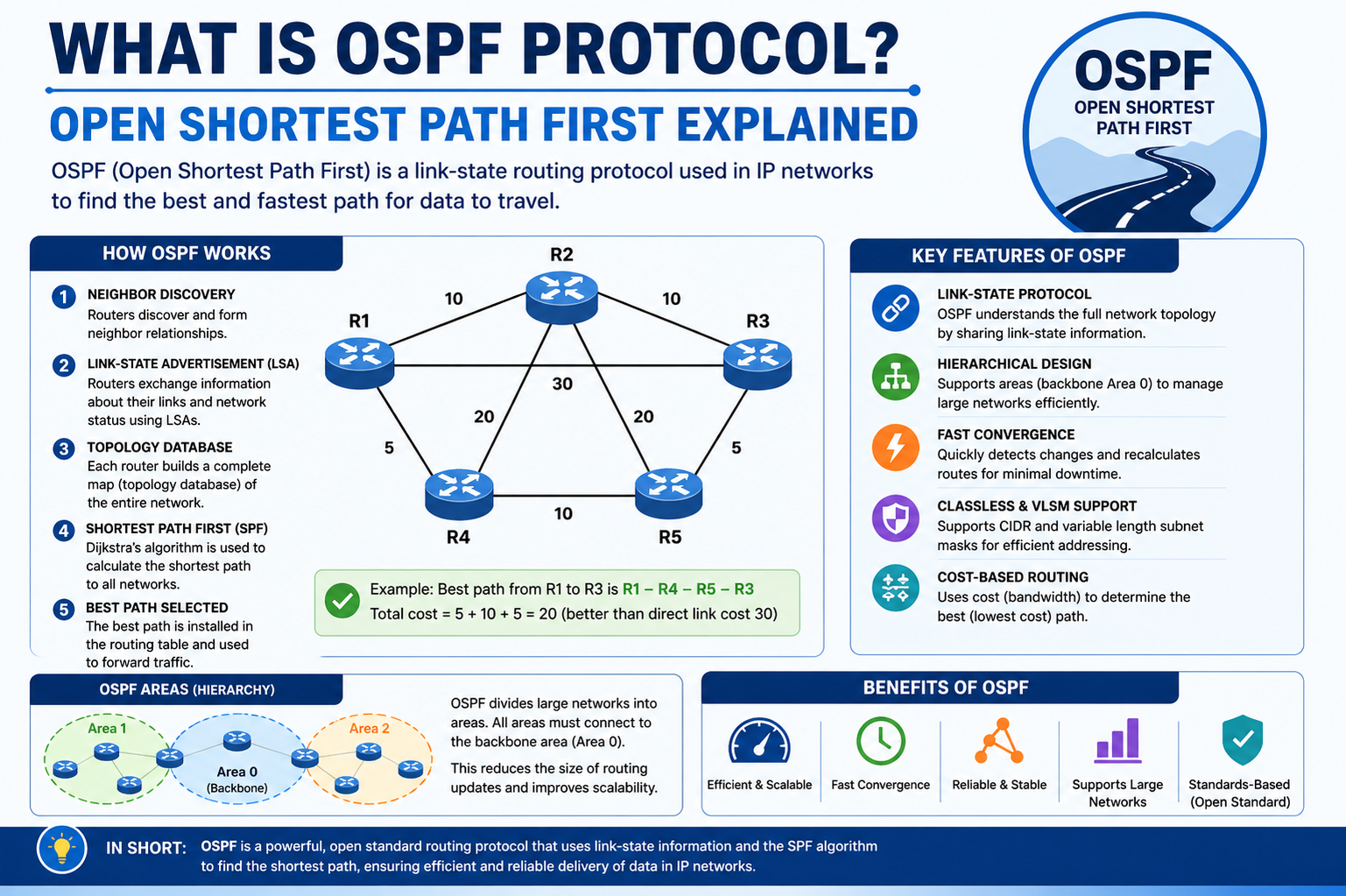
OSPF (Open Shortest Path First) is a dynamic routing protocol designed to determine the most efficient way for data to travel across an IP network. It operates at the network layer and is widely used inside a single autonomous system, where multiple routers need to exchange routing information in an intelligent and adaptive manner. Instead of relying on fixed routing paths, OSPF continuously evaluates the network structure and updates routes whenever changes occur, ensuring that data always follows the most optimal path available at any given time.
OSPF belongs to the category of link-state routing protocols, which means that each router in the network maintains a complete and updated view of the network topology. This is achieved through the exchange of detailed information about directly connected links between routers. Unlike simpler routing methods that only share distance information, OSPF builds a full map of the network, allowing it to make highly accurate routing decisions based on real-time conditions.
The protocol is especially important in large-scale networks where efficiency, scalability, and fast convergence are essential. It is commonly implemented in enterprise environments, service provider infrastructures, and complex LAN and WAN setups. Its ability to adapt quickly to network changes makes it significantly more reliable than older distance-vector routing protocols.
Core Concept of Link-State Routing in OSPF
At the heart of OSPF lies the link-state routing concept. In this model, every router gathers information about its directly connected neighbors and the state of its links. This information includes details such as link speed, cost, availability, and connectivity status. Instead of sharing complete routing tables with neighbors, routers share link-state information, which is far more efficient and scalable.
Each router uses this collected data to build a complete representation of the entire network, known as a topological map. This map allows every router to independently calculate the best possible routes without relying on other routers for decision-making. Because all routers operate with the same network view, routing decisions become consistent and loop-free.
Link-state routing significantly improves network performance because updates are only triggered when there is a change in the network, rather than periodic full-table updates. This reduces unnecessary traffic and ensures faster adaptation to network changes such as link failures or new route availability.
OSPF Link-State Database and Network Mapping
Every router running OSPF maintains a structured database known as the link-state database (LSDB). This database contains all the link-state advertisements received from neighboring routers. Each advertisement describes the state of a router’s interfaces, its connections, and the associated cost of those links.
The LSDB acts as a complete internal representation of the network topology. Once routers exchange link-state information, they synchronize their databases so that every router within the same OSPF area has an identical view of the network. This synchronization is critical because it ensures that all routing decisions are based on consistent data.
The LSDB is continuously updated whenever changes occur in the network. If a link goes down or a new router is added, updated link-state information is flooded throughout the network. This allows every router to quickly reflect the new topology in its database, ensuring accurate routing decisions at all times.
Shortest Path First Algorithm in OSPF Operation
OSPF relies on the Shortest Path First (SPF) algorithm to determine the best route for data transmission. This algorithm is also known as Dijkstra’s algorithm and is responsible for calculating the most efficient path from a source router to all other destinations in the network.
Once a router has a complete view of the network through its link-state database, it applies the SPF algorithm to compute a tree of shortest paths. This tree identifies the lowest-cost route to each destination based on predefined metrics assigned to each link. The result is a routing table that contains only the best possible paths, eliminating inefficient or redundant routes.
The SPF calculation is triggered whenever there is a change in the network topology. This ensures that routing decisions are always based on the most current information. Although SPF computation can be resource-intensive in large networks, OSPF optimizes the process by limiting recalculations only to affected areas, improving overall efficiency.
OSPF Packet Types and Communication Structure
OSPF uses several types of packets to communicate between routers and maintain network consistency. These packets are responsible for discovering neighbors, exchanging routing information, and synchronizing databases. Each packet type serves a specific purpose within the protocol’s operation.
Hello packets are used to discover and maintain relationships with neighboring routers. They are exchanged periodically to confirm that neighboring devices are still active and reachable. Database Description packets provide summaries of a router’s link-state database to its neighbors, allowing efficient comparison of network information.
Link-State Request packets are used when a router needs specific information from a neighbor’s database. Link-State Update packets carry detailed routing information and are used to distribute updates across the network. Finally, Link-State Acknowledgment packets confirm the receipt of updates, ensuring reliable communication between routers.
Together, these packet types form the communication foundation of OSPF, allowing routers to continuously share, verify, and update network information in a structured and reliable manner.
Neighbor Discovery and Relationship Formation in OSPF
Before routers can exchange routing information, they must first discover and establish relationships with neighboring routers. This process begins with the exchange of Hello packets, which are sent out on OSPF-enabled interfaces. These packets help routers identify other OSPF participants on the same network segment.
When a router receives a Hello packet from a neighbor, it checks whether the parameters match, such as area ID, authentication settings, and timers. If all conditions are satisfied, the routers form a neighbor relationship. This relationship is essential for further communication and database synchronization.
Not all neighbors become fully adjacent routers. Depending on network design and roles, some routers may only maintain partial relationships. However, in cases where full adjacency is required, routers proceed through additional stages of synchronization to ensure that their link-state databases are fully aligned.
This structured neighbor discovery process helps OSPF maintain stability and prevents incorrect routing information from being exchanged between incompatible routers.
Hello Protocol and Its Role in Network Stability
The Hello protocol plays a crucial role in OSPF by maintaining continuous communication between neighboring routers. Hello packets are transmitted at regular intervals to confirm that routers are still active and reachable. If a router stops receiving Hello packets from a neighbor within a specified time, it assumes that the neighbor is no longer available and updates the network topology accordingly.
Hello packets contain important information such as router ID, area ID, network mask, timers, and authentication data. This ensures that only compatible routers form relationships and participate in routing exchanges.
The Hello protocol also helps in maintaining network stability by detecting failures quickly. When a link or router becomes unavailable, OSPF immediately initiates recalculation of routes using the SPF algorithm. This fast detection and response mechanism contributes to OSPF’s reputation for rapid convergence in dynamic networks.
OSPF Role in Autonomous Systems and LAN Environments
OSPF is primarily designed for use within an autonomous system, which is a collection of networks managed under a single administrative domain. Within such systems, OSPF ensures that routing decisions are made efficiently and consistently across all connected devices.
In LAN environments, OSPF helps routers communicate effectively by dynamically adjusting to changes such as new device additions, link failures, or traffic congestion. It eliminates the need for manual route configuration, making network management significantly easier and more scalable.
OSPF also supports hierarchical network design, allowing large networks to be divided into smaller sections known as areas. This structure reduces routing overhead and improves performance by limiting the scope of routing updates. Although the concept of areas is more advanced, it plays a key role in making OSPF suitable for complex network environments.
By combining adaptability, structured communication, and efficient path calculation, OSPF forms one of the most reliable routing protocols used in modern networking systems.
OSPF Network Hierarchy and Area-Based Design
OSPF is built around a hierarchical structure that allows large networks to be divided into smaller, more manageable segments known as areas. This design is one of the key reasons OSPF is highly scalable and widely used in enterprise and service provider environments. Instead of treating the entire network as a single flat topology, OSPF organizes routers into logical groups, each with its own routing responsibilities and level of detail.
At the center of this hierarchy is the backbone structure, which connects all other areas together. Every OSPF network must have a backbone component, and all inter-area traffic must pass through it. This ensures a consistent flow of routing information between different sections of the network while preventing routing loops and unnecessary complexity.
By dividing the network into areas, OSPF reduces the amount of routing information each router must store and process. Routers inside a specific area only need to maintain detailed knowledge of that area’s topology, while relying on summarized information for external areas. This approach significantly improves efficiency and reduces CPU and memory usage on routers.
Backbone Area and Its Central Role in OSPF
The backbone area serves as the core of all OSPF operations and is responsible for connecting all other areas together. Every OSPF network design must include this central area to ensure proper communication between different segments. All inter-area routing information is exchanged through this backbone structure.
Routers that connect non-backbone areas to the backbone are known as Area Border Routers. These routers play a critical role in summarizing routing information and passing it between different areas. By doing so, they help reduce the amount of detailed routing data that must be propagated across the entire network.
The backbone area ensures that routing information remains consistent and organized. Without it, OSPF would lose its hierarchical efficiency and revert to a more complex and less scalable structure. This centralized design allows OSPF to handle large-scale networks with thousands of routers while maintaining stability and performance.
OSPF Area Types and Their Functional Differences
OSPF supports multiple area types, each designed to serve specific network requirements. These area types help control the amount of routing information exchanged within a region and improve overall efficiency.
A standard area is the most basic type and supports full OSPF functionality. Routers within this area maintain complete routing information and participate fully in link-state database exchanges. This type is typically used in core network segments where full visibility is required.
Stub areas are designed to reduce routing overhead by limiting external routing information. Instead of receiving multiple external routes, routers in stub areas rely on a default route for destinations outside their area. This simplifies routing tables and reduces processing requirements.
There are also more specialized area types designed for specific scenarios where external route handling needs to be further restricted or optimized. These variations allow network designers to tailor OSPF behavior based on performance needs and network size.
Link-State Advertisements and Network Information Exchange
OSPF relies heavily on Link-State Advertisements, which are used to distribute routing information throughout the network. These advertisements contain detailed information about routers, links, and network topology. Each router generates and floods these messages to ensure that all devices within an area maintain synchronized topology information.
Different types of link-state advertisements exist, each serving a specific purpose in the routing process. Some describe router connections, while others provide information about external routes or network summaries. Together, they form the foundation of OSPF’s database-driven approach to routing.
When a change occurs in the network, such as a link failure or a new connection, updated link-state advertisements are immediately generated and propagated. This ensures that all routers quickly become aware of the change and can update their routing decisions accordingly.
OSPF Neighbor Relationships and Adjacency Formation
Before routers can exchange link-state information, they must establish neighbor relationships. This process begins when routers detect each other through periodic communication messages. Once detected, they begin exchanging information to determine compatibility and shared configuration settings.
Not all neighbor relationships progress to full adjacency. Only routers that require complete synchronization of their routing databases become fully adjacent. This selective adjacency helps reduce unnecessary overhead in large networks where full communication between all routers is not required.
During adjacency formation, routers exchange detailed database summaries and ensure that their routing information is aligned. Once synchronization is complete, they can share updates efficiently and maintain consistent network views. This structured approach prevents routing inconsistencies and ensures reliable communication.
Designated Router and Backup Designated Router Concept
In multi-access networks, OSPF introduces the concept of designated routers to reduce unnecessary traffic and simplify communication. Instead of every router exchanging information with every other router, a designated router is elected to act as a central point for information exchange.
The designated router is responsible for collecting and distributing routing information on behalf of all routers in the segment. This reduces the number of direct connections required and significantly improves efficiency in broadcast networks.
A backup designated router is also elected to take over in case the primary designated router fails. This ensures continuity and prevents disruption in routing information exchange. The election process is based on predefined priorities and router identifiers, ensuring a stable and predictable selection mechanism.
OSPF Metrics and Cost Calculation Mechanism
OSPF determines the best path for data transmission using a cost-based metric system. Each interface in the network is assigned a cost value based on its bandwidth. Lower cost values indicate more efficient paths, while higher values represent less desirable routes.
The cost calculation is based on a reference bandwidth divided by the interface bandwidth. This allows OSPF to favor high-speed links over slower ones when determining the best route. As a result, traffic is automatically directed through the most efficient available path.
When multiple paths have the same cost, OSPF can use additional criteria such as router identifiers or interface priorities to select a preferred route. This ensures that routing decisions remain consistent even in complex network scenarios with multiple equal-cost paths.
SPF Algorithm Execution and Route Calculation Process
Once OSPF has built its link-state database, it uses the Shortest Path First algorithm to calculate optimal routes. This algorithm evaluates all possible paths and constructs a tree of shortest routes from the source router to all other destinations.
The algorithm works by analyzing the cost of each link and progressively building the most efficient path structure. It ensures that every destination in the network is reachable through the lowest-cost route, eliminating redundant or inefficient paths.
Whenever there is a change in the network topology, the SPF algorithm is recalculated to reflect the updated conditions. This dynamic recalculation ensures that routing decisions remain accurate and optimized at all times.
OSPF Convergence and Network Adaptation Speed
Convergence refers to the time it takes for all routers in a network to update their routing tables after a change occurs. OSPF is known for its fast convergence compared to older routing protocols, making it highly suitable for dynamic environments.
When a change is detected, such as a link failure, OSPF immediately floods updated information throughout the network. Routers quickly update their link-state databases and recompute routes using the SPF algorithm. This rapid response minimizes downtime and ensures continuous network operation.
Fast convergence is one of the key advantages of OSPF, especially in environments where network reliability and uptime are critical. It allows systems to recover quickly from failures and maintain consistent performance under changing conditions.
OSPF Timers and Stability Control Mechanisms
OSPF uses several timers to regulate communication between routers and maintain network stability. These timers control how often Hello packets are sent, how long routers wait before declaring a neighbor inactive, and how frequently updates are processed.
Proper timer configuration is essential for balancing responsiveness and stability. Short timers improve detection speed but can increase network overhead, while longer timers reduce traffic but may delay failure detection.
By carefully managing these timers, OSPF ensures that routers maintain accurate neighbor relationships without overwhelming the network with excessive control traffic.
Authentication and Security in OSPF Communication
OSPF supports authentication mechanisms to ensure that routing information is exchanged only between trusted devices. This prevents unauthorized routers from injecting false routing data into the network.
Authentication can be configured using simple password-based methods or more secure cryptographic techniques. When enabled, routers verify each received message before accepting it into their routing database.
This security feature is especially important in large or sensitive networks where routing integrity must be maintained. It ensures that only legitimate routing updates are processed and prevents potential network disruptions caused by malicious or misconfigured devices.
OSPF Packet Exchange Mechanism in Detail
OSPF operates through a structured exchange of different packet types that ensure routers can discover each other, synchronize routing information, and maintain an updated view of the entire network. These packets are designed for efficiency and reliability, allowing OSPF to function smoothly even in large and complex environments.
Each packet type serves a specific role in the routing process. Instead of sending full routing tables repeatedly, OSPF uses these specialized packets to exchange only the necessary information. This reduces bandwidth usage and ensures that updates are distributed quickly and accurately across the network.
The packet exchange process begins as soon as routers detect each other through Hello packets. From there, they move through a series of structured steps involving database description, link-state requests, and updates until both routers have synchronized routing information.
Hello Packets and Neighbor Discovery Process
Hello packets are the foundation of OSPF communication. They are sent periodically by routers to discover and maintain relationships with neighboring routers on the same network segment. These packets contain essential information such as router identity, timing intervals, and network parameters.
When a router receives a Hello packet, it compares the information with its own configuration. If the settings match, the router recognizes the sender as a valid neighbor and begins the process of forming a relationship. This initial discovery is crucial for building a stable routing environment.
Hello packets are also responsible for maintaining existing neighbor relationships. If a router stops receiving Hello packets from a neighbor within a defined time period, it assumes that the neighbor is no longer active. This triggers a recalculation of routes to adapt to the new network condition.
Database Description Packets and Topology Summarization
Once neighbor relationships are established, routers begin exchanging Database Description packets. These packets contain summarized information about each router’s link-state database rather than full routing details. This summarization allows routers to quickly compare their network views without overwhelming the network with large data transfers.
During this stage, routers identify differences between their databases. If one router has newer or missing information, additional synchronization steps are triggered. This ensures that both routers eventually maintain identical topology data.
Database Description packets are exchanged in a controlled sequence, allowing routers to efficiently negotiate which information needs to be updated. This step plays a critical role in ensuring consistency across the OSPF network.
Link-State Request Packets and Information Retrieval
When a router detects missing or outdated information in its database, it sends Link-State Request packets to its neighbors. These packets specifically request detailed information about certain routes or network segments.
The receiving router responds by sending the requested data through Link-State Update packets. This targeted approach ensures that only necessary information is exchanged, reducing unnecessary traffic and improving efficiency.
Link-State Request packets are an essential part of the synchronization process, as they allow routers to fill gaps in their understanding of the network topology. Without this mechanism, routers would be unable to maintain accurate and complete routing databases.
Link-State Update Packets and Network Propagation
Link-State Update packets carry detailed routing information between routers. These packets are responsible for distributing changes in network topology, such as new connections, link failures, or cost adjustments.
When a router detects a change in the network, it generates a Link-State Update packet and floods it to all its neighbors. Those neighbors then pass the update further until all routers in the area receive the information. This flooding mechanism ensures that updates propagate quickly and consistently.
Each update is acknowledged by receiving routers to confirm successful delivery. This reliability ensures that no critical routing information is lost during transmission, maintaining the integrity of the network’s routing database.
Link-State Acknowledgment and Reliability Assurance
To ensure reliable communication, OSPF uses Link-State Acknowledgment packets. These packets confirm that updates have been successfully received and processed by neighboring routers.
Without acknowledgments, there would be a risk of lost or incomplete routing information, which could lead to inconsistent network views. By requiring confirmation for each update, OSPF maintains high reliability in its communication process.
Acknowledgment packets also help regulate traffic flow by preventing unnecessary retransmissions. This improves efficiency and ensures that network resources are used optimally during synchronization events.
OSPF Flooding Process and Controlled Propagation
Flooding is the mechanism used by OSPF to distribute link-state updates across the network. When a router generates a new update, it sends it to all directly connected neighbors, who then forward it further to their own neighbors. This process continues until all routers in the area receive the update.
However, OSPF flooding is controlled and optimized to prevent loops and excessive traffic. Each update includes identifiers that allow routers to recognize whether they have already processed the information. If a router receives a duplicate update, it discards it instead of forwarding it again.
This controlled flooding ensures that all routers receive consistent information without overwhelming the network with redundant data. It is one of the key reasons OSPF can scale effectively in large environments.
OSPF Link-State Database Synchronization Process
Synchronization of the link-state database is a critical part of OSPF operation. Every router within the same area must maintain an identical database to ensure consistent routing decisions.
The synchronization process begins with neighbor discovery and continues through database description exchanges, requests, and updates. Once all differences are resolved, routers reach a fully synchronized state.
At this point, all routers have an identical view of the network topology. This consistency ensures that routing decisions are predictable and stable across the entire OSPF domain.
OSPF Area Border Routers and Inter-Area Communication
In a hierarchical OSPF network, Area Border Routers play a key role in connecting different areas. These routers are responsible for exchanging routing information between separate OSPF areas while maintaining summarized representations of external networks.
Instead of sharing full routing details across areas, Area Border Routers summarize information to reduce complexity and improve performance. This summarization helps minimize the size of routing tables and reduces the amount of processing required by internal routers.
By controlling inter-area communication, these routers ensure that the OSPF hierarchy remains efficient and scalable, even in very large networks with multiple interconnected segments.
OSPF Route Summarization and Efficiency Improvement
Route summarization is a technique used in OSPF to reduce the number of routes that need to be advertised between areas. Instead of advertising multiple individual routes, a single summarized route is used to represent a range of networks.
This reduces the size of routing tables and minimizes the amount of information that must be processed by routers. As a result, network performance improves, and resource usage is reduced.
Summarization is particularly useful in large networks where many similar routes exist. By grouping them into a single entry, OSPF simplifies routing decisions while maintaining accuracy and efficiency.
OSPF Virtual Links and Connectivity Extension
Virtual links are used in OSPF to maintain backbone connectivity in cases where direct physical connections are not available. These logical links allow routers in non-contiguous backbone areas to communicate as if they were directly connected.
Virtual links are typically used as a temporary solution in complex network designs. They ensure that the backbone structure remains intact even when physical topology does not fully support direct connectivity.
By using virtual links, OSPF maintains its hierarchical structure and ensures that routing information continues to flow correctly across all areas.
OSPF Scalability Through Hierarchical Design
One of the strongest features of OSPF is its ability to scale efficiently in large networks. This scalability is achieved through its hierarchical design, which divides networks into smaller areas and limits the scope of routing updates.
Each area handles its own internal routing, while only summarized information is shared between areas. This reduces the workload on individual routers and prevents unnecessary processing of unrelated routing data.
As networks grow in size and complexity, this hierarchical approach ensures that OSPF continues to operate efficiently without degrading performance or stability.
OSPF Adaptation to Network Changes and Dynamic Updates
OSPF is designed to respond quickly to changes in the network. When a change occurs, such as a link failure or new connection, routers immediately generate updated link-state information.
This information is rapidly distributed throughout the network using flooding mechanisms, and routers recalculate their routing tables using the SPF algorithm. This ensures that all devices quickly adapt to the new network conditions.
The ability to dynamically adjust to changes without manual intervention makes OSPF highly reliable in environments where uptime and performance are critical.
OSPF Metric Calculation and Cost-Based Routing Logic
OSPF determines the best path for data transmission using a cost-based metric system that evaluates the quality of each available route. The fundamental idea behind this system is that every link in the network is assigned a numerical cost value, and the total cost of a route is calculated by adding the costs of all links along that path. The route with the lowest total cost is selected as the optimal path for forwarding traffic.
The cost value in OSPF is not arbitrary; it is typically derived from the bandwidth of the interface. Higher bandwidth links are assigned lower cost values because they provide faster data transmission, while lower bandwidth links receive higher cost values. This ensures that OSPF naturally prefers high-performance links when selecting routes.
The standard formula used for cost calculation is based on dividing a reference bandwidth by the actual interface bandwidth. This produces a relative value that allows routers to compare different paths fairly, regardless of physical differences in network infrastructure.
Dijkstra’s Algorithm and Shortest Path Tree Construction
OSPF relies on Dijkstra’s Shortest Path First algorithm to compute the most efficient routing paths across the network. Once a router has built a complete link-state database, it applies this algorithm to construct a shortest path tree that represents the optimal route from itself to every other destination in the network.
The algorithm works by evaluating all possible paths and progressively selecting the lowest-cost links. It starts from the source router and expands outward, always choosing the next most efficient path based on accumulated cost values. This continues until all reachable nodes are included in the shortest path tree.
The resulting structure is then used to populate the routing table, ensuring that only the most efficient paths are installed for forwarding traffic. This process guarantees that OSPF routing decisions are both optimal and consistent across the network.
OSPF Convergence Process and Network Stability
Convergence in OSPF refers to the time required for all routers in the network to update their routing tables after a topology change. A fast convergence rate is one of the most important characteristics of OSPF, as it directly impacts network reliability and performance.
When a change occurs, such as a link failure or a new connection, OSPF immediately triggers the generation of updated link-state advertisements. These updates are flooded throughout the network so that all routers become aware of the change.
Once the updates are received, routers recompute their routing tables using the SPF algorithm. This rapid recalculation ensures that traffic is quickly redirected through alternative paths, minimizing downtime and maintaining continuous network operation.
OSPF Timer Mechanisms and Communication Control
OSPF uses several timers to regulate communication between routers and maintain network stability. These timers control how frequently Hello packets are sent, how long routers wait before declaring a neighbor inactive, and how often updates are processed.
The Hello interval determines how often routers send Hello packets to maintain neighbor relationships. The Dead interval defines the time period after which a router considers a neighbor unreachable if no Hello packets are received.
Proper timer configuration is essential for balancing responsiveness and stability. Short timers allow for faster detection of failures but may increase network overhead, while longer timers reduce traffic but may delay failure detection.
OSPF Authentication and Security Protection Mechanisms
To ensure the integrity of routing information, OSPF includes authentication mechanisms that verify the identity of routers participating in the network. This prevents unauthorized devices from injecting false routing data or disrupting network operations.
Authentication can be implemented using simple password-based methods or more advanced cryptographic techniques. When enabled, routers must verify that all received OSPF packets contain valid authentication information before processing them.
This security feature is essential in environments where network integrity is critical, as it ensures that only trusted routers are allowed to exchange routing information.
OSPF Troubleshooting Techniques and Diagnostic Commands
When issues arise in an OSPF network, several troubleshooting methods can be used to identify and resolve problems. One of the first steps is to verify whether neighbor relationships have been successfully established. If routers are not forming adjacency, routing information cannot be exchanged properly.
Checking the neighbor table allows administrators to confirm whether routers are correctly communicating. If expected neighbors are missing, it may indicate configuration mismatches or connectivity issues.
Another important step is verifying the OSPF configuration on each router. This includes checking area assignments, interface participation, and network statements to ensure consistency across the network.
The link-state database can also be inspected to confirm whether routers have synchronized topology information. If inconsistencies are found, it may indicate incomplete database exchange or packet loss.
OSPF Route Database Verification and Network Visibility
The OSPF routing database provides a complete view of all known routes within the network. Examining this database helps ensure that routers have accurate and up-to-date information about available paths.
Each entry in the database represents a network segment, along with its associated cost and path information. By analyzing this data, administrators can verify whether OSPF is correctly calculating routes and selecting optimal paths.
If expected routes are missing, it may indicate issues such as incorrect area configuration, failed adjacency formation, or missing link-state advertisements.
OSPF Performance Optimization and Network Efficiency
OSPF is designed to operate efficiently in both small and large networks, but performance can be further optimized through proper configuration. One key optimization technique is route summarization, which reduces the number of routes advertised between areas.
By summarizing multiple network entries into a single advertisement, routers reduce the size of their routing tables and decrease processing overhead. This improves overall performance and allows OSPF to scale more effectively.
Another optimization approach involves careful area design. By grouping routers logically into areas based on network topology and traffic patterns, administrators can reduce unnecessary routing updates and improve convergence speed.
OSPF Scalability in Large Network Environments
One of the strongest advantages of OSPF is its ability to scale across very large and complex networks. This scalability is achieved through its hierarchical structure, efficient database management, and intelligent update mechanisms.
As networks grow, OSPF ensures that routers only process relevant routing information within their assigned areas. This reduces memory usage and processing load, allowing the protocol to remain efficient even in environments with thousands of routers.
The use of backbone connectivity and area-based segmentation ensures that routing information is distributed in a controlled and structured manner. This prevents network congestion and maintains stability across large deployments.
OSPF Network Reliability and Fault Tolerance
OSPF is designed with built-in mechanisms that ensure high levels of reliability and fault tolerance. When a network failure occurs, OSPF quickly detects the issue through missed Hello packets or link-state changes.
Once a failure is detected, the protocol immediately recalculates routing paths and redirects traffic through alternative routes. This rapid response minimizes disruption and ensures continuous data flow.
Redundancy is also a key feature of OSPF networks. Multiple paths between destinations allow the protocol to switch routes seamlessly when one path becomes unavailable, improving overall network resilience.
OSPF Role in Modern Networking Infrastructure
OSPF remains one of the most widely used interior gateway routing protocols in modern networking environments. Its combination of scalability, efficiency, and rapid convergence makes it suitable for enterprise networks, data centers, and service provider infrastructures.
It supports advanced network designs that require flexibility and reliability, allowing organizations to build complex topologies without sacrificing performance. Its ability to dynamically adapt to changes ensures that it continues to meet the demands of evolving network architectures.
By combining structured hierarchy, intelligent path selection, and fast adaptation to change, OSPF plays a critical role in ensuring stable and efficient communication across modern IP networks.
Conclusion
OSPF (Open Shortest Path First) is a highly efficient and scalable dynamic routing protocol designed to manage routing within an autonomous system. Its link-state nature allows each router to maintain a complete and updated view of the network, ensuring accurate and reliable routing decisions at all times. By continuously exchanging link-state information and building a synchronized topology database, OSPF enables routers to adapt quickly to changes and maintain optimal network performance.
One of the strongest aspects of OSPF is its use of the Shortest Path First algorithm, which calculates the most efficient routes based on cost metrics derived from interface bandwidth. This ensures that data is always forwarded through the fastest and most reliable paths available. Combined with its fast convergence capability, OSPF minimizes downtime and quickly reacts to network failures or topology changes.
The hierarchical structure of OSPF, built around areas and a backbone design, makes it highly scalable for large and complex networks. By dividing networks into smaller segments, it reduces routing overhead and improves efficiency. Features such as route summarization, designated routers, and controlled flooding further enhance performance and stability.
In addition, OSPF includes essential mechanisms such as neighbor discovery, authentication, and structured packet exchange to ensure secure and reliable communication between routers. These features make it suitable for enterprise environments where network integrity and uptime are critical.
Overall, OSPF stands out as a powerful routing protocol that balances efficiency, scalability, and reliability. Its intelligent design allows it to handle both small and very large networks with ease, making it one of the most widely adopted routing protocols in modern IP networking.