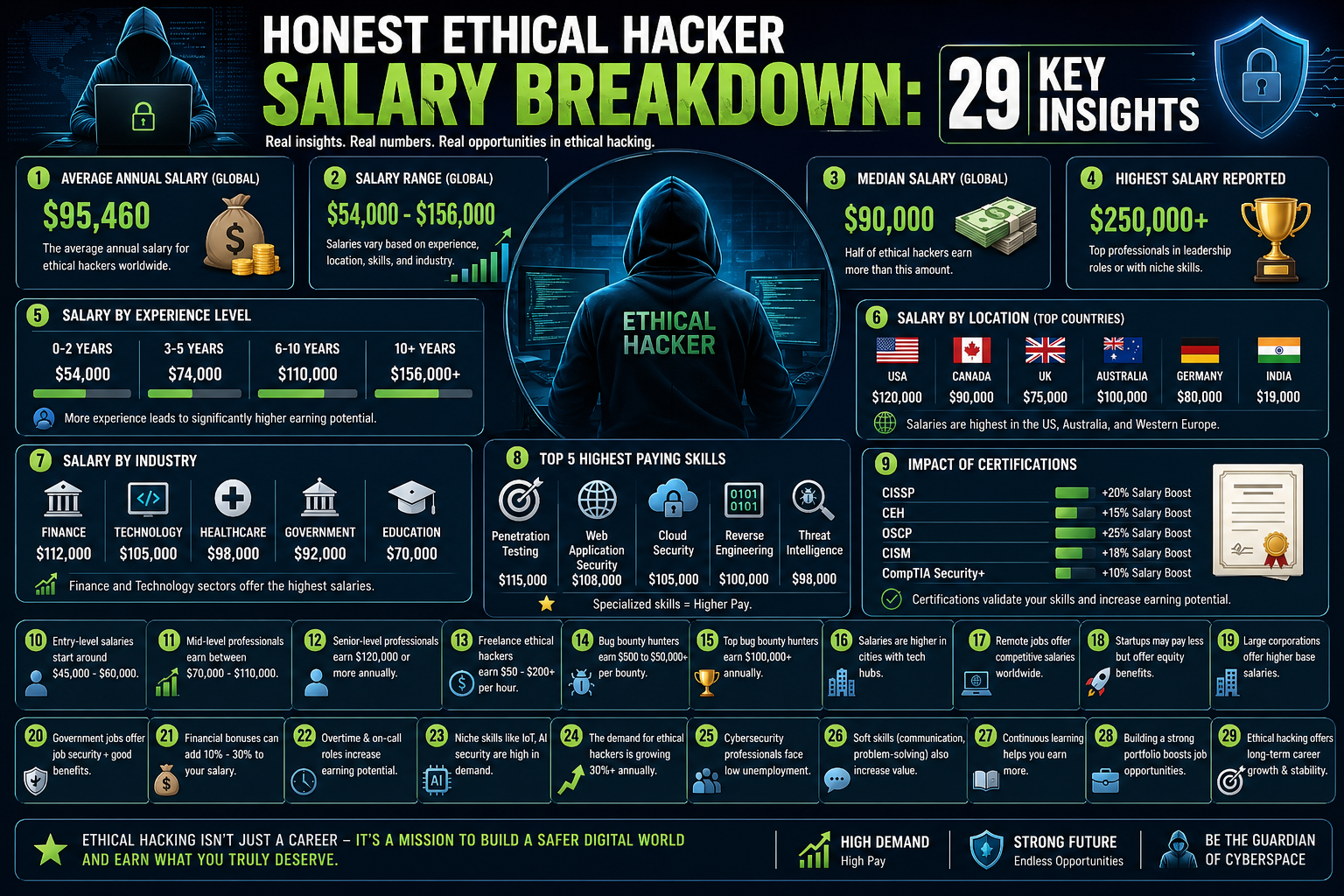
Ethical hackers are cybersecurity specialists who are hired to think like attackers so they can prevent real attacks from happening. Instead of breaking systems for harm, they are given permission to test networks, applications, and digital infrastructure to uncover weaknesses before criminals exploit them. In today’s digital environment, where businesses depend heavily on online systems, these professionals play a critical role in protecting sensitive data, financial systems, and user privacy. As cyber threats continue to evolve in complexity and scale, organizations are investing more in defensive strategies, which has significantly increased demand for skilled ethical hackers and, in turn, pushed salaries higher across the industry.
Understanding the Role of an Ethical Hacker
An ethical hacker is a cybersecurity professional who is authorized to simulate cyberattacks on systems in order to identify security flaws. Their main objective is not disruption but prevention. They work in controlled environments where they attempt to bypass security controls, test authentication systems, and probe networks for weaknesses that could be exploited by malicious hackers.
Their work often includes testing web applications for vulnerabilities, attempting controlled breaches of internal networks, analyzing access permissions, and reviewing system configurations. Once weaknesses are discovered, they document everything in detailed reports and collaborate with IT teams to ensure those issues are fixed. The role demands a strong understanding of networking concepts, operating systems, cryptography, and system architecture, along with the ability to think creatively in problem-solving situations.
Ethical hackers rely on specialized tools and environments that help them simulate attacks in a safe and controlled way. These tools are used for scanning networks, testing application security, and performing controlled exploitation to understand how far a vulnerability could be taken by a real attacker. The job is highly technical but also strategic, as it requires understanding how systems are designed and how they can fail under pressure.
How Ethical Hacker Salaries Are Structured
Salaries for ethical hackers are generally considered strong compared to many other IT roles, largely due to the high level of responsibility and specialized skill set required. Compensation varies depending on several key factors, including experience level, geographic location, industry type, and technical specialization.
At a broad level, entry-level professionals typically start with solid mid-range IT salaries, while experienced ethical hackers with advanced offensive security skills can earn well into six figures. In high-demand technology markets, compensation can rise significantly due to competition for skilled talent and the critical nature of cybersecurity roles.
Rather than a single fixed salary figure, ethical hacking income exists within a wide range. Organizations adjust pay based on how complex the security environment is, how sensitive the data being protected is, and how independently the professional can operate in real-world scenarios.
Geographic Differences in Ethical Hacker Pay
Location plays a major role in determining how much an ethical hacker earns. In major technology hubs, salaries are significantly higher due to both the cost of living and the concentration of large tech companies. Cities known for strong tech ecosystems tend to offer the highest compensation packages, especially in areas where cybersecurity talent is in short supply.
In top-tier technology regions, ethical hackers often earn some of the highest salaries in the field, with experienced professionals reaching compensation levels that reflect both their technical ability and the competitive nature of those job markets. These areas include major innovation centers where companies are constantly competing to secure the best security talent.
In contrast, secondary tech cities and smaller job markets still offer strong salaries but at slightly lower ranges. Even in these locations, ethical hackers can earn comfortable incomes that are well above average compared to many other IT roles. Interestingly, remote work opportunities are beginning to reduce the importance of location, as companies increasingly hire skilled professionals regardless of geography, sometimes offering compensation closer to major tech hub standards.
Factors That Influence Ethical Hacker Salaries
Several important factors influence how much an ethical hacker earns beyond just location. One of the most significant is the industry in which they work. High-risk sectors such as finance, defense, and large-scale technology companies tend to pay more because the potential impact of security breaches in these industries is extremely high.
Another major factor is the level of responsibility assigned to the role. Ethical hackers who focus on advanced penetration testing, red teaming, or adversary simulation typically earn more than those working in general security analysis. The more closely a role resembles real-world attack simulation, the more valuable it becomes to employers.
Security clearance can also significantly increase earning potential. Roles involving government contracts or sensitive infrastructure often require background checks and clearance approvals, and this added responsibility usually comes with higher compensation.
Remote work capability is another growing influence. Professionals who can independently perform complex security assessments without on-site supervision are increasingly in demand, and companies are often willing to pay premium salaries for proven remote talent.
Experience Levels and Salary Growth
Experience is one of the strongest determinants of ethical hacker income. As professionals gain more hands-on exposure to real systems and security challenges, their ability to identify and exploit vulnerabilities improves, which directly impacts their market value.
In the early stages of a career, ethical hackers typically focus on learning core tools, understanding system behavior, and assisting with basic security testing tasks. During this period, compensation is solid but still building toward higher levels. Entry-level professionals are often involved in vulnerability scanning, assisting senior testers, and learning how to document findings effectively.
As professionals move into mid-level roles, their responsibilities increase significantly. They begin conducting full penetration tests, independently analyzing systems, and presenting findings to technical and non-technical stakeholders. At this stage, salaries rise noticeably as they transition from learning roles into fully independent contributors.
Senior-level ethical hackers operate at a highly advanced level, often leading offensive security teams or designing complex attack simulations. They are expected to understand enterprise systems in depth and identify vulnerabilities across large and complex infrastructures. These professionals are among the highest earners in the field, often commanding salaries that reflect their leadership and technical expertise.
Tools and Technical Skills That Impact Earnings
The technical toolkit of an ethical hacker plays a key role in both job performance and salary growth. Professionals in this field rely on a wide range of tools designed for network scanning, vulnerability detection, exploitation, and reporting. These tools help simulate real-world cyberattacks in controlled environments and are essential for performing accurate security assessments.
Operating systems designed specifically for security testing are commonly used, along with scripting languages that allow automation of repetitive tasks. Python is widely used for creating custom tools and automating testing workflows, while Bash and PowerShell are also important for interacting with different system environments.
In addition to technical tools, strong reporting and documentation skills are essential. Ethical hackers must be able to clearly explain vulnerabilities, their potential impact, and recommended fixes. This communication aspect is highly valued by employers because it translates technical findings into actionable business decisions.
Professionals who master both offensive tools and communication skills often find themselves in higher-paying roles because they can bridge the gap between technical discovery and business security strategy.
Career Progression and Salary Growth Potential
Career growth in ethical hacking tends to be relatively fast for individuals who consistently develop advanced technical skills. The field rewards continuous learning, practical experience, and the ability to adapt to new attack methods and security technologies.
As professionals progress, they often move from general security roles into more specialized areas such as penetration testing, red teaming, or cloud security testing. These specializations are in high demand and often come with higher compensation due to the depth of expertise required.
Ethical hackers who gain experience in simulating real-world adversary behavior or working with complex enterprise environments often find themselves in leadership positions or advisory roles. These positions not only offer higher salaries but also greater influence over organizational security strategy.
At the same time, continuous skill development remains essential. The cybersecurity landscape changes rapidly, and professionals who stay updated with new attack techniques, tools, and defensive strategies are more likely to remain competitive in the job market.
Early Industry Outlook
The demand for ethical hackers continues to grow as organizations face increasing pressure to secure digital infrastructure. With cyber threats becoming more sophisticated, companies are prioritizing proactive defense strategies rather than reactive responses. This shift has made ethical hacking one of the most valuable roles in modern cybersecurity.
Salary trends reflect this demand, with consistent growth observed across multiple regions and industries. Even in non-technology sectors, organizations are investing in ethical hacking expertise to protect sensitive systems and maintain trust with users and stakeholders.
As the field continues to evolve, ethical hackers who combine technical depth with strategic thinking are likely to see continued salary growth and expanding career opportunities across global markets.
Ethical Hacker Salary Landscape Beyond Major Cities
Ethical hacker salaries do not exist only within the boundaries of major tech hubs. While cities like San Francisco, New York, and Seattle often dominate discussions, the broader salary landscape extends across mid-tier cities, remote environments, and international opportunities. In many cases, professionals working outside traditional hubs still achieve strong compensation because cybersecurity skills are globally transferable and highly in demand. Organizations are increasingly less concerned about where a security professional lives and more focused on what they can deliver in terms of real-world protection against cyber threats.
In many secondary cities, ethical hackers still earn competitive salaries that comfortably exceed national averages for IT roles. The difference is not always the skill level but rather the market pressure, cost of living adjustments, and concentration of large enterprises. Even within smaller technology ecosystems, companies dealing with sensitive data—such as healthcare providers, financial institutions, and government contractors—must maintain strong security teams, which keeps salaries relatively high.
At the same time, remote work has significantly reshaped how salary expectations are structured. Many companies now hire ethical hackers without requiring relocation, offering compensation based on skill level rather than geographic location. This shift has created a hybrid salary model where professionals in lower-cost regions can sometimes earn near–big city salaries without the associated living expenses.
Remote Ethical Hacker Salaries and Global Opportunities
Remote work has become one of the most influential forces shaping ethical hacker compensation. Instead of limiting hiring to specific cities, companies now build distributed security teams across different regions. This has expanded opportunities for skilled professionals who may not live near traditional tech centers.
Remote ethical hackers often earn salaries comparable to those in major cities, especially if they demonstrate strong independence and consistent performance. Employers value professionals who can operate without close supervision, manage their own testing schedules, and communicate findings clearly across digital platforms. In many cases, remote positions even include performance-based incentives or bonuses tied to security outcomes.
Globally, ethical hacking salaries vary significantly. In countries with strong cybersecurity industries, compensation can rival Western markets, particularly in finance-heavy or defense-related sectors. In emerging markets, salaries may be lower in absolute terms but still considered highly competitive relative to local wage standards. This global distribution of cybersecurity work is creating a more interconnected talent pool where expertise matters more than geography.
Another important factor in remote compensation is time zone alignment. Professionals who can overlap with company working hours in North America or Europe often have an advantage in securing higher-paying roles, as communication and collaboration become easier for distributed teams.
Industry-Based Salary Differences in Ethical Hacking
One of the most important drivers of salary variation in ethical hacking is the industry in which a professional works. Not all organizations face the same level of cyber risk, and compensation often reflects that difference.
Financial services tend to offer some of the highest salaries for ethical hackers due to the sensitive nature of financial data and the constant threat of fraud or cybercrime. Banks, investment firms, and payment processors require continuous security testing, and they are willing to invest heavily in offensive security talent to prevent breaches.
The defense and government sector is another high-paying area, especially for roles requiring security clearance. These positions often involve protecting national infrastructure, military systems, or classified data, which significantly increases both responsibility and compensation levels. Ethical hackers in these environments are expected to follow strict protocols while performing highly advanced security assessments.
Technology companies also offer strong salaries, particularly those operating large-scale platforms, cloud infrastructure, or global applications. These organizations face constant external threats due to their visibility and user base size, which increases demand for experienced penetration testers and red team operators.
On the other hand, sectors like education, nonprofit organizations, and small internal IT departments typically offer lower compensation. While the work is still important, the scale and risk level are usually smaller, which impacts salary structures accordingly.
Freelance Ethical Hacking and Bug Bounty Earnings
Beyond traditional employment, many ethical hackers choose freelance work or participate in bug bounty programs to supplement or even replace full-time income. This path offers flexibility but also introduces variability in earnings.
Bug bounty platforms reward security researchers for discovering vulnerabilities in software systems. Payments depend on the severity and impact of the vulnerability discovered. Critical security flaws can sometimes lead to substantial payouts, while lower-risk issues may result in modest rewards. Over time, experienced ethical hackers who specialize in vulnerability discovery can generate significant income through consistent participation in these programs.
Freelance penetration testing is another option where professionals are hired on a project basis. Companies may engage freelancers for short-term security audits, application testing, or compliance assessments. These roles often pay well on a per-project basis but lack the stability of full-time employment.
While freelance income can sometimes exceed traditional salaries, it requires strong reputation building, technical expertise, and the ability to continuously find new opportunities. Many professionals combine freelance work with full-time roles to maximize earnings while maintaining stability.
How Certifications Influence Salary Growth
Certifications play an important role in shaping ethical hacker salary potential, particularly for those early in their careers or transitioning into offensive security roles. While certifications alone do not guarantee high income, they often serve as a signal of technical ability and commitment to the field.
Entry-level certifications help professionals establish foundational knowledge in areas such as networking, system security, and vulnerability assessment. These certifications are often used to qualify for junior roles or meet hiring requirements in structured organizations.
More advanced certifications carry significantly more weight in salary negotiations. Hands-on certifications that require real-world exploitation skills are particularly valued because they demonstrate practical ability rather than theoretical knowledge. Employers often associate these certifications with higher competency in complex environments.
Specialized certifications also help professionals move into higher-paying niches such as red teaming or enterprise security testing. These areas require deeper understanding of attack simulation, identity management systems, and large-scale infrastructure security.
In many cases, certifications act as salary accelerators rather than salary foundations. They help professionals transition faster into mid-level and senior roles where compensation increases are more substantial.
Salary Negotiation Strategies for Ethical Hackers
Negotiation plays a key role in determining final compensation for ethical hackers. Even within the same role and experience level, salaries can vary based on how effectively a candidate communicates their value.
One of the most effective negotiation strategies is demonstrating measurable impact. Ethical hackers who can show how their work prevented security breaches, reduced vulnerabilities, or improved system resilience often have stronger leverage during salary discussions.
Another important factor is showcasing a broad technical skill set. Professionals who can perform multiple roles—such as penetration testing, scripting, and reporting—are often valued more highly because they reduce the need for additional hires.
Timing also matters in negotiation. Candidates who negotiate during periods of high demand or after completing successful projects are more likely to secure better compensation packages. Understanding market trends and demand cycles can provide additional advantage.
Beyond base salary, ethical hackers can also negotiate for benefits such as remote flexibility, training budgets, certification support, and performance bonuses. These additional elements can significantly increase overall compensation value even if base salary remains unchanged.
Contract vs Full-Time Ethical Hacker Income
Ethical hackers can work as full-time employees or independent contractors, and each path offers different salary structures and financial outcomes.
Full-time roles provide stability, consistent income, and additional benefits such as healthcare, paid leave, and retirement contributions. These positions are often preferred by professionals seeking long-term career growth within organizations. Salaries are structured and predictable, with regular performance reviews and incremental raises.
Contract roles, on the other hand, often offer higher short-term earning potential. Contractors are typically paid on a per-project or hourly basis, and experienced professionals can command premium rates for specialized work. However, contract roles may lack stability and require continuous sourcing of new projects.
Many experienced ethical hackers alternate between contract and full-time roles depending on career goals and market conditions. This flexibility allows them to balance income stability with higher earning opportunities when available.
Skill Specialization and Salary Acceleration
Specialization is one of the strongest drivers of long-term salary growth in ethical hacking. Professionals who focus deeply on specific areas often earn more than generalists because their expertise is harder to replace.
Application security specialists, cloud penetration testers, and identity access management experts are in particularly high demand. These areas require deep technical knowledge and are critical to modern enterprise environments.
Another high-value specialization is adversary simulation, where ethical hackers mimic real-world cyberattackers to test organizational defenses. This requires advanced planning, creativity, and technical execution, making it one of the highest-paid areas within cybersecurity.
Specialization not only increases salary potential but also improves career stability, as organizations tend to retain niche experts for long-term security initiatives.
Mid-Career Financial Growth Patterns
As ethical hackers progress into mid-career stages, their income growth often accelerates more rapidly compared to early career stages. This is because mid-level professionals begin to take ownership of entire security testing processes rather than assisting others.
At this stage, professionals often transition into roles that involve leadership, mentorship, and strategic planning. They are expected to manage complex testing environments, coordinate with multiple teams, and provide actionable insights to senior management.
Salary increases during this phase are often driven by both technical competence and communication ability. Professionals who can clearly explain technical risks in business terms tend to advance faster and secure higher compensation packages.
Mid-career growth is also influenced by reputation within the cybersecurity community. Professionals who build strong portfolios of successful security assessments or research contributions often attract better job opportunities and higher salaries.
Evolving Market Demand for Ethical Hackers
The demand for ethical hackers continues to grow steadily as organizations face increasing digital threats. Cybersecurity is no longer a secondary concern but a core business priority across nearly all industries.
This growing demand is directly influencing salary structures, making ethical hacking one of the most financially rewarding fields in cybersecurity. As systems become more complex and interconnected, the need for skilled professionals who can identify vulnerabilities before attackers do is becoming even more critical.
Organizations are also investing more in proactive security strategies, which increases demand for offensive security roles. This shift ensures that ethical hacking will remain a high-value career path with strong salary growth potential in the coming years.
Senior-Level Ethical Hacker Earnings and Career Plateau
At senior levels, ethical hacking becomes less about basic vulnerability discovery and more about strategic security leadership. Professionals at this stage are expected to operate at a high level of independence, often designing entire offensive security programs for organizations. Their work goes beyond testing individual systems and extends into shaping how an organization anticipates and responds to cyber threats.
Senior ethical hackers typically command some of the highest salaries in cybersecurity because their decisions directly influence organizational risk exposure. They are often responsible for leading red teams, coordinating large-scale penetration testing operations, and advising executives on security posture. In many cases, they also evaluate security investments, helping companies decide where to allocate budgets for maximum protection.
Despite the high earning potential, senior-level professionals may eventually reach a salary plateau where growth slows unless they transition into leadership, consulting, or specialized advisory roles. At this stage, further salary increases often depend more on business impact and leadership contribution rather than purely technical ability.
Red Team Specialists and High-Value Offensive Security Roles
Red team operators represent one of the most advanced and highest-paying roles within ethical hacking. Unlike general penetration testers who focus on specific systems or applications, red team professionals simulate full-scale cyberattacks that mirror real-world adversaries.
Their work often includes planning multi-stage attack simulations, bypassing layered security defenses, and testing how organizations respond under pressure. Because of the complexity and realism of these exercises, red team roles require deep technical expertise, creativity, and strong operational discipline.
Organizations value red team specialists highly because they provide realistic insights into how an actual cyberattack might unfold. This makes their contributions extremely valuable for enterprise security planning. As a result, salaries in this area tend to be higher than general ethical hacking roles, especially in large corporations, financial institutions, and government-linked organizations.
Red team professionals also tend to have more influence in strategic discussions, as their findings often shape long-term security investments and incident response planning.
Security Clearance and Its Impact on Salary Growth
Security clearance plays a significant role in increasing ethical hacker salaries, particularly in government, defense, and critical infrastructure sectors. Roles requiring clearance often involve access to highly sensitive systems or classified information, which increases both responsibility and compensation.
The process of obtaining and maintaining security clearance is strict and time-consuming, which naturally reduces the pool of eligible candidates. This scarcity creates upward pressure on salaries, as organizations must compete for a limited number of qualified professionals.
Clearance-based roles often come with additional expectations around compliance, confidentiality, and operational discipline. Ethical hackers in these positions are trusted not only for their technical skills but also for their reliability and integrity in handling sensitive systems.
Because of these factors, professionals with active clearance often enjoy stronger job security and higher long-term earning potential compared to those in non-cleared roles.
Ethical Hacker Salary Trends in Enterprise Environments
Large enterprises tend to offer more structured and competitive salary packages for ethical hackers due to the scale and complexity of their systems. These organizations typically operate global infrastructure, large user bases, and multiple interconnected applications, all of which require continuous security testing.
In enterprise environments, ethical hackers are often part of dedicated security teams that include specialists in different domains such as application security, cloud security, and infrastructure protection. This structure allows for deeper specialization, which can positively influence salary growth.
Enterprise roles also tend to include more formal career progression paths. As professionals gain experience, they move through clearly defined levels with corresponding salary increases and expanded responsibilities.
Another characteristic of enterprise environments is the emphasis on long-term security strategy. Ethical hackers are often involved in continuous security improvement programs rather than one-time testing engagements. This ongoing involvement increases their value within the organization over time.
Consulting Roles and High-End Ethical Hacking Income
Consulting is one of the highest-paying career paths within ethical hacking, particularly for professionals with extensive experience. Security consultants are typically hired by multiple organizations to provide expert-level assessments, audits, and advisory services.
Unlike full-time employees, consultants often work on a project basis and are compensated at significantly higher hourly or daily rates. Their income can fluctuate depending on demand, but experienced consultants often earn more than traditional salaried roles over time.
Consultants are expected to bring a broad range of experience across different industries and technologies. This allows them to quickly identify risks, recommend improvements, and guide organizations through complex security challenges.
Because consulting roles require both technical depth and strong communication skills, professionals who succeed in this space often build strong reputations that lead to continuous high-value engagements.
Automation, AI, and Future Salary Shifts
The rise of automation and artificial intelligence is beginning to influence ethical hacking roles, but not in a way that reduces demand. Instead, it is shifting the focus of work toward more advanced tasks.
Routine vulnerability scanning and basic testing are increasingly automated, allowing ethical hackers to concentrate on more complex challenges such as advanced exploitation, adversary simulation, and system-level analysis. This shift is increasing the value of professionals who can think creatively and adapt to evolving attack techniques.
As automation handles repetitive tasks, human ethical hackers are expected to focus more on strategy, interpretation, and decision-making. This change is likely to widen the salary gap between basic security roles and advanced offensive security positions.
Professionals who adapt to these changes by learning automation tools, scripting, and AI-assisted security techniques are more likely to experience long-term salary growth.
Cross-Industry Demand and Salary Stability
Ethical hacking is one of the few technical fields where demand exists across nearly every industry. Financial institutions, healthcare providers, technology companies, government agencies, and even manufacturing organizations all require cybersecurity expertise.
This cross-industry demand contributes to strong salary stability, even during economic fluctuations. While some industries may experience hiring slowdowns, cybersecurity remains a priority because of the constant risk of digital threats.
Industries dealing with sensitive personal or financial data tend to offer the highest salaries due to regulatory pressure and the potential cost of breaches. However, even less regulated industries are increasing their investment in security as cyber threats become more widespread.
This broad applicability ensures that ethical hackers have multiple career pathways and are not limited to a single sector for long-term employment.
Mid-to-Senior Transition and Compensation Growth
The transition from mid-level to senior-level ethical hacking roles is often the most significant period of salary growth. During this phase, professionals shift from executing tests to designing security strategies and leading offensive operations.
This transition requires more than technical skill alone. Ethical hackers must also develop leadership abilities, decision-making skills, and the ability to communicate risk clearly to non-technical stakeholders.
As professionals move into senior roles, their responsibilities expand to include mentoring junior staff, managing security projects, and influencing organizational security policies. These added responsibilities are a major factor in salary increases.
Many professionals also begin specializing during this phase, focusing on high-value areas such as cloud security, adversary simulation, or enterprise identity systems. Specialization during this stage often determines long-term earning potential.
Regional Salary Compression and Global Competition
As remote work becomes more common, salary differences between regions are gradually beginning to compress. Companies are increasingly hiring globally, which means ethical hackers in different regions may now compete for similar roles.
This global competition has created upward pressure on salaries in lower-cost regions while slightly stabilizing salaries in traditionally high-cost tech hubs. Employers are now more focused on skill level and performance rather than physical location alone.
At the same time, professionals who operate in global markets must also compete with a wider talent pool. This means continuous skill development is more important than ever for maintaining salary growth.
Despite this increased competition, the overall trend remains positive for ethical hackers, as global demand continues to exceed supply in many areas.
Advanced Skill Sets That Influence Senior Pay
At senior levels, salary is heavily influenced by advanced technical and strategic skills. These include deep knowledge of enterprise systems, advanced exploitation techniques, and the ability to simulate complex attack scenarios.
Senior ethical hackers are also expected to understand business impact, not just technical vulnerabilities. They must be able to translate security findings into actionable recommendations that align with organizational goals.
Skills in cloud security, identity management, and large-scale infrastructure testing are particularly valuable in modern enterprise environments. Professionals who master these areas often see stronger salary growth compared to generalists.
Another important skill is the ability to conduct long-term security planning. Senior ethical hackers are often involved in shaping security roadmaps, which directly affects organizational resilience and long-term risk management.
Evolving Expectations in Ethical Hacking Careers
The expectations for ethical hackers have evolved significantly over time. What was once a highly technical, tool-focused role has now become a strategic function within organizations.
Today, ethical hackers are expected to not only find vulnerabilities but also understand how those vulnerabilities impact business operations. This shift has elevated the role from a technical support function to a core part of organizational risk management.
As a result, salary structures are increasingly reflecting this broader scope of responsibility. Ethical hackers who can operate at both technical and strategic levels are seeing the strongest career growth.
This evolution suggests that the field will continue to expand in both complexity and compensation potential as cyber threats become more advanced and interconnected.
Advanced Ethical Hacker Career Paths and Executive Roles
As ethical hackers progress beyond senior technical positions, many move into advanced career paths that shift their focus from hands-on exploitation to broader security leadership. At this stage, professionals often transition into roles such as security architects, head of offensive security, or cybersecurity consultants at enterprise level. These positions are less about actively breaking systems and more about designing the frameworks that prevent breaches from happening in the first place.
In executive-level security roles, ethical hackers become responsible for shaping organizational cybersecurity strategy. They work closely with executives, compliance teams, and risk officers to define long-term security priorities. Instead of focusing on individual vulnerabilities, they evaluate entire ecosystems, ensuring that security is built into every layer of infrastructure.
These roles are typically among the highest-paying positions in cybersecurity because they combine technical depth with strategic leadership. Compensation at this level reflects not only technical expertise but also accountability for large-scale organizational risk.
Ethical Hacker Salary Growth Over Time
Salary growth in ethical hacking is not linear; it tends to accelerate significantly after a certain level of experience. Early career growth is usually steady but moderate, as professionals are still building foundational skills and gaining exposure to real-world environments.
Once an ethical hacker reaches mid-level experience, salary growth often becomes more noticeable. At this stage, professionals are trusted with full penetration testing engagements, independent research, and client-facing responsibilities. The ability to work independently and deliver actionable security insights becomes a key driver of compensation increases.
In senior and specialized roles, salary growth is often tied to expertise depth rather than years alone. Ethical hackers who develop rare skills—such as cloud exploitation, advanced red teaming, or identity infrastructure attacks—often see faster compensation growth than generalists.
Beyond technical ability, leadership skills also play a major role in long-term salary progression. Professionals who mentor teams, lead security programs, or influence organizational strategy are more likely to reach top-tier compensation levels.
Impact of Global Cybersecurity Demand on Salaries
The global demand for cybersecurity professionals continues to rise as organizations face increasingly sophisticated cyber threats. Ethical hacking sits at the center of this demand, as companies prioritize proactive defense strategies over reactive security measures.
This growing demand has created a consistent upward trend in salaries across most regions. Even industries that traditionally invested less in cybersecurity are now allocating larger budgets to offensive security testing and vulnerability assessment.
The shortage of highly skilled ethical hackers also contributes to salary growth. There are significantly more cybersecurity threats than there are professionals capable of effectively identifying and mitigating them. This imbalance ensures strong bargaining power for skilled ethical hackers in the job market.
As digital transformation continues across industries, the need for ethical hacking expertise is expected to remain strong, supporting long-term salary stability and growth.
Ethical Hacking in Emerging Technologies
Emerging technologies are creating new opportunities and challenges for ethical hackers, which directly influence earning potential. Fields such as cloud computing, artificial intelligence, blockchain systems, and Internet of Things (IoT) environments require specialized security testing approaches.
Cloud environments, in particular, have become a major focus area. As organizations move infrastructure to cloud platforms, ethical hackers are needed to test configurations, access controls, and data protection mechanisms in highly dynamic environments. This specialization often commands higher salaries due to its technical complexity.
Artificial intelligence systems also introduce new attack surfaces, including data poisoning, model manipulation, and algorithmic vulnerabilities. Ethical hackers who develop expertise in these areas are entering a relatively new and high-demand niche.
IoT security is another growing field, where ethical hackers test connected devices ranging from industrial systems to consumer electronics. The diversity and scale of these systems require advanced testing skills and often result in premium compensation.
Leadership and Management Roles in Ethical Hacking
Many experienced ethical hackers eventually transition into leadership or management positions. These roles focus on guiding security teams, managing offensive security programs, and aligning cybersecurity efforts with business objectives.
Security leaders are responsible for setting testing strategies, defining risk priorities, and ensuring that security initiatives support organizational goals. They also oversee teams of penetration testers and red team operators, coordinating large-scale security assessments.
Management roles typically come with higher salaries because they involve both technical oversight and people management responsibilities. Leaders must balance technical decision-making with communication across departments, making their role essential to organizational security.
As ethical hackers move into leadership, their influence extends beyond technical systems to organizational culture and security awareness.
Long-Term Financial Outlook for Ethical Hackers
The long-term financial outlook for ethical hackers remains strong due to sustained demand and increasing cyber risk exposure across industries. As organizations continue to digitize operations, security becomes a foundational requirement rather than an optional investment.
This long-term demand supports continued salary growth, especially for professionals who remain adaptable and continuously upgrade their skills. Ethical hackers who evolve with changing technologies tend to maintain strong earning potential throughout their careers.
Over time, many professionals also diversify their income sources through consulting, training, research, or advisory roles. This diversification allows them to increase overall earnings beyond traditional employment structures.
The field also offers strong career longevity, as cybersecurity expertise remains relevant even as technologies evolve. This stability contributes to its attractiveness as a long-term career path.
Skill Evolution and Continuous Learning Requirements
Ethical hacking is a field that demands continuous learning. Unlike many traditional IT roles, the skill set required evolves rapidly as attackers develop new techniques and technologies advance.
Professionals must regularly update their knowledge in areas such as network security, operating systems, encryption methods, and application vulnerabilities. New attack vectors emerge frequently, requiring ethical hackers to stay current with industry trends.
Continuous learning is not only important for job performance but also directly impacts salary growth. Employers tend to reward professionals who demonstrate adaptability and up-to-date expertise.
Those who invest in ongoing skill development are more likely to transition into higher-paying roles and remain competitive in the job market over time.
Final conclusion
Ethical hacking remains one of the most financially rewarding and stable career paths in cybersecurity. Salaries continue to reflect the high level of responsibility associated with protecting digital infrastructure from increasingly complex threats.
From entry-level positions to executive roles, compensation grows significantly with experience, specialization, and leadership capability. Professionals who build deep technical expertise while also developing strategic thinking skills tend to reach the highest earning potential.
The field also offers long-term sustainability due to its relevance across industries and continuous demand for security expertise. As long as digital systems exist, ethical hackers will remain essential to protecting them.
In the long run, ethical hacking provides not only strong financial rewards but also a dynamic and evolving career path that continues to expand alongside global technology development.