A Wide Area Network is designed to connect computers and networks across vast geographical distances. It can span regions, countries, or even continents, enabling communication regardless of physical location. The most well-known example of a WAN is the internet, which links billions of devices worldwide into a single, massive communication system. WANs make it possible for people and organizations to share data, access services, and communicate in real time across the globe.
One of the defining characteristics of a WAN is its ability to transmit data over long distances using infrastructure that is often owned and maintained by service providers. Instead of relying solely on privately owned equipment, WANs typically use leased telecommunication systems such as fiber optic cables and satellite links. These systems allow organizations to connect their internal networks to external locations efficiently.
WANs function by connecting multiple smaller networks, particularly LANs, into a larger system. This interconnection creates a unified network where devices from different locations can communicate as if they were part of the same environment. Routers play a critical role in this process, directing data packets between networks and ensuring that information takes the most efficient path to its destination.
Another important feature of WANs is the use of public IP addresses. Devices connected to a WAN are often identified by these globally unique addresses, which allow them to communicate across the internet. Unlike private IP addresses used within local networks, public IPs ensure that data can be routed correctly across vast distances.
Although WANs historically had slower speeds compared to LANs, modern advancements have significantly reduced this gap. High-speed fiber connections and improved infrastructure now enable gigabit-level performance in many regions. However, performance can still vary depending on distance, network congestion, and service quality.
Security is a major concern in WAN environments because data often travels across public or shared infrastructure. To protect sensitive information, organizations rely on encryption and secure communication methods such as Virtual Private Networks (VPNs). These technologies help maintain privacy and data integrity even when transmitting information over long distances.
WAN Technologies and Applications
WANs rely heavily on advanced technologies to function effectively across large areas. Fiber optic cabling is one of the most important components, as it allows data to travel at extremely high speeds over long distances. By transmitting information as light signals through glass fibers, fiber optics provide both high bandwidth and low signal loss, making them ideal for long-haul communication.
Routers are another essential element of WAN infrastructure. These devices act as gateways between networks, directing traffic between LANs and the broader WAN. They analyze data packets and determine the best route for transmission, ensuring efficient communication between distant locations. Large-scale WANs, such as those operated by internet service providers, rely on powerful routers to manage enormous volumes of traffic.
WANs support a wide range of applications that are essential in today’s connected world. Businesses use WANs to connect branch offices, enabling centralized data access and collaboration. Cloud computing services depend on WAN connectivity to deliver applications and storage over the internet. Video conferencing, online gaming, and streaming services also rely on WANs to function smoothly across long distances.
The Evolution of WAN
The development of WAN technology can be traced back to early communication systems like the telegraph. These systems introduced the concept of transmitting information over long distances using electrical signals. Over time, telecommunication evolved into telephone networks, where connections were manually or mechanically established between endpoints.
With the advent of digital technology, traditional analog systems were replaced by more efficient and reliable digital communication methods. This transformation laid the foundation for modern WANs, where data is transmitted in digital form across high-speed networks. The shift from copper-based systems to fiber optics marked a major milestone, dramatically increasing both speed and capacity.
Today’s WANs are far more advanced than their early predecessors, yet they still follow the same fundamental principle: connecting distant points to enable communication. The continuous demand for faster and more reliable connectivity continues to drive innovation in WAN technologies.
What is a LAN (Local Area Network)?
A Local Area Network is a network that connects devices within a limited geographic area, such as a home, office, or campus. Unlike WANs, LANs are designed for short-distance communication and are typically owned and managed by individuals or organizations. They provide a reliable and efficient way to connect devices for sharing resources and information locally.
LANs are commonly used in everyday environments, from residential homes to corporate offices. Any situation where multiple devices need to communicate within a confined space is likely to involve a LAN. Even if a LAN is connected to the internet, its primary purpose remains local communication between devices.
One of the key characteristics of a LAN is its use of private IP addresses. These addresses are assigned to devices within the network and are not accessible from outside the LAN. This structure helps organize communication within the network and enhances security by limiting external access.
LANs typically operate at high speeds, often reaching 1 Gbps or more, depending on the equipment used. Modern networks may even support multi-gigabit speeds, enabling fast data transfer between connected devices. This high performance makes LANs ideal for activities such as file sharing, media streaming, and local server access.
Security within a LAN is generally easier to manage compared to a WAN. Since the network is confined to a specific physical location, access can be controlled through physical security measures as well as network configurations. However, proper security practices are still necessary to protect against internal threats and unauthorized access.
Core Aspects of LAN
LANs rely on networking hardware that is typically owned and maintained by the organization or individual using the network. This includes devices such as switches, routers, and cabling systems. Unlike WANs, there is no need to lease infrastructure from external providers for internal communication.
Switches are the primary devices used in LANs to connect multiple devices. They operate at the data link layer and use MAC addresses to forward data between devices. This allows for efficient communication within the network without unnecessary data transmission.
Ethernet is the most common technology used in LANs, providing a standardized method for connecting devices through wired connections. Wireless technologies such as Wi-Fi also play a significant role in modern LANs, offering flexibility and mobility while maintaining high performance.
LANs often use protocols like DHCP to automatically assign IP addresses to devices, simplifying network management. Other protocols, such as TCP and IP, ensure reliable communication and data transfer between devices.
LAN Technologies and Applications
LAN technologies focus on enabling fast and efficient communication within a limited area. Ethernet remains the backbone of most wired LANs, while wireless networking continues to grow in importance. Together, these technologies provide a versatile and scalable networking environment.
LANs are used in a wide range of applications, from simple home networks to complex enterprise systems. In a home environment, a LAN connects devices like computers, smartphones, and smart TVs. In a business setting, LANs support internal communication, data sharing, and access to centralized resources such as servers and printers.
The reliability and speed of LANs make them essential for modern computing environments. Whether it’s streaming high-definition video or running business-critical applications, LANs provide the foundation for efficient local connectivity.
LAN in Today’s World
LANs have become an integral part of daily life, supporting the growing number of connected devices in homes and workplaces. As technology continues to evolve, LANs are adapting to meet increasing demands for speed and performance.
Advancements in networking hardware have led to faster switches and improved wireless technologies, enabling higher data transfer rates and better reliability. Despite these changes, the fundamental principles of LANs remain consistent, making them a stable and dependable networking solution.
Learning about LANs is an essential step for anyone interested in networking. Understanding how devices communicate within a local network provides a strong foundation for exploring more complex networking concepts. The knowledge gained from studying LANs remains relevant over time, as the core technologies and principles continue to be widely used.
What is a MAN (Metropolitan Area Network)?
A Metropolitan Area Network is designed to cover a geographic region larger than a local network but smaller than a wide area network. It typically spans a city or a large urban area, connecting multiple local networks into a unified system. MANs were created to address the growing need for high-speed communication between different locations within metropolitan regions, especially when traditional wide area connections were not efficient enough.
In earlier networking environments, organizations within the same city often depended on slower wide area connections to communicate with each other. This created limitations in speed and performance, particularly for institutions that required constant data exchange. MANs emerged as a solution to this problem by providing faster and more reliable connections within urban areas, allowing multiple LANs to communicate seamlessly.
A MAN essentially acts as a bridge between smaller local networks and larger wide networks. It enables efficient communication within a city while still allowing access to broader networks when needed. This makes it particularly useful for environments where multiple buildings or campuses require consistent and high-speed connectivity.
Unique Features of MAN
One of the key features of a MAN is its ability to deliver higher speeds and lower latency compared to older wide area connections. This is largely due to the use of advanced infrastructure, particularly fiber optic technology, which allows data to travel quickly across urban distances.
MANs are typically operated by service providers that manage the infrastructure within a metropolitan area. These providers offer private connections to organizations, enabling secure communication between different locations. Unlike public wide networks, MAN traffic often remains within a controlled environment, which reduces exposure to external threats.
Another important aspect of MANs is their use of routing technologies to connect multiple LANs. Data is transmitted across the network using high-capacity links, ensuring that communication remains efficient even when handling large volumes of traffic. Since these networks are designed for specific regions, they can be optimized to meet the needs of local users.
Unlike WANs, MANs generally do not rely on public IP addressing for internal communication. Instead, they operate within private network structures, ensuring that data remains within the service provider’s infrastructure. This adds an additional layer of control and can simplify network management for organizations.
MAN Applications
Metropolitan Area Networks have been used in a variety of urban settings where reliable, high-speed connectivity is essential. Large educational institutions often rely on MANs to connect multiple buildings across a campus or city. This allows students and staff to access shared resources without delays or interruptions.
Government organizations also benefit from MANs, particularly when different departments are spread across a city. By connecting these locations through a dedicated network, they can ensure secure and efficient communication. Similarly, businesses with multiple offices in the same metropolitan area use MANs to maintain consistent connectivity between locations.
Technology-driven cities have historically relied on MAN infrastructure to support growing data demands. In environments where bandwidth requirements are high, MANs provided a practical solution before the widespread availability of modern high-speed WAN connections.
MANs Today
In modern networking environments, the role of MANs has diminished significantly. Advances in wide area network technologies, particularly the expansion of fiber optic infrastructure, have made it possible to achieve high-speed connectivity without relying on separate metropolitan networks.
Today, many of the functions previously handled by MANs are now managed by advanced WAN solutions. High-speed internet connections can support both local and long-distance communication efficiently, reducing the need for dedicated metropolitan networks. As a result, MANs are now less common and are mainly found in specific scenarios where specialized infrastructure is still required.
Despite this decline, the concept of MANs remains important in understanding the evolution of networking. They played a crucial role in bridging the gap between local and wide networks during a period when technology was still developing.
Evolution of WAN, LAN, and MAN Technologies
The development of WAN, LAN, and MAN technologies has been driven by the increasing demand for faster and more reliable communication. As more devices became connected and data usage grew, network infrastructure had to evolve to keep up with these requirements.
In local networks, early systems operated at relatively low speeds, but continuous improvements in hardware led to significant increases in performance. Ethernet technology advanced from basic implementations to high-speed standards capable of handling gigabit and multi-gigabit data rates. These improvements allowed LANs to support more devices and more demanding applications.
Wide area networks also underwent major transformations. Early communication methods relied on copper-based technologies such as dial-up and leased lines, which had limited capacity. The introduction of fiber optics revolutionized WAN connectivity by enabling high-speed data transmission over long distances. This shift made it possible to support modern internet applications and services.
For metropolitan networks, the transition to fiber-based WAN infrastructure ultimately reduced their importance. The original purpose of MANs was to overcome the limitations of older wide area connections, but as WAN technology improved, it became capable of handling the same tasks more efficiently. This led to a gradual decline in the use of MANs in many regions.
Overall, the evolution of these network types reflects the ongoing need for better performance and scalability. Each advancement has built upon previous technologies, resulting in the highly connected world we experience today.
Key Differences Between WAN, LAN, and MAN
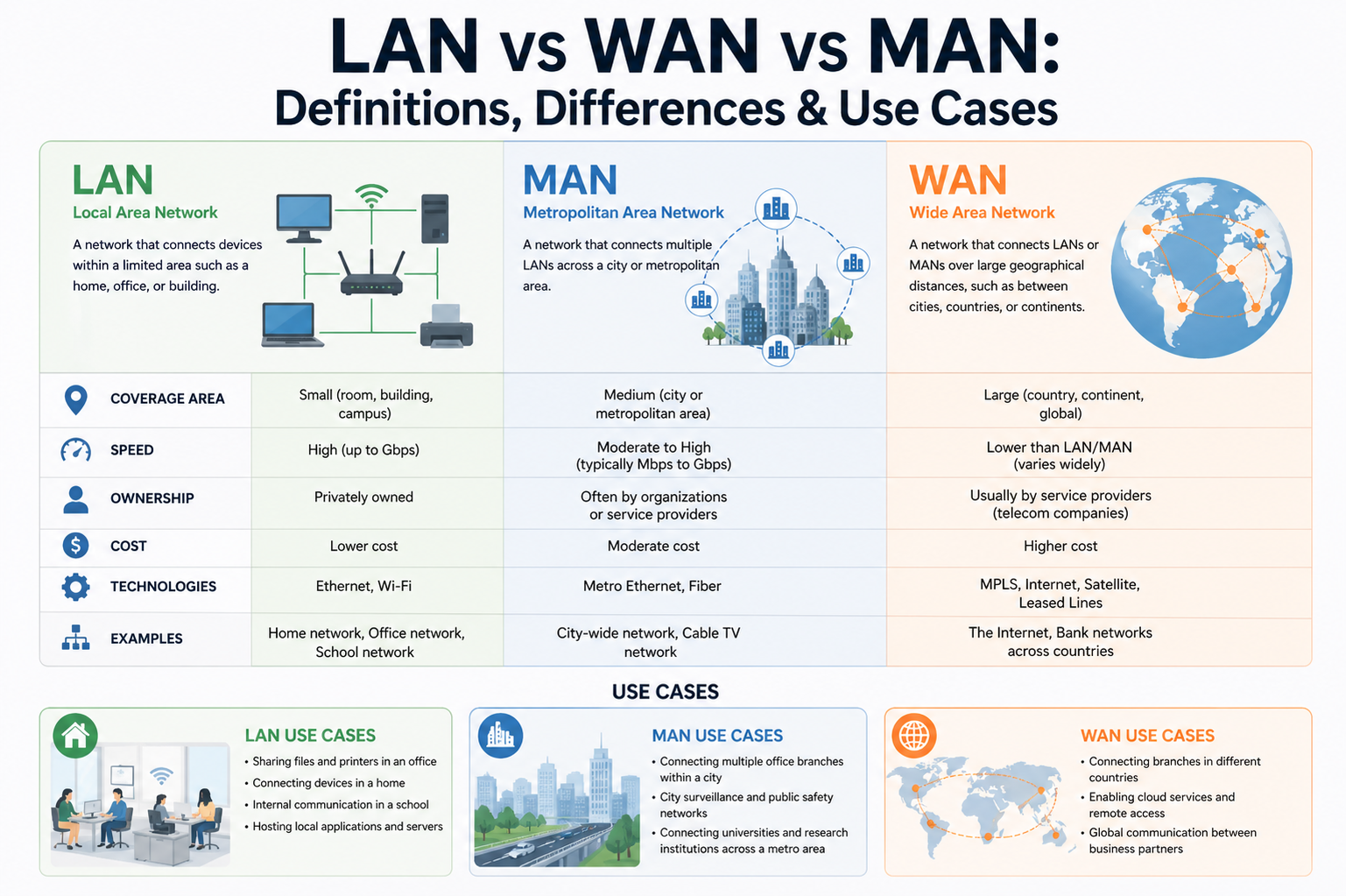
The primary difference between WAN, LAN, and MAN lies in the scale at which they operate and the purpose they serve. A LAN is confined to a small, specific location such as a home, office, or campus, making it ideal for fast and efficient local communication. A WAN, on the other hand, operates across vast distances, connecting networks that may be located in different cities, countries, or even continents. A MAN sits between these two, covering a metropolitan area and linking multiple LANs within a city.
Another major distinction is ownership and infrastructure. LANs are usually owned and maintained by individuals or organizations, giving them full control over the network. WANs rely heavily on infrastructure provided by telecommunications companies and internet service providers, meaning users depend on external entities for connectivity. MANs are also typically managed by service providers, offering shared infrastructure within a defined urban region.
Performance and speed also vary significantly between these network types. LANs generally provide the highest speeds and lowest latency because of their limited geographic scope and direct connections between devices. WANs may experience higher latency due to the long distances data must travel, although modern fiber technology has significantly improved performance. MANs were originally designed to offer better speeds than older WAN connections within cities, but their advantage has become less significant with advancements in WAN infrastructure.
Security considerations differ as well. LANs are considered more secure because they are confined to a controlled environment, where access can be physically restricted. WANs, especially public ones like the internet, require strong security measures such as encryption and secure tunneling to protect data. MANs, operating within managed service provider environments, offer a balance between control and accessibility, often providing secure private connections within metropolitan areas.
How WAN, LAN, and MAN Work Together
These three types of networks do not exist in isolation; instead, they work together to create a seamless communication system. A typical setup begins with a LAN, where devices within a home or office connect to each other. This LAN is then connected to a WAN through a router, allowing devices to communicate with external networks.
In scenarios where multiple LANs exist within a city, a MAN can be used to interconnect them efficiently. This allows organizations with multiple locations to share resources and communicate without relying entirely on long-distance WAN connections. Although MANs are less common today, the concept of intermediate networks still plays a role in optimizing connectivity.
The integration of these network types enables everything from simple file sharing within a home to global communication across continents. Without this layered structure, it would be difficult to manage the complexity of modern networking.
Advantages and Limitations of Each Network Type
Each network type offers unique advantages depending on the use case. LANs are known for their high speed, reliability, and ease of management within a confined area. They are ideal for environments where devices need to communicate quickly and efficiently without external interference.
WANs provide the ability to connect networks across vast distances, making them essential for global communication. They enable access to online services, cloud platforms, and remote resources, which are critical in today’s digital world. However, they may involve higher costs and require more complex security measures.
MANs, while less common today, historically provided a balance between speed and coverage. They allowed organizations within a city to connect efficiently without the limitations of older WAN technologies. Their main limitation now is redundancy, as modern WAN solutions can often achieve the same results more effectively.
Real-World Examples of WAN, LAN, and MAN
In everyday life, examples of these network types can be found all around us. A home network connecting laptops, smartphones, and smart devices is a typical LAN. Office networks that allow employees to share files and access internal systems are also LANs.
WANs are evident whenever you access the internet, send emails, or use cloud-based applications. These actions involve communication across vast distances, often connecting multiple networks around the world.
MANs were commonly used in large cities to connect institutions such as universities, government offices, and corporate branches. While their role has diminished, similar concepts are still used in specialized scenarios where localized high-speed connectivity is required.
Why Understanding These Networks Matters
Having a clear understanding of WAN, LAN, and MAN is important for designing and managing modern network systems. Each type addresses specific needs, and choosing the right approach can significantly impact performance, cost, and scalability.
For network professionals, this knowledge forms the foundation for more advanced topics such as network architecture, security, and optimization. Even for general users, understanding these concepts can provide insight into how everyday technologies function.
As digital communication continues to expand, the importance of efficient networking will only grow. Knowing how these network types differ and interact helps in making informed decisions about technology and infrastructure.
Future Trends in WAN, LAN, and MAN
As technology continues to advance, WAN, LAN, and MAN networks are evolving to meet the growing demand for faster speeds, lower latency, and greater reliability. One of the most noticeable trends is the widespread adoption of fiber optic infrastructure, which is transforming both local and wide area connectivity. Fiber is no longer limited to backbone networks; it is increasingly being deployed directly to homes and businesses, significantly improving performance across all network types.
Another major development is the rise of wireless technologies. Modern LANs are no longer dependent solely on wired connections, as high-speed Wi-Fi standards now provide performance that rivals traditional Ethernet in many scenarios. This shift has made networks more flexible and accessible, allowing users to connect from virtually anywhere within a coverage area without sacrificing too much speed or stability.
In the context of WANs, software-defined networking is becoming increasingly important. This approach allows network administrators to manage and optimize traffic through software rather than relying entirely on hardware configurations. It improves efficiency, reduces operational costs, and enables better control over how data flows across large-scale networks.
Cloud computing is also playing a significant role in shaping the future of networking. As more services and applications move to cloud platforms, WANs are becoming the backbone of digital operations. Businesses now rely on secure and high-speed WAN connections to access cloud-based resources, making reliability and security more critical than ever.
The Role of Security in Modern Networks
Security remains a central concern across all types of networks, but the approach varies depending on the network’s scale and exposure. LANs benefit from physical control and restricted access, but they still require protection against internal threats and unauthorized devices. Measures such as network segmentation, authentication, and monitoring are commonly used to maintain security within local environments.
WANs face greater challenges due to their public nature. Data traveling across wide area networks is more vulnerable to interception and cyber threats. To address this, encryption protocols and secure communication methods are widely implemented. Virtual private networks continue to play a crucial role in ensuring that sensitive data remains protected while traveling over public infrastructure.
For MANs, security is typically managed by service providers who ensure that traffic is logically separated between different users. Although these networks are less exposed than public WANs, maintaining strong security practices is still essential to prevent data breaches and unauthorized access.
As cyber threats become more sophisticated, network security strategies must continue to evolve. The integration of advanced technologies such as artificial intelligence and automated threat detection is helping organizations identify and respond to risks more effectively.
Impact of Emerging Technologies
Emerging technologies are reshaping how networks are designed and used. The growth of the Internet of Things has introduced a massive number of connected devices, increasing the demand for efficient and scalable networking solutions. LANs must now support a wider range of devices, from traditional computers to smart home systems and industrial sensors.
At the same time, advancements in mobile connectivity, including the rollout of 5G networks, are enhancing WAN capabilities. These technologies provide faster speeds and lower latency, enabling new applications such as real-time data processing, autonomous systems, and immersive digital experiences.
Edge computing is another important trend that affects all network types. By processing data closer to where it is generated, edge computing reduces the need for long-distance data transmission. This not only improves performance but also reduces the load on WAN infrastructure, making networks more efficient overall.
Choosing the Right Network Approach
Understanding the strengths and limitations of each network type helps in designing systems that are both efficient and scalable. A well-plannedSelecting the appropriate network type depends on the specific needs of an organization or environment. For small-scale setups such as homes or small offices, a LAN is usually sufficient to handle local communication and resource sharing. It offers high performance and is relatively easy to manage.
For organizations with multiple locations spread across different regions, a WAN becomes ضروری to connect these sites. It enables centralized management and access to shared resources, even when users are located far apart. Ensuring reliable and secure WAN connectivity is critical for maintaining business operations.
In cases where multiple locations exist within the same city, intermediate solutions inspired by MAN concepts may still be useful. These setups can provide efficient connectivity without relying entirely on long-distance WAN infrastructure. However, modern WAN technologies often fulfill these requirements without the need for dedicated metropolitan networks.
network can adapt to changing demands and support future growth without requiring major overhauls.
Practical Considerations for Network Design
When designing a network, several factors must be taken into account, including performance requirements, budget, scalability, and security. LANs are generally more cost-effective for small areas, but expanding connectivity across larger regions requires investment in WAN infrastructure or services.
Reliability is another important consideration. Networks must be designed to minimize downtime and ensure consistent performance. This often involves implementing redundancy, such as backup connections and failover systems, particularly in WAN environments.
Scalability is also crucial, as networks need to accommodate future growth. Choosing technologies that can support increasing data demands helps avoid costly upgrades later on. For example, investing in high-capacity cabling and modern networking equipment can provide long-term benefits.
Security should be integrated into every stage of network design. Protecting data and ensuring secure access are essential for maintaining trust and preventing disruptions. This includes implementing firewalls, encryption, and access control measures across all network layers.
Common Misconceptions About WAN, LAN, and MAN
There are several misunderstandings surrounding WAN, LAN, and MAN that can create confusion, especially for beginners. One of the most common misconceptions is that these network types are defined purely by the technology they use. In reality, the classification is based primarily on geographic scope rather than specific hardware or protocols. The same technologies, such as fiber optics or wireless communication, can be used across all three network types depending on the scale of deployment.
Another misunderstanding is that WANs are always slow and LANs are always fast. While this may have been true in the past, modern advancements have significantly reduced the performance gap. High-speed WAN connections now offer impressive bandwidth, and in some cases, they can rival or even exceed older LAN setups. Performance is no longer determined solely by network type but also by infrastructure quality and configuration.
Some also assume that MANs are still widely used in modern networking. While they played an important role in the past, their relevance has decreased as WAN technologies have improved. Many scenarios that once required a MAN can now be handled efficiently by advanced WAN solutions, making MANs less common in today’s environments.
Another frequent misconception is that LANs do not require strong security because they are private. While LANs are more controlled environments, they are not immune to threats. Unauthorized access, malware, and internal vulnerabilities can still pose significant risks. Proper security practices are essential regardless of the network type.
Best Practices for Managing WAN, LAN, and MAN
Effective network management requires a clear understanding of how each network type operates and how to optimize its performance. For LANs, maintaining high-quality hardware and ensuring proper configuration are key factors. Regular updates to firmware, proper segmentation of devices, and monitoring of network activity help maintain stability and security.
In WAN environments, choosing a reliable service provider is crucial. Since WAN infrastructure often depends on external providers, the quality of service can directly impact performance. Implementing redundancy, such as backup connections, can help minimize disruptions and ensure continuous connectivity.
For networks inspired by MAN concepts, coordination with service providers is essential. Ensuring that infrastructure is properly maintained and optimized for local connectivity can improve performance and reliability. Even though MANs are less common, the principles behind them still apply in certain scenarios.
Monitoring and troubleshooting are important across all network types. Using network monitoring tools allows administrators to identify issues early and take corrective action before they escalate. This proactive approach helps maintain consistent performance and reduces downtime.
Security management is another critical aspect. Implementing firewalls, intrusion detection systems, and encryption protocols ensures that data remains protected. Regular security audits and updates help address vulnerabilities and keep networks resilient against emerging threats.
Skills Needed to Work with These Networks
Working with WAN, LAN, and MAN requires a combination of technical knowledge and practical skills. Understanding fundamental networking concepts such as IP addressing, routing, and switching is essential. These basics form the foundation for more advanced topics and real-world applications.
Hands-on experience is equally important. Setting up and managing a LAN, configuring routers, and troubleshooting connectivity issues provide valuable insights into how networks function. Practical exposure helps reinforce theoretical knowledge and builds confidence in handling real-world scenarios.
Familiarity with network protocols and standards is also ضروری. Protocols such as TCP/IP, DHCP, and DNS play a crucial role in enabling communication across networks. Knowing how these protocols work and how to configure them is an important skill for network professionals.
As networking continues to evolve, staying updated with new technologies is essential. Learning about advancements such as cloud networking, software-defined networking, and modern security practices helps professionals remain relevant in a rapidly changing field.
Problem-solving and analytical thinking are key skills in networking. Identifying issues, diagnosing root causes, and implementing effective solutions require a systematic approach. These skills are valuable not only in technical roles but also in planning and optimizing network infrastructure.
Real-Life Use Cases Across Industries
Different industries rely on WAN, LAN, and MAN in unique ways to support their operations. In the corporate world, LANs are used within office environments to connect employees and resources, while WANs link multiple branches across regions. This combination enables seamless communication and centralized management.
In the education sector, LANs support classroom technology and campus networks, while broader connectivity allows institutions to access online resources and collaborate with other organizations. Large campuses that once relied on MAN-like structures now often use high-speed WAN connections to achieve similar results.
Healthcare systems depend heavily on reliable networking to manage patient data, support communication, and enable telemedicine. LANs are used within hospitals for internal operations, while WANs connect different facilities and allow access to centralized databases.
The financial sector requires secure and high-performance networks to handle transactions and sensitive data. WANs enable global operations, while LANs ensure efficient communication within offices. Strong security measures are critical in this industry to protect against cyber threats.
Manufacturing and industrial environments also benefit from these network types. LANs connect machines and control systems within facilities, while WANs enable remote monitoring and coordination across multiple sites. The integration of modern technologies further enhances efficiency and productivity.
Building a Strong Foundation in Networking
Developing a solid understanding of WAN, LAN, and MAN is an important step for anyone interested in technology. These concepts provide the groundwork for exploring more advanced areas of networking and IT infrastructure.
Starting with the basics, such as how devices communicate and how data is transmitted, helps build confidence and clarity. Gradually progressing to more complex topics, including routing, security, and network design, allows for deeper knowledge and practical expertise.
Certifications and structured learning paths can also be beneficial. They provide a clear roadmap for gaining knowledge and validating skills. While technology continues to evolve, the core principles of networking remain consistent, making foundational knowledge highly valuable.
Continuous learning is essential in this field. As new technologies emerge and existing systems evolve, staying informed ensures that skills remain relevant. Engaging with real-world projects and practical scenarios further enhances understanding and prepares individuals for professional challenges.
Final Wrap-Up
WAN, LAN, and MAN are essential concepts that define how networks are structured and how communication takes place across different scales. From small local setups to global systems, these network types enable the seamless flow of information that powers modern life.
Understanding their differences, applications, and evolution provides valuable insight into the world of networking. Whether for personal knowledge or professional development, mastering these concepts opens the door to a deeper understanding of how digital communication works.
As technology continues to advance, the importance of efficient and secure networking will only grow. By building a strong foundation and staying updated with new developments, it becomes possible to navigate this ever-changing landscape with confidence and skill.