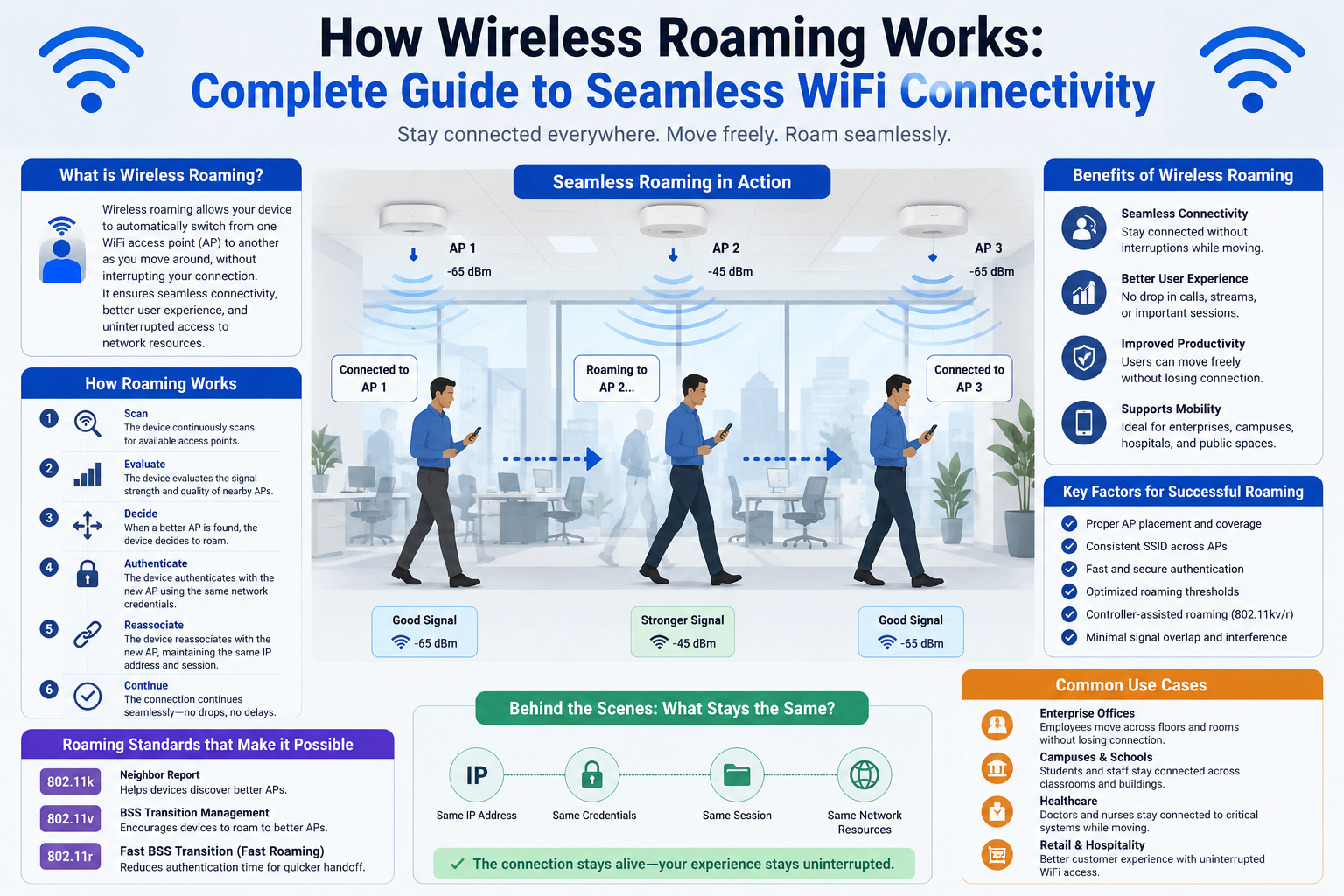
Wireless roaming is one of those network behaviors that most people rely on daily without ever noticing it working in the background. At its core, roaming refers to the ability of a Wi-Fi-enabled device to maintain connectivity while moving between different access points within the same network. This ensures that a user walking through a large building, office, campus, or even a home with multiple access points continues to stay connected without manually switching networks or experiencing noticeable interruptions.
The important idea here is continuity. The device does not disconnect from the network in a traditional sense; instead, it transitions from one access point to another while keeping the same network identity. This happens within a single administrative network environment, where all access points share the same configuration and are designed to support seamless movement.
Roaming is often associated with large enterprise environments, but it is increasingly common in modern homes due to mesh Wi-Fi systems and extended wireless setups. Even though the user experience is designed to feel invisible, the underlying process involves careful decision-making by the device, continuous signal evaluation, and coordination with access points that constantly advertise their presence.
Understanding roaming becomes especially important when connectivity issues arise. When a device does not roam efficiently, users may experience slowdowns, dropped video calls, or momentary disconnections. These problems are often not caused by a complete loss of signal but by inefficient transitions between access points.
The Structure of Wireless Networks That Enables Roaming
To understand roaming, it is essential to understand how wireless networks are structured. A typical Wi-Fi deployment consists of multiple access points connected to a central switching or routing infrastructure. These access points broadcast wireless signals using the same network name and security settings, forming what is logically known as a single unified wireless environment.
This structure is often described using two important concepts. The first is the Basic Service Set, which represents a single access point and its coverage area. The second is the Extended Service Set, which represents multiple access points working together under a shared network identity. Roaming occurs within this extended structure, allowing a device to move between coverage zones while remaining on the same network.
Each access point continuously transmits beacon frames. These beacons contain essential information such as network identity, supported data rates, security parameters, and other technical details required for devices to make connection decisions. Client devices listen to these beacons both when they are initially connecting and while they are already connected to evaluate whether a better connection is available nearby.
The overlap between coverage areas is intentional. Engineers design wireless deployments so that signal regions intersect, allowing devices to transition smoothly from one access point to another. Without overlap, devices would lose connection before establishing a new one, resulting in visible interruptions.
The Role of the Client Device in Roaming Decisions
One of the most important and often misunderstood aspects of wireless roaming is that the client device plays the primary role in deciding when and where to roam. Although access points provide the infrastructure and signal coverage, they do not directly force a device to switch connections under normal circumstances.
Instead, the client continuously evaluates the quality of its current connection. This evaluation includes multiple factors such as signal strength, packet loss, latency, and the availability of nearby access points. Each device uses its own internal logic, typically built into its wireless driver, to determine whether staying connected to the current access point is still optimal.
This is why roaming behavior can vary significantly between devices. Two smartphones in the same location may behave differently depending on their manufacturer, operating system, and driver design. One device may switch access points quickly when signal strength decreases slightly, while another may remain connected until the connection becomes significantly weaker.
This behavior is often described using informal terms such as “sticky clients,” which remain connected to an access point longer than ideal, or “aggressive roaming clients,” which switch too frequently. Both extremes can lead to performance issues, but they highlight how much control lies within the client itself rather than the network.
The client’s decision-making process is continuous and dynamic. It does not wait for a full disconnection before considering alternatives. Instead, it constantly evaluates whether a better connection exists in the background while maintaining active communication with the current access point.
Signal Strength and the Importance of RSSI in Roaming Behavior
One of the most widely used indicators in roaming decisions is signal strength, commonly measured as RSSI. This value represents how strongly a device receives a wireless signal from an access point. While RSSI is not the only factor considered, it plays a central role in determining when a device begins searching for alternative connections.
As a device moves away from an access point, the signal gradually weakens. At the same time, nearby access points may begin to appear stronger. When the difference between the current signal and a neighboring signal reaches a certain threshold, the device may consider initiating a roam.
However, signal strength alone is not a perfect indicator. Environmental factors such as walls, metal structures, interference from other devices, and even human movement can cause fluctuations. This means that a device may temporarily detect a stronger signal from a more distant access point due to reflections or obstructions, even if that access point is not actually the best long-term choice.
To prevent constant switching between access points, roaming algorithms often include stabilization logic. This logic ensures that a device does not immediately switch back and forth between two access points with similar signal strength. Without such protection, users would experience instability known as “ping-pong roaming,” where devices repeatedly switch between access points in short intervals.
RSSI thresholds are therefore combined with timing delays, signal averaging, and historical connection data. These combined factors help ensure that roaming decisions are both stable and meaningful, rather than reactive to momentary changes in the environment.
Scanning Behavior and How Devices Discover Better Access Points
Before a device can roam, it must first identify available alternative access points. This is achieved through a scanning process that occurs both when the device initially connects to a network and while it is already connected.
There are two primary types of scanning behavior: passive scanning and active scanning. In passive scanning, the device listens for beacon frames broadcast by access points. These beacons are sent at regular intervals and provide information about network availability. Passive scanning is less aggressive and conserves battery life, making it common in mobile devices.
In active scanning, the device sends probe requests into the environment. Nearby access points respond with probe responses, providing more immediate feedback about their availability. Active scanning is faster but consumes more power and generates additional wireless traffic.
While roaming, devices often use a combination of both scanning methods depending on their configuration and current conditions. The goal is to gather enough information about nearby access points without disrupting the current connection.
Scanning is usually performed on multiple wireless channels. Since Wi-Fi networks can operate across different frequency channels, a device must briefly tune into each one to detect available access points. This process happens rapidly and is typically invisible to the user.
The efficiency of scanning directly impacts roaming performance. If a device scans too slowly, it may remain connected to a weak access point for too long. If it scans too aggressively, it may waste resources or create unnecessary switching behavior.
The Transition Process Between Access Points
Once a device decides to roam, it must transition from its current access point to a new one. This process involves several steps that occur in quick succession to maintain continuity.
The device first identifies the target access point based on signal quality, compatibility, and internal roaming policies. It then prepares to disconnect from the current access point while simultaneously initiating communication with the new one.
This transition often involves reassociation, where the device informs the new access point that it wishes to join while maintaining the same network identity. The access point verifies the request and allows the device to connect without requiring a full authentication process from scratch in many optimized environments.
During this process, timing is critical. The device must minimize the gap between disconnection and reconnection to avoid noticeable interruptions. In well-designed networks, this transition happens in milliseconds, making it imperceptible during normal usage such as browsing or video streaming.
However, delays can occur if the new access point is overloaded, if security handshakes take longer than expected, or if the device must perform extensive scanning before making a decision. These delays are what users often perceive as brief freezes or drops in connectivity.
The roaming transition is therefore a carefully coordinated sequence of scanning, decision-making, disconnection, and reconnection, all occurring under strict timing constraints to preserve user experience.
Environmental Factors That Influence Roaming Behavior
Wireless roaming does not occur in isolation from the physical environment. Instead, it is heavily influenced by real-world conditions that affect signal propagation and network performance.
Physical obstacles such as walls, floors, and furniture can weaken or distort wireless signals. In some cases, materials like metal or reinforced concrete can significantly reduce signal quality, forcing devices to roam more frequently as they move through a space.
Interference from other wireless devices also plays a major role. In environments with many overlapping networks, such as office buildings or apartment complexes, devices must compete for limited wireless channels. This can lead to increased retransmissions, packet loss, and ultimately more frequent roaming decisions.
Human movement within a space can also impact signal behavior. Even a group of people walking between a device and an access point can temporarily alter signal strength, influencing how the device evaluates its connection.
Network design must account for these variables by strategically placing access points and ensuring sufficient overlap between coverage areas. Poor design can lead to dead zones, excessive roaming, or unstable connections.
Understanding these environmental influences is essential for diagnosing real-world wireless issues. Many connectivity problems that appear to be device-related are actually the result of physical layout or interference conditions rather than software behavior alone.
The Hidden Intelligence Behind Roaming Behavior
While Part 1 focused on the basic idea of roaming and how devices physically move between access points, the deeper reality is far more complex. Wireless roaming is not just a signal-strength reaction—it is a layered decision-making system involving firmware logic, driver intelligence, network infrastructure coordination, and timing-sensitive communication exchanges.
Modern devices do not simply “switch” access points when a signal drops. Instead, they continuously evaluate a combination of performance indicators, network responses, and historical connection behavior. This creates a dynamic system where roaming is both predictive and reactive.
At the center of this system is the idea that connectivity quality is multidimensional. Signal strength alone is insufficient. Devices also evaluate latency, retransmission rates, noise levels, and even the responsiveness of the access point. All of these metrics contribute to a hidden scoring system inside the client device that determines whether roaming should occur.
This decision-making process happens continuously in the background, even when the user is not actively moving. That is why roaming is not just a mobility feature—it is a constant optimization process designed to maintain the best possible connection at all times.
Roaming Thresholds and Device-Side Intelligence
Every wireless device operates with internal thresholds that determine when roaming should be considered. These thresholds are not standardized across all devices, which is one of the reasons roaming behavior can vary so widely between manufacturers.
A device may define a minimum acceptable signal level. Once the current connection falls below this level, the device begins actively searching for alternatives. However, most modern systems use more than just a single threshold. Instead, they implement layered thresholds that account for multiple conditions simultaneously.
For example, a device might remain connected to a weaker access point if performance remains stable, even if a stronger signal is available nearby. Conversely, it might roam even when signal strength is still moderate if packet loss or latency increases beyond acceptable limits.
These thresholds are often adaptive. Devices learn from previous roaming events and adjust their sensitivity over time. If a device frequently experiences poor performance before roaming, it may lower its threshold to switch earlier in the future. This adaptive behavior is part of what makes modern wireless systems feel intelligent and responsive.
However, this intelligence can also introduce unpredictability. Two identical devices in identical locations may still behave differently depending on their recent connection history and internal tuning state.
The Role of 802.11 Standards in Roaming Optimization
Wireless roaming has been significantly improved by enhancements in the 802.11 family of standards. These improvements are designed to reduce the time it takes for a device to switch between access points and to make the process more seamless.
One of the key challenges in early wireless networks was the delay associated with authentication and reassociation. When a device moved to a new access point, it often had to go through a full security handshake, which introduced noticeable interruptions.
Modern enhancements reduce this delay by allowing devices to reuse security credentials or pre-establish trust relationships with multiple access points. This means that when a device roams, it does not need to start the authentication process from scratch each time.
Another important improvement is the introduction of mechanisms that allow access points to share information about connected clients. This enables faster transitions and reduces the time spent scanning and negotiating connections.
These enhancements are particularly important in environments where real-time communication is critical, such as voice calls or video conferencing. Even small delays in roaming can result in noticeable disruptions in audio or video quality.
Fast Roaming and Time-Sensitive Connectivity
Fast roaming is designed to address the challenges of latency during access point transitions. In traditional roaming scenarios, the delay between disconnecting from one access point and reconnecting to another could be long enough to interrupt real-time applications.
Fast roaming reduces this delay by allowing devices to prepare for transitions in advance. Instead of waiting until signal quality becomes poor, the device begins building information about nearby access points early in the process.
This includes exchanging cryptographic information and preparing session keys in advance so that when the actual transition occurs, authentication can be completed almost instantly.
The result is a smoother user experience, especially for applications that rely on continuous data flow. Voice calls, online gaming, and live streaming benefit significantly from these improvements because they are highly sensitive to even brief interruptions.
However, fast roaming is not universally perfect. It requires compatibility between devices and infrastructure, and if either side does not fully support the optimization, the benefits may be reduced or inconsistent.
Access Point Behavior and Network Influence on Roaming
Although client devices make the final decision to roam, access points also play a subtle but important role in influencing roaming behavior. Modern wireless networks are not passive systems—they actively shape client behavior through signaling and response strategies.
Access points continuously broadcast information about their capabilities, load levels, and supported features. This information can indirectly influence whether a client chooses to stay connected or seek another access point.
In some environments, access points may intentionally discourage new connections if they are heavily loaded. This encourages devices to connect to less congested nearby access points, improving overall network balance.
This behavior is often referred to as client steering, although it is not a direct command. Instead, it is a combination of subtle signals that guide client decisions without forcing them.
Access points may also adjust their response behavior during roaming attempts. For example, they may delay responses or provide alternative suggestions to encourage better distribution of clients across the network.
This coordination helps prevent situations where one access point becomes overloaded while others remain underutilized.
Load Balancing and Its Impact on Roaming Patterns
Load balancing is an important concept in wireless networks that directly affects roaming behavior. In environments with multiple access points, distributing client devices evenly across the network is essential for maintaining performance.
Without load balancing, many devices might connect to the strongest visible access point, even if other access points are available and capable of handling additional traffic. This can lead to congestion, reduced performance, and increased packet loss.
To address this, wireless systems implement strategies that influence how clients distribute themselves. These strategies may include limiting the number of clients per access point or subtly adjusting signal behavior to make alternative access points more attractive.
From the client’s perspective, this can appear as unexpected roaming behavior. A device might switch to a different access point even though the original connection still has acceptable signal strength.
This is not random behavior—it is the result of network-level optimization designed to improve overall performance. However, it requires careful tuning, as overly aggressive load balancing can lead to excessive roaming and instability.
Sticky Clients and the Problem of Roaming Resistance
One of the most common challenges in wireless environments is the presence of sticky clients. These are devices that remain connected to a single access point for too long, even when better alternatives are available.
Sticky behavior is usually caused by overly conservative roaming thresholds or poorly optimized client drivers. Some devices prioritize connection stability over performance, which means they resist switching unless the current connection becomes significantly degraded.
While this can prevent unnecessary roaming, it can also lead to poor performance when a device remains connected to a distant access point with weak signal quality.
Sticky clients are particularly problematic in large environments where users move frequently. For example, in office buildings or campuses, a sticky device may stay connected to an access point on one side of a building even when the user has moved far away.
This results in slow speeds, increased retransmissions, and degraded user experience, even though better access points are physically available.
Network engineers often need to adjust configuration parameters or introduce steering mechanisms to encourage more balanced roaming behavior.
Aggressive Roaming and Connection Instability
On the opposite end of the spectrum are aggressive roaming behaviors. In these cases, devices switch access points too frequently, often reacting to small fluctuations in signal strength.
Aggressive roaming can be just as problematic as sticky behavior. Instead of maintaining a stable connection, the device repeatedly transitions between access points, causing interruptions and inconsistent performance.
This is often caused by overly sensitive thresholds or environments with fluctuating signal conditions. Small changes in movement or interference can trigger repeated roaming decisions.
Aggressive roaming is particularly noticeable in environments with overlapping coverage zones where multiple access points provide similar signal strength. Without proper stabilization logic, the device may “bounce” between them continuously.
To mitigate this, modern systems implement hysteresis mechanisms that require a significant improvement in connection quality before a roam is triggered. This helps ensure that transitions are meaningful rather than reactive.
The Importance of Timing in Roaming Transitions
Timing plays a critical role in wireless roaming performance. Even when a device makes the correct decision to roam, poor timing can result in noticeable disruptions.
The roaming process involves several time-sensitive steps, including scanning, decision-making, disconnection, and reconnection. Each of these steps must be completed quickly to maintain seamless connectivity.
Delays can occur at multiple points. Scanning may take longer in congested environments. Authentication may require additional time if security protocols are complex. Even slight delays in coordination between the device and the access point can result in temporary packet loss.
Modern wireless systems aim to minimize these delays by optimizing every stage of the process. This includes reducing scanning time, pre-establishing security context, and improving communication between access points.
In well-designed environments, roaming can occur so quickly that users do not notice any interruption at all. However, achieving this level of performance requires careful coordination between hardware, software, and network design principles.
Security Handshakes and Their Role in Roaming Efficiency
Security is an essential component of wireless networking, and it plays a significant role in roaming performance. Every time a device connects to an access point, it must establish a secure communication channel.
In older systems, this process required a full handshake every time a device roamed, which introduced delays. Modern systems reduce this overhead by allowing devices to reuse previously established security credentials.
This means that when a device moves between access points within the same network, it does not need to repeat the full authentication process. Instead, it can quickly validate its identity and resume communication.
This optimization is essential for maintaining seamless connectivity, especially in environments with frequent movement. Without it, even simple roaming events could result in noticeable interruptions.
However, security optimization must be balanced with protection requirements. Systems must ensure that reused credentials remain secure and cannot be exploited by unauthorized devices.
This balance between speed and security is one of the most important design considerations in modern wireless networking.
Controller-Based Networks and Centralized Roaming Influence
In enterprise environments, wireless networks are often managed by centralized controllers. These systems provide a unified view of all access points and connected devices, allowing for more intelligent roaming management.
Controllers can analyze network conditions in real time and make adjustments to improve performance. This includes modifying access point behavior, adjusting signal parameters, and influencing client distribution.
While the final roaming decision still belongs to the client device, controllers can guide behavior by shaping the environment in which decisions are made.
This centralized approach allows for more consistent performance across large-scale deployments. It reduces the variability seen in unmanaged environments and ensures that roaming behavior aligns with overall network objectives.
Controllers also provide visibility into roaming events, allowing engineers to analyze patterns and identify potential issues such as sticky clients, excessive roaming, or coverage gaps.
This level of insight is essential for maintaining stable performance in complex wireless environments where hundreds or thousands of devices may be active simultaneously.
How Roaming Behavior Evolves in Complex Wireless Environments
As wireless networks grow in size and complexity, roaming behavior becomes significantly more sophisticated. In small environments, such as a home with a single access point, roaming is rarely noticeable or even relevant. However, in enterprise environments, campuses, hospitals, warehouses, and multi-floor buildings, roaming becomes a continuous and critical process that directly impacts user experience.
In these environments, dozens or even hundreds of access points may operate within overlapping coverage zones. This creates a dense wireless ecosystem where client devices are constantly surrounded by multiple potential connection points. Instead of simply choosing between “connected” or “not connected,” devices are continuously evaluating a range of competing signals and network conditions.
At this scale, roaming is no longer just a response to weak signal strength. It becomes a balancing act between performance, stability, interference avoidance, and network load distribution. Devices must make rapid decisions while minimizing disruption, even as environmental conditions change dynamically.
What makes this even more complex is that every device behaves differently. A laptop, smartphone, IoT sensor, and industrial scanner may all interpret the same wireless environment in completely different ways. This variability is one of the biggest challenges in designing predictable roaming systems.
The Influence of Environmental Density on Roaming Decisions
Wireless density plays a major role in how roaming behaves in real-world scenarios. In low-density environments, where few access points exist, roaming events are rare and typically straightforward. A device moves far enough from one access point that another becomes clearly stronger, triggering a clean transition.
In high-density environments, however, the situation becomes much more complex. Multiple access points may provide similar signal strength in the same physical location. This creates ambiguity in the decision-making process, where no single access point is clearly superior at all times.
In such cases, devices rely on secondary factors such as signal stability, historical connection quality, channel congestion, and packet error rates. These additional metrics help refine the decision, but they also introduce variability.
One of the key challenges in dense environments is preventing unnecessary roaming. When too many access points appear equally viable, devices may switch too frequently, leading to instability. This is especially problematic in environments with moving users, such as airports or large office floors.
To mitigate this, wireless systems rely on carefully planned coverage zones. Engineers design overlapping areas intentionally, but control how much overlap exists to reduce confusion while still maintaining seamless coverage.
Roaming and the Hidden Cost of Wireless Interference
Interference is one of the most significant factors influencing roaming behavior, yet it is often invisible to users. Unlike signal strength, which can be measured directly, interference is the result of competing wireless signals, environmental noise, and overlapping frequency usage.
When interference increases, packet transmissions become less reliable. Devices may experience retransmissions, delays, or incomplete data delivery. These conditions can trigger roaming even if the signal strength appears strong.
This is because modern roaming algorithms do not rely solely on raw signal measurements. Instead, they consider the quality of the connection. A strong signal with high interference may be worse than a slightly weaker signal with cleaner transmission conditions.
In crowded wireless environments, interference can come from multiple sources. Other Wi-Fi networks operating on the same channel are a common cause. Non-Wi-Fi devices such as Bluetooth equipment, microwave ovens, and industrial machinery can also contribute.
As interference increases, devices may begin to shift between access points in search of a cleaner transmission path. This behavior can sometimes appear unpredictable, but it is actually a response to deteriorating communication quality rather than signal loss alone.
Roaming in Mobile and High-Mobility Scenarios
Mobile environments introduce a unique set of challenges for roaming systems. Unlike stationary devices, which remain in a relatively stable location, mobile devices constantly move through changing signal zones.
Examples include users walking through office buildings, employees using handheld scanners in warehouses, or passengers moving through transportation hubs. In each case, the device must continuously evaluate its environment and make rapid decisions about when to switch access points.
The key challenge in mobile roaming is timing. If a device switches too early, it may connect to a weaker or less stable access point. If it switches too late, it may experience performance degradation or temporary disconnection.
To handle this, modern devices use predictive logic. Instead of reacting only to current signal conditions, they attempt to anticipate future conditions based on movement patterns and signal trends.
For example, if signal strength is steadily decreasing while another access point is becoming stronger, the device may initiate a roam before the connection becomes unstable. This proactive behavior helps ensure smoother transitions.
However, prediction is not always perfect. Sudden changes in direction, obstacles, or interference can disrupt expected patterns, leading to occasional roaming errors or delays.
The Impact of Application Sensitivity on Roaming Behavior
Not all network traffic responds to roaming in the same way. Some applications are highly tolerant of brief interruptions, while others are extremely sensitive to even minor delays.
For example, background downloads or file synchronization processes may continue without noticeable impact during a roaming event. These applications can tolerate short pauses in connectivity and resume automatically once the connection stabilizes.
In contrast, real-time applications such as voice calls, video conferencing, and online gaming are highly sensitive to even small disruptions. A brief delay during roaming can result in audio gaps, frozen video frames, or gameplay lag.
To address this, modern wireless systems prioritize application-aware behavior. Devices and networks attempt to identify high-priority traffic and optimize roaming decisions accordingly.
This can include faster scanning, pre-emptive roaming preparation, and prioritizing stable connections over marginally stronger but less reliable alternatives.
In some cases, devices delay roaming entirely if the current connection is sufficient to support real-time traffic, even if a slightly stronger access point is available nearby.
The Complexity of Multi-Band Roaming
Modern wireless networks often operate across multiple frequency bands, typically including 2.4 GHz, 5 GHz, and increasingly 6 GHz. Each band has different characteristics in terms of range, speed, and interference behavior.
Roaming decisions become more complex in multi-band environments because devices must not only choose between access points but also between frequency bands. A device may remain connected to a 2.4 GHz signal even when a 5 GHz or 6 GHz option is available, depending on stability and compatibility.
Higher frequency bands typically offer faster speeds but shorter range, while lower frequency bands provide greater coverage but are more prone to congestion. This trade-off plays a significant role in roaming decisions.
Devices may initially connect to a lower frequency band for stability and then transition to higher bands as they move closer to access points. This behavior adds another layer of decision-making to the roaming process.
Band steering techniques are sometimes used to encourage devices to prefer higher-performing bands when conditions allow. However, final control still rests with the client device, which evaluates all options before making a decision.
Roaming Delays and the User Experience Gap
Even when roaming works correctly, delays can still occur, and these delays often define the user experience. A delay of just a few hundred milliseconds may be enough for users to notice a brief interruption in audio or video.
These delays typically occur during three main phases: discovery, authentication, and reassociation. Each phase introduces a small amount of latency, and together they determine the total roaming interruption time.
Discovery delay occurs when a device scans for available access points. Authentication delay occurs when the device verifies its identity with the new access point. Reassociation delay occurs when the connection is formally transferred.
While each of these steps is optimized in modern systems, they cannot be eliminated. Wireless communication is inherently asynchronous and must account for timing uncertainty.
Reducing roaming delay is therefore a constant goal in wireless engineering. Even small improvements in each phase can significantly enhance overall user experience.
The Role of Signal Overlap in Seamless Roaming
One of the most important design principles in wireless networks is signal overlap. Without overlapping coverage zones, roaming would not be seamless, and devices would experience frequent disconnections.
Overlap ensures that a device always has access to more than one potential connection point. As it moves, it transitions gradually rather than abruptly losing signal.
However, overlap must be carefully controlled. Too little overlap creates dead zones where no access point is reachable. Too much overlap creates confusion, leading to unstable roaming behavior and frequent switching.
The ideal overlap zone allows devices to detect alternative access points while still maintaining a strong enough connection to complete a smooth transition.
This balance is one of the most important aspects of wireless network design and has a direct impact on roaming performance.
Hidden Metrics That Influence Roaming Decisions
Beyond signal strength and packet loss, modern devices evaluate a wide range of hidden metrics when making roaming decisions. These metrics are not always visible to users, but they play a crucial role in determining connection quality.
One important metric is channel utilization, which measures how busy a wireless channel is. Even if the signal strength is strong, a heavily congested channel can lead to delays and packet loss.
Another factor is the retry rate, which measures how often data packets must be retransmitted due to failed delivery. High retry rates indicate poor connection quality and can trigger roaming decisions.
Latency is also a key factor, especially for time-sensitive applications. Even if the signal strength is acceptable, high latency can prompt a device to search for a better-performing access point.
Some devices also consider historical performance data, meaning they remember how well previous connections performed at a given location. This allows them to make more informed decisions over time.
The Continuous Nature of Roaming Optimization
Roaming is not a single event—it is an ongoing process that happens continuously throughout the lifetime of a connection. Devices are constantly monitoring their environment, evaluating alternatives, and adjusting their behavior based on changing conditions.
Even when no roaming occurs, the system is actively working in the background. It is scanning, analyzing, predicting, and preparing for potential transitions.
This continuous optimization is what allows modern wireless networks to feel seamless. Users are rarely aware of the complexity involved because most transitions happen smoothly and without interruption.
However, when something goes wrong—such as poor coverage design, interference, or misconfigured thresholds—the complexity becomes visible through dropped connections, lag, or unstable performance.
Understanding this continuous process is essential for diagnosing wireless issues and improving overall network reliability.
Roaming Troubleshooting Patterns and Real-World Performance Signals
In real wireless environments, roaming problems rarely appear as obvious “failures.” Instead, they show up as subtle performance symptoms that can be confusing without understanding what is happening underneath. Users may report lag during calls, short freezes in video streams, slow loading times while walking between rooms, or random drops that seem to fix themselves within seconds. These issues are often tied to roaming inefficiencies rather than complete network outages.
One of the most common patterns is delayed roaming, where a device holds onto an access point too long before switching. This usually results in a gradual performance decline rather than an immediate disconnection. The connection may still appear active, but throughput drops significantly, and latency increases as the device struggles to maintain communication with a distant or congested access point. This type of issue is often mistaken for an internet slowdown, when in reality the device is simply “stuck” on a suboptimal connection.
Another pattern is premature roaming, where devices switch access points too quickly without sufficient stability confirmation. This can lead to short bursts of instability as the device oscillates between multiple access points. Instead of improving performance, the device spends more time transitioning than actually maintaining a stable link. This is especially noticeable in environments with overlapping coverage zones where signal differences are minimal.
A third behavior often observed is inconsistent roaming recovery, where a device fails to properly settle after switching. Even after connecting to a stronger access point, the device may continue scanning or evaluating alternatives, causing brief interruptions in traffic flow. This is often linked to overly aggressive scanning logic or poor driver optimization rather than infrastructure failure.
Network engineers often diagnose these issues by observing patterns rather than isolated events. Repeated reconnect logs, fluctuating signal reports, and inconsistent latency spikes all help reveal whether roaming behavior is functioning correctly. The challenge is that roaming issues rarely point to a single cause. Instead, they emerge from the interaction between device behavior, environmental conditions, and network design choices.
Ultimately, roaming performance is best understood as a continuous negotiation between stability and mobility. Devices must constantly decide whether to stay where they are or move to a better location, and even small miscalculations in this balance can create noticeable user experience problems.
Conclusion
Wireless roaming is a continuous, intelligent process that allows devices to move across different access points without breaking connectivity. While it may appear seamless to users, it is the result of constant evaluation happening inside the device, combined with carefully designed network infrastructure and signal planning. Every transition between access points involves scanning, decision-making, and rapid reassociation, all executed within fractions of a second to preserve user experience.
The effectiveness of roaming depends heavily on multiple factors working together. Signal strength is only one piece of the puzzle, as devices also evaluate interference levels, latency, retransmission rates, and overall connection quality. At the same time, access point density, environmental obstacles, and network load distribution all influence how and when roaming occurs.
Modern wireless systems aim to balance stability and mobility. If devices remain connected to weak access points for too long, performance suffers. If they switch too frequently, users experience instability. The challenge lies in finding the right equilibrium where transitions happen only when they genuinely improve connectivity.
Advancements in wireless standards, optimization techniques, and controller-based management have significantly improved roaming performance in recent years. However, differences in device behavior and environmental complexity mean that roaming is never entirely uniform across all scenarios.
Understanding how roaming works provides valuable insight into diagnosing wireless issues and improving network design. It reveals that most connectivity problems are not caused by failure, but by timing, thresholds, and environmental conditions interacting in subtle ways.