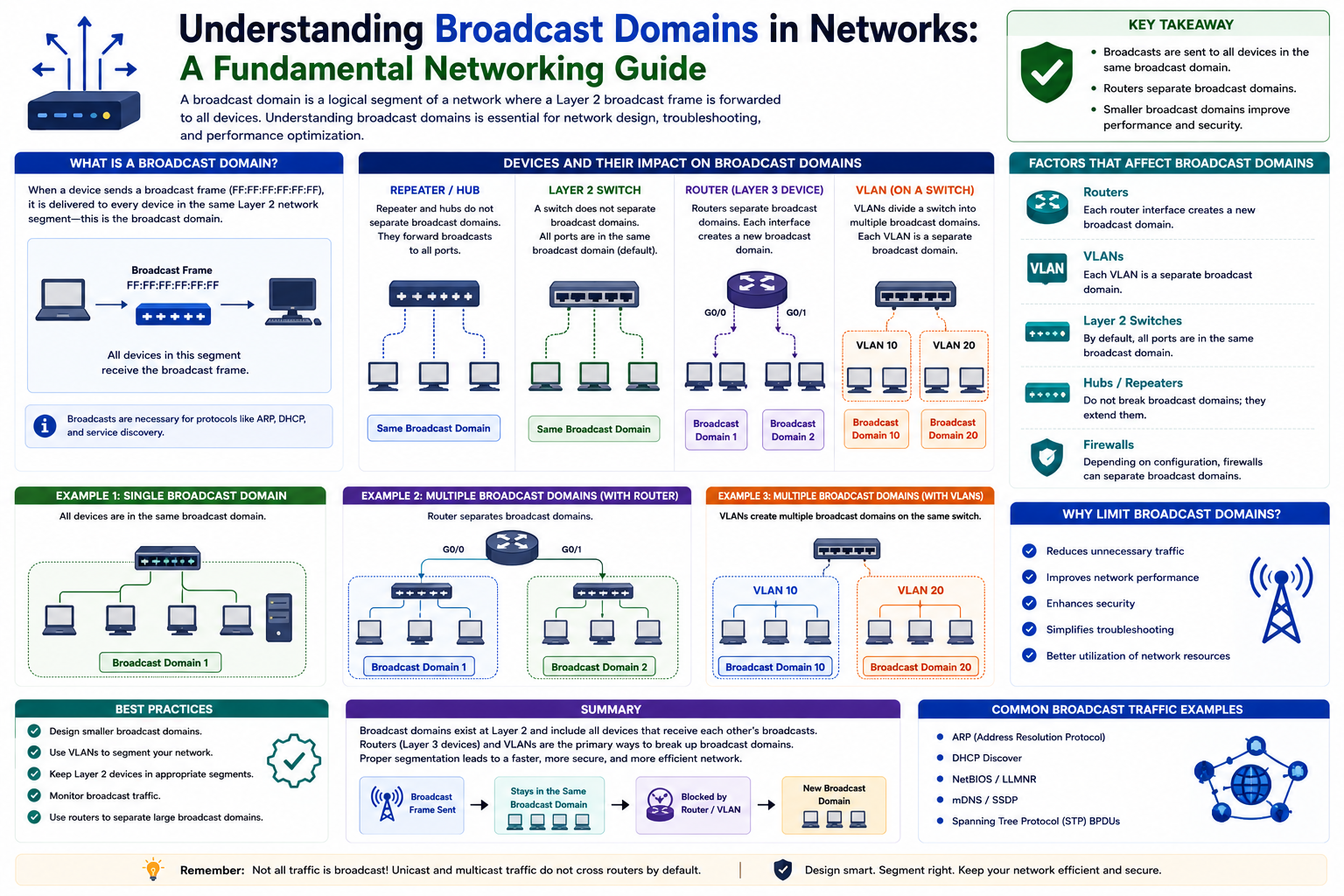
In computer networking, communication between devices is not always direct or targeted. Many processes rely on messages being shared with multiple devices at the same time. This is where the concept of broadcasting becomes essential. A broadcast domain is the environment within a network where a broadcast message sent by one device is received by all other devices in the same segment.
To understand this better, imagine a group of people in a single room. If one person speaks loudly, everyone in that room can hear the message. However, people in other rooms or behind closed doors will not hear it. In networking terms, that “room” is the broadcast domain.
A broadcast domain exists at the data link layer, which is Layer 2 of the networking model. This layer is responsible for local communication within a network segment using MAC addresses. Devices within the same broadcast domain can communicate directly using these physical addresses, and they also receive broadcast messages sent across the network segment.
The idea of a broadcast domain becomes especially important when networks grow larger. Without proper segmentation, too many broadcast messages can flood the network, reducing efficiency and causing unnecessary load on devices.
How Layer 2 Switches Manage Broadcast Traffic
A key device in understanding broadcast domains is the Layer 2 switch. This type of switch operates primarily at the data link layer and uses MAC addresses to forward data between devices.
When a device connects to a Layer 2 switch, the switch begins to learn the MAC address of that device. Every network interface card has a unique MAC address, which is a hardware-based identifier. The switch stores this information in a MAC address table.
This table allows the switch to make intelligent forwarding decisions. Instead of sending data to every connected device, the switch sends data only to the specific port where the destination device is located. This process is known as unicast forwarding.
However, broadcast traffic behaves differently. When a broadcast frame arrives, the switch does not look for a specific destination in its MAC table. Instead, it forwards the frame out of all ports within the same broadcast domain. This ensures that every device in that segment receives the message.
This behavior is essential for many network functions, such as device discovery and service announcements. At the same time, it highlights why broadcast domains need to be carefully managed, especially in larger networks.
The Role of MAC Addresses in Network Communication
MAC addresses are central to communication within a broadcast domain. Each device connected to a network interface has a unique MAC address, typically represented in hexadecimal format.
These addresses act like physical identifiers for devices. Unlike IP addresses, which can change depending on network configuration, MAC addresses are permanently assigned to network hardware.
When a device sends data on a local network, it includes the destination MAC address in the frame header. If the destination is known, the switch forwards the frame directly to the correct port. If the destination is unknown, the frame may be broadcast to all devices within the broadcast domain.
One important special MAC address is the broadcast MAC address, written as ff:ff:ff:ff:ff:ff. When a frame is sent to this address, it signals the switch to deliver the frame to all devices in the broadcast domain.
This mechanism is critical for many networking operations, especially when devices need to communicate with unknown or newly connected systems.
What Defines a Broadcast Domain in Practical Terms
A broadcast domain is not just a theoretical concept; it has a very practical meaning in network design. It defines the boundary within which broadcast traffic is contained.
If a network consists of a single switch with multiple devices connected, then all those devices typically belong to the same broadcast domain. Any broadcast message sent by one device will be received by all others connected to that switch.
However, as networks grow, they are often divided into multiple broadcast domains to improve performance and control traffic flow. This is usually done using virtual LANs, commonly known as VLANs.
Each VLAN creates a separate broadcast domain, even if devices are physically connected to the same switch. This allows network administrators to logically separate traffic without requiring additional physical hardware.
By controlling broadcast domains, networks can be made more efficient, secure, and scalable.
Why Broadcast Traffic Exists in Networks
Broadcast traffic is not accidental; it serves specific and necessary functions in networking. One of the most important uses of broadcast communication is device discovery.
When a device first connects to a network, it often does not know the address of the services it needs to communicate with. Instead of sending targeted messages, it sends a broadcast to discover available services.
For example, when a device needs an IP address, it may not yet know the location of a DHCP server. In this case, it sends a broadcast request across the network. Any DHCP server within the same broadcast domain can respond with configuration information.
This process allows devices to join networks dynamically without manual configuration. However, because broadcast messages are delivered to all devices in the domain, they can become a source of unnecessary traffic if not controlled.
DHCP and Broadcast Domain Behavior
A common real-world example of broadcast domain behavior can be seen in the Dynamic Host Configuration Protocol process.
When a device connects to a network, it does not initially have an IP address. To obtain one, it sends a broadcast message asking if any DHCP server is available. This message is sent to all devices within the broadcast domain.
If a DHCP server is present, it responds with an available IP address and other configuration details such as subnet mask, default gateway, and DNS settings.
This exchange is entirely dependent on broadcast communication within the same domain. If the DHCP server is located outside the broadcast domain, special routing configurations are required to forward the request.
This illustrates how broadcast domains directly influence basic network functionality.
The Relationship Between Broadcast Domains and Network Efficiency
While broadcast communication is necessary, it also has limitations. Every device in a broadcast domain must process broadcast frames, even if the information is not relevant to it. This consumes processing power and network bandwidth.
In small networks, this is usually not a problem. However, in larger networks with hundreds or thousands of devices, excessive broadcast traffic can degrade performance.
This is why network segmentation is important. By dividing a large network into multiple broadcast domains, administrators can limit the scope of broadcast traffic. Each segment handles its own broadcasts independently, reducing overall network congestion.
This separation improves both performance and stability.
How Layer 2 Switching Supports Broadcast Domains
Layer 2 switches play a key role in maintaining broadcast domains. They are responsible for ensuring that broadcast traffic is delivered only within the appropriate segment.
When a broadcast frame arrives at a switch, the device checks which ports belong to the same VLAN or network segment. It then forwards the frame only to those ports.
This ensures that broadcast traffic does not leak into unrelated parts of the network. However, it is important to note that Layer 2 switches do not stop broadcast traffic within a domain; they only control its boundaries.
This distinction is important for understanding how networks are structured and managed.
Network Segmentation and Logical Separation
One of the most powerful features in modern networking is the ability to create logical separation within physical infrastructure. This is achieved using VLANs, which allow multiple broadcast domains to exist on a single switch.
Each VLAN acts as an independent network segment. Devices within one VLAN can communicate freely with each other, but they cannot directly communicate with devices in another VLAN without routing.
This separation helps improve security, reduce broadcast traffic, and organize network resources more efficiently.
For example, a company might separate its network into different VLANs for departments such as administration, finance, and technical support. Each department operates within its own broadcast domain, reducing unnecessary communication between unrelated systems.
Understanding Broadcast Containment in Modern Networks
As networks evolve, controlling broadcast traffic becomes increasingly important. Modern network design focuses on limiting the size of broadcast domains to prevent performance issues.
Smaller broadcast domains mean fewer devices receiving each broadcast message. This reduces unnecessary processing and improves overall responsiveness.
Network designers carefully plan how devices are grouped and how broadcast domains are structured. This planning is essential in environments such as corporate networks, data centers, and service provider infrastructures.
Broadcast containment is not about eliminating broadcasts entirely but about managing them efficiently.
The Invisible Structure Behind Everyday Connectivity
Most users never think about broadcast domains when using the internet or accessing network resources. However, these logical structures are constantly working in the background.
Every time a device connects to a network, obtains an IP address, or discovers another device, broadcast communication is often involved. The broadcast domain ensures that these communications happen efficiently within the correct boundaries.
Without broadcast domains, networks would become chaotic, with messages reaching unnecessary devices and overwhelming the system.
Understanding this hidden structure provides deeper insight into how modern networks operate and why they are designed the way they are.
Expanding the Idea of Broadcast Boundaries in Larger Networks
As networks evolve from small local setups into large enterprise environments, the concept of a broadcast domain becomes more complex and significantly more important. In a simple network, a broadcast domain might consist of just a few devices connected to a single switch. However, in modern infrastructures, broadcast domains can span multiple switches, buildings, or even entire campuses, depending on how the network is designed.
At its core, a broadcast domain defines where broadcast traffic is allowed to travel. But in real-world networking, this definition becomes a design principle that shapes performance, scalability, and security. Network engineers carefully decide how large or small a broadcast domain should be, balancing communication efficiency with traffic control.
If a broadcast domain becomes too large, it can lead to excessive broadcast traffic, where every device receives and processes unnecessary data. If it becomes too small, communication overhead increases due to additional routing between segments. The challenge lies in finding an optimal structure that supports both efficiency and functionality.
VLANs as a Tool for Broadcast Domain Segmentation
One of the most important innovations in managing broadcast domains is the use of Virtual Local Area Networks, commonly known as VLANs. VLANs allow a single physical switch or network infrastructure to be divided into multiple logical networks.
Each VLAN represents its own broadcast domain. Devices assigned to one VLAN will only receive broadcast traffic from devices within the same VLAN. This logical separation happens regardless of whether devices are physically connected to the same switch.
For example, in an organization, employees in the finance department might be placed in one VLAN, while the engineering team is placed in another. Even though all devices may connect to the same physical switch, broadcast traffic from finance devices will not reach engineering devices.
This separation provides several advantages. It reduces unnecessary broadcast traffic, improves network performance, and enhances security by isolating different groups of users.
VLANs effectively allow administrators to design multiple broadcast domains without requiring additional physical hardware, making them a fundamental part of modern network architecture.
The Role of Routers in Controlling Broadcast Domains
While switches operate within broadcast domains, routers serve as the boundaries between them. A router is a Layer 3 device that connects different networks and does not forward broadcast traffic by default.
When a broadcast frame reaches a router, it is typically dropped rather than forwarded. This behavior ensures that broadcast traffic remains confined to its original network segment.
This separation is critical because it prevents broadcast messages from spreading across large networks or between different organizational units. Without routers acting as boundaries, broadcast traffic could quickly overwhelm interconnected networks.
Routers also enable communication between different broadcast domains by using unicast routing. Instead of forwarding broadcasts, they analyze destination IP addresses and send data directly to the appropriate network.
This combination of restricting broadcasts while enabling targeted communication is what allows modern networks to scale efficiently.
ARP and the Dependency on Broadcast Communication
The Address Resolution Protocol, commonly known as ARP, is another important mechanism that relies heavily on broadcast domains. ARP is used to map IP addresses to MAC addresses within a local network.
When a device needs to communicate with another device on the same network, it must first determine the MAC address associated with the destination IP address. If this information is not already known, the device sends an ARP request as a broadcast message.
This request is received by all devices within the broadcast domain. Each device checks whether the request matches its own IP address. If a match is found, the device responds with its MAC address.
This process is essential for enabling communication at the data link layer. Without ARP, devices would not be able to properly forward frames to their intended destinations.
However, because ARP relies on broadcasts, it also contributes to overall broadcast traffic within the network. In large environments, excessive ARP requests can become a performance concern, further highlighting the importance of carefully managing broadcast domains.
Broadcast Storms and Network Instability
One of the most serious issues related to broadcast domains is the occurrence of broadcast storms. A broadcast storm happens when excessive broadcast traffic floods a network segment, overwhelming devices and degrading performance.
Broadcast storms can be caused by network loops, misconfigured devices, or malfunctioning hardware. When a loop exists in a Layer 2 network, broadcast frames can circulate endlessly between switches, multiplying rapidly and consuming all available bandwidth.
As the volume of broadcast traffic increases, devices begin to struggle to process incoming frames. This can lead to network slowdowns, packet loss, and in severe cases, complete network failure.
To prevent this, modern networks use mechanisms such as Spanning Tree Protocol, which helps eliminate loops by selectively blocking redundant paths in the network. This ensures that broadcast frames follow a controlled path and do not circulate endlessly.
Proper design of broadcast domains is one of the most effective ways to reduce the risk of broadcast storms. Smaller and well-segmented domains limit the impact of any potential broadcast issues.
Subnetting and Its Relationship with Broadcast Domains
Subnetting is a logical method of dividing IP networks into smaller segments. While subnetting operates at the IP layer, it is closely related to broadcast domains because each subnet typically corresponds to a separate broadcast domain.
In a subnet, all devices share the same network portion of an IP address and can communicate directly at Layer 2. Broadcast messages sent within a subnet are received by all devices in that subnet, defining its broadcast domain.
When a network is subnetted, routers are required to enable communication between different subnets. Since routers do not forward broadcast traffic, each subnet becomes its own isolated broadcast domain.
This relationship between subnetting and broadcast domains allows network designers to structure networks logically while maintaining control over broadcast traffic.
Subnetting also helps improve address efficiency and reduces unnecessary broadcast exposure, making it a fundamental concept in scalable network design.
DHCP Relay and Broadcast Limitations
Earlier, it was explained that DHCP relies on broadcast communication to assign IP addresses to devices. However, this presents a challenge when DHCP servers are located in different broadcast domains.
Since routers do not forward broadcast traffic, a device in one broadcast domain cannot directly reach a DHCP server in another. To solve this, DHCP relay agents are used.
A DHCP relay agent is configured on a router or Layer 3 device. When it receives a DHCP broadcast request, it converts it into a unicast message and forwards it to the DHCP server in another network.
This allows DHCP services to function across multiple broadcast domains without breaking the rule that broadcasts remain local. It also reduces the need to deploy DHCP servers in every network segment.
This mechanism demonstrates how broadcast limitations can be overcome while still maintaining the integrity of broadcast domain boundaries.
Wireless Networks and Broadcast Domain Behavior
Wireless networks introduce additional complexity to broadcast domain behavior. In a wireless environment, all connected devices share the same radio frequency channel, which effectively creates a shared communication medium.
This means that broadcast traffic in a wireless network can be even more noticeable, as all devices must listen to all transmitted frames within range.
Wireless access points often act as bridges between wired and wireless broadcast domains. They extend the broadcast domain from the wired network into the wireless environment, allowing seamless communication between devices.
However, this also means that broadcast traffic generated by wireless devices contributes directly to the overall load of the broadcast domain.
To manage this, wireless networks often use segmentation techniques such as multiple SSIDs mapped to different VLANs. This allows administrators to create separate broadcast domains for different user groups, even within the same physical wireless infrastructure.
Security Implications of Broadcast Domains
Broadcast domains are not only important for performance but also play a significant role in network security. Since broadcast traffic is visible to all devices within a domain, sensitive information should not be transmitted through broadcast messages.
By dividing networks into smaller broadcast domains, administrators can limit the exposure of broadcast traffic and reduce the risk of unauthorized access to network information.
For example, separating guest users from internal corporate systems using different broadcast domains ensures that guest devices cannot observe or interact with internal broadcast traffic.
This segmentation is a simple but effective security measure that helps protect sensitive systems from unnecessary exposure.
Broadcast Containment in High-Performance Networks
In high-performance environments such as data centers, broadcast domain design becomes even more critical. These environments often contain thousands of devices, making broadcast traffic a potential bottleneck if not properly controlled.
Network architects design these systems with strict segmentation, often using multiple layers of switching and routing to control traffic flow. Broadcast domains are kept small and well-defined to ensure predictable performance.
Advanced switching technologies also help reduce broadcast impact by optimizing how frames are forwarded within the network.
By carefully controlling broadcast domains, high-performance networks can maintain stability even under heavy loads.
The Invisible Structure of Modern Connectivity
Although users rarely interact directly with broadcast domains, these structures are fundamental to every network interaction. From connecting to Wi-Fi to loading a web page or accessing a shared file, broadcast communication often plays a role in the background.
Every network device operates within a broadcast domain, and every domain is carefully designed to balance communication efficiency with network control.
As networks continue to grow in complexity, the importance of understanding and managing broadcast domains becomes even more critical for ensuring reliable and efficient communication.
Scaling Broadcast Domains in Enterprise Network Architectures
As networks grow into enterprise and global-scale systems, broadcast domain design becomes less about simple segmentation and more about structured architecture. In small environments, a single switch or a few VLANs may be enough to manage broadcast traffic. However, in enterprise environments, thousands of devices may exist across multiple floors, buildings, or geographic locations. At this scale, broadcast domains must be carefully engineered to ensure stability and predictable performance.
Enterprise networks are typically designed using hierarchical models, where the network is divided into access, distribution, and core layers. Broadcast domains are primarily contained at the access layer, where end devices such as computers, printers, and IoT devices connect. The distribution and core layers are designed to route traffic efficiently between these segmented domains without carrying unnecessary broadcast load.
This layered approach ensures that broadcast traffic remains localized, preventing it from spreading across the entire infrastructure. Without this design principle, large networks would suffer from excessive overhead, where broadcast frames consume bandwidth and processing resources across all connected systems.
In such environments, broadcast domain planning becomes a critical part of network architecture rather than just a configuration detail.
Hardware-Level Handling of Broadcast Traffic
Modern networking devices are not only software-driven but also heavily optimized at the hardware level. Switches and routers use specialized hardware components such as ASICs (Application-Specific Integrated Circuits) to handle traffic forwarding efficiently.
When a broadcast frame arrives at a switch, it is processed in a way that minimizes CPU involvement. Instead of being handled by general-purpose processors, the forwarding decision is made at hardware speed. This allows millions of frames per second to be processed without overwhelming the device.
However, even with hardware acceleration, broadcast traffic still consumes resources. Every device in the broadcast domain must process broadcast frames at some level, even if only to determine whether the message is relevant. This means that excessive broadcast traffic can still degrade overall network performance.
For this reason, broadcast domain size is not only a logical concern but also a hardware efficiency concern. Network engineers must consider how much traffic edge devices can realistically handle without performance degradation.
Broadcast Suppression Techniques in Modern Networks
To maintain efficiency, modern networks implement several techniques to suppress unnecessary broadcast traffic. These methods are designed to limit the spread of broadcasts or reduce their frequency.
One common technique is broadcast filtering at the switch level. Some switches allow administrators to limit or block certain types of broadcast traffic on specific ports. This helps prevent unnecessary propagation of broadcast frames to devices that do not need them.
Another technique is storm control, which monitors the rate of broadcast traffic on a network segment. If broadcast traffic exceeds a predefined threshold, the switch automatically limits or drops excess frames. This prevents broadcast storms from overwhelming the network.
Additionally, some networks implement rate limiting for specific protocols that rely heavily on broadcast communication. This ensures that essential services can operate without flooding the network.
These suppression techniques do not eliminate broadcast domains but instead help control their impact, ensuring that they remain manageable even in high-density environments.
The Impact of Broadcast Domains on Network Performance
Broadcast domains have a direct and measurable impact on network performance. Every broadcast frame sent within a domain is processed by every device in that domain. This creates a scaling challenge, where the amount of broadcast traffic increases with the number of connected devices.
In small networks, this impact is minimal. However, in larger environments, broadcast traffic can become a significant source of inefficiency. Devices must allocate processing power to handle broadcast frames, even if the frames are irrelevant to their operation.
This is why network segmentation is so important. By dividing a large network into smaller broadcast domains, the load on each device is reduced. Each segment handles its own local broadcasts, preventing unnecessary cross-device processing.
Performance optimization in modern networks often revolves around reducing broadcast overhead while maintaining necessary communication functionality.
Multicast as an Alternative to Broadcast Communication
While broadcast communication sends data to all devices within a domain, multicast provides a more efficient alternative. Multicast allows data to be sent only to a specific group of devices that have expressed interest in receiving that traffic.
Unlike broadcast traffic, multicast traffic is not automatically processed by every device in the network. Instead, devices must join a multicast group to receive the data. This significantly reduces unnecessary network load.
Multicast is commonly used in applications such as video streaming, real-time data distribution, and financial information feeds. These applications require efficient delivery to multiple recipients without flooding the entire network.
In comparison, broadcast traffic is more general and less efficient, but still necessary for certain foundational network operations. Both mechanisms coexist, but multicast is often preferred for scalable communication.
The shift from broadcast-heavy communication to multicast and unicast-based systems is a key evolution in modern networking.
The Absence of Broadcast Domains in IPv6 Networks
One of the most significant changes in modern networking is the transition from IPv4 to IPv6. In IPv6, the concept of broadcast traffic does not exist. Instead, IPv6 uses multicast and anycast communication methods.
This means that traditional broadcast domains, as understood in IPv4 networks, are no longer present in IPv6 environments. Devices do not send broadcast frames to all nodes. Instead, they use more targeted communication methods.
For example, neighbor discovery in IPv6 replaces ARP, which was heavily dependent on broadcast communication. Instead of broadcasting requests to all devices, IPv6 uses multicast groups to communicate with relevant nodes.
This change significantly reduces unnecessary network traffic and improves efficiency, especially in large-scale environments.
By eliminating broadcast traffic, IPv6 simplifies network design and reduces the challenges associated with managing broadcast domains.
Virtualization and Broadcast Domains in Cloud Environments
In virtualized and cloud-based environments, broadcast domain management becomes even more abstract. Instead of physical switches and cables, virtual networks are created using software-defined infrastructure.
Virtual machines and containers operate within virtual broadcast domains that are isolated from one another. These domains are created using virtual switches that replicate the behavior of physical Layer 2 devices.
Each virtual network behaves like a traditional broadcast domain, but it is managed entirely through software. This allows cloud providers to create highly flexible and scalable network architectures.
However, even in virtual environments, broadcast traffic still exists and must be managed carefully. Excessive broadcast traffic within virtual networks can impact performance just as it does in physical networks.
To address this, cloud platforms often implement strict segmentation and isolation policies, ensuring that broadcast domains remain small and controlled.
Software-Defined Networking and Broadcast Control
Software-defined networking (SDN) has introduced a new level of control over broadcast domains. In SDN environments, network behavior is centrally managed through software controllers rather than individual hardware devices.
This allows administrators to define how broadcast traffic should be handled across the entire network from a single control point. Broadcast domains can be dynamically adjusted based on traffic patterns, application requirements, or security policies.
SDN also enables more intelligent traffic management. Instead of relying on static VLAN configurations, broadcast behavior can be modified in real time to adapt to changing network conditions.
This flexibility makes it easier to optimize broadcast domains for performance, scalability, and security in complex environments.
Troubleshooting Broadcast Domain Issues
Understanding broadcast domains is essential when diagnosing network problems. Many common network issues are related to excessive or misdirected broadcast traffic.
One common issue is network slowdown caused by broadcast storms. In such cases, devices may become unresponsive due to excessive processing of broadcast frames. Identifying the source of the storm is a critical troubleshooting step.
Another issue involves misconfigured VLANs, where devices unintentionally belong to the wrong broadcast domain. This can lead to communication failures or unexpected network behavior.
Network administrators often analyze traffic patterns to identify abnormal broadcast activity. High levels of broadcast traffic may indicate misconfiguration, loop issues, or malfunctioning devices.
Effective troubleshooting requires a clear understanding of how broadcast domains are structured and how traffic flows within them.
Security Considerations in Broadcast Domain Design
Broadcast domains also play a significant role in network security. Since broadcast traffic is visible to all devices within a domain, sensitive information should never be transmitted through broadcast mechanisms.
Segmenting networks into smaller broadcast domains helps reduce the risk of unauthorized data exposure. Devices in one segment cannot easily observe broadcast traffic from another segment, improving isolation.
Additionally, limiting broadcast domain size reduces the attack surface for certain types of network-based attacks. Attackers who gain access to one segment are confined to that broadcast domain, preventing them from easily accessing other parts of the network.
Security-focused network design often involves strict control over broadcast boundaries, ensuring that sensitive systems are isolated from general network traffic.
Evolution of Broadcast Domains in Modern Infrastructure
Broadcast domains have evolved significantly alongside networking technology. In early networks, broadcast domains were large and difficult to control. As networks grew, limitations in performance and scalability became apparent.
The introduction of switches, VLANs, routers, and modern segmentation techniques allowed engineers to break large networks into smaller, more manageable broadcast domains. This evolution greatly improved performance and reliability.
Today, with the rise of cloud computing, virtualization, and software-defined networking, broadcast domains are no longer purely physical or static structures. They are dynamic, programmable, and adaptable to changing network conditions.
Despite these advancements, the fundamental concept remains the same: a broadcast domain defines the boundary within which broadcast traffic is contained.
This simple idea continues to play a crucial role in how modern networks are designed, optimized, and secured.
Understanding How Engineers Measure Broadcast Activity
In modern network environments, managing broadcast domains is not only about designing segments but also about continuously observing how those segments behave in real time. Network engineers rely on detailed visibility into broadcast traffic to ensure that each domain remains healthy, efficient, and free from abnormal behavior.
Instead of simply knowing that broadcast traffic exists, engineers measure how frequently it occurs, which devices generate it, and how it spreads across a segment. This measurement is often done using network monitoring systems that collect traffic statistics from switches, routers, and virtual network components.
One of the most important indicators is broadcast rate, which shows how many broadcast frames are being transmitted per second within a given domain. A consistently high broadcast rate may indicate inefficient applications, misconfigured devices, or loops at Layer 2.
Another key metric is broadcast distribution, which helps identify whether broadcast traffic is evenly spread or concentrated in specific areas of the network. Uneven distribution can point to problematic segments that require isolation or redesign.
By continuously tracking these metrics, engineers gain a real-time understanding of how broadcast domains behave under normal and peak conditions.
The Relationship Between Broadcast Domains and Network Convergence
Network convergence refers to the time it takes for a network to stabilize after a change, such as a link failure or topology adjustment. Broadcast domains play an indirect but important role in convergence behavior, especially in Layer 2 networks.
When a change occurs in the network, switches may need to update their forwarding tables, including MAC address entries. During this period, broadcast traffic can temporarily increase as devices attempt to rediscover paths and reestablish communication.
In poorly optimized broadcast domains, convergence delays can become more noticeable. Excessive broadcast traffic during instability can slow down recovery and increase the time it takes for the network to return to normal operation.
Modern network designs aim to minimize this impact by reducing broadcast domain size and ensuring that changes in one segment do not unnecessarily affect others. This separation improves stability and allows networks to recover more quickly from failures.
Microsegmentation and Fine-Grained Broadcast Control
A more advanced approach to managing broadcast domains is microsegmentation. Instead of dividing a network into large VLAN-based domains, microsegmentation breaks the network into much smaller, highly controlled segments.
Each segment may contain only a few devices or even a single workload. This approach significantly reduces the scope of broadcast traffic, ensuring that only the most relevant devices receive each broadcast frame.
Microsegmentation is especially useful in environments where security and performance are critical, such as financial systems or cloud-based application infrastructures. By limiting broadcast exposure, the network becomes more predictable and easier to secure.
Unlike traditional segmentation, microsegmentation often relies on software-based policies rather than physical or VLAN-based boundaries. This allows for more flexible and dynamic control over broadcast behavior.
Broadcast Behavior in Edge and IoT Environments
The rise of edge computing and Internet of Things (IoT) devices has introduced new challenges for broadcast domain management. In these environments, thousands of small devices often operate within a limited physical or logical space.
Many IoT devices rely on broadcast communication for initial discovery, configuration, or synchronization. However, when too many devices generate broadcast traffic simultaneously, the result can be network congestion and performance degradation.
Edge networks must therefore carefully control broadcast domains to prevent overload. This often involves isolating groups of IoT devices into separate segments or using gateway devices that filter and manage broadcast traffic before it spreads further.
In edge computing environments, broadcast traffic must also be balanced with latency requirements. Since edge systems often support real-time applications, excessive broadcast processing can directly impact responsiveness.
As a result, broadcast domain design in these environments focuses heavily on efficiency and isolation.
The Role of Redundancy Protocols in Broadcast Environments
Redundancy protocols are designed to ensure network availability in case of failures, but they also interact closely with broadcast domains. In Layer 2 networks, redundant paths can unintentionally create loops, which significantly amplify broadcast traffic.
To prevent this, protocols like Spanning Tree ensure that only one active path exists between switches within a broadcast domain. Redundant links are kept in standby mode until needed, preventing broadcast frames from circulating endlessly.
This controlled redundancy allows networks to remain resilient without introducing instability caused by broadcast loops.
In more advanced systems, modern variations of redundancy protocols allow faster recovery and more efficient path selection, reducing the time broadcast traffic is affected during topology changes.
Quality of Service and Broadcast Traffic Prioritization
Quality of Service (QoS) is another important concept that interacts indirectly with broadcast domains. While broadcast traffic is generally treated as low priority, in some cases, it can still affect network performance if not properly managed.
QoS policies allow networks to prioritize critical traffic, such as voice, video, or application data, over less important traffic types. Although broadcast traffic is typically not prioritized, it still consumes bandwidth that could otherwise be used by higher-priority flows.
By controlling how much bandwidth broadcast traffic can consume, QoS policies help ensure that important services remain unaffected even during periods of high broadcast activity.
This becomes especially important in converged networks where multiple types of traffic share the same infrastructure.
Predicting Broadcast Growth in Expanding Networks
As networks grow, broadcast traffic does not increase linearly—it often increases exponentially if not controlled. Each additional device in a broadcast domain contributes not only to its own broadcast activity but also to the processing load of every other device.
This creates a scaling challenge where network performance can degrade rapidly if broadcast domains are not properly designed.
To address this, network planners often simulate broadcast growth before deploying large systems. These simulations help predict how broadcast traffic will behave as the number of devices increases.
By understanding these growth patterns, engineers can design broadcast domains that remain stable even as the network scales.
The Invisible Discipline Behind Stable Networks
Broadcast domain management is often invisible to end users, but it is one of the most critical aspects of network engineering. It influences everything from basic device communication to enterprise-level performance and security.
Whether in traditional enterprise networks, cloud environments, or edge systems, broadcast domains define how efficiently devices can communicate and how well the network can handle scale.
The continuous evolution of networking technologies has not eliminated broadcast domains but has instead refined how they are controlled, measured, and optimized across increasingly complex infrastructures.
Conclusion
Broadcast domains remain one of the most fundamental concepts in computer networking, shaping how devices communicate within local network segments. At its core, a broadcast domain defines the boundary where broadcast messages are shared between devices at the data link layer, ensuring that all nodes within the same segment receive relevant network-wide transmissions. While this mechanism is essential for tasks such as device discovery, address resolution, and service announcements, it also introduces challenges when networks grow in size and complexity.
Modern networking has evolved sophisticated methods to manage broadcast domains efficiently. Technologies such as VLANs, routers, and software-defined networking allow administrators to control the scope of broadcast traffic with precision. By dividing large networks into smaller, well-structured domains, organizations can significantly reduce unnecessary traffic, improve performance, and enhance overall network stability. This segmentation also plays an important role in security, limiting exposure between different user groups and reducing the risk of unauthorized access to broadcast information.
At the same time, advancements like multicast communication, IPv6 architecture, and virtualization have reduced reliance on traditional broadcast-heavy processes, pushing networks toward more efficient and scalable communication models. Despite these innovations, the principles of broadcast domains remain deeply embedded in network design.
Ultimately, understanding broadcast domains is essential for anyone involved in networking, as it provides insight into how data flows, how networks are structured, and how performance and security are maintained in both small and enterprise-level environments.