Software testing has evolved far beyond the simple idea of finding bugs before a product is released. In today’s fast-paced digital world, a software tester plays a central role in shaping the quality, reliability, and overall user experience of modern applications. Every app, website, or digital service that people interact with daily goes through multiple layers of testing before it reaches the end user, and software testers are at the heart of this process.
At its core, the role of a software tester is about ensuring that software behaves as expected under different conditions. However, this responsibility extends much deeper than just checking whether a feature works. Testers are responsible for understanding how users will interact with a product, predicting potential failure points, and ensuring that systems remain stable even under unexpected usage patterns. This requires both technical knowledge and a user-focused mindset.
Unlike earlier eras of software development, where testing was often treated as a final step, modern development practices integrate testing throughout the entire lifecycle. Software testers are now involved from the earliest stages of planning and design. This shift has elevated the importance of the role, making testers key contributors rather than just quality gatekeepers.
Another important aspect of the role is collaboration. Software testers do not work in isolation. They are deeply connected with developers, designers, business analysts, and product managers. This collaboration ensures that quality is built into the product rather than inspected afterward. Testers often participate in requirement discussions, helping teams identify ambiguities or potential risks before development begins.
In many organizations, testers also act as advocates for the end user. While developers focus on building functionality, testers focus on usability, performance, and edge cases that might affect real-world usage. This dual perspective helps bridge the gap between technical execution and user expectations.
The role is also becoming increasingly technical. While manual testing is still important, many companies now expect testers to understand coding concepts, automation frameworks, and system architecture. This shift reflects the growing complexity of software systems and the need for faster release cycles without compromising quality.
Why Software Testing Demand Is Growing in the Digital Economy
The demand for software testers continues to rise steadily as businesses become more dependent on digital platforms. Almost every industry—from finance and healthcare to entertainment and retail—relies on software to operate efficiently. As a result, ensuring that these systems work correctly has become a critical business priority rather than just a technical requirement.
One of the main reasons for this growing demand is the increasing complexity of software systems. Modern applications are no longer standalone products; they are interconnected ecosystems involving cloud services, APIs, mobile platforms, and third-party integrations. Each of these components introduces potential points of failure, making thorough testing essential.
Another driving factor is the expectation of continuous delivery. Businesses today aim to release updates quickly and frequently. This rapid development cycle increases the risk of introducing bugs into production environments. Software testers help mitigate this risk by ensuring that new updates do not break existing functionality. Without effective testing, companies risk losing customer trust due to unstable or unreliable software.
User expectations have also changed significantly. In the past, users may have tolerated minor glitches or performance issues. Today, however, users expect seamless, fast, and error-free digital experiences. Even small bugs can lead to negative reviews, customer churn, and reputational damage. This puts additional pressure on organizations to invest heavily in quality assurance.
Security concerns also play a major role in the growing importance of software testing. With increasing cyber threats and data breaches, companies must ensure that their applications are secure and resilient. Testers are often involved in identifying vulnerabilities, checking data protection mechanisms, and validating compliance with industry standards.
Additionally, the rise of mobile applications and cloud-based services has expanded the scope of testing. Applications must now perform consistently across different devices, operating systems, and network conditions. This diversity adds complexity to testing processes and increases the need for skilled professionals who can manage these challenges effectively.
The global shift toward digital transformation has also contributed to job growth in this field. As organizations modernize their systems and move away from legacy infrastructure, they require extensive testing to ensure smooth transitions. This transformation creates continuous opportunities for software testers across industries and regions.
Core Responsibilities That Define a Software Tester
The responsibilities of a software tester are diverse and often vary depending on the organization, project, and level of experience. However, several core duties define the role across most environments.
One of the primary responsibilities is designing and executing test cases. Test cases are structured scenarios that describe how a system should behave under specific conditions. Testers create these scenarios based on requirements and user expectations, ensuring that all possible interactions are considered. Once created, these test cases are executed to verify whether the software behaves correctly.
Another key responsibility is defect identification and reporting. When testers discover issues, they document them in detail so that developers can reproduce and fix the problem. A good bug report includes clear steps, expected outcomes, actual results, and supporting evidence such as screenshots or logs. This clarity helps development teams resolve issues efficiently.
Regression testing is another essential task. Whenever changes are made to software, there is a risk that existing functionality may be affected. Testers run regression tests to ensure that new updates do not introduce unexpected problems. This is especially important in systems that undergo frequent updates.
Testers are also responsible for validating fixes. Once developers address reported issues, testers verify that the problem has been resolved correctly and that no new issues have been introduced in the process. This cycle of reporting and verification ensures continuous improvement in software quality.
In many environments, testers also participate in requirement analysis. Before development begins, they review documentation to identify gaps, inconsistencies, or unclear specifications. This proactive involvement helps prevent issues later in the development cycle.
Test planning is another important responsibility. Testers help define the scope of testing, identify required resources, and estimate timelines. This planning ensures that testing activities are structured and aligned with project goals.
In more advanced roles, testers may also contribute to automation. This involves writing scripts that automatically execute test cases, reducing manual effort and increasing efficiency. Automation is particularly useful in large-scale projects where repeated testing is required.
How Software Testing Fits into Agile and DevOps Environments
Modern software development has largely shifted toward Agile and DevOps methodologies, both of which emphasize speed, collaboration, and continuous improvement. In these environments, software testing is not a separate phase but an integrated part of the entire development process.
In Agile environments, development happens in short cycles known as sprints. Software testers are involved in each sprint from the beginning, participating in planning sessions, reviewing user stories, and defining acceptance criteria. This early involvement ensures that testing considerations are built into the development process rather than added afterward.
Testers in Agile teams often work alongside developers in real time. As features are developed, testing begins almost immediately. This continuous feedback loop allows teams to identify and fix issues quickly, reducing the cost and effort of late-stage bug fixes.
DevOps takes this integration even further by combining development and operations into a unified workflow. In DevOps environments, automation plays a critical role. Software testers contribute by building automated test suites that are integrated into continuous integration and continuous deployment pipelines.
This means that every time new code is added, automated tests are run to ensure that the system remains stable. If issues are detected, the deployment process is halted until the problem is resolved. This approach significantly improves software reliability and reduces downtime.
In both Agile and DevOps environments, communication is essential. Testers must constantly collaborate with developers, product owners, and operations teams. They are expected to provide fast feedback and adapt quickly to changing requirements.
The role of software testers in these environments is more dynamic than ever before. They are not just validators of quality but active contributors to the development lifecycle, helping shape the product at every stage.
Key Skills That Shape a Successful Software Tester
Success in software testing requires a combination of technical, analytical, and interpersonal skills. While the role may appear straightforward at first glance, it demands a deep understanding of both systems and user behavior.
Analytical thinking is one of the most important skills for a software tester. Testers must be able to break down complex systems into smaller components and understand how each part interacts with others. This helps them identify potential failure points that may not be immediately obvious.
Attention to detail is equally critical. Even minor issues can have significant impacts on software performance or user experience. A successful tester must be able to notice subtle inconsistencies and unexpected behaviors.
Communication skills also play a major role. Testers must clearly document issues and explain them to developers in a way that is easy to understand. Poor communication can lead to misunderstandings, delays, and unresolved bugs.
Technical skills are becoming increasingly important. While not all testing roles require programming knowledge, familiarity with scripting languages, automation tools, and testing frameworks can significantly enhance career opportunities. Testers who can write automated tests are often more valuable to organizations.
Domain knowledge is another key factor. Understanding the industry in which the software operates helps testers identify relevant test scenarios. For example, testing financial software requires different considerations compared to testing a gaming application.
Adaptability is also essential. Software development environments are constantly evolving, and testers must be able to learn new tools, technologies, and methodologies quickly.
Factors Influencing Software Tester Salaries in Depth
Software tester salaries are shaped by a combination of technical, organizational, and economic factors that go far beyond job titles or years of experience. While it is common to think of salary as a fixed range tied to a role, the reality is much more dynamic. Companies evaluate testers based on the value they bring to product quality, development speed, and risk reduction, which makes compensation highly variable across different environments.
One of the most influential factors is the level of technical expertise a tester brings to the role. Testers who understand not only how to execute tests but also how software is built tend to command higher salaries. This includes knowledge of programming concepts, system architecture, databases, and APIs. The more deeply a tester understands the underlying technology, the more effectively they can identify complex issues that automated tools or less experienced testers might miss.
Another major factor is the complexity of the software being tested. Testing a simple web application is very different from testing enterprise systems, financial platforms, or distributed cloud architectures. The more complex the system, the more valuable the tester becomes, especially if they can navigate multiple integrated components and identify cross-system issues.
Organizational structure also plays a significant role. Large tech companies and well-funded startups often have higher budgets for quality assurance compared to smaller businesses. These organizations typically invest more in testing infrastructure, tools, and talent, which naturally leads to higher compensation levels for skilled testers.
The maturity of the testing process within a company can also influence salary levels. In organizations where testing is highly integrated into development workflows, testers often take on more strategic roles. This includes shaping quality standards, influencing release decisions, and participating in architectural discussions, all of which contribute to higher pay.
Finally, the demand for specific skill sets in the job market has a direct impact on salaries. When certain testing skills become scarce—such as automation expertise or performance testing—companies are willing to pay a premium to attract professionals with those capabilities.
The Impact of Experience Levels on Long-Term Earnings
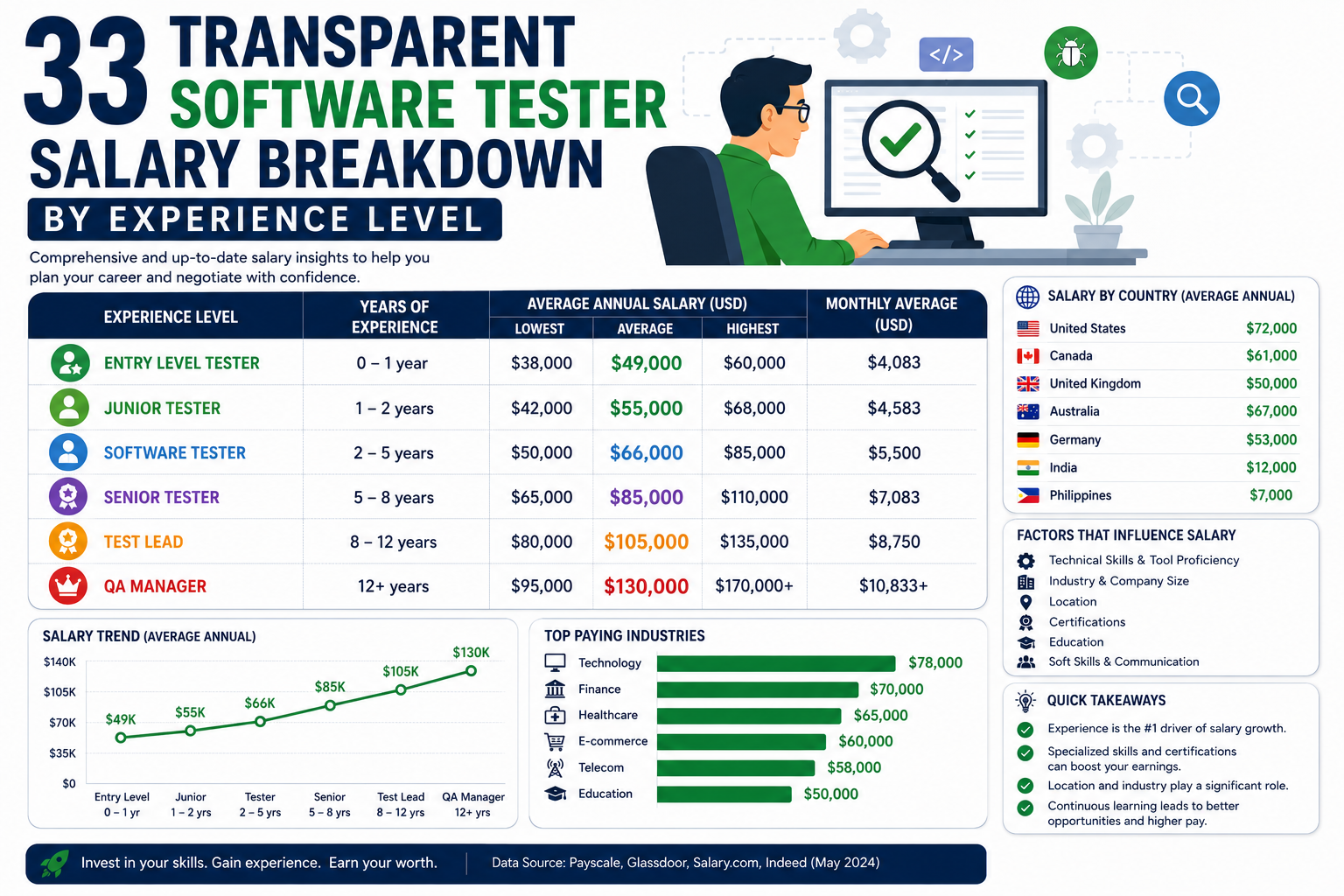
Experience is one of the most consistent and predictable drivers of salary growth in software testing careers. As testers gain exposure to different systems, tools, and workflows, their ability to identify issues early and contribute strategically to projects increases significantly.
At the early stage of a career, testers are primarily focused on learning foundational skills. They spend much of their time executing predefined test cases, reporting bugs, and familiarizing themselves with testing tools. While entry-level salaries are modest compared to other stages, this phase is crucial for building technical and analytical foundations.
As testers transition into mid-level roles, their responsibilities expand significantly. They begin to design test cases, contribute to test planning, and often take ownership of specific modules or features. At this stage, testers are expected to understand not only what to test but why certain scenarios matter from a business and user perspective. This deeper involvement naturally leads to higher compensation.
Mid-level testers also start developing automation skills, which significantly enhances their value in the job market. Even partial automation experience can result in noticeable salary increases because it improves efficiency and reduces manual effort for development teams.
Senior-level testers operate at a strategic level. They are often responsible for defining quality standards across entire projects or departments. Their work may involve designing automation frameworks, mentoring junior testers, and collaborating directly with leadership teams. Because their decisions impact product quality at a systemic level, their compensation reflects this responsibility.
Over time, experience does not just increase salary—it also expands career options. Experienced testers can transition into roles such as test architects, QA managers, or even product-focused positions, all of which offer higher earning potential.
Manual Testing vs Automation Testing Earnings Gap
One of the most significant distinctions in software testing salaries is the difference between manual testing and automation testing. While both are essential to quality assurance, they require different skill sets and offer different career trajectories.
Manual testing involves executing test cases without the use of automation tools. Testers manually interact with software to identify bugs, usability issues, and inconsistencies. This type of testing is highly important, especially during early development stages or for exploratory testing where human judgment is critical.
However, manual testing roles tend to have lower salary ceilings compared to automation roles. This is primarily because manual testing does not scale efficiently in large or fast-moving development environments. As software becomes more complex and release cycles become shorter, companies increasingly rely on automation to maintain efficiency.
Automation testing, on the other hand, involves writing scripts that execute test cases automatically. This requires knowledge of programming languages and testing frameworks. Automation testers are responsible for building reusable test scripts that can be executed repeatedly with minimal human intervention.
Because automation testers combine testing expertise with programming skills, they are often compensated at higher levels. Their work directly contributes to faster release cycles, improved coverage, and reduced manual effort, all of which have clear business value.
The salary gap between manual and automation testers can be substantial, especially in mature tech companies. Automation testers are often seen as hybrid professionals who bridge the gap between development and quality assurance, making them highly valuable in modern engineering teams.
Over time, many manual testers transition into automation roles to increase their earning potential and career growth opportunities. This shift is one of the most common progression paths in the QA field.
Industry-Specific Salary Differences in QA Roles
Software tester salaries are heavily influenced by the industry in which a professional works. Different sectors place varying levels of importance on software quality, which directly impacts compensation structures.
In the financial services industry, software testing is considered critical due to the high stakes involved in transactions, data security, and regulatory compliance. Even minor software issues can result in significant financial losses or legal consequences. As a result, testers in this industry often receive higher-than-average salaries.
Healthcare is another industry where software testing is highly valued. Medical systems, patient records, and diagnostic tools must function with extreme accuracy. Testers working in this field often deal with strict compliance requirements, which increases both responsibility and compensation.
The technology sector itself, particularly software-as-a-service companies, also offers competitive salaries. These companies rely heavily on continuous software updates and user satisfaction, making testing a core part of their development cycle.
In contrast, industries such as education or non-profit organizations may offer lower salaries for testing roles. While the work is still important, budget constraints and lower commercial pressure often result in reduced compensation.
E-commerce companies fall somewhere in the middle. They value testing highly due to the direct impact of software performance on customer experience and sales. However, salary levels can vary significantly depending on company size and market position.
The gaming and entertainment industries present another interesting case. While some large gaming companies offer competitive salaries, smaller studios may pay less despite requiring highly specialized testing skills, such as performance and usability testing in interactive environments.
Geographic Location and Cost-of-Living Influence
Location remains one of the most significant factors affecting software tester salaries. Even in an increasingly remote-friendly world, geographic differences continue to play a major role in determining compensation levels.
In major technology hubs, salaries tend to be significantly higher due to strong demand for skilled professionals and higher living costs. Cities with large tech ecosystems often attract global companies, which increases talent competition and drives salaries upward.
However, higher salaries in these regions are often offset by increased living expenses. Housing, transportation, and the general cost of living can significantly reduce the real value of higher pay. As a result, some testers prefer mid-sized cities where salaries are slightly lower, but purchasing power is higher.
Mid-tier cities often offer an attractive balance between salary and cost of living. These locations typically have growing tech scenes and provide enough opportunities for career advancement without the financial pressure of major metropolitan areas.
Smaller cities and regions with limited tech industries generally offer lower salaries. However, they may provide greater job stability and lower competition, which can be appealing for long-term career planning.
Geographic influence is also changing due to remote work. Many companies now adjust salaries based on employee location rather than company headquarters, creating a more flexible compensation landscape.
Remote Work and Global Salary Standardization
The rise of remote work has significantly changed how software tester salaries are structured. Instead of being tied strictly to physical location, compensation is increasingly influenced by skill level, experience, and company policies.
Remote work has opened opportunities for testers to work for companies located in high-paying regions without relocating. This has expanded access to better-paying roles for professionals in lower-cost regions.
At the same time, some companies have adopted location-based pay adjustments, meaning salaries are calibrated based on where the employee lives. This creates a more balanced but sometimes controversial compensation model.
Global talent competition has also increased. Companies are no longer limited to hiring locally, which raises expectations for skill levels. Testers must now compete in a global job market where technical expertise and adaptability are more important than ever.
Remote work has also increased demand for self-management skills. Testers must be able to communicate effectively, manage their workload independently, and collaborate across time zones. These soft skills can indirectly influence salary growth by making professionals more valuable in distributed teams.
Specialized Testing Domains That Increase Pay
Certain areas of software testing are considered highly specialized and tend to offer higher salaries due to their complexity and demand.
Performance testing is one such area. It involves evaluating how systems behave under load, stress, or high traffic conditions. Testers in this domain help ensure that applications remain stable during peak usage, which is critical for large-scale platforms.
Security testing is another high-value specialization. As cyber threats continue to grow, companies place increasing importance on identifying vulnerabilities before they can be exploited. Testers with security expertise often command premium salaries.
API testing has also become more important with the rise of microservices and cloud-based architectures. Testers who understand how to validate backend systems and ensure proper data flow between services are highly sought after.
Mobile testing is another growing field. With the dominance of smartphones, ensuring consistent performance across devices and operating systems is essential. This requires familiarity with multiple platforms and testing environments.
Each of these specialized areas requires deeper technical knowledge, which is why they tend to offer higher compensation compared to general testing roles.
Hidden Compensation Components Beyond Base Salary
When evaluating software tester salaries, it is important to consider that base salary is only one part of total compensation. Many organizations offer additional benefits that significantly increase overall earnings.
Performance bonuses are common in many tech companies. These bonuses are often tied to individual performance, team success, or company profitability. For testers, bonuses may be awarded for contributing to successful product releases or improving testing efficiency.
Stock options and equity are another important component, especially in startups and large tech companies. While these do not provide immediate income, they can become highly valuable over time if the company performs well.
Health benefits, retirement contributions, and paid time off also contribute to overall compensation. While these may not directly increase take-home pay, they add significant financial value.
Some companies also offer learning budgets, certification reimbursement, and conference attendance opportunities. These benefits support career growth and indirectly contribute to long-term earning potential.
Relocation assistance, remote work allowances, and flexible working arrangements can also add financial and lifestyle value to a compensation package.
Career Progression Paths That Lead to Higher Income
Software testing offers multiple career progression paths that can lead to significant salary growth over time. One common path is transitioning from manual testing to automation testing, which opens up higher-paying technical roles.
Another progression path involves moving into leadership positions. QA leads and test managers are responsible for overseeing teams, defining testing strategies, and ensuring quality standards across projects. These roles come with increased responsibility and higher compensation.
Some testers transition into specialized roles such as performance engineers or security testers. These positions require deeper technical expertise but offer higher salaries due to their niche nature.
There is also a path toward becoming a test architect, where professionals design entire testing frameworks and strategies for organizations. This role is highly strategic and often well-compensated.
In some cases, experienced testers move into broader software development or product management roles. Their understanding of quality and user experience makes them valuable in cross-functional positions that often offer higher earning potential.
Market Trends Shaping Future QA Salaries
The future of software tester salaries is being shaped by several key trends in the technology industry. One major trend is the increasing use of artificial intelligence in testing processes. AI-powered testing tools are automating many routine tasks, which is shifting the role of testers toward more strategic responsibilities.
Another trend is the growing importance of continuous testing in DevOps environments. As release cycles become shorter, testers are expected to integrate testing directly into development pipelines. This increases demand for automation and technical expertise.
The rise of cloud computing is also influencing QA roles. Testers must now understand distributed systems, scalability challenges, and cloud-based infrastructure, all of which add complexity to their work.
Cybersecurity concerns are also driving demand for specialized testing skills. As data breaches become more common, companies are investing more in security-focused testing roles.
Finally, globalization and remote work continue to reshape salary structures. As companies hire globally, competition increases, but so do opportunities for skilled testers in different regions.
These trends suggest that software testing will continue to evolve into a more technical, specialized, and strategically important profession, with salaries reflecting this growing complexity.
The Evolution of Software Testing Careers in Modern Tech Environments
Software testing has undergone a major transformation over the past decade. What was once considered a support function has now become a core engineering discipline in many organizations. This evolution has reshaped job expectations, career paths, and ultimately salary structures for professionals in the field.
In earlier software development models, testers were often positioned at the end of the development cycle. Their job was to identify defects after the product was built. While this approach still exists in some environments, it is becoming increasingly outdated. Modern development practices emphasize continuous quality, where testing begins at the earliest stages of design and continues throughout the entire lifecycle.
This shift has elevated the role of testers from passive validators to active contributors in software engineering teams. Many companies now refer to advanced testing professionals as Software Development Engineers in Test. These professionals combine traditional QA skills with software engineering capabilities, allowing them to build testing frameworks, contribute to codebases, and participate in architectural decisions.
As a result, career paths in testing have become more diverse. Instead of a single linear progression, professionals can now specialize in automation, performance engineering, security validation, or test architecture. Each of these paths comes with its own set of responsibilities and compensation levels.
This evolution also reflects broader changes in the software industry. Faster release cycles, cloud-native systems, and distributed architectures have made quality assurance more complex. Testing is no longer just about finding bugs—it is about ensuring system reliability, scalability, and user satisfaction at every stage of development.
The Modern Automation Ecosystem and Its Impact on Earnings
Automation has become one of the most influential factors in shaping software tester salaries. As organizations scale their development processes, manual testing alone is no longer sufficient to maintain quality at speed. Automation testing fills this gap by enabling repetitive test cases to be executed efficiently and consistently.
The automation ecosystem consists of multiple layers, including test frameworks, scripting languages, execution environments, and reporting systems. Testers working in automation must understand how these components interact to build reliable testing pipelines.
One of the key drivers of higher salaries in automation testing is the requirement for programming knowledge. Unlike manual testing, automation testing requires the ability to write code that interacts with software systems. This includes scripting test cases, building reusable functions, and integrating tests into development workflows.
Automation testers often work with complex frameworks that support different types of testing, including functional, regression, and integration testing. These frameworks must be designed to handle changes in software without requiring constant rewrites, which requires strong architectural thinking.
The demand for automation skills has grown significantly due to the rise of continuous delivery models. In these environments, code is deployed frequently, sometimes multiple times per day. Without automation, it would be impossible to maintain quality at this speed.
Because of this increased responsibility, automation testers typically earn more than manual testers. Their work directly impacts release velocity, system stability, and operational efficiency, making them highly valuable in modern engineering teams.
Continuous Integration and Continuous Delivery in Testing Workflows
Continuous integration and continuous delivery have fundamentally changed how software testing is performed. These practices emphasize the constant integration of code changes and automated validation of software at every stage of development.
In a continuous integration environment, developers frequently merge code changes into a shared repository. Each change triggers automated builds and tests, ensuring that issues are identified early. Software testers play a critical role in designing and maintaining these automated test suites.
Continuous delivery extends this concept by ensuring that software is always in a deployable state. This requires rigorous testing at every stage of the pipeline, including unit testing, integration testing, system testing, and regression testing.
Testers working in these environments must understand how to integrate their tests into deployment pipelines. This involves configuring automated workflows, managing test environments, and ensuring that test results are accurately reported.
The shift toward continuous testing has increased the technical expectations placed on testers. They are now expected to understand version control systems, build tools, and deployment pipelines. This technical depth contributes directly to higher salary levels, as testers become integral to the delivery process rather than external validators.
Another important aspect of CI/CD environments is feedback speed. Test results must be delivered quickly to development teams so that issues can be resolved immediately. This requires efficient test design and optimization strategies.
Artificial Intelligence and Its Growing Influence on QA Roles
Artificial intelligence is beginning to reshape the software testing landscape in significant ways. AI-powered tools are being used to automate test case generation, predict defect-prone areas, and optimize testing coverage.
One of the most notable impacts of AI in testing is the reduction of repetitive manual work. AI systems can analyze application behavior and generate test scenarios automatically, reducing the need for manual test design in certain cases.
AI is also being used to enhance defect prediction. By analyzing historical data, machine learning models can identify areas of code that are more likely to contain bugs. This allows testers to focus their efforts more strategically.
Another emerging application of AI in testing is visual validation. AI tools can compare user interfaces across different versions of an application and detect subtle changes that might not be easily identified by traditional testing methods.
While AI is automating certain aspects of testing, it is also increasing the demand for higher-level skills. Testers are now expected to understand how AI tools work, how to interpret their results, and how to integrate them into existing workflows.
Rather than replacing testers, AI is shifting its focus toward more analytical and strategic responsibilities. This shift is likely to influence salary structures in the long term, with higher compensation for professionals who can effectively leverage AI-driven testing systems.
Career Growth Strategies That Directly Influence Salary Progression
Salary growth in software testing is closely tied to strategic career development. Professionals who actively expand their skills and take on additional responsibilities tend to progress faster than those who remain in static roles.
One of the most effective strategies for career growth is skill diversification. Testers who expand beyond manual testing into automation, performance, or security testing significantly increase their market value. This diversification allows them to work on more complex systems and take on higher-level responsibilities.
Another important strategy is specialization. While general testing skills are valuable, deep expertise in a specific area can lead to higher salaries. Specialized testers are often seen as experts who can solve complex problems that generalists cannot.
Leadership experience also plays a major role in salary progression. Testers who take on mentoring roles, lead testing efforts, or manage QA teams often transition into higher-paying positions. Leadership roles require not only technical knowledge but also communication, planning, and decision-making skills.
Cross-functional experience can also accelerate career growth. Testers who work closely with development, product, and operations teams gain a broader understanding of software delivery. This holistic perspective is highly valued in senior roles.
Another important factor is visibility within an organization. Testers who actively contribute to improving processes, identifying risks early, and enhancing product quality are more likely to be recognized and promoted.
The Software Testing Hiring Process and Salary Expectations
The hiring process for software testing roles typically involves multiple stages designed to assess both technical and analytical capabilities. Understanding this process can help candidates position themselves more effectively for higher-paying roles.
Initial screening often focuses on foundational knowledge of testing concepts, tools, and methodologies. Candidates are expected to demonstrate an understanding of test case design, defect reporting, and basic testing principles.
Technical assessments are common in mid-level and senior roles. These assessments may include scenario-based questions, problem-solving exercises, or practical demonstrations of testing skills. For automation roles, coding exercises are often included.
Behavioral interviews are also an important part of the hiring process. Employers evaluate communication skills, teamwork abilities, and problem-solving approaches. These soft skills are especially important in Agile and DevOps environments.
Salary discussions typically occur after technical evaluations. At this stage, compensation is influenced by experience, technical depth, and specialization. Candidates with automation or niche testing expertise often have stronger negotiating positions.
Companies also consider industry experience when determining salary offers. Testers with experience in high-stakes industries such as finance or healthcare may receive higher compensation due to their familiarity with compliance and risk management.
The Importance of Portfolio Development in QA Careers
In modern hiring environments, practical demonstration of skills is often more important than formal credentials alone. A strong portfolio can significantly influence salary outcomes for software testers.
A testing portfolio typically includes examples of test cases, automation scripts, bug reports, and project documentation. It demonstrates not only technical ability but also problem-solving skills and attention to detail.
Automation projects are particularly valuable in portfolios. They show the ability to design and implement testing frameworks, integrate tools, and manage test execution pipelines.
Real-world project experience is also highly valued. Testers who can demonstrate experience working on complex systems or large-scale applications are often viewed as more capable of handling senior roles.
Documentation quality is another important aspect of a portfolio. Clear, structured documentation reflects strong communication skills, which are essential in collaborative environments.
A well-developed portfolio can also help candidates stand out in competitive job markets, potentially leading to higher salary offers and faster career progression.
Common Barriers That Limit Salary Growth in Testing Careers
While software testing offers strong earning potential, certain factors can limit salary growth if not addressed.
One common barrier is over-reliance on manual testing. While manual testing is important, failing to develop automation skills can restrict career advancement and limit access to higher-paying roles.
Another limitation is the lack of technical depth. Testers who do not develop programming or system knowledge may find it difficult to transition into advanced roles such as SDET or test architect positions.
Limited exposure to modern development practices can also hinder growth. Testers who are not familiar with Agile, DevOps, or CI/CD workflows may struggle to adapt to modern engineering environments.
Communication challenges can also impact career progression. Poor documentation or ineffective collaboration with development teams can reduce a tester’s perceived value within an organization.
Staying in the same role for extended periods without skill development can also limit salary growth. The testing field evolves rapidly, and continuous learning is essential for long-term success.
Globalization and the Expansion of Remote Testing Careers
The globalization of the technology workforce has significantly expanded opportunities for software testers. Remote work has enabled companies to hire talent from different regions, creating a more competitive and diverse job market.
This shift has allowed testers to access international opportunities without relocating. It has also increased competition, as companies can now source talent globally.
Remote work has changed expectations for communication and self-management. Testers must be able to work independently, manage time effectively, and collaborate across different time zones.
Global hiring practices have also influenced salary structures. Some companies adopt location-based compensation models, while others offer standardized global salaries for certain roles.
This globalization has created both opportunities and challenges. While access to higher-paying roles has increased, competition has also intensified, requiring testers to continuously improve their skills.
Advanced Specializations That Shape High-Income QA Roles
Specialization is one of the most effective ways to increase earning potential in software testing. Certain advanced domains require deep technical expertise and offer significantly higher compensation.
Performance testing is one such specialization. It involves analyzing system behavior under various loads and identifying performance bottlenecks. This requires both technical and analytical skills.
Security testing is another high-value specialization. Testers in this area focus on identifying vulnerabilities and ensuring that systems are protected against potential threats. This field is particularly important in industries handling sensitive data.
Test architecture is a more strategic specialization. Test architects design entire testing frameworks and define quality standards for organizations. This role requires deep experience and strong system-level thinking.
Data testing and analytics validation are also emerging areas. As data-driven systems become more common, ensuring data accuracy and integrity has become increasingly important.
Each of these specializations requires continuous learning and technical growth, but they also offer some of the highest salary levels in the testing profession.
Conclusion
Software testing has become a highly strategic and evolving career path in the modern technology landscape. What was once considered a purely supportive function has now transformed into a core discipline that directly influences product quality, user satisfaction, and business success. As software systems grow more complex and development cycles become faster, the need for skilled testers continues to increase across industries and regions.
Salary potential in this field is shaped by several interconnected factors, including experience level, technical expertise, specialization, industry type, and geographic location. Professionals who invest in automation skills, understand modern development workflows, and gain experience in high-demand areas such as performance or security testing are consistently positioned for higher earning opportunities.
At the same time, career growth in software testing is no longer linear. Testers today have multiple pathways available, from automation engineering to leadership and architecture roles. Each path offers different challenges and rewards, allowing individuals to align their careers with their strengths and interests.
Ultimately, software testing rewards continuous learning and adaptability. Those who stay current with evolving tools, methodologies, and industry practices are best positioned to build long-term career stability and maximize their earning potential in this dynamic field.