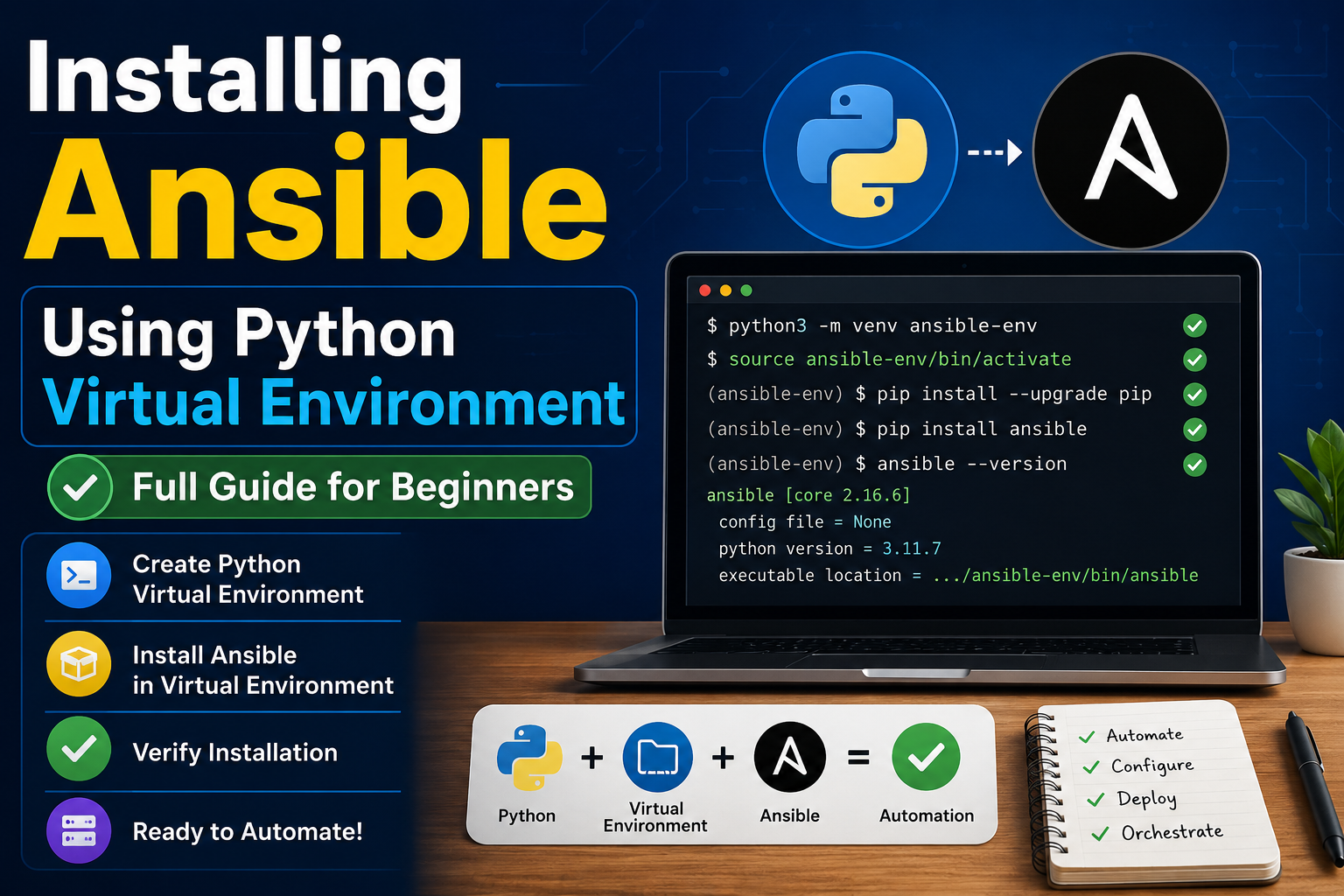
Automation has become one of the defining pillars of modern IT operations. Whether it is managing servers, configuring networks, or deploying applications at scale, teams rely heavily on tools that reduce manual effort and improve consistency. Among these tools, Ansible has earned a strong reputation because of its simplicity, agentless architecture, and ability to describe infrastructure in a human-readable way.
At its core, Ansible allows engineers to define desired system states and then automatically enforce those states across multiple machines. This removes the need for repetitive manual configuration and reduces the chances of human error. As organizations grow, the number of systems, environments, and configurations increases rapidly. In such environments, automation is not just a convenience but a necessity.
However, as soon as automation becomes part of daily operations, another challenge emerges. Different teams, projects, and environments often require different versions of tools and dependencies. This is where Python becomes relevant, and more specifically, how Python manages its runtime environments.
Ansible itself is built on Python, meaning it depends heavily on Python libraries and packages to function correctly. Because of this tight relationship, managing Python properly becomes an important part of working with Ansible effectively.
Why Python Matters for Ansible
To understand why Python is so important in the Ansible ecosystem, it helps to recognize how Ansible is delivered and executed. When you run an Ansible command or execute a playbook, you are indirectly running Python code in the background. Ansible modules are Python-based, and many of the underlying operations depend on Python libraries such as templating engines, cryptographic tools, and data processing utilities.
This dependency on Python introduces flexibility but also complexity. Different versions of Ansible depend on different versions of supporting Python libraries. In addition, system-level Python installations often come with pre-installed packages that may conflict with project-specific requirements.
In a simple environment where only one automation project exists, this complexity might not be noticeable. A single version of Ansible installed globally may work without issues. However, in real-world environments, this simplicity rarely lasts.
As soon as multiple projects are introduced, each with different requirements, version mismatches begin to appear. One project might require a newer version of Ansible to support updated modules, while another project might rely on an older stable version due to compatibility constraints with legacy systems.
This is where Python’s environment management capabilities become essential.
The Growing Complexity of Automation Projects
In modern IT environments, it is common for engineers to work on multiple automation projects at the same time. These projects may differ in scope, infrastructure, and even underlying technologies. For example, one project may focus on cloud infrastructure provisioning, while another manages on-premise networking equipment.
Each of these projects evolves independently. Over time, they accumulate different dependencies, configurations, and version requirements. Without proper isolation, these differences can create conflicts that are difficult to troubleshoot.
A particularly common issue arises when multiple projects depend on different versions of the same package. If one project updates a shared dependency, it may unintentionally break another project that relies on an older version. These conflicts are not always immediately visible, which makes them even more problematic in production environments.
This challenge is not unique to Ansible or Python. It is a general problem in software development and system administration. However, because Ansible relies heavily on Python, it becomes especially relevant in automation workflows.
Introducing the Concept of Isolated Python Environments
To solve the problem of dependency conflicts, Python provides a mechanism known as isolated environments. The idea behind this approach is simple but powerful: instead of installing packages globally across the entire system, each project gets its own self-contained workspace.
In this isolated workspace, the project has its own Python interpreter and its own set of installed libraries. This means that changes made in one environment do not affect other environments. Each project becomes independent, with its own dependencies and configurations.
This isolation is particularly useful in automation work. When working with Ansible, it ensures that each project uses the exact version of Ansible and its dependencies that it was designed for. This eliminates unexpected behavior caused by version mismatches.
By separating environments in this way, engineers gain full control over their project dependencies. It also becomes much easier to replicate environments across different systems, such as development machines, testing servers, and production infrastructure.
Dependency Conflicts in Real-World Automation Teams
To better understand the importance of isolation, consider how automation teams typically operate. In many organizations, different teams or even individual engineers maintain their own automation projects. These projects often evolve at different speeds.
One team might be actively developing new playbooks and regularly updating their Ansible version to take advantage of new features. Another team might be maintaining a stable system that cannot afford frequent upgrades due to strict operational requirements.
Without isolation, these teams would be forced to agree on a single shared version of Ansible. This often leads to compromise, where one team is forced to delay updates or another team is forced to work with outdated tools.
Dependency conflicts can also appear in more subtle ways. Even when teams are using the same version of Ansible, differences in supporting libraries can cause unexpected behavior. A small update in a shared library might change how a module behaves, leading to inconsistencies in automation outcomes.
These inconsistencies can be difficult to diagnose because the root cause is not always obvious. What appears to be a configuration issue might actually be a dependency version mismatch.
Isolated environments eliminate this entire class of problems by ensuring that each project operates in a controlled and predictable setup.
How Python Virtual Environments Work Conceptually
A Python virtual environment is essentially a self-contained directory that mimics a full Python installation. Inside this directory, you find everything needed to run Python-based applications independently from the rest of the system.
This includes a Python interpreter, package management tools, and a dedicated location for installed libraries. When a virtual environment is activated, the system temporarily redirects Python-related commands to use this isolated setup instead of the global installation.
From a conceptual standpoint, this means that each project behaves as if it has its own private version of Python. Any packages installed within that environment remain contained within it and are not shared with other environments unless explicitly configured.
This design makes virtual environments extremely powerful for managing complex projects. It allows developers and engineers to experiment freely without worrying about breaking other systems.
In the context of Ansible, this means that each automation project can have its own version of Ansible, its own collections, and its own dependencies without interfering with others.
The Role of Virtual Environments in Ansible Stability
Stability is one of the most important requirements in automation systems. When playbooks are executed across production infrastructure, even small inconsistencies can lead to significant disruptions.
Virtual environments contribute to stability by ensuring that the execution context remains consistent. When a project is set up within its own environment, it always runs using the same versions of Ansible and its dependencies, regardless of where it is executed.
This consistency is especially valuable when automation workflows are shared across teams or deployed across multiple systems. Without isolation, a playbook that works perfectly in one environment might fail in another due to subtle differences in installed packages.
By using isolated environments, engineers can ensure that the behavior of their automation remains predictable across all stages of deployment.
Improving Reproducibility Across Systems
Reproducibility is another major advantage of using isolated Python environments with Ansible. In automation, reproducibility means that a setup or workflow can be recreated the same way on a different machine.
This is essential when working in distributed teams or when deploying automation across development, staging, and production environments. If each environment behaves differently, troubleshooting becomes significantly more difficult.
With virtual environments, the entire dependency stack can be replicated precisely. This includes not only Ansible itself but also all supporting libraries and modules.
As a result, engineers can move between environments with confidence, knowing that their automation will behave consistently. This reduces debugging time and improves overall productivity.
Preparing the Mental Model for Environment-Based Workflows
Before working directly with Ansible inside isolated environments, it is important to develop a clear mental model of how these systems interact. Instead of thinking of Ansible as a single global tool installed on a machine, it is more accurate to think of it as a project-specific component.
Each project carries its own version of Ansible and its own dependencies. The system does not rely on a shared installation but instead activates the appropriate environment whenever needed.
This approach requires a shift in mindset, especially for those who are new to Python-based tooling. Instead of installing tools once and using them everywhere, you begin to think in terms of isolated project spaces.
This mindset not only applies to Ansible but also extends to other Python-based tools and frameworks. Once understood, it becomes a foundational skill for working with modern automation systems.
The Importance of Version Control in Automation Environments
Another important aspect of working with isolated environments is version control. In automation workflows, version control is not limited to code alone. It also extends to the environment in which the code runs.
Different versions of Ansible can introduce changes in module behavior, syntax support, and execution logic. Even minor version updates can lead to differences in how playbooks are interpreted.
By isolating environments, engineers gain the ability to lock each project to a specific version of Ansible. This ensures that updates in one project do not unintentionally impact others.
This level of control is especially important in enterprise environments where stability and predictability are critical. It allows teams to upgrade systems gradually without disrupting existing workflows.
Why Isolation Becomes Essential at Scale
At a small scale, managing dependencies manually might seem manageable. A single project with a single version of Ansible can often run without issues. However, as soon as the number of projects increases, manual management becomes unsustainable.
Large organizations may have dozens or even hundreds of automation projects running simultaneously. Each of these projects may have unique requirements, dependencies, and release cycles.
Without isolation, maintaining such an environment would require constant coordination and careful synchronization of package versions. Even then, conflicts would still be likely.
Isolated environments remove this complexity by allowing each project to manage its own dependencies independently. This decentralization makes large-scale automation far more manageable and resilient.
Transitioning Toward Practical Setup Concepts
Understanding the theory behind Python virtual environments and their role in Ansible automation is the first step toward building robust automation systems. Once the conceptual foundation is clear, the next stage involves learning how these environments are created, activated, and managed in practice.
This transition from theory to practical application is where the benefits of isolation become fully visible. Engineers begin to see how simple it is to switch between different project setups without causing conflicts or requiring system-wide changes.
As this understanding deepens, virtual environments become an essential part of the automation workflow rather than an optional enhancement.
Preparing the System for Ansible Virtual Environment Usage
Once the concept of isolated Python environments is understood, the next stage is preparing the system so that Ansible can be installed and managed cleanly within those isolated spaces. This preparation is not about installing Ansible directly but about ensuring the underlying Python setup is stable, consistent, and capable of supporting multiple independent environments without conflict.
In most modern systems, Python is already available, but its default configuration is usually designed for system-wide operations. That means it is shared across all applications that depend on it. While this works for general use, it becomes problematic when different projects require different versions of packages or even different versions of Ansible itself.
A properly prepared system for automation work should treat Python not as a single shared runtime but as a foundation on which multiple independent environments can be created. This mindset ensures that every Ansible project remains isolated, predictable, and easy to maintain.
Before any environment is created, it is important to confirm that Python is installed in a stable version and that its package management system is functioning correctly. In most cases, modern Linux distributions and development systems already include the required components. However, the key is not just availability but compatibility.
Ansible depends on a range of Python libraries, and these libraries evolve. Ensuring that the base Python installation is modern enough to support these dependencies is essential for avoiding unexpected errors later in the workflow.
Understanding the Role of Package Management in Automation
Package management is at the heart of any Python-based automation system. It is responsible for installing, updating, and maintaining all the external libraries that Ansible depends on. Without proper package management, even a simple automation task can become unstable.
In a global Python environment, package management is shared across all applications. This means that any change made to a package affects everything that relies on it. While this might seem efficient at first, it quickly becomes a source of instability in automation environments.
For example, updating a single dependency for one automation project might unintentionally break another project that relies on an older version of the same dependency. These conflicts are not always immediately visible and may only surface during execution, making them difficult to diagnose.
Within isolated environments, package management becomes local rather than global. Each environment maintains its own set of installed packages, independent of others. This means that updates and changes remain contained within the project they belong to.
This separation dramatically reduces the risk of conflicts and ensures that each Ansible project operates within a stable and controlled dependency structure.
The Creation of Isolated Automation Workspaces
When setting up Ansible for professional use, one of the most important steps is the creation of isolated workspaces for each project. These workspaces act as self-contained environments where all dependencies, configurations, and tools exist independently from the system-wide Python installation.
Each workspace behaves like a miniature ecosystem. Inside it, Ansible is installed along with its required libraries, and any additional tools needed for automation are also included. This ensures that every project has everything it needs without relying on external configurations.
The creation of these environments is typically done using Python’s built-in environment management capabilities. Once created, each environment has its own directory structure, which includes a dedicated Python interpreter and a separate location for installed packages.
This structure is what allows multiple Ansible projects to coexist on the same system without interfering with each other. It also makes it possible to replicate environments across different machines, ensuring consistency in development, testing, and production workflows.
Activating and Isolating Project Contexts
Creating an isolated environment is only part of the process. The next step is activating it whenever a project needs to be worked on. Activation is what tells the system to temporarily switch from the global Python environment to the project-specific one.
When an environment is activated, all Python-related commands, including package installations and Ansible executions, are redirected to that isolated workspace. This ensures that any changes made during that session remain confined to the project.
This activation process is critical for maintaining separation between projects. Without it, there would be no clear boundary between different automation setups, and dependency conflicts would become unavoidable.
Once activated, the system effectively behaves as though the project has its own dedicated Python installation. This illusion of separation is what makes virtual environments so powerful and widely used in automation workflows.
Installing Ansible Within a Controlled Environment
After an isolated workspace is activated, Ansible can be installed safely within that environment. This installation does not affect the global system and remains entirely contained within the project directory.
Installing Ansible in this way ensures that each project can use a specific version tailored to its requirements. This is particularly important because different versions of Ansible may introduce changes in module behavior, syntax handling, or collection compatibility.
By controlling the version at the environment level, engineers gain full control over how their automation behaves. This eliminates uncertainty and ensures that playbooks execute consistently regardless of external system changes.
In addition to Ansible itself, its dependencies are also installed within the same environment. These include libraries responsible for templating, encryption, configuration parsing, and task execution. Each of these components is versioned and managed within the environment, ensuring full compatibility.
Managing Multiple Ansible Versions Across Projects
One of the most powerful advantages of isolated environments is the ability to run multiple versions of Ansible on the same system. This capability is essential in real-world automation scenarios where different projects evolve independently.
For example, a legacy automation system may rely on an older version of Ansible that is tightly integrated with existing infrastructure. At the same time, a newer project may require the latest version to take advantage of updated features and improved performance.
Without isolation, these two requirements would conflict, forcing teams to choose one version over the other. With isolated environments, both versions can exist simultaneously without interference.
Each project simply activates its own environment before execution, ensuring that the correct version of Ansible is used every time. This eliminates the need for constant reinstallations or version switching at the system level.
This flexibility is one of the key reasons why virtual environments have become a standard practice in modern automation workflows.
Dependency Isolation and Its Impact on Stability
Dependencies play a crucial role in how Ansible behaves. Every module, plugin, and extension relies on underlying Python libraries to function correctly. When these dependencies are not properly managed, instability can quickly arise.
In shared environments, updating a dependency for one project can unintentionally affect others. This creates a chain reaction of compatibility issues that can be difficult to resolve.
Isolated environments prevent this by ensuring that each project has its own independent set of dependencies. Changes made within one environment do not propagate to others, preserving stability across the system.
This isolation also makes it easier to test updates safely. New versions of dependencies can be installed and evaluated within a specific project without risking disruption to other automation workflows.
Once validated, these updates can be adopted gradually across other environments, reducing the risk of widespread failures.
Ensuring Consistency Across Development and Production
Consistency between development and production environments is one of the most important goals in automation engineering. When environments behave differently, troubleshooting becomes significantly more complex.
Virtual environments help solve this problem by allowing identical setups to be replicated across multiple systems. Once an Ansible environment is configured and tested in development, it can be recreated exactly in production.
This ensures that playbooks behave the same way in every stage of deployment. It also reduces the likelihood of unexpected behavior when moving automation workflows from testing to production systems.
Consistency is not just about functionality but also about reliability. When engineers know that their automation behaves predictably across environments, they can deploy changes with greater confidence.
Handling Configuration Drift in Automation Environments
Over time, systems tend to diverge from their original configurations. This phenomenon, known as configuration drift, is a common challenge in large-scale infrastructure management.
Virtual environments help reduce the impact of configuration drift by isolating dependencies and execution contexts. Since each environment is self-contained, external changes in the system do not directly affect it.
However, drift can still occur within environments if they are not properly managed. For this reason, it is important to treat each environment as a versioned component of the automation system.
By regularly reviewing and updating environments in a controlled manner, engineers can ensure that drift is minimized and that automation remains reliable over time.
The Relationship Between Collections and Environmental Isolation
In Ansible, collections play a significant role in extending functionality. They contain modules, plugins, and roles that enhance automation capabilities. However, collections also introduce additional dependency complexity.
Different projects may rely on different versions of the same collection. Without isolation, this creates conflicts similar to those caused by package version mismatches.
Virtual environments solve this problem by allowing each project to maintain its own collection of versions. This ensures that changes in one project do not affect others, even when they use similar or identical collections.
This level of control is especially important in environments where automation is highly customized or where third-party collections are frequently used.
Troubleshooting Environment-Related Issues
Despite their advantages, virtual environments can sometimes introduce their own set of challenges, particularly when they are not properly managed. One common issue arises when environments are activated incorrectly or when multiple environments are confused with one another.
In such cases, Ansible may appear to be using the wrong version or may fail to locate expected dependencies. These issues are typically not caused by Ansible itself but by misalignment between the active environment and the intended project setup.
Another common issue involves forgetting to activate the correct environment before running automation tasks. This can lead to unexpected behavior, as the system may default to a global Python installation instead of the project-specific one.
Understanding how environments are activated and ensuring that the correct one is always in use is essential for avoiding these problems.
Scaling Automation with Environment-Based Design
As automation systems grow, the number of environments also increases. Each new project typically requires its own isolated setup, leading to a structured ecosystem of environments across the system.
This scaling approach allows organizations to manage complex automation infrastructures without introducing dependency conflicts. Each environment operates independently, yet all contribute to a unified automation strategy.
This design also makes it easier to onboard new projects. Instead of modifying existing environments, new ones can be created without affecting existing systems.
Over time, this leads to a highly modular and scalable automation architecture that can adapt to changing requirements without disruption.
Integrating Virtual Environments into Long-Term Automation Strategy
Virtual environments are not just a short-term solution for dependency management. They are a foundational element of long-term automation strategy. By incorporating them into standard workflows, organizations can ensure that their automation systems remain stable, scalable, and maintainable over time.
This integration requires discipline and consistency. Every new automation project should be created within its own isolated environment from the beginning. Similarly, updates and changes should always be tested within these environments before being applied more broadly.
When treated as a standard practice rather than an optional step, virtual environments become an invisible but essential part of the automation lifecycle, supporting everything from development to production deployment.
Working With Ansible Inside Isolated Python Environments
Once a stable, isolated environment has been created and Ansible is installed within it, the focus shifts from setup to actual operational use. This is where virtual environments start to show their real value in day-to-day automation work. Instead of thinking about installation steps or dependency management, attention moves toward how Ansible behaves inside these controlled spaces and how workflows are executed consistently.
At this stage, each environment is treated as a self-contained automation workspace. Inside that workspace, Ansible is no longer just a tool installed on the system; it becomes part of a carefully structured ecosystem designed for a specific project or purpose. This separation ensures that every action taken within the environment remains predictable and does not interfere with other automation systems.
The way Ansible is executed inside a virtual environment is slightly different from a global installation, even though the commands may look similar. The key difference lies in the context in which those commands run. Every playbook execution, module call, or configuration task is processed using the environment’s own Python interpreter and dependency set.
This design creates a high level of consistency, especially in complex infrastructures where multiple automation projects are running in parallel. Each project behaves independently, yet all follow the same underlying principles of execution.
Understanding Execution Context in Ansible Workflows
Execution context refers to the environment in which Ansible commands are interpreted and run. When a virtual environment is activated, it changes the execution context so that all Python-based operations are routed through that isolated workspace.
This means that when Ansible runs a playbook, it does not rely on system-wide libraries or external configurations. Instead, it uses the versions of dependencies that are installed within the active environment.
This separation is crucial for avoiding unexpected behavior. Without it, Ansible might pick up libraries from the global system that differ from those required by the project. These differences can lead to subtle inconsistencies in module behavior, template rendering, or task execution.
By controlling execution context through virtual environments, engineers gain full visibility into how and where their automation is running. This predictability is one of the main reasons why isolated environments are considered essential in professional automation workflows.
Running Playbooks in Isolated Environments
When working with Ansible inside a virtual environment, running playbooks becomes a controlled process. The playbook itself remains unchanged, but the environment in which it is executed defines how it behaves.
Each playbook execution is influenced by the version of Ansible installed in the environment, the available modules, and the associated Python libraries. This means that two identical playbooks can behave differently if executed in different environments.
This behavior is not a flaw but a feature of environment-based design. It allows engineers to test different configurations safely without affecting production systems. For example, a new version of Ansible can be tested in a dedicated environment before being adopted across all automation workflows.
This approach significantly reduces risk during upgrades and ensures that changes are validated in isolation before being introduced into stable systems.
Managing Collections Within Isolated Automation Spaces
Collections are a core part of modern Ansible usage. They provide reusable components such as modules, roles, and plugins that extend Ansible’s functionality. However, collections also introduce complexity because they evolve independently of Ansible itself.
Different projects may require different versions of the same collection. Without isolation, this creates conflicts that are difficult to resolve. One project might depend on a newer feature in a collection, while another project may rely on older behavior that is no longer supported in updated versions.
Within a virtual environment, each project can maintain its own collection of versions. This ensures that changes in one project do not affect others, even if they use similar automation logic.
Collections are typically installed and managed at the environment level, meaning they exist only within the scope of that project. This isolation ensures that automation workflows remain stable and predictable, regardless of external updates.
Over time, this approach leads to a more modular structure where each project evolves independently while still benefiting from shared automation principles.
Dependency Behavior and Runtime Stability
One of the most important aspects of working inside isolated environments is understanding how dependencies behave during runtime. Every Ansible operation relies on a chain of Python libraries that work together to execute automation tasks.
When these dependencies are managed within a virtual environment, they form a tightly controlled ecosystem. Each library version is fixed, and interactions between them are predictable.
This stability is especially important in production environments where automation failures can have significant consequences. Even small changes in dependency versions can affect how modules behave, how data is processed, or how templates are rendered.
By isolating dependencies, engineers ensure that runtime behavior remains consistent over time. Once an environment is tested and validated, it can be reused without modification, providing a reliable foundation for automation execution.
Debugging Automation Issues in Virtual Environments
Debugging Ansible issues becomes significantly easier when working within isolated environments. Since each environment contains its own set of dependencies, the scope of potential problems is automatically reduced.
Instead of investigating system-wide configurations, engineers can focus on the specific environment where the issue occurs. This narrows down the possible causes and speeds up the troubleshooting process.
Common issues often relate to version mismatches or missing dependencies within the environment. Because each environment is self-contained, these issues are usually isolated and do not affect other projects.
Another advantage is that environments can be recreated easily. If an issue becomes too complex to resolve, the environment can be rebuilt from scratch without impacting other systems. This makes debugging more flexible and less risky.
Handling Multiple Automation Projects Simultaneously
In real-world scenarios, it is common for engineers to manage multiple Ansible projects at the same time. These projects may differ in purpose, complexity, and lifecycle stage. Some may be in active development, while others are in maintenance mode.
Virtual environments make it possible to handle all of these projects simultaneously without conflict. Each project operates within its own isolated workspace, meaning changes in one do not affect the others.
This separation allows engineers to switch between projects quickly by activating the appropriate environment. Once activated, all commands and operations automatically apply to that specific project context.
This workflow improves productivity by reducing the need for constant reconfiguration. It also minimizes the risk of accidentally applying changes to the wrong project.
Environment Switching and Workflow Efficiency
Switching between environments is a fundamental part of working with multiple Ansible projects. Each time a different project is selected, the corresponding environment must be activated.
This activation process ensures that the correct dependencies and configurations are loaded. Once active, all automation tasks are executed within that environment’s context.
Efficient environment switching allows engineers to work across multiple projects without losing track of configurations. It also ensures that each project remains isolated, even when they share similar infrastructure or automation logic.
Over time, this workflow becomes second nature, allowing seamless transitions between different automation tasks without manual reconfiguration.
Version Control Alignment With Virtual Environments
Version control systems play a major role in modern automation workflows. While version control manages code, virtual environments manage execution context. When used together, they provide a complete system for managing automation projects.
Each version of a project can be associated with a specific environment configuration. This ensures that not only the code but also the runtime environment remains consistent across different stages of development.
When a project is checked out from version control, it can be paired with a matching environment that reflects the correct dependency versions. This alignment ensures that the project behaves exactly as intended, regardless of where it is deployed.
This approach eliminates many of the inconsistencies that arise when code and environment configurations drift apart over time.
Reproducibility of Automation Workflows
Reproducibility is one of the most valuable benefits of using virtual environments with Ansible. It ensures that automation workflows can be recreated exactly across different systems.
This is particularly important in distributed teams where multiple engineers may be working on the same project. Without reproducibility, differences in local environments can lead to inconsistent results.
By encapsulating all dependencies within an isolated environment, engineers can share entire automation setups with confidence. When another system activates the same environment, it behaves identically to the original.
This consistency reduces debugging time and improves collaboration across teams. It also ensures that automation workflows remain reliable when moved between development, testing, and production environments.
Long-Term Maintenance of Isolated Environments
Over time, automation environments require maintenance to ensure they remain up to date and functional. This includes updating dependencies, upgrading Ansible versions, and removing unused packages.
However, maintenance must be done carefully to avoid introducing instability. Because each environment is isolated, updates can be tested safely before being applied more broadly.
In some cases, it may be preferable to create a new environment rather than modifying an existing one. This approach ensures that older projects remain stable while newer configurations are developed independently.
This separation between old and new environments supports long-term sustainability in automation systems.
Scaling Automation Infrastructure With Environment Isolation
As automation systems grow, the number of environments also increases. Each new project typically introduces its own isolated workspace, leading to a structured and scalable architecture.
This scalability is one of the key strengths of environment-based design. It allows organizations to expand automation capabilities without introducing dependency conflicts or system-wide instability.
Each environment operates independently, but all contribute to a larger automation ecosystem. This modular structure makes it easier to manage complex infrastructures and adapt to changing requirements.
Over time, this approach leads to a highly organized and efficient automation system where each component has a clearly defined role.
Operational Discipline in Environment-Based Automation
Working effectively with isolated environments requires operational discipline. Engineers must consistently activate the correct environment before running any automation tasks. They must also ensure that dependencies are installed and maintained within the correct context.
This discipline helps prevent accidental execution in the wrong environment, which can lead to unexpected behavior. It also ensures that all changes are intentional and controlled.
As teams become more experienced with environment-based workflows, this discipline becomes part of their standard operating procedure. It helps maintain order across complex automation systems and ensures long-term stability.
The Evolution of Ansible Workflows Through Isolation
The use of isolated environments represents an evolution in how Ansible workflows are designed and executed. Instead of relying on a single global installation, automation becomes modular, flexible, and highly controlled.
This evolution reflects a broader shift in software engineering toward containerized and isolated systems. By separating dependencies and execution contexts, engineers gain greater control over their tools and workflows.
In the context of Ansible, this means that automation is no longer tied to a single system configuration. Instead, it becomes portable, reproducible, and adaptable to different environments and requirements.
This transformation is what makes virtual environments such a powerful concept in modern automation engineering.
Strengthening Reliability Through Controlled Environment Practices
As automation systems continue to grow, reliability becomes one of the most important outcomes of good design choices. Isolated Python environments directly contribute to this reliability by ensuring that every Ansible execution happens in a predictable and repeatable context. Instead of relying on assumptions about what exists in a system, each environment explicitly defines what is available and how it behaves.
This explicit control reduces uncertainty during execution. When a playbook runs, there is no ambiguity about which version of a module is being used or which library is handling a specific operation. Everything is sourced from the environment itself, which acts as a self-contained reference point for execution behavior.
Over time, this approach significantly reduces operational risk. Many automation failures in large systems are not caused by logic errors in playbooks but by environmental inconsistencies. A missing dependency, an unexpected version upgrade, or a conflicting library can all lead to unpredictable results. By isolating environments, these risks are contained and managed at the project level rather than being allowed to spread system-wide.
Another important advantage is the ability to restore systems quickly. If an environment becomes corrupted or misconfigured, it can be recreated without affecting other projects. This makes recovery faster and more predictable, especially in critical automation pipelines where downtime must be minimized.
In practice, this means that engineers can treat each environment as a disposable but reproducible unit. Instead of spending time repairing broken configurations, they can rebuild a clean and known-good state in a matter of minutes. This shift in approach improves both efficiency and confidence when working with complex automation infrastructures.
Ultimately, controlled environment practices help transform Ansible from a powerful but potentially fragile tool into a stable and scalable automation foundation.
Conclusion
Working with Ansible inside Python virtual environments fundamentally improves how automation projects are structured, executed, and maintained. Instead of relying on a single shared system installation, each project operates within its own isolated workspace, carrying its own dependencies, version requirements, and execution context. This separation removes one of the most common sources of failure in automation systems: dependency conflicts.
By isolating environments, engineers gain precise control over which version of Ansible is used, along with the supporting libraries and collections that define how playbooks behave. This control is especially valuable in real-world environments where multiple projects often evolve at different speeds and require different configurations. Without isolation, maintaining stability across such systems becomes increasingly difficult and error-prone.
Virtual environments also strengthen reproducibility, which is essential for consistent automation behavior across development, testing, and production systems. When an environment is properly configured, it can be recreated anywhere with the same behavior, reducing uncertainty and simplifying collaboration between teams. This consistency leads to more reliable deployments and fewer unexpected failures during execution.
Another important benefit is scalability. As automation needs grow, new environments can be created without affecting existing ones. This modular approach allows systems to expand organically while maintaining order and predictability. Each project remains self-contained, making it easier to manage, update, and troubleshoot over time.
Ultimately, using virtual environments with Ansible is not just a technical preference but a best practice for modern automation engineering. It encourages clean project separation, improves stability, and ensures that automation workflows remain predictable even as systems become more complex.