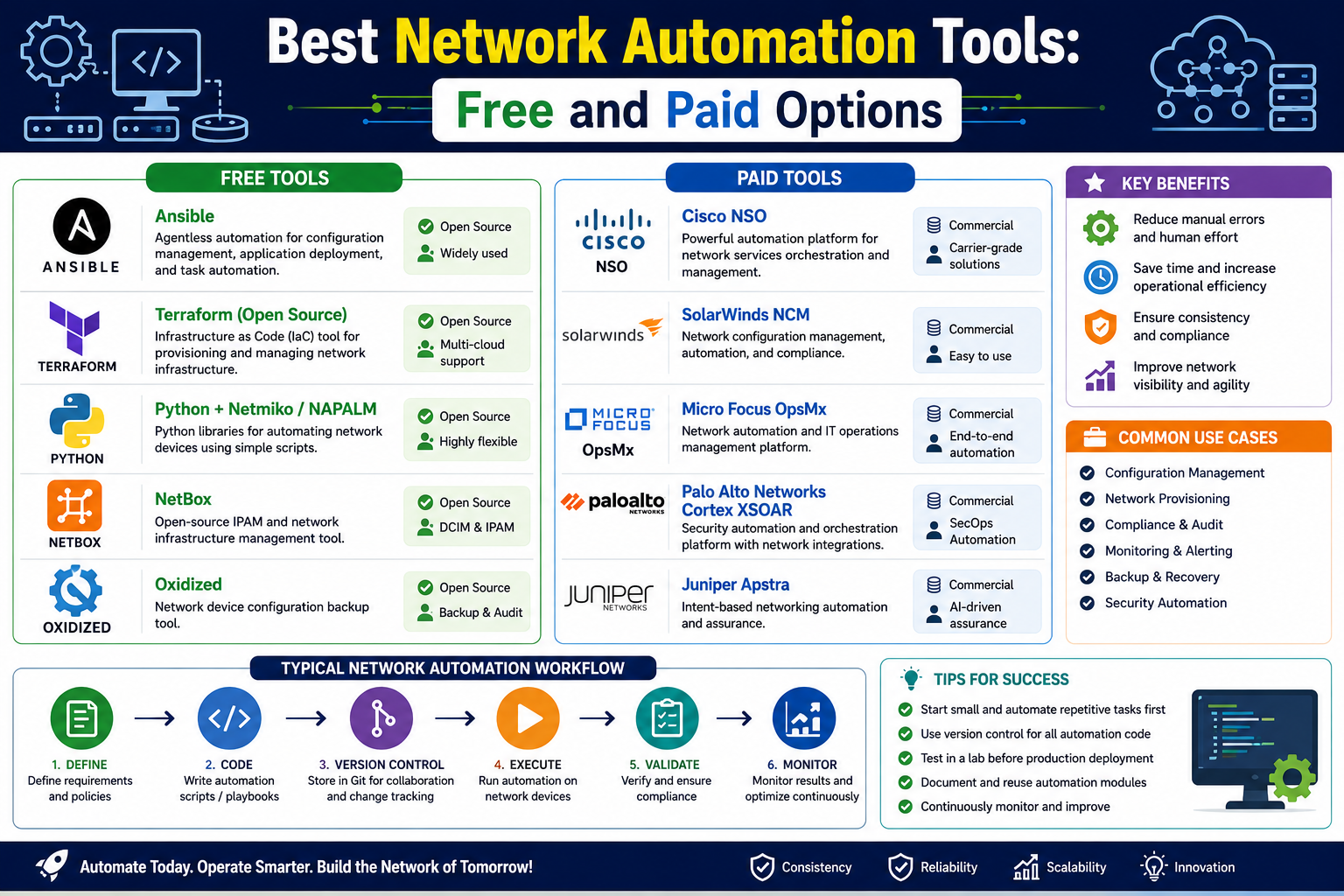
Have you ever found yourself repeating the same command-line tasks across dozens of network devices, wishing there were a faster and more reliable way to get things done? That frustration is exactly what has pushed network automation from a luxury into a necessity. As networks continue to grow in scale and complexity, relying solely on manual configuration is no longer practical. Teams are expected to manage more infrastructure without a proportional increase in staffing, and that gap is where automation becomes essential. By reducing repetitive tasks and minimizing human error, automation allows network professionals to focus on strategic improvements instead of routine maintenance. It transforms how networks are built, maintained, and optimized, bringing efficiency and consistency into daily operations.
Why Automation Is No Longer Optional
In earlier stages of networking, automation was often considered optional, something that could improve workflows but was not required. Today, that perspective has changed dramatically. Modern networks are dynamic, often spanning on-premises environments, cloud platforms, and hybrid infrastructures. Managing such environments manually introduces delays, inconsistencies, and higher risks of misconfiguration. Automation tools solve these problems by enabling repeatable processes that can be executed at scale. They also support faster deployment cycles, making it easier to roll out updates, apply patches, and maintain compliance. Organizations that embrace automation gain a competitive advantage by improving reliability and reducing downtime, which directly impacts business continuity and user experience.
How APIs Changed the Game
One of the biggest enablers of network automation is the widespread adoption of APIs. Network devices are no longer isolated systems that only respond to manual input; they now expose programmable interfaces that allow external tools and scripts to interact with them. APIs make it possible to define configurations in code and apply them across multiple devices simultaneously. This shift has opened the door for a new generation of automation tools that can communicate directly with network infrastructure. Instead of logging into each device individually, engineers can write scripts or use automation platforms to push changes in a consistent and controlled manner. This approach not only saves time but also ensures that configurations are applied uniformly across the entire network.
Understanding the Landscape of Automation Tools
For someone entering the world of network automation, the variety of available tools can feel overwhelming. Each tool serves a different purpose, and the best choice depends on the specific tasks you want to automate. Some tools are designed for configuration management, others for testing and validation, and some focus on API interaction. There are also frameworks that allow you to build custom automation solutions using programming languages. Understanding these categories is crucial because it helps you select the right tool for the job instead of trying to force one solution to fit every scenario. A well-rounded automation strategy often involves combining multiple tools to achieve the desired outcome.
Configuration Management and Its Importance
Configuration management tools are among the most widely used in network automation. Their primary role is to standardize and automate the process of applying configurations to network devices. Instead of manually entering commands on each device, you define the desired configuration in a structured format and let the tool handle the deployment. This approach ensures consistency and reduces the likelihood of errors. It also makes it easier to implement changes across large environments, whether you are updating security policies, modifying routing configurations, or deploying new services. These tools are particularly valuable in environments where maintaining uniform configurations is critical for stability and compliance.
Ansible and Its Simplicity
Ansible has become a favorite among network engineers due to its simplicity and ease of use. It operates without requiring agents on network devices, which simplifies deployment and reduces overhead. Configurations are defined in human-readable files that outline the desired state of the network. This makes it accessible even to those who are new to automation. Ansible’s approach allows teams to automate repetitive tasks quickly and efficiently, reducing the time required for routine operations. Its widespread adoption also means there is a large community contributing resources and best practices, making it easier to find solutions and accelerate learning.
Terraform and Infrastructure as Code
Terraform introduces a different perspective by treating infrastructure as code. Instead of focusing solely on configuration, it allows you to define entire environments, including network components, using code. This declarative approach means you specify the desired end state, and the tool determines how to achieve it. Terraform is particularly useful in environments that combine traditional networking with cloud infrastructure. By integrating with various platforms through APIs, it enables consistent management of resources across different environments. This approach also supports version control, allowing teams to track changes, collaborate effectively, and roll back configurations when necessary.
Nornir for Python-Based Automation
For those who prefer working with programming languages, Nornir offers a flexible framework built on Python. It allows network engineers to create customized automation solutions tailored to their specific needs. Unlike tools that rely on predefined structures, Nornir provides greater control over how tasks are executed. This flexibility makes it ideal for complex scenarios where standard tools may not be sufficient. However, it also requires a solid understanding of Python, which can present a learning curve for beginners. For those willing to invest the time, it opens up powerful possibilities for building advanced automation workflows.
The Role of Testing in Automation
Automation brings efficiency, but it also introduces risks if changes are not properly tested. A single incorrect configuration can impact multiple devices simultaneously, leading to widespread issues. This is why testing and validation tools are an essential part of any automation strategy. They provide a safe environment to experiment with changes before applying them to production systems. By simulating real-world scenarios, these tools help identify potential problems and ensure that automation scripts behave as expected. Incorporating testing into your workflow reduces the likelihood of disruptions and increases confidence in automated processes.
Virtual Labs for Safe Experimentation
Virtual lab environments allow you to build and test network topologies without affecting live systems. These platforms replicate real network behavior, enabling you to validate configurations and automation scripts in a controlled setting. They are especially useful for learning and development, as they provide hands-on experience without the need for physical hardware. By experimenting in a virtual environment, you can refine your automation workflows and address potential issues before deploying them in production. This approach not only improves reliability but also accelerates the learning process.
Container-Based Testing Approaches
Containerization has introduced lightweight options for network testing and simulation. By using container-based environments, you can quickly deploy and manage network scenarios on standard hardware. This approach is efficient and scalable, making it suitable for both individual learners and teams working on complex projects. Container-based tools allow you to replicate network conditions and test automation scripts with minimal resource requirements. They also integrate well with modern development workflows, enabling faster iteration and continuous improvement.
Working with APIs Effectively
APIs are at the core of modern network automation, but working with them requires the right tools and understanding. API testing tools provide a user-friendly interface for sending requests and analyzing responses. They allow you to experiment with different endpoints, validate data formats, and ensure that your automation logic is correct. By using these tools, you can refine your approach before integrating API calls into larger workflows. This step is crucial for building reliable automation solutions that interact seamlessly with network devices.
Postman as a Practical Tool
Postman is widely used for interacting with APIs and testing requests. It provides a visual interface that makes it easy to understand how API calls work and what responses they return. For network engineers, it serves as a testing ground where ideas can be validated quickly. By experimenting with different requests, you can gain a deeper understanding of how network devices expose their functionality through APIs. This knowledge is essential for building effective automation workflows that rely on programmatic interaction.
Alternative API Testing Options
There are other tools available that offer similar capabilities for API testing and integration. Each tool has its own interface and workflow, allowing users to choose the one that best fits their preferences. Exploring different options can help you find a tool that aligns with your working style. Regardless of the choice, the goal remains the same: to simplify the process of interacting with APIs and ensure that automation scripts are accurate and reliable.
Validation Frameworks for Network State
Validation frameworks take automation a step further by enabling you to compare network states before and after changes. These tools use structured data to analyze configurations and verify that they meet expected criteria. By incorporating validation into your automation workflow, you can detect discrepancies and ensure that changes have been applied correctly. This approach enhances reliability and provides an additional layer of assurance, especially in complex environments where manual verification would be time-consuming and error-prone.
Free Tools That Deliver Real Value
When budgets are limited, free automation tools provide a great starting point. They offer powerful capabilities without requiring significant investment, making them accessible to individuals and small teams. These tools allow you to experiment, learn, and build practical solutions without financial constraints. While they may lack some advanced features found in enterprise platforms, they are often more than sufficient for many automation tasks. By leveraging free tools effectively, you can achieve meaningful improvements in efficiency and workflow management.
Enterprise Tools for Large-Scale Operations
As networks grow and become more critical to business operations, enterprise-grade automation tools become increasingly valuable. These platforms offer advanced features such as centralized management, role-based access control, and detailed analytics. They are designed to handle large-scale environments and provide the reliability needed for mission-critical systems. While they come with higher costs, the benefits often justify the investment by improving efficiency, reducing downtime, and enhancing overall network performance.
Balancing Cost and Capability
Choosing between free and paid tools requires careful consideration of your needs and resources. Free tools are ideal for learning and smaller environments, while enterprise solutions are better suited for large organizations with complex requirements. The key is to evaluate the features, scalability, and support offered by each option. By understanding your specific use case, you can select the tools that provide the best balance between cost and capability. This approach ensures that your automation strategy is both effective and sustainable.
Building Skills for Automation Success
Adopting network automation is not just about tools; it also requires developing the right skills. Learning a programming language like Python can significantly enhance your ability to create custom automation solutions. Even a basic understanding of programming concepts can open up new possibilities for improving workflows. By combining programming knowledge with automation tools, you can build solutions that are tailored to your specific environment and challenges. This skill set is becoming increasingly valuable as automation continues to shape the future of networking.
Taking the First Steps
Getting started with network automation does not require a complete overhaul of your workflow. Begin by identifying repetitive tasks that consume time and effort. Automate these tasks using simple scripts or tools, and gradually expand your efforts as you gain confidence. This incremental approach allows you to learn and adapt without overwhelming yourself. Over time, these small improvements can lead to significant gains in efficiency and productivity.
The Evolving Role of Network Engineers
The role of network engineers is evolving as automation becomes more prevalent. Instead of focusing solely on manual configuration, engineers are now expected to design, implement, and manage automated systems. This shift requires a broader skill set that includes programming, API integration, and infrastructure design. While this may seem challenging, it also presents new opportunities for growth and career advancement. By embracing automation, network professionals can stay relevant and contribute more strategically to their organizations.
Conclusion
Network automation is no longer a forward-looking concept reserved for large enterprises; it has become a practical and necessary approach for managing modern network environments of all sizes. As networks continue to expand in complexity, relying on manual processes introduces inefficiencies, inconsistencies, and unnecessary risks. Automation tools, whether free or enterprise-grade, provide a structured and reliable way to handle repetitive tasks, enforce consistency, and improve overall operational performance.
The wide range of available tools ensures that there is something suitable for every stage of the automation journey. From beginner-friendly solutions that simplify configuration management to advanced platforms that integrate with entire infrastructures, each tool plays a role in building a comprehensive automation strategy. The key is not to adopt everything at once, but to understand the problem you are trying to solve and select tools that align with your goals.
Equally important is the development of foundational skills such as basic programming, understanding APIs, and working with structured data. These skills empower you to move beyond simple automation tasks and create solutions that are tailored to your environment. Combined with consistent practice and real-world application, they form the backbone of long-term success in network automation.
Ultimately, the transition to automation is about working smarter rather than harder. By gradually integrating automation into your daily workflow, you can reduce manual effort, minimize errors, and free up time for more strategic initiatives. As the field continues to evolve, those who embrace automation will be better positioned to manage complex systems, adapt to new technologies, and drive meaningful improvements in network operations.