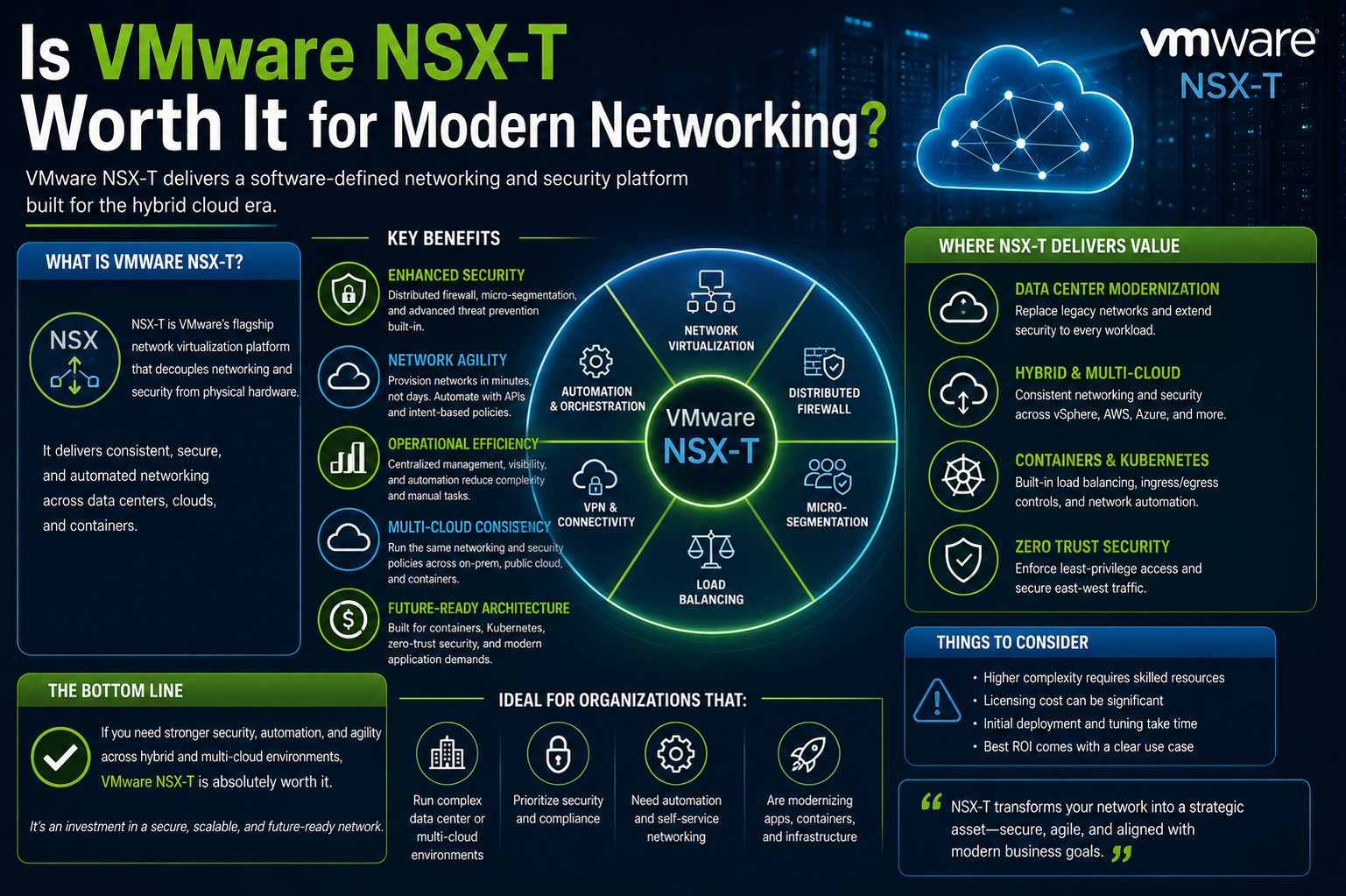
Understanding whether VMware NSX-T is worth the investment begins with simplifying the idea of network virtualization itself. At a surface level, virtualization appears straightforward, but as soon as organizations begin evaluating real-world deployment, scalability, and cost, the discussion becomes more complex. A helpful way to visualize this concept is by comparing physical ownership with flexible access. When a business owns physical infrastructure, it is tied to specific capabilities, limitations, and maintenance overhead. In contrast, virtualization introduces flexibility, allowing organizations to dynamically adapt their network resources based on changing needs. This flexibility becomes a major advantage in modern IT environments where agility and responsiveness are critical.
The Value of Flexibility in Network Virtualization
Flexibility is one of the defining strengths of virtualized networking, and it plays a central role in determining the value of NSX-T. Instead of relying on fixed hardware configurations, organizations can create, modify, and scale networks entirely through software. This enables rapid provisioning of environments, whether for development, testing, or production. Teams are no longer constrained by physical infrastructure limitations, which reduces delays and improves operational efficiency. The ability to deploy complex network topologies within minutes significantly enhances productivity, especially in fast-paced digital environments.
Cost Efficiency and Operational Optimization
Cost considerations are often a deciding factor when evaluating new technologies. NSX-T contributes to cost efficiency not just by reducing the need for physical hardware, but also by optimizing how resources are utilized. Traditional networking requires significant investment in equipment, maintenance, and manual configuration. With NSX-T, much of this overhead is minimized through automation and centralized management. Over time, organizations can achieve substantial savings by reducing downtime, lowering operational complexity, and improving resource allocation.
The Evolution from Traditional Networking to Software-Defined Networking
The shift from traditional networking to software-defined networking represents a fundamental transformation in how IT infrastructure is managed. NSX-T is built on the principles of software-defined networking, where control and data planes are decoupled, enabling centralized control over distributed environments. This approach allows administrators to manage networks programmatically, leading to greater consistency and fewer human errors. As businesses continue to digitize their operations, this level of control becomes increasingly important for maintaining reliability and performance.
What VMware NSX-T Brings to the Table
VMware NSX-T stands out as a comprehensive platform designed to virtualize networking and security across diverse environments. It enables organizations to create fully functional virtual networks that operate independently of the underlying hardware. This independence allows for seamless integration across on-premises data centers, private clouds, and public cloud environments. By abstracting networking functions into software, NSX-T empowers organizations to achieve a level of agility that is difficult to replicate with traditional infrastructure.
Multi-Cloud Capabilities and Centralized Control
One of the most compelling features of NSX-T is its ability to support multi-cloud environments. Modern enterprises often rely on a combination of cloud providers and on-premises systems, which can lead to fragmented network management. NSX-T addresses this challenge by providing a unified platform where all network components can be managed from a single interface. This centralized control simplifies operations and ensures consistent policies across different environments. It also enables better visibility into network performance and security.
Improved Architecture Over Previous Solutions
NSX-T represents a significant advancement over earlier virtualization platforms. Previous solutions were often limited in their ability to scale or integrate across multiple environments. NSX-T was designed from the ground up to overcome these limitations, offering greater flexibility and broader compatibility. Its architecture supports a wide range of deployment scenarios, making it suitable for organizations of all sizes. This evolution reflects the growing demand for solutions that can adapt to increasingly complex IT landscapes.
Enhanced Network Scalability
Scalability is a critical requirement for modern businesses, and NSX-T excels in this area. Organizations can scale their networks up or down based on demand without the need for additional physical infrastructure. This capability is particularly valuable for businesses experiencing rapid growth or fluctuating workloads. By enabling dynamic scaling, NSX-T ensures that resources are used efficiently and that performance remains consistent even during peak demand.
Integrated Security Features
Security is no longer an afterthought in network design, and NSX-T integrates security directly into its architecture. This approach, often referred to as intrinsic security, ensures that protection is built into every layer of the network. Features such as micro-segmentation allow organizations to isolate workloads and prevent unauthorized lateral movement within the network. This significantly reduces the risk of breaches and enhances overall security posture. By embedding security into the network itself, NSX-T eliminates the need for separate security solutions, simplifying management.
Automation and Operational Efficiency
Automation is another key benefit of NSX-T, enabling organizations to streamline network operations. Routine tasks such as configuration, monitoring, and troubleshooting can be automated, reducing the burden on IT teams. This not only improves efficiency but also minimizes the risk of human error. Automation also allows for faster response times when addressing issues, ensuring that networks remain reliable and resilient. Over time, this leads to more consistent performance and improved service delivery.
Support for Modern Applications and Containers
As application architectures evolve, networking solutions must adapt to support new technologies. NSX-T is designed to work seamlessly with modern applications, including those built using microservices and container-based architectures. This compatibility ensures that organizations can adopt new development practices without compromising on network performance or security. By supporting containers and distributed applications, NSX-T positions itself as a future-ready solution for evolving IT environments.
Simplified Network Management
Managing complex networks can be a challenging task, especially in large organizations with multiple environments. NSX-T simplifies this process by providing a centralized management interface that offers comprehensive visibility and control. Administrators can monitor network activity, enforce policies, and troubleshoot issues from a single platform. This streamlined approach reduces complexity and makes it easier to maintain consistent configurations across the entire network.
Training and Expertise Requirements
While NSX-T offers numerous benefits, it is important to recognize that successful implementation requires skilled professionals. Network virtualization introduces new concepts and tools that may be unfamiliar to traditional network administrators. Organizations must invest in training to ensure that their teams have the necessary expertise to manage and optimize the platform. This includes understanding virtualization concepts, security practices, and automation tools. Proper training is essential for maximizing the value of NSX-T.
Certification Pathways and Skill Development
To support skill development, VMware provides a structured certification pathway that covers various levels of expertise. These certifications validate an administrator’s ability to design, deploy, and manage virtualized networks. They also serve as a benchmark for organizations looking to build a capable IT team. By pursuing these certifications, professionals can gain a deeper understanding of NSX-T and its capabilities, ensuring that they are well-equipped to handle complex network environments.
The Role of Structured Learning Programs
Structured learning programs play a crucial role in helping organizations adopt NSX-T effectively. These programs provide hands-on experience and practical knowledge that goes beyond theoretical understanding. By participating in training courses, IT teams can develop the skills needed to implement and manage virtual networks confidently. This investment in education not only improves operational efficiency but also reduces the risk of errors during deployment.
Challenges to Consider Before Adoption
Despite its advantages, NSX-T is not without challenges. Organizations must carefully evaluate their existing infrastructure and determine whether it aligns with the requirements of the platform. Implementation can be complex, especially for businesses with limited experience in virtualization. Additionally, the initial investment in training and setup may be significant. However, these challenges are often outweighed by the long-term benefits of improved efficiency and scalability.
Assessing Organizational Needs
Determining whether NSX-T is worth it ultimately depends on an organization’s specific needs and goals. Businesses with complex networks, multiple environments, or a strong focus on automation are more likely to benefit from its capabilities. On the other hand, smaller organizations with simpler requirements may find that the platform offers more features than they need. A thorough assessment of current and future requirements is essential for making an informed decision.
Long-Term Strategic Advantages
From a strategic perspective, NSX-T offers significant advantages for organizations looking to المستقبل-proof their IT infrastructure. Its ability to support multi-cloud environments, integrate security, and enable automation makes it a valuable asset in a rapidly evolving technological landscape. By adopting NSX-T, businesses can position themselves to adapt to future challenges and opportunities with greater agility.
Performance and Reliability Improvements
Performance and reliability are critical factors in any network environment, and NSX-T delivers on both fronts. By leveraging software-defined networking principles, it ensures consistent performance across distributed environments. Built-in monitoring and analytics tools provide insights into network behavior, allowing administrators to identify and address issues proactively. This results in a more stable and reliable network infrastructure.
The Overall Value Proposition
When evaluating the overall value of NSX-T, it is important to consider both tangible and intangible benefits. While cost savings and efficiency gains are significant, the platform also provides improved flexibility, security, and scalability. These advantages contribute to a more resilient and adaptable IT environment, which is essential for long-term success. Organizations that prioritize innovation and growth are likely to find NSX-T to be a worthwhile investment.
Final Thoughts
VMware NSX-T ultimately proves its value when viewed through the lens of long-term transformation rather than short-term convenience. It is not simply a tool for network virtualization, but a strategic platform that reshapes how organizations design, manage, and secure their infrastructure. Its ability to abstract complex networking functions into software introduces a level of agility that traditional approaches cannot easily match. For businesses operating in dynamic environments where speed, scalability, and adaptability are essential, this shift becomes more than beneficial—it becomes necessary.
At the same time, NSX-T is not a one-size-fits-all solution. Its full potential is realized in environments that demand advanced networking capabilities, multi-cloud integration, and strong security controls. Organizations with simpler infrastructures may find that its extensive feature set exceeds their immediate needs. However, even in such cases, it offers a forward-looking foundation that can support future growth without requiring a complete redesign of the network architecture.
The investment in NSX-T extends beyond technology into people and processes. Proper training, thoughtful implementation, and a clear understanding of organizational goals are critical to unlocking its benefits. Without these elements, even the most powerful platform can fall short of expectations. When approached strategically, however, NSX-T can significantly reduce operational complexity, improve efficiency, and strengthen overall network resilience.
In the broader context of digital transformation, NSX-T aligns with the direction modern IT infrastructure is heading. It supports automation, enhances visibility, and embeds security directly into the network fabric. These capabilities are becoming essential as organizations continue to adopt cloud-native applications and distributed systems. By embracing such a platform, businesses position themselves to respond more effectively to changing demands and technological advancements.
In the end, whether NSX-T is worth it depends on the scale, complexity, and ambition of the organization. For those seeking a robust, future-ready networking solution with deep control and flexibility, it stands out as a compelling choice.