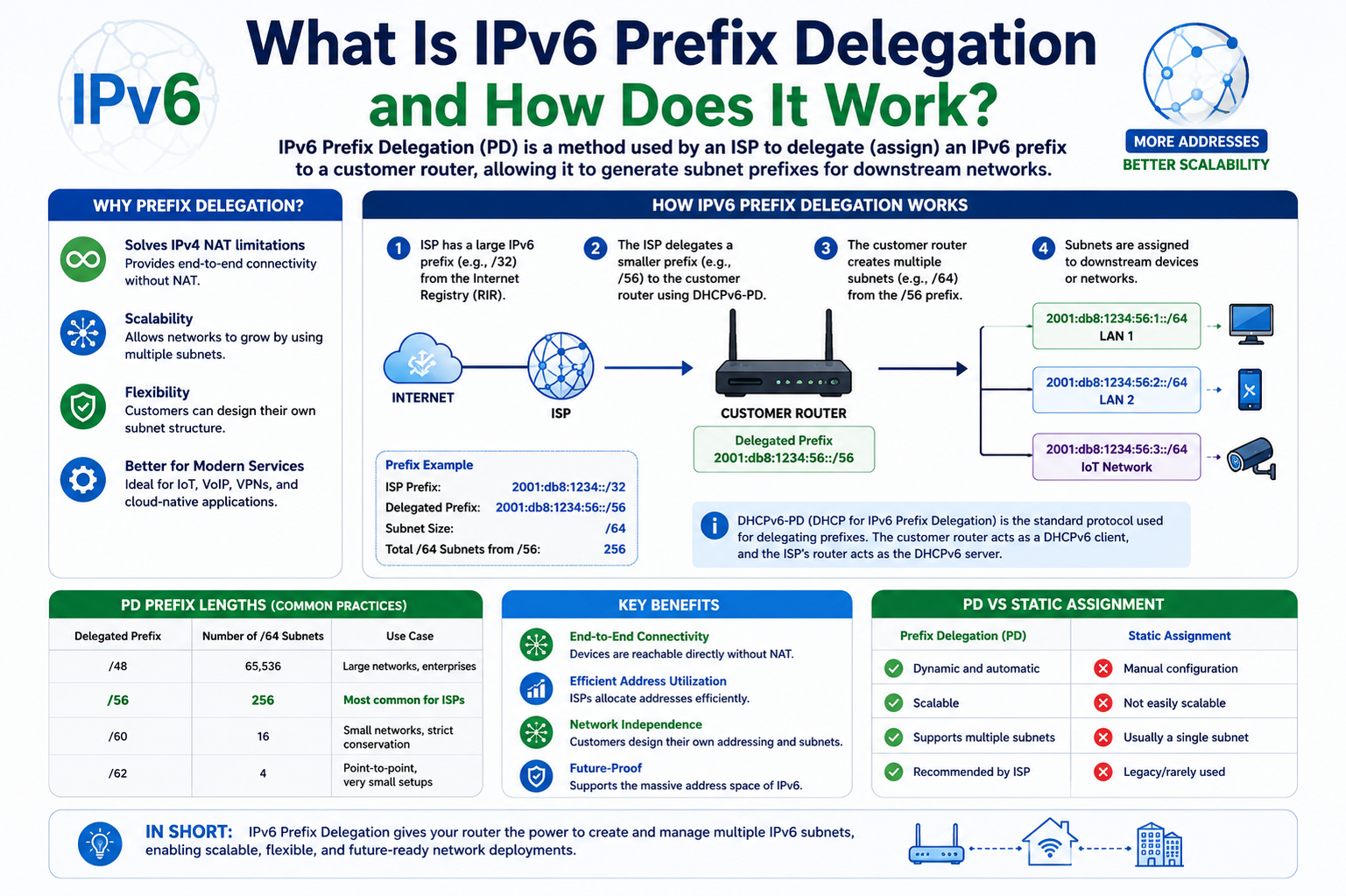
IPv6 Prefix Delegation is a mechanism used in modern networking that allows an Internet Service Provider to assign an entire block of IPv6 addresses to a customer instead of giving only a single IP address. This delegated block is called a prefix, and it can be further divided by the customer into smaller subnets to build and manage their own internal networks. In simple terms, it is a way of handing over control of a chunk of IPv6 address space so the receiving network can organize it independently.
IPv6 Prefix Delegation is commonly implemented using DHCPv6, which is the IPv6 version of the Dynamic Host Configuration Protocol. Instead of only distributing individual addresses, DHCPv6 can also distribute prefixes that represent whole networks. This makes IPv6 highly scalable and flexible for large organizations and home networks that require multiple subnets.
Why IPv6 Prefix Delegation is Used in Modern Networks
IPv6 Prefix Delegation is important because it solves a fundamental requirement in networking: providing scalable address space management. In IPv4, address scarcity forced networks to rely heavily on NAT and complex sharing techniques. IPv6 removes this limitation by providing a massive address space, but it still requires a structured way to allocate that space efficiently.
Service providers use Prefix Delegation to give customers full control over their own addressing plan. Instead of managing every device individually, the provider simply delegates a block, and the customer’s router takes responsibility for distributing addresses inside its network. This reduces operational overhead and improves scalability.
For enterprise environments, this is extremely useful because organizations often need multiple internal subnets for departments, services, security zones, and devices. With Prefix Delegation, they can design their own internal structure without requesting separate IP allocations for each segment.
Understanding IPv6 Address Structure in Prefix Delegation
IPv6 addresses are 128 bits long and are typically divided into two main parts: the network prefix and the interface identifier. In most standard deployments, a /64 prefix is used for a single subnet, leaving the remaining 64 bits for host addresses.
In Prefix Delegation, instead of assigning a single /64 subnet, a provider can assign a larger block such as a /56 or /48. This gives the customer multiple /64 subnets to work with. For example, a /56 delegation allows the customer to create 256 different /64 networks, each usable for different internal segments.
This structure is what makes IPv6 Prefix Delegation powerful. It allows hierarchical network design where the ISP controls large address blocks, and customers control smaller subdivisions within those blocks.
How IPv6 Prefix Delegation Works at a High Level
The process of Prefix Delegation typically involves a client router requesting a prefix from a service provider using DHCPv6. The router acts as a DHCPv6 client and sends a request specifically asking for a delegated prefix rather than just an IP address.
The service provider’s router or DHCPv6 server receives this request and responds by assigning an available prefix from a predefined pool. Once the client router receives this prefix, it stores it and begins using it to configure its internal interfaces and subnet structure.
This interaction may seem simple, but it is a coordinated exchange of messages that ensures the correct allocation and tracking of address space. It also ensures that prefixes are unique and do not overlap between customers.
Role of the Customer Edge Router in Prefix Delegation
The customer edge router plays a central role in IPv6 Prefix Delegation. It is responsible for initiating the request, receiving the delegated prefix, and distributing it internally. This router effectively becomes the boundary between the ISP network and the customer network.
When configured for Prefix Delegation, the customer router sends a DHCPv6 request on its WAN interface. Once it receives a prefix, it does not use it directly for a single device. Instead, it assigns parts of that prefix to its LAN interfaces and downstream networks.
This allows the customer router to behave like a small service provider itself, managing subnets internally without needing additional external IP allocations.
How Service Providers Prepare Prefix Pools
On the service provider side, Prefix Delegation requires a carefully defined pool of IPv6 addresses. This pool represents the total range of prefixes that can be assigned to customers. For example, a provider might have a large /48 or /32 block and divide it into smaller chunks for delegation.
Each chunk is defined in a way that allows consistent distribution. The provider configures a DHCPv6 server or router to know which prefixes are available and how large each delegated block should be. This ensures that each customer receives a unique and non-overlapping prefix.
The size of the delegated block depends on customer needs. Residential users might receive a smaller prefix, while enterprise customers might receive larger allocations.
Concept of Prefix Subdivision in IPv6
One of the key advantages of IPv6 Prefix Delegation is the ability to subdivide a large network into smaller functional networks. When a customer receives a prefix such as a /56, they can divide it into multiple /64 networks.
Each /64 subnet can be used for a different purpose such as internal office networks, guest networks, servers, or IoT devices. This structured subdivision improves organization, security, and routing efficiency.
Because IPv6 has such a large address space, this subdivision does not create exhaustion problems like in IPv4. Instead, it encourages clean and logical network design.
DHCPv6 Process Behind Prefix Delegation
Prefix Delegation is implemented using a sequence of DHCPv6 messages. The process begins when the client router sends a solicitation message requesting configuration information. This request includes an option specifically asking for a delegated prefix.
The server responds with an advertisement indicating available services. The client then formally requests a prefix, and the server assigns one from its pool. Finally, the server confirms the allocation, and the client stores the delegated prefix.
Once this process is complete, the client router can begin using the prefix for internal configuration. This exchange ensures that both the provider and client are synchronized regarding address usage.
Service Provider Configuration Concept
On the provider side, configuration involves defining a prefix pool and enabling DHCPv6 Prefix Delegation on the interface connected to customers. The provider must specify which address ranges are available and how they should be divided.
The router also needs to associate the DHCPv6 service with the correct interface so that incoming requests from customers are properly handled. Once configured, the provider system automatically responds to delegation requests and tracks assigned prefixes.
The provider may also configure lifetime settings for delegated prefixes, ensuring that assignments remain valid for a defined duration or indefinitely depending on policy.
Client Router Configuration Concept
On the customer side, the router must be configured to act as a DHCPv6 client for Prefix Delegation. The WAN interface is set to request a delegated prefix, and the router is instructed to automatically configure itself based on the received information.
Once the prefix is received, the router stores it using a label or identifier. This label helps associate the delegated prefix with internal interfaces. The router then uses this information to assign subnets to its LAN segments.
This automation eliminates the need for manual IP assignment and ensures consistent addressing across the internal network.
Internal Use of Delegated Prefixes
After receiving a prefix, the customer router applies it to internal interfaces. Each interface can be assigned a portion of the delegated block, typically a /64 subnet.
The router uses the delegated prefix as a base and appends additional bits to create unique subnets. This allows multiple internal networks to exist under a single delegated allocation.
For example, one interface might use one subnet, while another interface uses a different subnet derived from the same prefix. This flexibility is one of the strongest features of IPv6 Prefix Delegation.
Verification and Network Behavior in Prefix Delegation
Once Prefix Delegation is configured, network administrators can verify the assigned prefixes using routing and DHCPv6 status commands. The system will display the delegated block and confirm that it is active.
Internal interfaces will show IPv6 addresses derived from the delegated prefix. Routing tables will also reflect the presence of these networks, ensuring proper communication within the customer environment and beyond.
This verification step confirms that the delegation process is functioning correctly and that the network is correctly utilizing the assigned IPv6 space.
Conclusion
IPv6 Prefix Delegation is a foundational mechanism that enables scalable and organized distribution of IPv6 address space across modern networks. Instead of limiting users to a single IP address, it empowers service providers to assign entire blocks of addresses, allowing customers to design and manage their own internal subnet structures efficiently.
This approach significantly improves network flexibility, especially for enterprises that require multiple segmented networks for security, performance, and organizational needs. By leveraging DHCPv6-based delegation, both providers and clients benefit from automation, reduced manual configuration, and better utilization of the vast IPv6 address space.
Ultimately, IPv6 Prefix Delegation is not just a technical feature—it is a practical solution for building structured, scalable, and future-ready networks in an Internet environment that increasingly depends on IPv6.