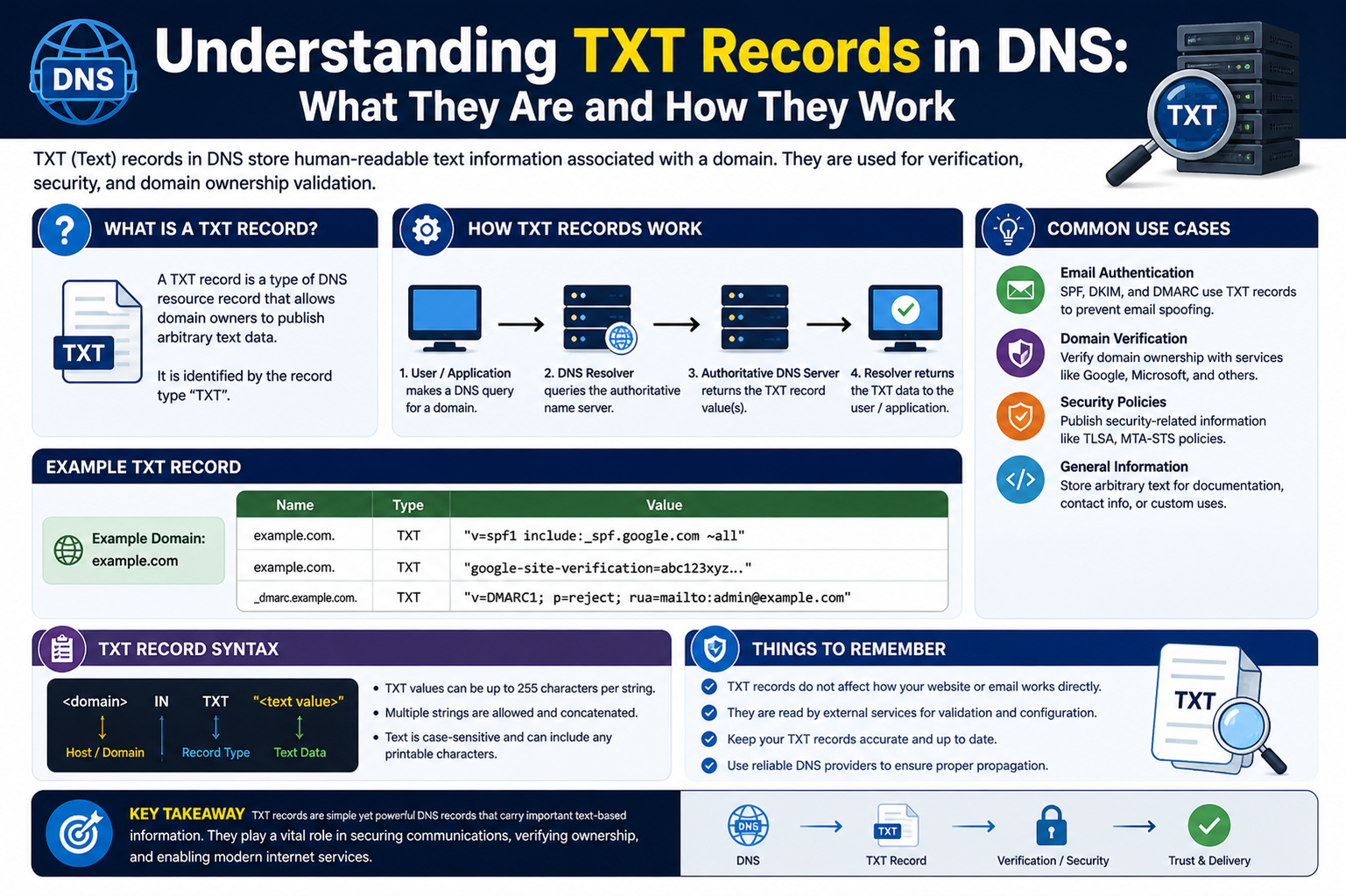
A DNS TXT record is a type of entry stored within the Domain Name System that allows domain owners to associate arbitrary text information with their domain. Unlike many other DNS records that directly guide internet traffic, a TXT record is primarily used to store descriptive or verification-based data. This data is often used by external services to confirm identity, improve security, or validate ownership of a domain.
At its core, DNS functions like a global directory that translates human-readable domain names into machine-readable IP addresses. While most DNS records are responsible for directing traffic, TXT records act more like informational notes attached to a domain, providing additional instructions or authentication details that can be read by servers and security systems.
These records are especially important in modern internet communication because they support verification systems that help prevent fraud, spoofing, and unauthorized access. Even though they do not directly influence where a user is sent on the internet, they play a critical role behind the scenes in maintaining trust and security.
How DNS TXT Records Work in the Background of the Internet
When a system queries a domain, it does not only look for an IP address. It can also request supplementary DNS information, including TXT records. These records are returned as plain text strings, which can then be interpreted by services such as email providers, security systems, or verification tools.
The DNS infrastructure itself is distributed and hierarchical. If a local resolver does not know the answer to a query, it forwards the request to other DNS servers until the correct information is found. TXT records are part of this same lookup process, meaning they are globally accessible and can be retrieved by authorized systems anywhere in the network.
Unlike structured DNS entries such as address mapping records, TXT records are flexible in format. This flexibility allows domain administrators to define custom strings, which are often used for validation purposes. Because of this versatility, TXT records have become a foundation for several modern internet security mechanisms.
Why DNS TXT Records Are Important for Internet Security
TXT records are not just optional additions to DNS—they are widely used for securing online communication. One of their primary roles is to help verify that a domain is legitimately associated with a service or organization. This is especially important in preventing impersonation attacks and fraudulent communications.
For example, when an email is sent, receiving servers often check TXT records to confirm whether the sender is authorized. If the information in the TXT record matches expected security policies, the email is treated as legitimate. If it does not match, the message may be flagged as suspicious or rejected entirely.
This verification layer helps reduce phishing attempts and email spoofing, which are common tactics used by attackers. By relying on DNS TXT records, organizations can strengthen trust in their digital communications without requiring complex user-side actions.
How TXT Records Support Domain Ownership Verification
One of the most common uses of TXT records is domain ownership verification. Many external services require proof that a user actually controls a domain before granting access to advanced features or integrations.
Instead of uploading files or modifying server code, users are often asked to add a specific TXT record to their DNS settings. Once the record is added, the service checks the DNS system to confirm the presence of the correct value. If it matches, ownership is verified.
This method is widely used because it is simple, secure, and does not require direct access to web server infrastructure. It also works universally across hosting environments, making it a flexible solution for validation.
The Role of TXT Records in Email Authentication Systems
Email security heavily relies on DNS TXT records to validate senders and protect recipients. These records support multiple authentication frameworks that work together to ensure email integrity.
One major function is verifying whether an email actually originates from an authorized server. This prevents attackers from sending messages that appear to come from trusted domains. TXT records store rules that help receiving servers determine whether a message should be trusted or rejected.
These authentication systems are widely adopted because email remains one of the most common attack vectors on the internet. By using TXT records as part of verification, organizations reduce the risk of unauthorized email activity significantly.
Understanding Sender Authorization Through TXT-Based Policies
TXT records are often used to define which servers are allowed to send emails on behalf of a domain. These rules are read by receiving mail systems, which compare the sending server against the authorized list stored in DNS.
If the sending server is included in the allowed list, the message is considered valid. If it is not included, the message may be flagged or blocked. This process helps ensure that only trusted systems can send emails using a specific domain identity.
This method adds an additional layer of trust to email communication, making it harder for attackers to impersonate legitimate organizations.
Structure and Format of TXT Records in DNS Systems
TXT records are stored as plain text strings, but they often follow structured formatting rules depending on their use case. While DNS itself does not enforce strict formatting for TXT values, external systems interpret the data based on predefined patterns.
For example, email authentication systems expect specific keywords and parameters in a defined order. These may include version identifiers, authorized sources, and policy instructions. If the format is incorrect, the system may ignore the record entirely.
Because of this, precision is extremely important when configuring TXT records. Even small formatting errors can lead to authentication failures or misinterpretation by external services.
How TXT Records Are Created and Stored in DNS Settings
Creating a TXT record typically involves accessing a domain’s DNS management interface through a hosting environment or domain control system. Within this interface, users can add a new record by selecting the TXT type and entering the required details.
Each record generally includes a name, a value, and a time-to-live setting. The name identifies the domain or subdomain, while the value contains the actual text data used for verification or configuration. The time-to-live determines how long the record is cached before being refreshed.
Once saved, the record becomes part of the global DNS system. However, changes are not instant, as they must propagate across multiple DNS servers worldwide before becoming fully active.
Propagation and Delay in TXT Record Updates
When a TXT record is created or modified, it does not immediately appear everywhere on the internet. Instead, DNS servers gradually update their cached information based on the configured time-to-live value.
This process is known as propagation. During this period, some systems may see the updated record while others may still see the previous version. The duration of this process depends on caching behavior and network distribution.
Because of this delay, administrators often wait before testing or relying on newly updated TXT records. Understanding propagation is important for troubleshooting and ensuring that configurations work as expected.
Common Use Cases of DNS TXT Records Beyond Email
Although email authentication is one of the most common uses, TXT records serve several other purposes as well. They can be used for domain verification by third-party platforms, security configuration, and service integration.
Some systems use TXT records to confirm that a domain is linked to a specific service account. Others use them to store policy information or configuration data that can be read programmatically.
This flexibility makes TXT records one of the most versatile components of DNS infrastructure. They act as a bridge between domain ownership and external service validation.
Limitations and Considerations When Using TXT Records
Despite their usefulness, TXT records do have limitations. One major constraint is size. Some DNS systems impose limits on how much text a single record can contain. When large configurations are required, multiple TXT records may be necessary.
Another consideration is accuracy. Since TXT records are often used for security, even a small error can disrupt authentication processes. Careful attention to formatting and syntax is essential.
Additionally, because DNS data is publicly accessible, sensitive information should never be stored in TXT records. They are intended for verification and configuration, not for confidential data storage.
Importance of Accuracy in DNS TXT Record Configuration
Proper configuration of TXT records is critical because many automated systems rely on them for decision-making. Email delivery, domain verification, and security checks can all fail if records are incorrect or incomplete.
Attention to detail ensures that systems interpreting these records receive the correct instructions. This includes verifying spelling, structure, and placement within DNS settings.
Accurate configuration helps maintain uninterrupted communication between services and ensures that authentication mechanisms function properly across different platforms.
Foundation for Advanced DNS-Based Security Systems
TXT records form the foundation of several advanced DNS-based security frameworks. These frameworks rely on consistent and accurate DNS data to verify identities and enforce communication policies.
By combining TXT records with other DNS mechanisms, organizations can build layered security systems that reduce the risk of impersonation and unauthorized access.
This makes TXT records a key component in modern internet security architecture, even though they are often invisible to end users.
SPF Records and Their Role in DNS TXT Configuration
Sender Policy Framework, commonly known as SPF, is one of the most widely used applications of DNS TXT records. It is designed to define which mail servers are authorized to send email on behalf of a domain. This helps receiving email systems determine whether a message is legitimate or potentially forged.
SPF works by storing a structured policy inside a TXT record that lists trusted sending sources. When an email is received, the recipient’s mail server checks the SPF record in DNS and compares it against the IP address that sent the message. If the sender is listed in the record, the email passes the check. If not, it may be rejected or flagged as suspicious.
This mechanism significantly reduces email spoofing, where attackers attempt to send messages pretending to be a trusted domain. Because SPF records are stored in DNS, they are publicly accessible and can be validated by any email security system worldwide.
How SPF Information Is Structured Inside TXT Records
SPF data is stored as a specially formatted string within a TXT record. This string follows a predictable structure that email servers can interpret consistently. It typically begins with a version identifier that tells the system the record is using SPF formatting.
After the version identifier, the record includes a list of authorized IP addresses or domains. These represent servers that are permitted to send emails for the domain. Additional rules can also be included to define external services that are allowed to send mail on behalf of the domain.
The final part of an SPF record usually defines what should happen if a sender does not match any authorized sources. This policy can either allow, reject, or flag the message depending on the configuration chosen by the domain administrator.
DKIM and Its Function Within DNS TXT Records
DomainKeys Identified Mail, known as DKIM, is another critical email authentication method that uses DNS TXT records. Unlike SPF, which validates sending servers, DKIM focuses on verifying the integrity and authenticity of the email content itself.
DKIM works by attaching a digital signature to outgoing emails. This signature is generated using cryptographic methods and is stored in DNS as a public key inside a TXT record. When an email is received, the recipient system retrieves this public key from DNS and uses it to verify the signature in the email header.
If the signature matches, it confirms that the email has not been altered during transmission and that it was sent from an authorized source. This adds an additional layer of trust beyond simple sender verification.
Structure of DKIM Data in TXT Records
DKIM records contain several key components that allow email systems to perform authentication checks. These include version information, encryption algorithms, domain identifiers, and selector values that help locate the correct key in DNS.
Each DKIM record is associated with a specific selector, which acts as a reference point for retrieving the correct public key. This allows organizations to use multiple keys for different services or departments while maintaining centralized control.
The actual cryptographic key stored in the TXT record is typically a long encoded string. This key is used by receiving mail servers to validate the digital signature included in the email header, ensuring both authenticity and message integrity.
DMARC as an Extension of SPF and DKIM in DNS TXT Records
Domain-based Message Authentication, Reporting, and Conformance, commonly referred to as DMARC, builds on both SPF and DKIM to provide a complete email security policy framework. It is also implemented using DNS TXT records.
DMARC allows domain owners to define what should happen when an email fails SPF or DKIM checks. This makes it possible to enforce strict policies that protect against unauthorized email usage while also providing reporting capabilities.
By combining SPF and DKIM validation results, DMARC helps organizations gain visibility into how their domain is being used across the internet. It also allows them to instruct receiving servers to quarantine or reject suspicious emails.
How DMARC Policies Are Represented in TXT Records
DMARC records are stored in DNS as structured text entries that define authentication rules and reporting instructions. These records typically specify policy actions such as monitoring, quarantine, or rejection based on authentication results.
They also include email addresses where reports about authentication failures are sent. These reports provide valuable insight into potential abuse or misconfiguration involving the domain.
Because DMARC depends on SPF and DKIM, it acts as a final decision layer. It evaluates whether emails pass authentication checks and determines how strictly they should be handled based on the domain’s configured policy.
How Multiple TXT Records Can Coexist for a Single Domain
A single domain can have multiple TXT records at the same time, each serving a different purpose. For example, one record may be used for SPF configuration, another for DKIM verification, and another for domain ownership validation.
These records are stored independently within DNS, meaning they do not interfere with each other as long as they are correctly formatted. Each service or system reading DNS data will look for the specific TXT record relevant to its function.
This flexibility allows a domain to support multiple authentication and verification systems simultaneously without conflicts or overlap in functionality.
Common Formatting Rules and Mistakes in TXT Records
Correct formatting is essential when working with TXT records because even small errors can lead to authentication failures. One of the most common mistakes is missing or incorrect syntax, which can prevent systems from reading the record properly.
Another frequent issue involves incorrect spacing or malformed strings. Since many authentication systems rely on exact patterns, any deviation from expected formatting can cause validation errors.
Typos in domain names, IP addresses, or policy instructions can also lead to major configuration issues. Because DNS changes are widely distributed, correcting these mistakes may take time to fully propagate across all systems.
Propagation Behavior of TXT Record Changes
When a TXT record is created or updated, the changes do not take effect instantly across the entire internet. Instead, DNS servers update their cached data gradually based on configured time limits.
This delay is known as propagation, and it can vary depending on network caching rules and server configurations. During this time, different users or systems may see different versions of the same record.
Because of this behavior, administrators must often wait before verifying changes. Testing too early can lead to confusion if some servers have not yet received the updated information.
Tools Used to Verify TXT Record Configuration
There are several tools available that allow administrators to check whether TXT records are properly configured. These tools query DNS servers directly and display the current values stored for a domain.
By using these tools, administrators can confirm whether records have propagated correctly and whether the formatting is valid. This helps identify issues early before they affect email delivery or authentication systems.
These verification methods are essential for ensuring that DNS-based security configurations are working as intended across all environments.
Troubleshooting Common TXT Record Issues
When problems arise with TXT records, the first step is usually to verify syntax and formatting. Missing characters, incorrect values, or misplaced text are among the most common causes of failure.
Another important factor is propagation delay. If a record was recently changed, it may not yet be visible to all systems. Waiting for full propagation often resolves inconsistencies.
In more complex cases, administrators may need to review DNS settings through their hosting interface or consult diagnostic tools to identify deeper configuration issues.
Security Importance of DNS-Based Email Authentication
DNS TXT records play a major role in protecting email communication from malicious activity. By combining SPF, DKIM, and DMARC, organizations can build a layered defense system that verifies both sender identity and message integrity.
This reduces the risk of phishing attacks, spoofed emails, and unauthorized use of domain names. It also helps maintain trust between organizations and their users by ensuring that communications are authentic.
Because these systems rely on DNS, they are globally distributed and difficult for attackers to manipulate without access to domain-level control.
Role of TXT Records in Modern Internet Infrastructure
Beyond email security, TXT records have become an essential part of modern internet infrastructure. They are widely used for verification, integration with cloud services, and system authentication processes.
Many platforms rely on DNS TXT records to confirm domain ownership before allowing configuration changes or service activation. This ensures that only authorized users can manage domain-related services.
As internet systems continue to evolve, TXT records remain a flexible and widely supported mechanism for storing verification and configuration data.
Beyond Email: Additional Uses of DNS TXT Records
DNS TXT records are widely recognized for their role in email authentication, but their usefulness extends far beyond that. Many modern online services rely on TXT records as a simple and reliable method to verify domain ownership, configure integrations, and exchange lightweight configuration data between systems.
One of the most common non-email uses is domain verification for third-party platforms. When a service needs to confirm that a user actually controls a domain, it often asks the user to add a specific TXT record. Once the record is added, the service checks DNS to confirm its presence. If the expected value is found, ownership is verified.
This approach is popular because it does not require direct changes to website files or server code. Instead, everything is handled at the DNS level, making it compatible with virtually any hosting environment.
How TXT Records Enable Service Integration and Verification
Many cloud-based platforms and online tools rely on DNS TXT records to establish trust between systems. When a domain is connected to a service, the provider often generates a unique verification string that must be placed in DNS.
Once the TXT record is published, the external system queries DNS to confirm the match. This confirms that the domain owner has authorized the connection. After verification, the service can safely enable features such as analytics, content delivery, or API access.
This method is widely used because it is both secure and decentralized. It does not require sharing sensitive credentials, and it allows verification to happen automatically through DNS lookups.
Role of TXT Records in Domain-Based Security Policies
TXT records are often used to define security-related policies that guide how external systems should interact with a domain. These policies may include rules for email handling, authentication requirements, or reporting instructions.
Because TXT records are publicly accessible, they serve as a transparent way for domains to communicate security expectations. External systems can read these policies and adjust their behavior accordingly.
This makes TXT records a foundational component in modern trust-based internet systems, where automated verification is essential for safe communication between services.
Understanding DNS TXT Record Flexibility and Structure
One of the key advantages of TXT records is their flexibility. Unlike other DNS record types that have strict formats, TXT records allow free-form text entries. This means they can store a wide variety of information depending on the needs of the system using them.
However, even though they are flexible, many applications impose their own formatting rules. These rules ensure that the data can be correctly interpreted by machines. For example, authentication systems expect structured key-value pairs or predefined syntax patterns.
This combination of flexibility and structure makes TXT records suitable for both simple verification tasks and more complex security configurations.
How TXT Records Store Verification Tokens
Many online services use TXT records to store verification tokens. These tokens are unique strings generated by a service to confirm domain ownership. Once added to DNS, they act as proof that the domain is controlled by the person or organization performing the setup.
When the service queries DNS and finds the correct token, it completes the verification process. This mechanism is widely used for setting up integrations with cloud platforms, analytics tools, and security services.
Because these tokens are stored in DNS, they can be validated globally without requiring direct communication with the domain server itself.
TXT Records and Their Role in Cloud-Based Systems
Cloud platforms frequently depend on TXT records to connect domains with services. Whether it is enabling content delivery, configuring security settings, or linking external APIs, TXT records often serve as the verification layer.
This is because DNS is universally accessible and does not depend on specific infrastructure. Any system connected to the internet can query DNS records, making it an ideal method for cross-platform verification.
As cloud ecosystems continue to expand, the use of TXT records for configuration and authentication has become increasingly important.
How Multiple TXT Records Work Together for a Single Domain
A domain can contain multiple TXT records simultaneously, each serving a different function. One record may be used for email authentication, another for service verification, and another for security policy definition.
These records coexist without conflict because each one is treated independently by DNS. Systems querying DNS typically look for specific values or patterns relevant to their purpose.
This allows a single domain to support multiple services and security configurations at the same time without interference between records.
Challenges of Managing Multiple TXT Records
While multiple TXT records offer flexibility, they can also create management challenges. As more services are connected to a domain, the number of required records increases, making it harder to keep track of configurations.
Administrators must ensure that each record is correctly maintained and does not conflict with others. Misconfiguration can lead to authentication failures or service disruptions.
Proper organization and documentation of DNS settings are important to avoid confusion, especially in environments where multiple systems rely on the same domain.
Importance of Correct Syntax in TXT Record Entries
Correct syntax is essential when configuring TXT records because many systems depend on exact formatting. Even a small mistake can prevent a record from being recognized correctly.
Common issues include missing characters, incorrect separators, or misplaced values. Since DNS is case-sensitive in many implementations, consistency in formatting is also important.
When errors occur, they can disrupt authentication processes or prevent services from verifying domain ownership, which may temporarily block access to important features.
Propagation Behavior and Global DNS Distribution
Once a TXT record is updated, the changes must propagate across DNS servers around the world. This process ensures that all systems eventually receive the updated information.
Propagation time depends on caching settings and network configurations. During this period, some users may see updated records while others still see older versions.
This delay is a normal part of DNS behavior and is important for maintaining stability across the global internet infrastructure.
How Caching Affects TXT Record Visibility
DNS caching plays a major role in how quickly TXT record changes become visible. When a system queries DNS, it stores the result for a certain period of time to reduce repeated lookups.
During this caching period, even if a TXT record is updated, some systems may continue using the older cached version until it expires. This is why changes may not appear immediately everywhere.
Understanding caching behavior is important when troubleshooting DNS-related issues, especially after making recent updates.
Tools for Checking TXT Record Accuracy
There are several tools available that allow administrators to check whether TXT records are correctly configured. These tools query DNS servers directly and display the current values associated with a domain.
By using these tools, it is possible to confirm whether changes have propagated and whether records match expected values. This helps identify issues such as formatting errors or missing entries.
These diagnostic tools are widely used in network administration to ensure DNS configurations are functioning correctly.
Common Mistakes in DNS TXT Record Setup
One of the most common mistakes in TXT record configuration is incorrect formatting. Since many systems rely on strict syntax, even minor errors can prevent proper recognition.
Another frequent issue is adding unnecessary spaces or incorrect characters, which can break the expected structure of the record. Misconfigured values can also lead to authentication failures or service rejection.
Careful attention to detail is required when creating or editing TXT records to avoid these issues.
Security Considerations When Using TXT Records
Although TXT records are useful for verification and authentication, they must be used carefully from a security perspective. Since DNS data is publicly accessible, sensitive information should never be stored in TXT records.
Instead, TXT records should only contain verification data, policies, or non-sensitive configuration strings. This ensures that security is maintained while still enabling system integration.
Proper use of TXT records helps strengthen overall domain security without exposing confidential information.
Role of TXT Records in Modern Internet Ecosystems
TXT records have become an essential part of modern internet systems due to their flexibility and compatibility. They support a wide range of use cases, from email security to cloud service integration and domain verification.
As digital ecosystems become more interconnected, the need for reliable and universal verification methods continues to grow. TXT records fulfill this need by providing a simple yet powerful mechanism for storing and retrieving verification data.
Their widespread adoption across platforms demonstrates their importance in maintaining trust and security on the internet.
Best Practices for Managing DNS TXT Records Effectively
Managing DNS TXT records properly is essential for maintaining stable authentication systems and ensuring smooth communication between services. One of the most important practices is maintaining consistency in formatting. Since many systems rely on exact string matching, even small variations can lead to failed verification or misinterpretation of records.
Another key practice is documentation. Keeping a clear record of what each TXT entry is used for helps avoid confusion when multiple services are connected to the same domain. As environments grow more complex, this documentation becomes essential for long-term management and troubleshooting.
Regular review of existing TXT records is also important. Over time, some records may become outdated as services change or are replaced. Removing unnecessary entries helps reduce clutter and minimizes the risk of conflicts or security issues.
Importance of Regular DNS Auditing for TXT Records
DNS auditing is the process of reviewing all DNS configurations to ensure they are accurate, secure, and up to date. TXT records should always be included in these audits because they often control critical authentication and verification systems.
During an audit, administrators check whether each record is still required and whether it aligns with current service configurations. Outdated or incorrect entries can lead to authentication failures or unexpected behavior in connected services.
Auditing also helps identify potential security risks. For example, unused or forgotten TXT records could be exploited if they reference outdated services or weak configurations.
How TXT Records Impact Email Deliverability
TXT records play a major role in determining whether emails are successfully delivered or marked as spam. Email providers use authentication data stored in TXT records to evaluate the legitimacy of incoming messages.
If the records are properly configured, emails are more likely to reach inboxes without being flagged. However, incorrect or missing TXT records can cause emails to fail authentication checks, resulting in rejection or spam classification.
This makes TXT record accuracy critical for organizations that rely heavily on email communication. Proper configuration directly influences trust and deliverability rates.
Troubleshooting Advanced TXT Record Issues
When basic troubleshooting steps do not resolve TXT record issues, more advanced diagnostics may be required. One approach involves checking DNS resolution at different levels to identify where inconsistencies occur.
Another method is comparing DNS responses across multiple servers to determine whether propagation is complete. This helps identify whether the issue is local caching or a configuration error.
In some cases, conflicts between multiple TXT records can also cause problems. Reviewing all existing entries and ensuring they align with expected formats can help resolve such issues.
Understanding TXT Record Limits and Constraints
Although TXT records are flexible, they are subject to certain technical limitations. One of the most common constraints is character length. DNS systems often impose limits on how much data can be stored in a single TXT entry.
When longer configurations are needed, multiple TXT records may be used instead of a single large one. This ensures compatibility while still allowing sufficient data storage.
Another limitation involves compatibility with external systems. Some services expect specific formatting rules, and deviations from these expectations can result in failed validation.
Security Benefits of DNS-Based Verification Systems
DNS TXT records provide a strong foundation for secure verification systems because they rely on globally distributed infrastructure. This makes them difficult to tamper with without direct control of the domain.
By using TXT records for authentication, organizations reduce reliance on centralized credentials and instead use distributed validation methods. This improves resilience and reduces the risk of certain types of attacks.
These systems also support transparency, since verification data is publicly accessible and can be independently validated by any authorized system.
How TXT Records Support Multi-Service Environments
Modern digital environments often rely on multiple interconnected services, and TXT records help enable smooth integration between them. Each service can use a unique TXT entry for verification or configuration without interfering with others.
This allows a single domain to support email systems, cloud platforms, analytics tools, and security services simultaneously. Each system reads only the records relevant to its function.
This modular approach makes TXT records highly scalable and suitable for complex digital infrastructures.
Role of TXT Records in Automation and System Integration
TXT records are frequently used in automated system setups where services need to verify domain ownership or configuration without manual intervention. Automation tools query DNS directly to confirm required values.
This enables faster deployment of services and reduces the need for human verification steps. Once a TXT record is added, systems can automatically detect it and complete configuration processes.
This level of automation is especially important in cloud environments where services are frequently created, updated, or removed.
Common Misconfigurations and Their Effects
Misconfiguration of TXT records can lead to a wide range of issues, from email delivery failures to broken service integrations. One common issue is incorrect formatting, which prevents systems from reading the record properly.
Another issue is incomplete configuration, where required values are missing or partially entered. This can result in authentication failures or rejected connections.
Conflicts between multiple TXT records can also cause unexpected behavior, especially when different services require similar but incompatible configurations.
Impact of DNS Propagation Delays on TXT Records
DNS propagation delays can affect how quickly changes to TXT records become visible across the internet. During this period, some systems may still use outdated information while others access updated values.
This inconsistency can temporarily affect authentication systems or service integrations. Understanding propagation timing helps administrators avoid unnecessary troubleshooting during update periods.
Waiting for full propagation is often necessary before confirming that changes have been successfully applied.
Importance of Secure DNS Management Practices
Secure management of DNS TXT records is essential for protecting domain integrity. Since these records often control authentication systems, unauthorized changes can have serious consequences.
Access to DNS settings should be restricted to authorized personnel only. Strong authentication mechanisms should also be used to prevent unauthorized modifications.
Regular monitoring of DNS changes helps detect suspicious activity early and ensures that records remain consistent with expected configurations.
Future Role of TXT Records in Internet Infrastructure
As internet systems continue to evolve, TXT records are expected to remain an important part of DNS infrastructure. Their flexibility allows them to adapt to new authentication methods and integration requirements.
They are likely to continue supporting emerging technologies that rely on decentralized verification and secure communication between systems.
Their simplicity and compatibility ensure that they will remain a reliable tool for configuration and validation in future digital environments.
Final Conclusion
DNS TXT records are a versatile and essential component of the Domain Name System. They support a wide range of functions, including email authentication, domain verification, service integration, and security policy definition.
Their ability to store flexible text-based data makes them suitable for both simple and complex use cases. While they do not directly control internet traffic, they play a critical behind-the-scenes role in maintaining trust, security, and system connectivity across the internet.
Proper configuration, regular maintenance, and secure management of TXT records ensure that they continue to function effectively as part of modern digital infrastructure.