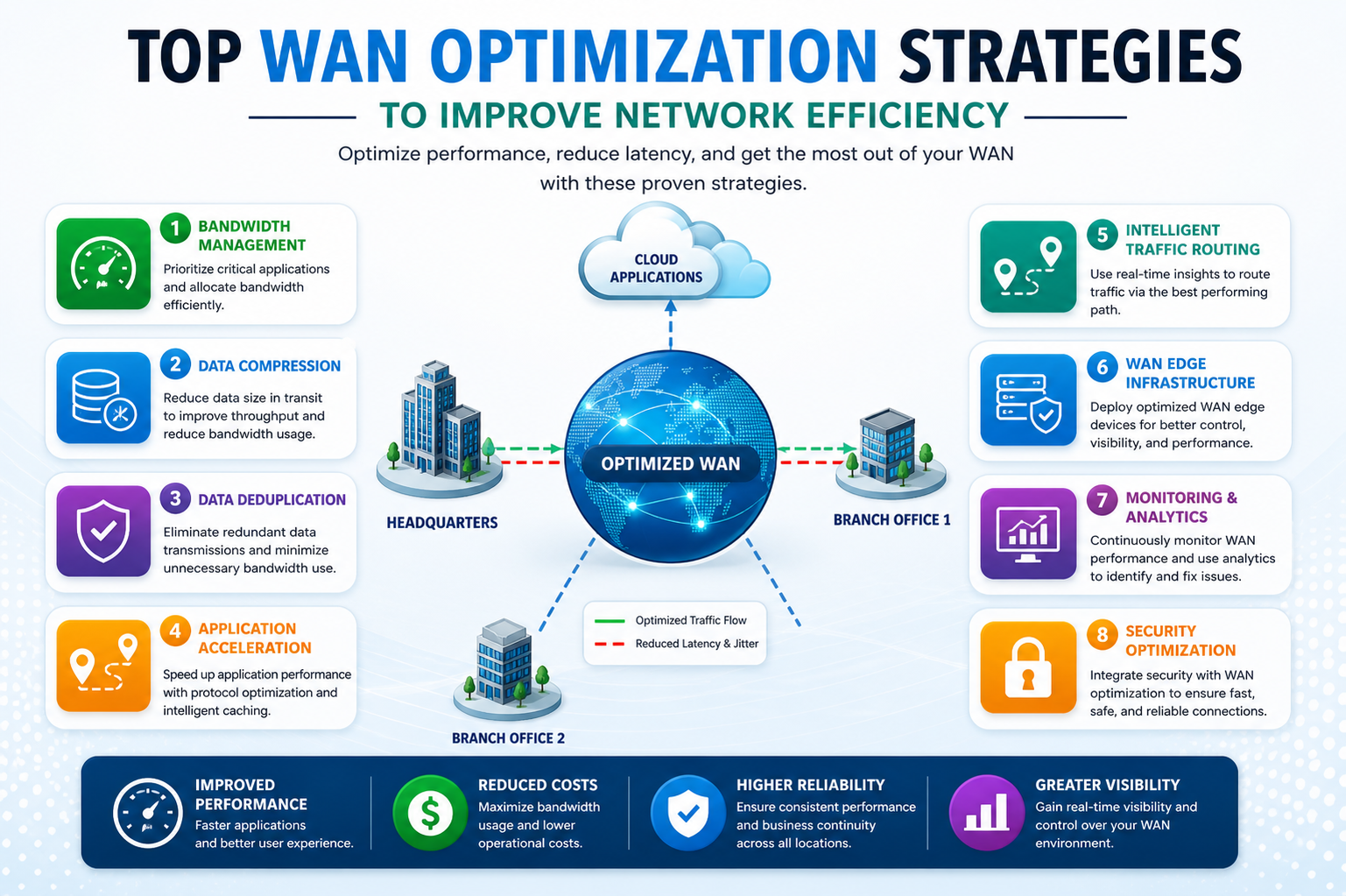
WAN optimization refers to a collection of intelligent methods designed to improve the efficiency and performance of data transfer across wide-area networks. Instead of relying on expensive upgrades like increasing bandwidth or replacing physical infrastructure, it focuses on making existing network resources work more effectively. The core idea is to reduce delays, minimize data redundancy, and ensure smoother communication between geographically separated systems.
In modern digital environments, businesses depend heavily on continuous connectivity between branch offices, data centers, and cloud platforms. However, long-distance data transmission naturally introduces latency, packet loss, and congestion. WAN optimization addresses these challenges by refining how data travels rather than changing the network itself. It ensures that users experience faster access to applications and data, even when systems are located far apart.
This approach has become increasingly important as organizations adopt cloud computing, remote work environments, and globally distributed systems. Without optimization, performance issues can lead to slow application response times, reduced productivity, and inefficient use of network resources. WAN optimization provides a practical solution to bridge the gap between growing data demands and limited network capacity.
Core Objective of WAN Optimization in Network Performance
The main goal of WAN optimization is to enhance data transfer efficiency while reducing latency and improving bandwidth utilization. It achieves this by applying intelligent techniques that streamline communication across the network. Instead of sending unnecessary or duplicate data repeatedly, optimization ensures that only essential information is transmitted.
Another important objective is to reduce the number of round trips required for data communication. In traditional WAN environments, each request and response between systems may involve multiple confirmations, which slows down overall performance. WAN optimization techniques aim to reduce this overhead, allowing data to move more quickly and efficiently.
It also focuses on improving user experience by making applications more responsive. Whether it is accessing cloud storage, downloading files, or running enterprise applications, optimized WAN performance ensures that users feel minimal delay regardless of their physical location. This becomes especially critical for businesses with multiple branch offices or remote employees who rely on centralized systems.
Key Challenges in Wide Area Network Communication
Before understanding optimization techniques, it is important to recognize the challenges that exist in WAN environments. One of the most significant issues is latency, which occurs due to the physical distance data must travel between locations. Even at high speeds, long-distance transmission introduces delays that affect application performance.
Another challenge is bandwidth limitation. Unlike local networks, WAN connections often have restricted capacity, making it difficult to handle large volumes of data efficiently. When multiple users or applications compete for the same bandwidth, congestion can occur, leading to slower performance and potential packet loss.
Packet loss is another common issue in WAN communication. When data packets are dropped during transmission, they must be resent, which increases delay and reduces efficiency. This problem becomes more noticeable in unstable or heavily loaded networks.
Additionally, redundant data transmission further burdens the network. Many systems repeatedly send identical information across the WAN, wasting valuable bandwidth. These challenges highlight the need for optimization techniques that can reduce inefficiencies and improve overall performance.
Fundamental Approach Behind WAN Optimization Techniques
WAN optimization is not based on a single method but rather a combination of techniques working together. These methods are designed to target different aspects of network inefficiency, such as data redundancy, transmission delays, and error handling. By combining multiple strategies, organizations can significantly improve network performance.
One of the key principles is reducing the amount of data that needs to be transmitted. This is achieved through techniques like deduplication and compression, which eliminate unnecessary repetition and shrink data size before transmission. Another principle is improving transmission reliability, which ensures that data reaches its destination without requiring excessive retransmissions.
Optimization also focuses on intelligent data handling, where frequently used information is stored closer to the user or reused from previous transfers. This reduces the need to repeatedly fetch the same data from distant servers. Overall, the approach is about making WAN communication smarter rather than simply faster.
Role of TCP Optimization in Improving Data Flow
TCP optimization plays a crucial role in enhancing WAN performance because Transmission Control Protocol is widely used for reliable data communication. TCP ensures that data packets are delivered accurately by requiring acknowledgments for received data. While this guarantees reliability, it also introduces delays due to constant back-and-forth communication.
WAN optimization improves TCP performance by reducing unnecessary overhead. One important technique is TCP window scaling, which increases the amount of data that can be sent before waiting for acknowledgment. This reduces the number of interruptions in data flow and improves throughput across long distances.
Another method is selective acknowledgment, which allows the receiver to inform the sender about only the missing packets instead of retransmitting entire data segments. This reduces redundant retransmissions and improves efficiency, especially in networks where occasional packet loss occurs.
By fine-tuning these mechanisms, TCP optimization ensures smoother and faster communication across WAN links, making applications more responsive and reducing delays caused by protocol overhead.
Understanding Data Deduplication in WAN Efficiency
Data deduplication is a powerful technique used to eliminate redundant data during transmission. In many network environments, the same data is often sent multiple times to different users or locations. Instead of repeatedly transmitting identical information, deduplication ensures that only one copy is sent and reused whenever needed.
This technique is especially useful in environments with multiple branch offices where employees frequently access the same files and applications. Local caching systems store previously transmitted data so that when the same request is made again, the data can be delivered locally instead of being fetched from the central server.
Deduplication reduces bandwidth consumption significantly and improves transfer speeds. It also reduces the load on central servers, allowing them to handle more important tasks instead of repeatedly sending identical data. This makes it an essential part of WAN optimization strategies.
Compression Techniques for Reducing Data Size
Compression is another widely used WAN optimization technique that focuses on reducing the size of data before transmission. By encoding data more efficiently, compression minimizes the amount of bandwidth required to send information across the network.
When data is compressed, it becomes smaller and faster to transmit. Once it reaches its destination, it is decompressed back into its original form. This process happens quickly and transparently, ensuring that users do not experience delays in accessing information.
Compression is particularly effective for large files and data-heavy applications. It helps improve transfer speeds while reducing network congestion. When combined with deduplication, compression can significantly enhance overall WAN performance by minimizing unnecessary data transmission.
Importance of Caching in WAN Optimization
Caching is a technique that stores frequently accessed data closer to the user to reduce retrieval time and network load. Instead of repeatedly fetching data from a central server located far away, cached copies are stored at strategic locations within the network.
This method is commonly used in content delivery systems where users across different regions access the same digital content. By placing cached versions of data closer to users, response times are significantly improved, and network traffic is reduced.
Caching not only enhances speed but also improves reliability. In cases where the main server becomes unavailable, cached data can still be accessed, ensuring continuity of service. This makes caching an essential part of modern WAN optimization strategies.
Forward Error Correction and Its Role in Reliability
Forward Error Correction is a technique designed to improve data reliability by sending additional redundant information along with the original data packets. If some packets are lost during transmission, the receiving system can reconstruct the missing information without requesting retransmission.
This reduces delays caused by packet loss and improves overall efficiency in unstable network conditions. However, it also introduces additional data overhead since extra information must be transmitted continuously.
Despite this trade-off, Forward Error Correction is valuable in environments where retransmissions would cause significant delays. It ensures smoother data flow and enhances the reliability of WAN communication.
Strategic Importance of Combining WAN Optimization Techniques
WAN optimization becomes most effective when multiple techniques are used together rather than individually. Each method addresses a specific challenge, such as latency, redundancy, or packet loss. When combined, they create a comprehensive system that significantly enhances network performance.
For example, compression reduces data size, while caching reduces repeated data requests. At the same time, TCP optimization ensures smoother transmission, and deduplication eliminates unnecessary repetition. Together, these methods create a balanced and efficient WAN environment.
Organizations must carefully evaluate their network structure, application requirements, and user distribution to determine the right combination of optimization techniques. This strategic approach ensures maximum performance improvement without unnecessary complexity.
Advanced Role of TCP Optimization in WAN Performance
TCP optimization becomes even more critical when dealing with high-latency WAN environments where data must travel long distances. In such cases, the standard behavior of TCP can significantly slow down communication because of its strict acknowledgment and retransmission mechanisms. Every packet sent requires confirmation before the next set of data can be fully processed, which creates delays in high-latency links.
To overcome this limitation, WAN optimization introduces smarter handling of TCP sessions. One key improvement is TCP acceleration, where the communication between sender and receiver is split into multiple optimized segments. Instead of relying on a single end-to-end connection, optimized systems manage localized TCP sessions that reduce delay and improve throughput.
Another enhancement involves window size tuning, where the system dynamically adjusts how much data can be sent before waiting for acknowledgment. In traditional setups, small window sizes limit performance, especially over long distances. By increasing the window size intelligently, more data can flow continuously, reducing idle time in the transmission process.
These improvements allow applications such as file transfers, database synchronization, and cloud-based services to perform much more efficiently across WAN links. Without TCP optimization, these applications would experience noticeable lag and reduced responsiveness, especially when multiple users are accessing them simultaneously.
Deep Dive into Data Deduplication Efficiency Mechanisms
Data deduplication operates by identifying repeated patterns in transmitted data and ensuring that only unique information is sent across the network. In enterprise environments, this is particularly useful because many users often access the same files, documents, or application resources repeatedly.
At a technical level, deduplication systems break data into smaller segments and assign unique identifiers to each segment. When a new transmission request occurs, the system checks whether the data segment already exists in its cache. If it does, instead of retransmitting the entire data block, only a reference pointer is sent, which dramatically reduces bandwidth consumption.
This method is especially powerful in scenarios involving backups, software distribution, and shared file access across branch offices. Over time, as more data is reused, the efficiency gains become even more significant because fewer new transmissions are required.
Deduplication also reduces strain on centralized storage systems. Instead of repeatedly serving identical data requests, the system can respond using local cached references. This not only improves speed but also extends the lifespan of network infrastructure by reducing unnecessary load.
Advanced Compression Techniques and Real-Time Processing
Compression in WAN optimization is not just about reducing file size but also about doing it in real time without affecting application performance. Modern compression algorithms are designed to balance speed and efficiency so that data can be compressed and decompressed almost instantly during transmission.
Different types of data respond differently to compression. Text-based data, such as documents and logs, typically compress very well, resulting in significant size reduction. On the other hand, already compressed formats like videos or images may not benefit as much. WAN optimization systems are intelligent enough to detect data types and apply compression only when it is beneficial.
Real-time compression is particularly useful for applications like email systems, enterprise messaging platforms, and cloud-based file sharing. By reducing the amount of data traveling across the WAN, it improves both speed and network stability.
Another important aspect is adaptive compression, where the system continuously monitors network conditions and adjusts compression levels accordingly. If bandwidth becomes constrained, higher compression ratios are applied to maintain performance. If the network is stable, lower compression may be used to reduce processing overhead.
Caching Strategies for Distributed Network Environments
Caching plays a central role in improving WAN efficiency by reducing repeated data retrieval from central servers. In distributed environments, users often access the same applications, files, and web resources. Without caching, every request would need to travel across the WAN, creating unnecessary delays.
Edge caching is one of the most effective approaches, where data is stored closer to the end users at strategic network locations. This ensures that frequently accessed content is delivered quickly without needing to reach the origin server every time.
Another form is application-level caching, where specific application data is stored temporarily for faster retrieval. This is commonly used in enterprise systems where database queries or application responses are repeated frequently.
Caching also improves resilience. If the main server becomes temporarily unavailable, cached data can still be served, ensuring uninterrupted access to critical resources. This makes caching not only a performance optimization technique but also a reliability enhancement strategy.
Forward Error Correction in High-Latency Networks
Forward Error Correction is particularly useful in environments where packet loss is common or where retransmissions would cause significant delays. Instead of waiting for lost packets to be resent, additional redundant information is transmitted along with the original data.
This redundancy allows the receiving system to reconstruct missing packets without requesting retransmission. As a result, data flows more smoothly even in unstable or high-latency network conditions.
In WAN environments, this is especially valuable for real-time applications such as voice communication, video conferencing, and live data streaming. These applications cannot afford delays caused by retransmission requests, so Forward Error Correction ensures continuity of data flow.
However, it is important to balance redundancy with efficiency. Sending too much additional data can increase bandwidth usage unnecessarily. Therefore, WAN optimization systems carefully calculate the optimal level of redundancy based on network conditions.
Strategic Decision Factors in WAN Optimization Implementation
Implementing WAN optimization requires careful planning because not all environments benefit from the same techniques. One of the most important considerations is network architecture. Centralized organizations with multiple branch offices often benefit more from deduplication and caching, while cloud-heavy environments may prioritize latency reduction techniques.
Application type is another critical factor. Real-time applications such as video conferencing require low latency and minimal packet loss, making TCP optimization and error correction essential. On the other hand, file-heavy environments benefit more from compression and deduplication strategies.
Network traffic patterns also play a major role. If users frequently access the same data repeatedly, caching becomes highly effective. If data is highly unique and constantly changing, compression and TCP tuning may provide better results.
Finally, scalability must be considered. As organizations grow, their WAN optimization strategy must be able to adapt without requiring major infrastructure changes. This ensures long-term efficiency and cost-effectiveness.
Enterprise Network Design and Its Impact on WAN Optimization
Enterprise network design plays a major role in how effectively WAN optimization techniques can be applied. The structure of a network determines how data flows between branches, data centers, and cloud environments, which directly influences latency, bandwidth usage, and overall performance. In centralized architectures, where most data and applications reside in a primary data center, WAN traffic is often heavy and repetitive. This makes optimization techniques like deduplication and caching especially valuable because many users access the same centralized resources.
In contrast, decentralized or cloud-first architectures distribute applications and services across multiple locations. In these environments, WAN optimization must focus more on reducing latency and improving application responsiveness rather than simply minimizing duplicate data. Each architectural model requires a different optimization approach, and understanding this distinction is essential for achieving efficient network performance.
Hybrid network models, which combine on-premises infrastructure with cloud services, present additional complexity. Data flows between local servers, cloud platforms, and remote users must be carefully managed to avoid bottlenecks. WAN optimization in such environments often relies on adaptive techniques that dynamically adjust based on traffic patterns and application demands.
Traffic Management Techniques in WAN Optimization Systems
Traffic management is a core element of WAN optimization that ensures data flows efficiently across the network without congestion or delay. One of the primary methods used is traffic prioritization, where critical business applications are given higher priority over less important traffic. This ensures that essential services such as ERP systems, video conferencing tools, or financial applications receive sufficient bandwidth even during peak usage.
Another important technique is bandwidth allocation, which involves dividing available network capacity among different types of traffic. By assigning specific limits or guarantees, organizations can prevent any single application from consuming excessive resources and degrading overall performance.
Traffic shaping is also widely used in WAN optimization. This method controls the rate at which data is transmitted, smoothing out bursts of traffic that could otherwise overwhelm network links. By regulating data flow, traffic shaping helps maintain consistent performance across the WAN.
Together, these techniques ensure that network resources are used efficiently and that critical applications remain stable and responsive even under heavy load conditions.
Application Acceleration in WAN Environments
Application acceleration is a specialized aspect of WAN optimization focused on improving the performance of specific business applications. Many enterprise applications are not originally designed for high-latency environments, which can result in slow response times when accessed over WAN links.
To address this, WAN optimization systems modify how application data is transmitted and processed. One approach is protocol optimization, where inefficient application protocols are replaced or enhanced to reduce communication overhead. This minimizes the number of round trips required between client and server.
Another method is data prefetching, where frequently requested data is proactively loaded and stored closer to the user. This reduces wait times when users request that data, improving the overall responsiveness of applications.
Session persistence is also important in application acceleration. By maintaining continuous sessions between users and applications, optimization systems reduce the need for repeated authentication and connection setup, which can significantly improve performance.
These techniques are especially valuable for cloud-based applications, virtual desktop environments, and enterprise software systems that rely heavily on constant communication between users and centralized servers.
Role of WAN Optimization in Cloud Computing Environments
Cloud computing has significantly changed how organizations use WAN infrastructure. Instead of relying solely on on-premises data centers, businesses now distribute workloads across multiple cloud platforms. This shift increases the importance of WAN optimization because data must travel between users and cloud services over public or hybrid networks.
One of the key challenges in cloud environments is variability in latency. Since cloud resources may be hosted in different geographic regions, the distance between users and servers can vary widely. WAN optimization helps reduce this impact by routing traffic more efficiently and caching frequently used data closer to users.
Another important aspect is multi-cloud communication, where applications interact with services from different cloud providers. Without optimization, this can lead to inefficient routing and increased latency. WAN optimization systems streamline these interactions by creating more direct and efficient data paths.
Security also plays a role in cloud WAN optimization. Since data often travels over public networks, encryption and secure tunneling are commonly integrated into optimization solutions. This ensures that performance improvements do not compromise data security.
Latency Reduction Strategies in Global Networks
Latency is one of the most significant challenges in WAN communication, especially in global networks where data must travel across continents. WAN optimization addresses this issue using several techniques designed to reduce delays and improve responsiveness.
One approach is route optimization, where data is directed through the most efficient network path rather than the default routing structure. This minimizes the number of hops between source and destination, reducing transmission time.
Another strategy is data localization, where frequently accessed data is stored closer to users in different geographic regions. This reduces the need for long-distance communication and significantly improves response times.
Session optimization also contributes to latency reduction by minimizing the number of connection setups required for repeated communication between systems. By maintaining persistent sessions, the network avoids unnecessary delays caused by repeated handshakes.
These strategies are especially important for multinational organizations that rely on consistent performance across different regions.
Bandwidth Efficiency and Resource Utilization
Efficient bandwidth usage is a central goal of WAN optimization. Since WAN links are often expensive and limited in capacity, maximizing their utilization is essential for maintaining performance without increasing costs.
One method of improving bandwidth efficiency is data filtering, where unnecessary or low-priority traffic is eliminated before it enters the WAN. This ensures that only relevant data consumes network resources.
Another method is intelligent packet aggregation, where multiple small data packets are combined into larger ones before transmission. This reduces protocol overhead and improves overall throughput.
Load balancing also plays a role in bandwidth efficiency by distributing traffic evenly across multiple WAN links. This prevents congestion on a single connection and ensures that all available resources are used effectively.
Together, these techniques help organizations make the most of their existing network infrastructure without requiring costly upgrades.
Reliability Enhancements in WAN Optimization Systems
Reliability is a critical factor in WAN performance because network disruptions can significantly impact business operations. WAN optimization improves reliability through several mechanisms designed to ensure consistent data delivery.
One such mechanism is failover routing, where traffic is automatically redirected to alternative paths if the primary route becomes unavailable. This ensures continuous connectivity even during network failures.
Another important feature is packet recovery, where lost or corrupted data packets are reconstructed using redundant information. This reduces the need for retransmissions and improves overall stability.
Error detection systems also play a key role by identifying issues in data transmission early and triggering corrective actions before they impact users. These systems continuously monitor network conditions to maintain optimal performance.
By combining these methods, WAN optimization ensures that networks remain stable and resilient even under challenging conditions.
Impact of WAN Optimization on Business Productivity
WAN optimization has a direct impact on business productivity by improving the speed and reliability of networked applications. When employees experience faster access to data and applications, they can complete tasks more efficiently and with fewer delays.
In distributed organizations, improved WAN performance reduces downtime and enhances collaboration between teams located in different regions. This leads to smoother workflows and better communication across departments.
It also supports digital transformation initiatives by enabling organizations to adopt cloud-based tools and remote work models without sacrificing performance. As more businesses move toward digital operations, WAN optimization becomes a critical enabler of productivity and growth.
Additionally, reduced network congestion and improved resource utilization help organizations lower operational costs while maintaining high performance levels.
Security Considerations in WAN Optimization Environments
Security is an essential component of WAN optimization because data is constantly moving across distributed networks, often through public or semi-trusted infrastructure. While performance improvement is the primary goal, it cannot come at the cost of exposing sensitive information or weakening network defenses. As a result, modern WAN optimization solutions integrate security mechanisms alongside performance enhancements to maintain a balanced approach.
One of the primary security concerns in WAN environments is data interception during transmission. Since WAN traffic often travels long distances, it may pass through multiple network nodes where interception risks exist. To address this, encryption is commonly applied to protect data in transit. Even when optimization techniques such as compression or deduplication are used, encrypted tunnels ensure that unauthorized parties cannot access or modify the data.
Another important aspect is secure traffic segmentation. By separating different types of traffic into isolated channels, organizations can reduce the risk of cross-application interference or unauthorized access. This is especially useful in enterprise environments where multiple departments or services share the same WAN infrastructure.
Authentication and access control also play a critical role. WAN optimization systems often integrate identity verification processes to ensure that only authorized users and devices can access network resources. This helps prevent malicious activity and strengthens overall network integrity.
Additionally, secure WAN optimization solutions must ensure that performance improvements do not interfere with compliance requirements. Many industries require strict adherence to data protection regulations, and optimization techniques must be implemented in a way that preserves auditability and data integrity.
WAN Optimization in Remote Work and Distributed Workforce Models
The rise of remote work and distributed teams has significantly increased the importance of WAN optimization. Employees now access corporate applications, files, and communication tools from various geographic locations, often using different types of internet connections. This creates variability in network performance that must be managed effectively.
WAN optimization helps ensure consistent user experience regardless of location. By reducing latency and improving data delivery efficiency, employees can access centralized systems with minimal delay. This is particularly important for cloud-based collaboration tools, virtual desktops, and enterprise resource planning systems.
One key benefit in remote environments is reduced dependency on raw bandwidth. Instead of requiring high-speed connections for every user, optimization techniques allow systems to function efficiently even on moderate internet connections. This makes remote work more accessible and scalable.
Caching also plays an important role in remote work scenarios. Frequently accessed files and application data can be stored closer to remote users, reducing repeated downloads and improving responsiveness. This ensures that employees working from different regions still experience fast access to essential resources.
Overall, WAN optimization enables organizations to maintain productivity and collaboration standards across distributed workforces without requiring extensive infrastructure upgrades for every location.
Role of WAN Optimization in Virtualization and Cloud Workloads
Virtualization and cloud computing have transformed how computing resources are deployed and managed. However, they also increase reliance on WAN connectivity, especially when virtual machines, storage systems, and applications are distributed across different locations.
WAN optimization plays a crucial role in ensuring that virtualized environments operate smoothly. One of the main challenges in virtualization is the constant exchange of data between virtual machines and centralized storage systems. Without optimization, this can lead to significant latency and reduced performance.
Data deduplication is particularly effective in virtual environments because many virtual machines share similar operating system files and application components. By eliminating redundant data transfers, WAN optimization significantly reduces bandwidth usage.
Another important factor is storage replication. Many organizations replicate virtual machine data across multiple data centers for redundancy and disaster recovery. WAN optimization ensures that this replication process is efficient by compressing and optimizing data transfers between locations.
Cloud workloads also benefit from WAN optimization through improved API communication and faster synchronization between distributed services. This ensures that cloud-native applications remain responsive even when operating across multiple regions.
Performance Monitoring and Analytics in WAN Optimization Systems
Effective WAN optimization is not a one-time setup but an ongoing process that requires continuous monitoring and analysis. Performance monitoring tools are used to track network behavior, identify bottlenecks, and measure the effectiveness of optimization techniques.
One of the key metrics monitored is latency, which indicates the time it takes for data to travel between two points. By analyzing latency trends, organizations can identify problematic network paths and adjust routing strategies accordingly.
Bandwidth utilization is another critical metric. Monitoring how much bandwidth is being consumed helps identify inefficiencies such as unnecessary data transfers or poorly optimized applications. This allows administrators to fine-tune optimization settings for better performance.
Packet loss and retransmission rates are also closely tracked. High levels of packet loss may indicate network instability, which can negatively impact application performance. WAN optimization systems use this data to adjust error correction and retransmission strategies dynamically.
Advanced analytics tools provide deeper insights by identifying usage patterns and predicting future network demands. This helps organizations proactively adjust their WAN optimization strategies before performance issues arise.
Scalability Challenges in WAN Optimization Deployments
As organizations grow, their network requirements become more complex, making scalability a key consideration in WAN optimization. A solution that works well for a small network may not be sufficient for a global enterprise with hundreds of branch offices and cloud services.
One of the main scalability challenges is maintaining consistent performance across all locations. As the number of users and applications increases, WAN optimization systems must handle higher traffic volumes without introducing bottlenecks.
Another challenge is managing distributed optimization appliances or virtual instances. In large networks, optimization functions may be deployed at multiple points, requiring centralized management and coordination to ensure consistency.
Cloud integration also introduces scalability concerns. As organizations expand their use of cloud services, WAN optimization systems must adapt to dynamic workloads that change frequently and unpredictably.
To address these challenges, modern solutions often use centralized control systems that manage distributed optimization resources. This allows organizations to scale efficiently without losing visibility or control over network performance.
Cost Efficiency and Return on Investment in WAN Optimization
One of the key motivations for implementing WAN optimization is cost efficiency. Increasing bandwidth alone can be expensive, especially for organizations with global operations. WAN optimization provides an alternative by maximizing the efficiency of existing infrastructure.
By reducing bandwidth consumption through techniques like compression and deduplication, organizations can delay or avoid costly bandwidth upgrades. This results in significant long-term savings.
Improved application performance also contributes to productivity gains. When employees can access systems faster and with fewer delays, operational efficiency increases, which indirectly improves financial performance.
However, it is important to consider the initial investment required for WAN optimization solutions. This may include hardware, software, licensing, and training costs. Organizations must evaluate whether the long-term benefits justify these upfront expenses.
In many cases, the return on investment becomes evident over time as network efficiency improves and operational costs decrease.
Future Trends in WAN Optimization Technologies
WAN optimization continues to evolve as network environments become more complex and data-driven. One of the major trends shaping the future is the integration of artificial intelligence and machine learning. These technologies enable optimization systems to automatically analyze network patterns and make real-time adjustments without human intervention.
Another emerging trend is deeper integration with cloud-native architectures. As more organizations adopt cloud-first strategies, WAN optimization tools are being designed to work seamlessly with distributed cloud environments and microservices.
Edge computing is also influencing WAN optimization. By processing data closer to its source, edge computing reduces the need for long-distance data transmission, complementing traditional optimization techniques.
Additionally, software-defined networking is playing a growing role in making WAN optimization more flexible and programmable. This allows organizations to dynamically adjust network behavior based on real-time requirements.
These trends indicate that WAN optimization will continue to become more intelligent, automated, and deeply integrated into modern digital infrastructures.
Conclusion
WAN optimization is a comprehensive approach to improving the efficiency, reliability, and performance of wide-area networks without requiring major infrastructure upgrades. By using techniques such as TCP optimization, data deduplication, compression, caching, and forward error correction, organizations can significantly enhance data transmission across long distances.
Its importance has grown with the rise of cloud computing, remote work, virtualization, and globally distributed systems. These environments demand high performance and low latency, which traditional WAN configurations often struggle to provide.
While implementation involves challenges such as cost, complexity, and ongoing management, the benefits in terms of speed, efficiency, productivity, and cost savings are substantial. WAN optimization not only improves technical performance but also supports business growth by enabling faster communication and better user experiences across global networks.
As technology continues to evolve, WAN optimization will remain a critical component of modern networking strategies, adapting to new architectures and increasingly complex digital demands.