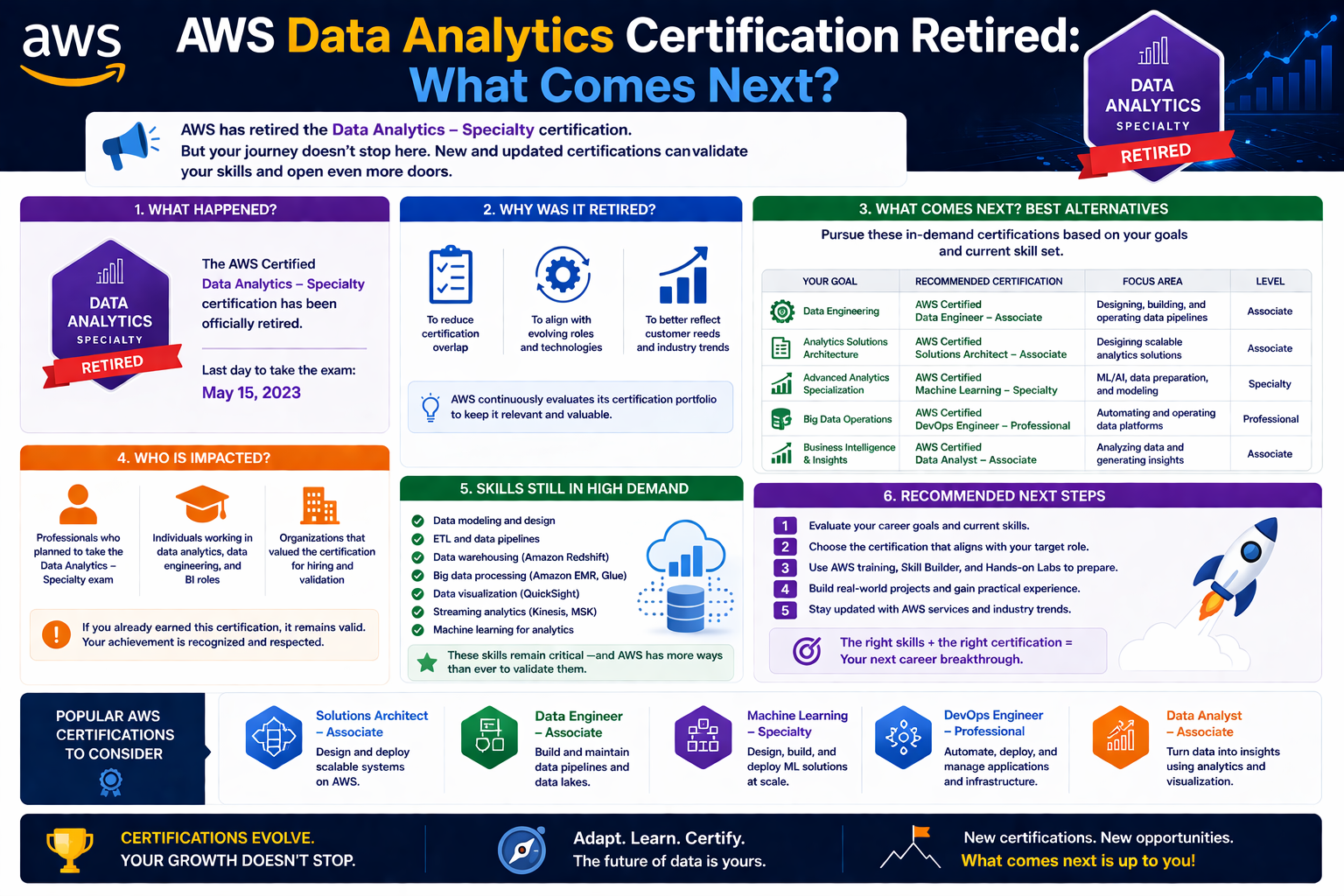
The landscape of cloud certifications evolves as rapidly as the technologies they represent, and the retirement of the AWS Data Analytics certification marks a clear shift in how data expertise is defined in the cloud ecosystem. For a long time, this certification stood as a benchmark for professionals who specialized in working with large-scale data systems on AWS. It validated not only technical capability but also the ability to design and implement complete analytics pipelines using a wide range of AWS services. Its retirement does not diminish its value; instead, it reflects a broader transition toward more integrated and role-focused skill validation. The introduction of a new certification focused on data engineering signals that the industry now prioritizes end-to-end data handling rather than isolated analytics functions.
The shift also highlights how organizations increasingly expect professionals to move beyond analyzing data into building and maintaining the systems that produce insights. Modern businesses rely on continuous data flows, real-time processing, and scalable architectures. As a result, certifications must align with these expectations. The earlier certification focused heavily on analytics tools and their application, while the newer direction places equal emphasis on infrastructure, pipelines, and operational efficiency. This evolution mirrors how job roles themselves have changed, with data professionals now expected to possess a hybrid skill set that combines analytics, engineering, and cloud architecture.
Understanding this transition is essential for anyone planning a career in data-related fields. Certifications are not just badges; they are indicators of industry demand. When a certification is retired and replaced, it often means that employers are redefining what they value. In this case, the move suggests that simply analyzing data is no longer sufficient. Professionals must understand how data is collected, transformed, stored, and delivered at scale. This broader perspective is now considered fundamental rather than advanced, making it an essential part of modern data roles.
The retirement also prompts an important question about long-term learning strategies. Instead of focusing on a single certification, professionals need to think in terms of adaptable skill sets. Cloud platforms continue to introduce new tools, and the ability to learn and integrate these tools becomes more valuable than mastering a fixed set of services. The previous certification rewarded deep familiarity with specific AWS analytics services, but the new direction encourages a more flexible understanding of how systems work together. This shift ultimately benefits those who are willing to continuously update their knowledge and adapt to changing requirements.
What the AWS Data Analytics Certification Represented
The AWS Data Analytics certification was designed to validate expertise in handling complex data workflows within the AWS ecosystem. It built upon earlier concepts introduced under a different name and evolved into a specialized credential that focused on real-world applications of big data technologies. Professionals who pursued this certification were expected to understand how to design scalable data systems, process large volumes of information, and derive meaningful insights using AWS services. It was not an entry-level certification; rather, it targeted individuals who already had significant experience working with data and cloud technologies.
One of the defining aspects of this certification was its emphasis on practical implementation. Instead of testing theoretical knowledge alone, it presented scenarios that required candidates to choose appropriate services and design solutions based on specific requirements. This approach ensured that certified professionals could apply their knowledge in real-world situations. It also meant that preparation involved more than memorizing concepts; candidates needed hands-on experience with tools and a clear understanding of how different components interacted within a data pipeline.
The certification covered a wide range of topics, reflecting the complexity of modern data systems. From ingestion and storage to processing and visualization, it addressed every stage of the data lifecycle. This comprehensive scope made it highly valuable for organizations looking to build robust analytics capabilities. Employers could rely on certified individuals to design systems that were not only functional but also efficient, secure, and scalable. The certification effectively acted as a guarantee that the holder could handle the challenges associated with large-scale data operations.
Another important aspect was its focus on AWS-specific services. While many data analytics principles are universal, the certification required detailed knowledge of how those principles were implemented within AWS. This included understanding the strengths and limitations of various services and knowing when to use each one. Such specialization made the certification particularly relevant for organizations that relied heavily on AWS infrastructure. It ensured that professionals could maximize the potential of the platform and make informed decisions about architecture and design.
The certification also played a role in shaping career paths. For many professionals, it served as a stepping stone to more advanced roles in data engineering, architecture, and analytics leadership. By demonstrating expertise in both data handling and cloud technologies, it opened doors to opportunities that required a combination of skills. It also provided a structured way to learn and validate knowledge, making it easier for individuals to progress in their careers. Even though it has been retired, the skills it represented remain highly relevant and continue to influence the direction of data-related roles.
How the Exam Evaluated Real-World Data Skills
The structure of the AWS Data Analytics exam was carefully designed to reflect the complexities of working with data in real environments. It was not a simple test of definitions or isolated concepts. Instead, it challenged candidates to think critically about how to design and implement solutions under various conditions. The exam format included multiple-choice and multiple-response questions, each based on realistic scenarios that required a deep understanding of both data principles and AWS services. This approach ensured that passing the exam demonstrated genuine capability rather than surface-level knowledge.
Candidates were given a limited amount of time to answer a significant number of questions, which added an additional layer of difficulty. Time management became an essential skill, as questions often required careful reading and analysis. Each scenario presented unique challenges, such as optimizing performance, ensuring data security, or selecting the most cost-effective solution. These scenarios mirrored the types of decisions professionals face in their daily work, making the exam highly relevant to real-world applications.
The exam was divided into several domains, each focusing on a different aspect of data analytics. These domains covered the entire lifecycle of data, from collection and storage to processing and visualization. By structuring the exam in this way, it ensured that candidates had a well-rounded understanding of how data systems operate. It also highlighted the interconnected nature of these domains, as decisions made in one area often impact others. For example, choices related to data storage could influence processing performance and security considerations.
Another key feature of the exam was its emphasis on selecting the right tools for specific tasks. AWS offers a vast array of services, each designed for particular use cases. The exam required candidates to understand these services in detail and know when to use each one. This included evaluating trade-offs between different options, such as performance versus cost or scalability versus complexity. Such decision-making is a critical skill in data analytics, where the choice of tools can significantly impact the success of a project.
The exam also tested the ability to implement solutions effectively. It was not enough to know which service to use; candidates needed to understand how to configure and integrate these services into a cohesive system. This required a deep understanding of how data flows through different stages and how various components interact. By focusing on implementation, the exam ensured that certified professionals could move beyond theory and contribute directly to real-world projects.
Ultimately, the exam served as a comprehensive assessment of a candidate’s ability to handle complex data challenges. It validated not only technical knowledge but also problem-solving skills and practical experience. This made it a valuable credential for both individuals and organizations, as it provided a clear indication of a professional’s capabilities. Even though the certification is no longer available, the skills it tested remain essential for anyone working in data analytics and continue to be relevant in the evolving landscape of cloud computing.
The Transition to a Data Engineering Focus
The replacement of the AWS Data Analytics certification with a data engineering–focused credential reflects a deeper shift in how organizations approach data. Instead of treating analytics as a separate layer that sits on top of existing systems, modern architectures integrate analytics directly into the data pipeline. This means that professionals are now expected to understand how data is ingested, transformed, stored, and delivered in a seamless flow. The transition emphasizes building reliable systems that can handle large volumes of data efficiently while maintaining accuracy and accessibility.
This change aligns with the growing importance of real-time data processing. Businesses no longer rely solely on historical analysis; they need immediate insights to make decisions. As a result, the role of a data professional has expanded to include designing pipelines that can process streaming data and deliver results instantly. The new certification direction reflects this need by focusing on the skills required to build such systems. It highlights the importance of understanding how different services work together to create a cohesive and scalable data infrastructure.
Another aspect of this transition is the increased emphasis on automation and reliability. Data pipelines must operate continuously without manual intervention, and they must be able to recover from failures quickly. This requires a strong understanding of system design principles, including fault tolerance and monitoring. The newer approach to certification recognizes these requirements and places greater importance on operational aspects of data systems. Professionals are expected to design solutions that are not only functional but also resilient and maintainable over time.
The shift also encourages a more holistic understanding of data systems. Instead of focusing on individual tools or services, professionals must consider how all components fit together. This includes understanding data flow, dependencies, and the impact of design decisions on overall system performance. By adopting this broader perspective, individuals can create solutions that are more efficient and adaptable to changing requirements. This approach ultimately leads to better outcomes for organizations and more meaningful career opportunities for professionals.
Key Skills Emphasized in the New Certification Path
The move toward a data engineering certification highlights a set of core skills that are now considered essential for working with data in the cloud. One of the most important skills is the ability to design scalable data architectures. This involves understanding how to handle large volumes of data while maintaining performance and reliability. Professionals must be able to choose appropriate storage solutions, design efficient data models, and ensure that systems can scale as demand grows.
Another critical skill is data transformation. Raw data is often messy and unstructured, and it must be cleaned and organized before it can be used for analysis. This requires knowledge of data processing techniques and tools that can handle complex transformations. The new certification path emphasizes the importance of building pipelines that can automate these processes and deliver clean, usable data consistently. This ensures that downstream applications and analytics tools can operate effectively.
Security is also a major focus. As data becomes more valuable, protecting it becomes increasingly important. Professionals must understand how to implement security measures that safeguard data at every stage of its lifecycle. This includes encryption, access control, and monitoring. The ability to design secure systems is now a fundamental requirement, and it is given significant attention in the updated certification framework.
In addition to technical skills, the new direction places importance on operational knowledge. This includes monitoring system performance, identifying bottlenecks, and optimizing resource usage. Professionals must be able to maintain systems over time and ensure that they continue to meet performance and reliability standards. This operational perspective is essential for managing complex data environments and ensuring that systems remain efficient and cost-effective.
Collaboration is another key aspect. Data systems often involve multiple teams, including developers, analysts, and business stakeholders. Professionals must be able to communicate effectively and work with others to design and implement solutions. This requires not only technical expertise but also the ability to understand business requirements and translate them into technical solutions. The new certification path reflects this need by emphasizing real-world scenarios that require collaboration and decision-making.
Comparing Analytics Expertise with Engineering Responsibilities
While data analytics and data engineering are closely related, they involve different responsibilities and skill sets. The previous certification focused more on analyzing data and extracting insights, while the new direction emphasizes building the systems that make those insights possible. This distinction is important because it reflects the evolving nature of data roles in the industry. Organizations are increasingly looking for professionals who can handle both aspects, but the emphasis is shifting toward engineering capabilities.
Analytics expertise involves understanding data patterns, creating visualizations, and generating reports that help organizations make decisions. It requires a strong foundation in statistics and the ability to interpret data effectively. While these skills are still important, they are no longer sufficient on their own. Professionals must also understand how data is generated and processed, which requires knowledge of engineering principles.
Engineering responsibilities, on the other hand, involve designing and maintaining data systems. This includes building pipelines, managing storage, and ensuring that data is available when needed. It requires a deep understanding of system architecture and the ability to work with various tools and technologies. The new certification path places greater emphasis on these responsibilities, reflecting the growing importance of infrastructure in data-driven organizations.
The shift toward engineering also changes how professionals approach problem-solving. Instead of focusing solely on analyzing data, they must consider how to build systems that can handle data efficiently. This involves thinking about scalability, performance, and reliability. It requires a different mindset, one that prioritizes system design and long-term sustainability over short-term analysis.
Despite these differences, analytics and engineering are not mutually exclusive. In fact, the most effective professionals are those who can bridge the gap between the two. They understand how data is processed and how it can be used to generate insights. This combination of skills is highly valuable and is increasingly sought after by employers. The new certification path encourages this integration by covering both aspects, although with a stronger focus on engineering.
Why Experience Still Matters More Than Certification Alone
While certifications provide a structured way to validate knowledge, they cannot replace real-world experience. The AWS Data Analytics certification required candidates to have significant hands-on experience, and this remains true for its replacement. Experience is essential because it allows professionals to apply their knowledge in practical situations and develop a deeper understanding of how systems work. It also helps them build problem-solving skills that cannot be learned through study alone.
Working with real data systems exposes professionals to challenges that are not covered in exams. These challenges include dealing with unexpected errors, optimizing performance under constraints, and adapting to changing requirements. Such experiences are invaluable and contribute to a more comprehensive understanding of data systems. They also help professionals develop the ability to think critically and make informed decisions.
Experience also plays a crucial role in building confidence. Professionals who have worked on real projects are more likely to trust their instincts and take initiative. They understand the implications of their decisions and are better equipped to handle complex situations. This confidence is important in roles that require responsibility for critical systems and data.
Another important aspect of experience is familiarity with tools and technologies. While certifications introduce various services, hands-on work allows professionals to explore these tools in depth. They learn how to configure, optimize, and troubleshoot them, which is essential for effective implementation. This practical knowledge is often what distinguishes experienced professionals from those who have only theoretical understanding.
Ultimately, certifications and experience should be seen as complementary rather than competing elements. Certifications provide a framework for learning and validation, while experience brings that knowledge to life. Together, they create a strong foundation for a successful career in data. As the certification landscape evolves, the importance of experience remains constant, serving as a key factor in professional growth and success.
Learning Paths That Replace the Old Certification Journey
With the retirement of the AWS Data Analytics certification, professionals are no longer following a single, clearly defined path to validate their expertise. Instead, the journey has become more flexible, allowing individuals to build skills through a combination of focused learning tracks. This shift encourages a more customized approach to education, where learners can prioritize the areas most relevant to their career goals. Rather than relying on one certification to cover everything, professionals now combine multiple resources and skill areas to achieve a similar or even greater level of expertise.
One of the most effective approaches is to start with foundational knowledge and gradually move toward advanced topics. This includes understanding basic data concepts such as data structures, storage models, and query languages before progressing to cloud-based implementations. By building a strong base, learners can more easily adapt to specific tools and services within AWS. This method also ensures that knowledge is transferable, allowing professionals to work across different platforms if needed.
Another important aspect of modern learning paths is hands-on practice. Theoretical knowledge alone is not enough to succeed in data roles. Professionals must actively work with data, build pipelines, and experiment with different solutions. This practical experience helps reinforce concepts and provides a deeper understanding of how systems operate. It also prepares individuals for real-world challenges, where problems are often complex and require creative solutions.
Specialization is another key factor in the new learning landscape. While the previous certification covered a broad range of topics, professionals now have the opportunity to focus on specific areas such as data engineering, data visualization, or machine learning. This allows them to develop deeper expertise in a particular domain while still maintaining a general understanding of the overall data ecosystem. Specialization can lead to more targeted career opportunities and make individuals more valuable in specific roles.
Continuous learning has also become essential. The pace of change in cloud technologies means that skills can quickly become outdated. Professionals must stay up to date with new tools, features, and best practices. This requires a commitment to ongoing education, whether through courses, documentation, or hands-on experimentation. By adopting a mindset of continuous improvement, individuals can remain competitive and adapt to evolving industry demands.
Courses and Training Options That Build Real Capability
In the absence of a single certification path, training programs play a crucial role in helping professionals develop the necessary skills. These programs vary in scope and focus, offering options for both beginners and experienced individuals. Some courses are designed to introduce basic concepts, while others provide in-depth coverage of advanced topics. By selecting the right combination of courses, learners can create a comprehensive learning experience that aligns with their goals.
Introductory courses are particularly valuable for those who are new to data analytics or cloud computing. These courses typically cover fundamental concepts such as data collection, storage, and basic analysis techniques. They provide a solid starting point and help learners understand the core principles that underpin more advanced topics. For many individuals, this foundational knowledge is the first step toward a successful career in data.
More advanced training programs focus on specific skills such as building data pipelines, working with large datasets, and optimizing performance. These courses often include hands-on labs and real-world scenarios, allowing learners to apply their knowledge in practical situations. This type of training is especially important for those who want to transition into data engineering roles, as it provides the experience needed to design and implement complex systems.
Vendor-neutral courses also play an important role in skill development. While AWS-specific training is essential for working within that ecosystem, broader courses can help learners understand general data concepts that apply across platforms. This includes topics such as data modeling, statistical analysis, and visualization techniques. By combining vendor-specific and vendor-neutral training, professionals can develop a well-rounded skill set that is both deep and versatile.
Another valuable aspect of modern training is the inclusion of interactive elements such as quizzes, practice exams, and projects. These components help reinforce learning and provide opportunities to test knowledge in a structured way. They also simulate real-world challenges, preparing learners for the types of problems they will encounter in their careers. This approach ensures that training is not only informative but also engaging and effective.
Ultimately, the goal of any training program should be to build real capability rather than simply prepare for an exam. This means focusing on practical skills and understanding how to apply them in different contexts. By prioritizing hands-on experience and real-world applications, learners can develop the expertise needed to succeed in modern data roles.
Understanding the Role of SQL and Core Data Skills
Despite the changes in certification paths, certain skills remain fundamental to working with data, and SQL is one of the most important among them. SQL serves as the foundation for interacting with databases, allowing professionals to query, manipulate, and analyze data efficiently. Regardless of the tools or platforms used, a strong understanding of SQL is essential for any data-related role. It enables individuals to extract meaningful information from datasets and supports a wide range of analytical and engineering tasks.
Learning SQL involves more than just writing basic queries. Professionals must understand how to structure data, optimize queries for performance, and handle complex operations such as joins and aggregations. These skills are critical for working with large datasets, where efficiency and accuracy are paramount. By mastering SQL, individuals can significantly enhance their ability to work with data and contribute to data-driven projects.
In addition to SQL, other core data skills are equally important. This includes understanding data modeling, which involves designing the structure of databases to ensure efficient storage and retrieval. Good data modeling practices can improve performance and make systems easier to maintain. It also helps ensure that data is organized in a way that supports analysis and reporting.
Data cleaning and preparation are also essential skills. Raw data is often incomplete or inconsistent, and it must be processed before it can be used effectively. This involves identifying and correcting errors, handling missing values, and transforming data into a usable format. These tasks are a critical part of any data workflow and require attention to detail and a strong understanding of data structures.
Another important skill is data visualization. While engineering focuses on building systems, visualization helps communicate insights to stakeholders. Professionals must be able to present data in a clear and meaningful way, using charts and dashboards to highlight key trends and patterns. This requires both technical and creative skills, as well as an understanding of the audience and their needs.
Together, these core skills form the foundation of any data career. They are not tied to a specific certification or platform, making them highly valuable and transferable. By developing these skills, professionals can adapt to different roles and technologies, ensuring long-term success in the field.
Building a Career Strategy After Certification Changes
The retirement of a major certification can create uncertainty, but it also presents an opportunity to rethink career strategies. Instead of relying on a single credential, professionals can focus on building a diverse set of skills and experiences that align with their goals. This approach provides greater flexibility and allows individuals to adapt to changing industry trends.
One effective strategy is to define a clear career path based on personal interests and strengths. This could involve focusing on data engineering, analytics, or a combination of both. By identifying a specific direction, professionals can tailor their learning and development efforts to match their goals. This targeted approach can lead to more meaningful progress and better career outcomes.
Networking is another important aspect of career development. Engaging with other professionals in the field can provide valuable insights and opportunities. This includes participating in online communities, attending events, and collaborating on projects. Networking helps individuals stay informed about industry trends and learn from the experiences of others.
Practical experience should also be a priority. Working on real projects, whether through employment or personal initiatives, allows professionals to apply their skills and build a portfolio. This not only reinforces learning but also demonstrates capability to potential employers. A strong portfolio can often be more impactful than a certification alone, as it ցույցs real-world application of skills.
Another key element of a successful career strategy is adaptability. The technology landscape is constantly changing, and professionals must be willing to learn new tools and approaches. This requires a proactive mindset and a commitment to continuous improvement. By staying flexible and open to change, individuals can navigate shifts in the industry and maintain their relevance.
Finally, it is important to maintain a balance between depth and breadth of knowledge. While specialization can lead to expertise in a particular area, a broader understanding of related fields can enhance overall capability. This combination allows professionals to approach problems from multiple perspectives and develop more effective solutions. As the field of data continues to evolve, this balanced approach will remain a key factor in long-term success.
Evaluating Whether the Certification Was Worth the Effort
For many professionals, the AWS Data Analytics certification represented a significant investment of time, effort, and resources. Evaluating its worth requires looking beyond the credential itself and considering the skills and opportunities it provided. The certification was valuable because it validated a deep understanding of data systems within a cloud environment. It demonstrated that an individual could handle complex data workflows, select appropriate tools, and implement solutions effectively. These capabilities remain highly relevant, even after the certification’s retirement.
The real value of the certification was in the learning process it encouraged. Preparing for the exam required hands-on experience with data pipelines, storage solutions, and processing frameworks. This practical exposure helped professionals develop skills that could be directly applied in their roles. It also built confidence in working with large-scale data systems, which is a critical requirement in many organizations. Even without the certification being active, the knowledge gained during preparation continues to provide long-term benefits.
Another factor to consider is how the certification influenced career growth. For many individuals, it served as a stepping stone to more advanced roles. It helped them stand out in a competitive job market and demonstrated a commitment to professional development. Employers often look for candidates who have proven their expertise through recognized credentials, and this certification fulfilled that role effectively. While it is no longer available, those who earned it still carry its value as part of their professional profile.
However, the worth of any certification ultimately depends on how it aligns with an individual’s career goals. For those working directly with data systems and AWS services, it was a strong asset. For others whose roles did not involve data analytics, the investment may not have been as beneficial. This highlights the importance of choosing certifications that match one’s professional direction. The retirement of this certification reinforces the idea that skills and experience are more important than any single credential.
What Professionals Should Focus on Moving Forward
With the certification no longer available, professionals need to shift their focus toward building skills that align with current industry demands. This includes developing expertise in data engineering, cloud architecture, and system design. These areas are increasingly important as organizations rely on data-driven decision-making and require robust systems to support it. By focusing on these skills, individuals can position themselves for future opportunities and remain competitive in the job market.
One of the most important areas to focus on is building end-to-end data pipelines. This involves understanding how data is collected, processed, stored, and delivered. Professionals must be able to design systems that handle these tasks efficiently and reliably. This requires knowledge of various tools and services, as well as an understanding of how they interact. By mastering these concepts, individuals can create solutions that meet the needs of modern organizations.
Another key focus area is scalability. Data systems must be able to handle increasing volumes of data without compromising performance. This requires careful planning and design, as well as the ability to optimize resources. Professionals must understand how to scale systems horizontally and vertically, and how to manage costs effectively. These skills are essential for building systems that can grow with an organization’s needs.
Security is also a critical consideration. As data becomes more valuable, protecting it becomes increasingly important. Professionals must understand how to implement security measures that safeguard data at every stage of its lifecycle. This includes encryption, access control, and monitoring. By prioritizing security, individuals can ensure that their systems are not only functional but also trustworthy.
In addition to technical skills, professionals should focus on developing soft skills such as communication and problem-solving. These skills are essential for working in collaborative environments and translating business requirements into technical solutions. By combining technical expertise with strong interpersonal skills, individuals can become more effective and valuable team members.
Adapting to Continuous Change in Cloud Technologies
The retirement of a certification is just one example of how quickly the technology landscape can change. Cloud platforms are constantly evolving, introducing new services and updating existing ones. This means that professionals must be prepared to adapt and learn continuously. Staying relevant in this environment requires a proactive approach to learning and a willingness to embrace change.
One way to adapt is by staying informed about new developments. This includes following updates from cloud providers, reading documentation, and մասնակցing in professional communities. By keeping up with the latest trends, professionals can identify new opportunities and adjust their skills accordingly. This helps them stay ahead of the curve and remain competitive in the job market.
Experimentation is another important aspect of adaptation. Trying out new tools and technologies allows professionals to gain hands-on experience and understand their potential applications. This can lead to innovative solutions and improved efficiency. By experimenting regularly, individuals can expand their skill set and discover new ways to solve problems.
Flexibility is also key. Professionals must be willing to adjust their approaches and learn new methods as technologies evolve. This may involve shifting from one tool to another or adopting new best practices. By remaining flexible, individuals can navigate changes more effectively and continue to deliver value in their roles.
Continuous improvement should be seen as an ongoing process rather than a one-time effort. This involves regularly تقييم skills, identifying areas for growth, and seeking out opportunities to learn. By adopting this mindset, professionals can ensure that they remain relevant and capable in a rapidly changing industry.
Final Thoughts
The retirement of the AWS Data Analytics certification marks the end of one chapter but the beginning of another. It reflects a broader shift in how data roles are defined and how skills are validated. While the certification itself is no longer available, the knowledge and expertise it represented continue to be highly valuable. The introduction of a new certification focused on data engineering highlights the growing importance of building and maintaining data systems.
Looking ahead, data certifications are likely to continue evolving to reflect industry needs. This means that professionals must be prepared to adapt and update their skills regularly. Instead of relying on a single credential, they should focus on building a diverse set of capabilities that can be applied across different roles and technologies. This approach provides greater flexibility and ensures long-term career growth.
The future of data careers will be shaped by the ability to integrate analytics and engineering skills. Professionals who can design systems, process data, and generate insights will be in high demand. This requires a combination of technical expertise, practical experience, and continuous learning. By focusing on these areas, individuals can position themselves for success in the evolving landscape of data and cloud technologies.
Ultimately, the most important takeaway is that certifications are just one part of a larger journey. They provide structure and validation, but they do not define a professional’s capabilities. Real value comes from the ability to apply knowledge, solve problems, and adapt to change. By embracing this perspective, individuals can navigate shifts in the certification landscape and continue to grow in their careers.