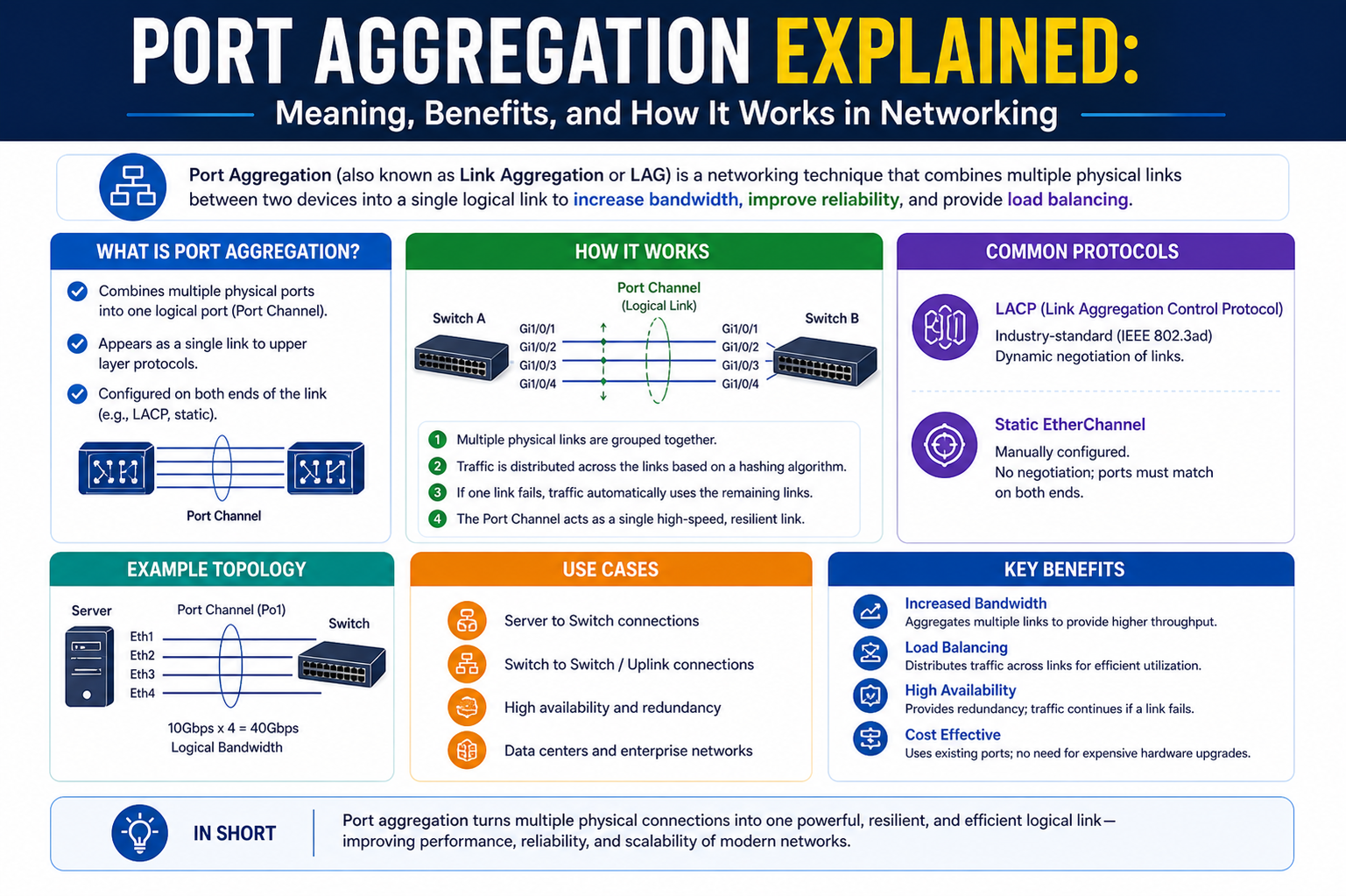
Port aggregation is a networking technique that combines multiple physical network connections into a single logical connection. This logical grouping allows devices such as switches, routers, and servers to treat several separate links as one unified pathway. The main purpose of this approach is to improve overall network efficiency, increase available bandwidth, and provide a higher level of reliability for data transmission. Instead of relying on a single cable or port, the system distributes traffic across multiple links while still presenting them as one connection to the network layer.
This method is widely used in modern network infrastructures where stability and performance are critical. By combining several connections, organizations can achieve better utilization of their hardware resources while also reducing the chances of network downtime. It is especially useful in environments where large volumes of data are constantly being transferred, such as enterprise systems and data centers.
Core Concept Behind Port Aggregation
At its core, port aggregation is based on the idea of link bundling. Multiple Ethernet ports are grouped together to function as one logical interface. This logical interface behaves like a single high-capacity connection, even though it is made up of several smaller links working together.
The system distributes network traffic across these links using load balancing techniques. This ensures that no single connection becomes overloaded while others remain underutilized. At the same time, if one of the physical links fails, the remaining links continue to carry the traffic without interrupting the connection. This built-in redundancy is one of the strongest advantages of port aggregation.
The concept is often compared to combining multiple small pipes into one large pipeline. Even if one pipe gets blocked, water still flows through the remaining ones, ensuring continuous delivery without major disruption.
Importance of Port Aggregation in Modern Networks
In today’s digital environment, networks are expected to handle high-speed communication without delays or interruptions. Port aggregation plays a critical role in meeting these expectations by improving both performance and reliability.
One of its key benefits is bandwidth expansion. Instead of being limited by a single link’s capacity, aggregated links provide a combined throughput that is significantly higher. This is particularly important for applications that require heavy data transfer, such as cloud services, virtualization platforms, and large-scale database systems.
Another important aspect is fault tolerance. If one connection in the group fails due to hardware issues or cable damage, traffic is automatically rerouted through the remaining active links. This minimizes downtime and ensures continuous network availability, which is essential for business operations that depend on constant connectivity.
How Port Aggregation Works in Practice
Port aggregation operates by creating a logical interface known as a link aggregation group. This group is formed by combining multiple physical ports on a network device. Once configured, these ports act as a single entity from the perspective of the network.
When data is transmitted, the system uses specific algorithms to distribute packets across the available links. The distribution can be based on factors such as source and destination addresses, port numbers, or even session information. This ensures balanced utilization of all active connections.
On the receiving end, the aggregated links are reassembled so that the data appears as a single continuous stream. This process happens seamlessly, without requiring any manual intervention during normal operation. The entire mechanism is designed to be transparent to end users and applications.
Load Balancing in Port Aggregation
Load balancing is a fundamental function of port aggregation. It ensures that network traffic is evenly distributed across all available links in the aggregation group. Without load balancing, one link could become congested while others remain idle, leading to inefficient network performance.
Different load balancing methods may be used depending on the network configuration. Some systems distribute traffic based on MAC addresses, while others use IP addresses or transport layer information. The goal is always the same: maximize efficiency and avoid bottlenecks.
By spreading traffic intelligently, port aggregation allows networks to handle higher data loads without requiring additional physical infrastructure. This makes it a cost-effective solution for improving performance.
Redundancy and Fault Tolerance
One of the most valuable features of port aggregation is its ability to provide redundancy. In traditional single-link connections, a failure in the cable or port can result in a complete loss of connectivity. Port aggregation eliminates this risk by ensuring that multiple paths are always available.
If one link fails, the system automatically detects the issue and redistributes traffic across the remaining active links. This failover process happens quickly and without disrupting ongoing communication sessions. As a result, users experience uninterrupted service even during hardware failures.
This level of fault tolerance is essential in mission-critical environments where downtime can lead to financial loss or operational disruption.
Difference Between Physical and Logical Connections
Port aggregation introduces an important distinction between physical and logical connections. Physical connections refer to the actual Ethernet cables and ports used to establish communication between devices. Logical connections, on the other hand, represent the virtual grouping of these physical links.
Even though multiple physical cables are used, the network treats them as a single logical interface. This abstraction simplifies network management and configuration. Administrators do not need to manage each cable individually; instead, they configure and monitor the aggregated group as one unit.
This separation of physical and logical layers is one of the reasons why port aggregation is so efficient and scalable.
Role of Protocols in Port Aggregation
Protocols play a crucial role in managing how port aggregation is established and maintained. These protocols ensure that devices can automatically negotiate and form aggregation groups without requiring manual configuration for every connection.
Two commonly used approaches exist in this area. One is an open standard protocol that allows devices from different manufacturers to work together in forming link aggregation groups. The other is a proprietary method designed for specific hardware ecosystems, offering tighter integration within those environments.
These protocols handle tasks such as link discovery, negotiation, and continuous monitoring of active connections. They ensure that all links in the aggregation group remain synchronized and functional.
Network Efficiency Through Aggregation
Port aggregation significantly improves network efficiency by optimizing the use of available resources. Instead of relying on a single high-capacity link, multiple lower-capacity links are combined to achieve greater overall throughput.
This approach reduces congestion and improves data flow across the network. It also allows organizations to scale their infrastructure gradually by adding more links to the aggregation group as demand increases.
The ability to dynamically balance traffic and utilize multiple paths makes networks more responsive and adaptable to changing workloads.
Scalability Advantages
Scalability is another major advantage of port aggregation. As network demand grows, additional links can be added to the existing aggregation group without requiring major changes to the overall network design.
This flexibility allows organizations to expand their bandwidth capacity incrementally. Instead of replacing existing infrastructure, they can simply increase the number of active links in the aggregation group.
This makes port aggregation a cost-effective solution for long-term network growth and expansion.
Operational Transparency
One of the reasons port aggregation is widely adopted is its transparency to users and applications. Once configured, it operates in the background without affecting how devices communicate on the network.
Applications do not need to be aware of the underlying physical structure of the network. They simply send and receive data as they normally would, while the aggregation system handles traffic distribution and failover internally.
This simplicity reduces complexity at the application level and ensures a smoother user experience.
Foundation for Advanced Networking
Port aggregation serves as a foundational technology for many advanced networking environments. It is commonly used in enterprise networks, virtualization platforms, and high-performance computing systems where reliability and speed are essential.
By combining multiple links into a single logical connection, it provides the backbone for scalable and resilient network architectures. It also works seamlessly with other technologies that enhance performance and security in modern infrastructures.
Its role in supporting high-demand environments makes it an essential concept in networking design.
Initial Understanding Before Configuration
Before configuring port aggregation, it is important to understand how physical ports, logical interfaces, and traffic distribution interact with each other. Each component plays a specific role in ensuring that the system functions correctly.
Proper planning is required to determine which ports will be grouped and how traffic will be distributed. Without a clear understanding of these elements, configuration errors can lead to inefficiencies or connectivity issues.
A strong conceptual foundation ensures that port aggregation is implemented effectively and delivers the intended performance benefits.
Port Aggregation Control Protocol (PAgP) Overview
Port Aggregation Control Protocol is a Cisco-developed mechanism designed to simplify the creation and management of aggregated links between network devices. It automatically negotiates the bundling of multiple physical interfaces into a single logical connection, reducing manual configuration effort and minimizing configuration errors. This protocol is primarily used in Cisco environments and is not universally supported across all vendors, which makes it less flexible compared to open-standard alternatives.
PAgP continuously exchanges messages between connected interfaces to determine whether they can be grouped together. These messages ensure that both ends of the connection are compatible in terms of speed, duplex settings, and VLAN configuration before forming an aggregated link. This verification process helps maintain network stability and prevents mismatched configurations that could lead to communication failures.
PAgP Operational Modes and Behavior
PAgP operates using two primary modes that define how interfaces behave during negotiation. These modes control whether a port actively attempts to form an aggregation or waits for the remote device to initiate the process.
In passive behavior, an interface remains in standby mode and only responds when it receives negotiation requests from another device. It does not initiate the aggregation process on its own, which makes it dependent on the configuration of the opposite side. This mode is often used in environments where administrators want controlled and predictable link formation.
In active behavior, an interface actively seeks to establish an aggregation by sending negotiation messages to the remote device. It is more proactive and is commonly used when administrators want faster and more reliable link formation. When both sides are configured correctly, the protocol automatically builds the logical link without additional intervention.
EtherChannel and Logical Interface Formation
EtherChannel is a technology closely associated with port aggregation, particularly in Cisco networks. It refers to the logical grouping of multiple physical Ethernet links into a single channel. This logical channel is treated as one interface by higher layers of the network stack.
The EtherChannel concept simplifies network design by reducing the number of individual interfaces that need to be managed. Instead of configuring each physical link separately, administrators configure the logical group as a whole. This ensures consistency across all bundled links and reduces the chance of configuration mismatches.
Once formed, the EtherChannel behaves like a single high-bandwidth connection. All participating links share the traffic load, and the system dynamically adjusts distribution based on current network conditions.
Link Aggregation Control Protocol (LACP) Explained
Link Aggregation Control Protocol is an open-standard protocol defined under IEEE specifications. Unlike proprietary solutions, it allows interoperability between devices from different vendors, making it more widely used in modern networks. LACP automates the process of detecting and forming link aggregation groups across compatible interfaces.
LACP works by exchanging control packets between devices to determine whether links can be safely grouped. These packets carry information about interface capabilities, configuration settings, and operational status. Only when both ends agree that the links are compatible does the aggregation form.
One of the key advantages of LACP is its ability to dynamically adjust to changes in network conditions. If a link becomes unstable or fails, LACP automatically removes it from the group and redistributes traffic across remaining active links without disrupting communication.
LACP Active and Passive Roles
LACP defines two operational roles that determine how devices participate in link aggregation. These roles influence how negotiation begins and how connections are established.
In active role, a device actively sends LACP packets to initiate negotiation. It continuously attempts to form an aggregation with the connected device. This role is commonly used on critical network devices where administrators want to ensure that link aggregation is always attempted.
In passive role, a device does not initiate negotiation but responds to LACP packets received from the active side. It waits for the other device to start the process. This role is useful in controlled environments where administrators want to limit unnecessary negotiation traffic.
A successful aggregation requires at least one side to be in active mode. If both sides are passive, the link aggregation will not form.
Load Balancing Mechanisms in Port Aggregation
Load balancing is a core function that determines how traffic is distributed across multiple links within an aggregation group. The goal is to ensure that no single link becomes overloaded while others remain underutilized.
Different algorithms are used for load balancing depending on the network design and requirements. One common method is source-based distribution, where traffic is assigned based on the originating device’s address. Another method uses destination-based distribution, where the receiving address determines the path selection.
More advanced systems combine multiple parameters such as IP addresses, MAC addresses, and even transport layer ports. This allows for more granular control over traffic distribution and improves overall efficiency in high-performance networks.
Hashing Algorithms in Traffic Distribution
Hashing plays a critical role in determining how packets are assigned to specific links within an aggregation group. A hashing algorithm processes packet information and generates a value that maps the traffic to a particular physical link.
This process ensures that packets belonging to the same session follow the same path, preventing issues such as packet reordering. Maintaining session consistency is important for applications that require reliable and ordered delivery of data.
The selection of hashing fields can significantly impact performance. For example, using only MAC addresses may result in uneven distribution in certain traffic patterns, while incorporating IP addresses and port numbers provides a more balanced approach.
Compatibility Requirements for Aggregation
For port aggregation to function correctly, all participating interfaces must meet specific compatibility requirements. These include matching speed, duplex settings, and encapsulation types. Any mismatch can prevent successful formation of the aggregation group.
VLAN configurations must also be consistent across all links in the group. Inconsistent VLAN settings can lead to traffic loss or segmentation issues. Ensuring uniform configuration is essential for maintaining network stability.
Hardware compatibility is another important factor. Not all devices support the same aggregation protocols, so verifying support before configuration is a critical step in network design.
Dynamic Link Monitoring and Failover Behavior
Dynamic link monitoring is a mechanism that continuously checks the health of all links within an aggregation group. It ensures that only functional links are actively used for traffic forwarding.
If a link fails due to physical damage, congestion, or hardware malfunction, the monitoring system detects the failure and removes the link from the active group. Traffic is then redistributed across the remaining operational links.
This automatic failover process ensures uninterrupted communication and minimizes downtime. It is one of the key features that makes port aggregation suitable for mission-critical environments.
Network Design Considerations for Aggregation
When designing a network that uses port aggregation, careful planning is required to ensure optimal performance. One important consideration is the placement of aggregated links within the network topology.
Balanced distribution of traffic across multiple devices helps prevent bottlenecks and improves overall throughput. Network architects often design redundant paths to ensure that failure of a single device does not disrupt communication.
Scalability must also be considered during design. Aggregation groups should be structured in a way that allows for easy expansion as network demand increases.
Role of Port Aggregation in Data Center Environments
Data centers heavily rely on port aggregation to handle large volumes of traffic between servers, storage systems, and networking equipment. The ability to combine multiple links into a single high-speed connection is essential for maintaining performance in these environments.
Virtualization and cloud computing platforms also benefit from aggregation because they require consistent and high-bandwidth communication between virtual machines and physical infrastructure. Aggregation ensures that these workloads can operate efficiently without network congestion.
In large-scale deployments, aggregation also simplifies management by reducing the number of individual links that need to be monitored and maintained.
Layer Interaction and OSI Model Placement
Port aggregation primarily operates at the data link layer of the OSI model. It interacts with physical layer components such as cables and ports while presenting a unified interface to higher layers.
By abstracting multiple physical links into a single logical interface, it simplifies communication at the network layer and above. Applications and protocols operating at higher layers are unaware of the underlying complexity.
This separation of responsibilities allows for more efficient network operation and easier troubleshooting when issues arise.
Traffic Distribution Challenges
Although port aggregation improves performance, improper configuration can lead to uneven traffic distribution. This can occur when hashing algorithms do not align well with traffic patterns.
In some cases, certain links may become heavily utilized while others remain underused. This reduces the overall efficiency of the aggregation group and can create unexpected bottlenecks.
Careful selection of load balancing methods and continuous monitoring are required to avoid these issues and maintain optimal performance.
Network Stability Through Aggregation Design
A well-designed aggregation setup contributes significantly to overall network stability. By providing multiple active paths for data transmission, it reduces the risk of single points of failure.
Even during hardware or link failures, communication remains active through alternative paths. This resilience is essential for environments where continuous uptime is required.
Proper configuration ensures that the system can adapt dynamically to changing conditions without manual intervention.
LACP Configuration in Real Network Environments
Link Aggregation Control Protocol configuration in real-world environments involves carefully preparing network devices before enabling any aggregation. The process begins with identifying which physical interfaces will participate in the link aggregation group. These interfaces must belong to the same device or compatible devices and must support identical operational parameters.
In practical deployments, network administrators first verify interface capabilities such as speed, duplex mode, and supported protocols. This step is important because mismatched interfaces cannot form a stable aggregation group. Once compatibility is confirmed, the interfaces are grouped logically under a single channel configuration.
After grouping, the system begins exchanging control messages between connected devices. These messages ensure both sides agree on forming a logical link. Only when both devices reach an agreement does the aggregation become active and start carrying traffic.
Interface Selection and Planning Strategy
Selecting the right interfaces is a critical part of implementing LACP. Not all available ports should automatically be included in an aggregation group. Instead, careful analysis of traffic flow patterns and bandwidth requirements is necessary.
In enterprise environments, administrators often choose interfaces that connect high-traffic systems such as servers, storage devices, or core switches. These links are prioritized because they handle large volumes of data and benefit the most from increased bandwidth and redundancy.
Proper planning also includes ensuring that all selected interfaces are physically located in a way that minimizes cable congestion and reduces latency. This structured approach helps improve long-term maintainability of the network infrastructure.
Command-Level Understanding of Aggregation Setup
From a configuration perspective, LACP setup involves switching network devices into privileged modes where interface settings can be modified. Administrators then select a range of interfaces and assign them to a logical channel group.
Once assigned, each interface inherits the properties of the aggregated group rather than operating independently. This ensures uniform behavior across all participating links. Any configuration applied at the logical level is automatically propagated to the physical interfaces.
This abstraction simplifies network management because changes do not need to be repeated on every individual interface. Instead, a single configuration applies to the entire group, reducing administrative effort and minimizing human error.
Role of Port-Channel Interfaces in Aggregation
A port-channel interface represents the logical aggregation of multiple physical links. Once configured, this interface acts as the single point of management for the entire group.
Traffic entering the port-channel is distributed across all active member links based on the selected load balancing method. From the perspective of higher network layers, this port-channel behaves like a standard network interface with increased capacity.
This design allows network systems to scale bandwidth without requiring changes at the application level. Applications continue to communicate normally while the underlying infrastructure handles distribution and redundancy.
Active Traffic Distribution Behavior
Once a link aggregation group becomes operational, traffic distribution begins immediately. The system continuously evaluates network load and distributes packets across available links.
Each packet is assigned a path based on predefined criteria such as source address, destination address, or session identifiers. This ensures that traffic is evenly balanced while maintaining session consistency.
The distribution process is dynamic, meaning it adapts in real time as network conditions change. If one link becomes congested, new traffic is directed to less utilized links, improving overall performance and reducing delays.
Handling Link Failures in Aggregated Systems
One of the most important features of LACP-based aggregation is its ability to handle link failures without disrupting communication. When a physical link goes down, the system immediately detects the failure through continuous monitoring.
Once detected, the failed link is removed from the aggregation group, and traffic is redistributed across remaining active links. This process occurs automatically and does not require manual intervention.
Applications connected through the network remain unaffected because the logical interface continues to function even when individual physical links fail. This ensures uninterrupted service and high availability.
Role of Negotiation Timers in Stability
LACP uses timers to manage communication between devices and maintain stable aggregation. These timers control how frequently control messages are exchanged and how quickly failures are detected.
Shorter timers allow for faster detection of link issues, improving responsiveness but increasing protocol overhead. Longer timers reduce overhead but may delay failure detection.
Administrators typically adjust these timers based on network requirements. High-performance environments often prefer faster detection, while stable environments may prioritize reduced overhead.
Synchronization Between Network Devices
Synchronization is a key requirement for successful aggregation. Both devices participating in a link aggregation group must maintain consistent configuration states.
This includes matching VLAN settings, trunk configurations, and interface capabilities. If synchronization fails, the aggregation will not form or may become unstable.
LACP helps maintain synchronization by continuously exchanging state information between devices. This ensures that both ends remain aligned throughout the lifecycle of the connection.
Traffic Consistency and Session Preservation
Maintaining session consistency is essential in aggregated networks. If packets belonging to the same session are sent through different paths in an inconsistent manner, it can lead to data reordering or communication errors.
To avoid this, LACP ensures that packets from the same session follow the same physical path within the aggregation group. This is achieved through deterministic hashing methods that assign traffic flows to specific links.
This approach ensures reliable communication for applications such as video streaming, database transactions, and real-time services.
Advanced Load Distribution Techniques
More advanced load balancing techniques in LACP-enabled systems consider multiple layers of network information. Instead of relying on a single parameter, they combine several factors to make distribution decisions.
These may include source and destination IP addresses, MAC addresses, and transport layer port numbers. By analyzing multiple fields, the system achieves a more even distribution of traffic.
This reduces the likelihood of link saturation and improves overall network efficiency, especially in environments with diverse traffic patterns.
Scalability in LACP-Based Networks
LACP allows networks to scale gradually by adding more links to existing aggregation groups. This scalability is one of its most important advantages in large infrastructures.
As demand increases, additional physical interfaces can be added without redesigning the entire network. These new links automatically become part of the aggregation group and contribute to increased bandwidth.
This flexibility enables organizations to expand network capacity in a cost-effective and controlled manner.
Role in High Availability Systems
High availability systems rely heavily on link aggregation to ensure continuous operation. By providing multiple active paths, these systems eliminate single points of failure.
Even if one or more links fail, communication continues without interruption. This is especially important in environments where downtime is not acceptable, such as financial systems, cloud platforms, and critical business applications.
The redundancy provided by aggregation ensures that services remain accessible even during hardware failures or maintenance activities.
Interoperability in Multi-Vendor Networks
One of the strengths of LACP is its ability to operate across devices from different manufacturers. Because it is based on open standards, it ensures compatibility in multi-vendor environments.
This allows organizations to build flexible networks without being locked into a single hardware provider. Devices from different vendors can participate in the same aggregation group as long as they support the protocol standards.
This interoperability makes LACP a preferred choice in modern heterogeneous network infrastructures.
Impact on Network Latency and Performance
When properly configured, port aggregation can significantly reduce network latency by distributing traffic more efficiently. However, incorrect configuration can lead to uneven distribution and increased delays.
Performance depends heavily on the quality of load balancing and the capacity of individual links. If one link becomes overloaded while others remain underutilized, overall efficiency decreases.
Careful monitoring and tuning are required to maintain optimal performance levels in aggregated environments.
Monitoring Aggregated Links in Operation
Continuous monitoring is essential for maintaining the health of an aggregation group. Network administrators use monitoring tools to track link status, traffic distribution, and error rates.
These tools provide insights into how traffic is flowing across the network and help identify potential bottlenecks. Monitoring also helps detect failing links before they cause major disruptions.
By analyzing this data, administrators can make informed decisions about optimizing or expanding network capacity.
Behavior Under Network Congestion
During periods of heavy traffic, aggregation systems automatically adjust load distribution to reduce congestion. Traffic is shifted toward less utilized links whenever possible.
However, if all links reach maximum capacity, congestion may still occur. In such cases, performance depends on the total available bandwidth of the aggregation group.
Proper design and adequate provisioning of links help minimize congestion-related issues in high-traffic environments.
Port Aggregation Design in Enterprise Networks
Port aggregation design in enterprise environments focuses on building a network structure that can handle large-scale traffic while maintaining stability and flexibility. In such environments, aggregation is not just a performance enhancement but a foundational design element that supports core business operations. Network architects carefully decide where aggregation should be implemented, typically placing it between core switches, distribution layers, and critical server connections.
The design process involves analyzing traffic flow patterns, identifying high-demand links, and ensuring that aggregation groups are placed where they can deliver maximum benefit. Proper placement helps reduce bottlenecks and ensures that data flows smoothly across different segments of the network.
Enterprise designs also emphasize redundancy at multiple layers. Port aggregation contributes to this by providing multiple active links that can take over in case of failure, ensuring uninterrupted communication between systems.
Integration with Data Center Architecture
In data center environments, port aggregation plays a crucial role in maintaining high-speed communication between servers, storage systems, and networking devices. Data centers often handle extremely large volumes of traffic, making single-link connections insufficient for modern workloads.
Aggregation is commonly used to connect top-of-rack switches to core switches, as well as to link storage systems with application servers. This ensures that multiple data streams can be handled simultaneously without congestion.
In these environments, performance and uptime are critical. Even small delays or packet losses can impact application performance. Port aggregation helps reduce these risks by distributing traffic evenly and providing backup paths in case of failure.
Redundancy Planning in Network Topology
Redundancy is a key principle in network topology design, and port aggregation is one of the most effective tools for achieving it. Instead of relying on a single connection, multiple physical links are combined to create a resilient communication path.
This redundancy ensures that even if one or more links fail, the network continues to function without interruption. The remaining active links automatically take over the load, maintaining service continuity.
In advanced network designs, aggregation is combined with other redundancy techniques such as dual-homing and failover routing to create highly resilient infrastructures capable of handling unexpected failures.
Traffic Engineering and Optimization
Traffic engineering in aggregated networks involves controlling how data flows across multiple links to achieve optimal performance. This process ensures that network resources are used efficiently and that no single link becomes a bottleneck.
Administrators analyze traffic patterns to determine the best load balancing strategy. Depending on the type of traffic, different hashing methods may be applied to distribute data evenly.
Optimization also includes adjusting configuration parameters to match real-world usage patterns. This ensures that the aggregation group adapts to changing network conditions and continues to perform efficiently under varying loads.
Impact on Network Security
Port aggregation can also have implications for network security. While it primarily focuses on performance and reliability, it must be configured carefully to avoid introducing vulnerabilities.
Consistent configuration across all links is essential to prevent unauthorized access or traffic leakage between VLANs. Misconfigured aggregation groups can lead to unexpected behavior that may expose sensitive data.
Security policies must be applied uniformly across all member interfaces to ensure that the logical aggregation group maintains a secure posture. This includes access control lists, VLAN segmentation, and monitoring rules.
Role in Cloud Computing Infrastructure
Cloud computing environments heavily depend on port aggregation to support virtualized workloads and distributed systems. Virtual machines and containers often require high-speed communication between physical hosts, making aggregated links essential.
In cloud data centers, aggregation is used to connect compute nodes, storage clusters, and management systems. This ensures that resources can be accessed quickly and reliably, even under heavy demand.
The scalability of aggregation makes it particularly suitable for cloud environments, where workloads can change rapidly and require flexible bandwidth allocation.
Virtualization and Network Efficiency
Virtualization adds another layer of complexity to modern networks, and port aggregation helps manage this complexity effectively. Virtual machines share physical hardware resources, including network interfaces, which can become congested without proper optimization.
By using aggregation, virtualized systems can distribute network traffic across multiple physical links, ensuring consistent performance for all virtual machines.
This improves efficiency by allowing multiple workloads to share aggregated bandwidth without interfering with each other’s performance.
High-Performance Computing Applications
High-performance computing environments rely on extremely fast and reliable network connections. Port aggregation is commonly used in these systems to connect compute clusters and processing nodes.
These environments require minimal latency and maximum throughput to handle complex calculations and large data sets. Aggregated links provide the necessary bandwidth and redundancy to support such demanding workloads.
The ability to scale bandwidth by adding more links makes aggregation a practical solution for evolving high-performance systems.
Troubleshooting Aggregated Networks in Depth
Troubleshooting port aggregation requires a structured approach that focuses on both physical and logical layers. The first step is always to verify physical connectivity, ensuring that all cables are properly connected and functioning.
Next, configuration consistency must be checked across all interfaces. Even minor mismatches in settings such as speed, duplex mode, or VLAN assignment can prevent aggregation from functioning correctly.
Administrators also examine protocol status to ensure that negotiation between devices is occurring as expected. If links fail to join the aggregation group, logs and diagnostic tools are used to identify the root cause.
Common Configuration Mistakes
One of the most frequent issues in aggregation setups is inconsistent configuration between connected devices. If one side is configured differently from the other, the link may fail to form or behave unpredictably.
Another common mistake is improper selection of interfaces. Including interfaces with different speeds or capabilities in the same group can lead to performance imbalance.
VLAN misconfiguration is also a frequent issue. If VLAN settings are not consistent across all member links, traffic may not be properly forwarded, resulting in connectivity problems.
Performance Monitoring and Analysis
Continuous performance monitoring is essential in aggregated networks. Administrators track metrics such as bandwidth usage, packet loss, and link utilization to ensure optimal operation.
Monitoring tools provide visibility into how traffic is distributed across the aggregation group. This helps identify whether load balancing is working effectively or if adjustments are needed.
Regular analysis of these metrics allows for proactive optimization, ensuring that the network continues to perform efficiently as demand changes.
Scalability Challenges and Solutions
While port aggregation offers excellent scalability, it is not without challenges. As more links are added, managing configuration consistency becomes more complex.
Additionally, hardware limitations can restrict the maximum number of links that can be grouped together. This requires careful planning to ensure that scalability goals are achievable within the available infrastructure.
Solutions to these challenges include structured design practices, standardized configurations, and the use of automation tools to maintain consistency across large-scale deployments.
Future Role of Aggregation in Networking
As networks continue to evolve, port aggregation remains a fundamental technology supporting performance and reliability. Even with the emergence of newer networking technologies, the basic principles of combining multiple links for increased capacity remain highly relevant.
Future networks are expected to integrate aggregation with more intelligent traffic management systems, allowing even more efficient use of available resources.
The continued importance of high-speed, reliable communication ensures that port aggregation will remain a key component of modern networking architectures.
Final Conclusion
Port aggregation is a foundational networking technique that enhances performance, reliability, and scalability by combining multiple physical network links into a single logical connection. This approach allows networks to deliver higher bandwidth while also maintaining continuous availability, even when individual links fail or experience issues.
By distributing traffic across multiple active paths, it eliminates single-link limitations and reduces the risk of congestion. At the same time, built-in redundancy ensures that network communication continues smoothly during hardware failures, making it highly valuable in enterprise environments, data centers, and cloud infrastructures.
The use of protocols such as LACP and PAgP further simplifies configuration and ensures proper coordination between devices, enabling automatic negotiation and dynamic adjustment of links. When properly designed and implemented, port aggregation significantly improves network efficiency and provides a strong foundation for scalable, high-performance network architectures.
Overall, it remains one of the most important concepts in modern networking, supporting both current demands and future growth of complex digital systems.