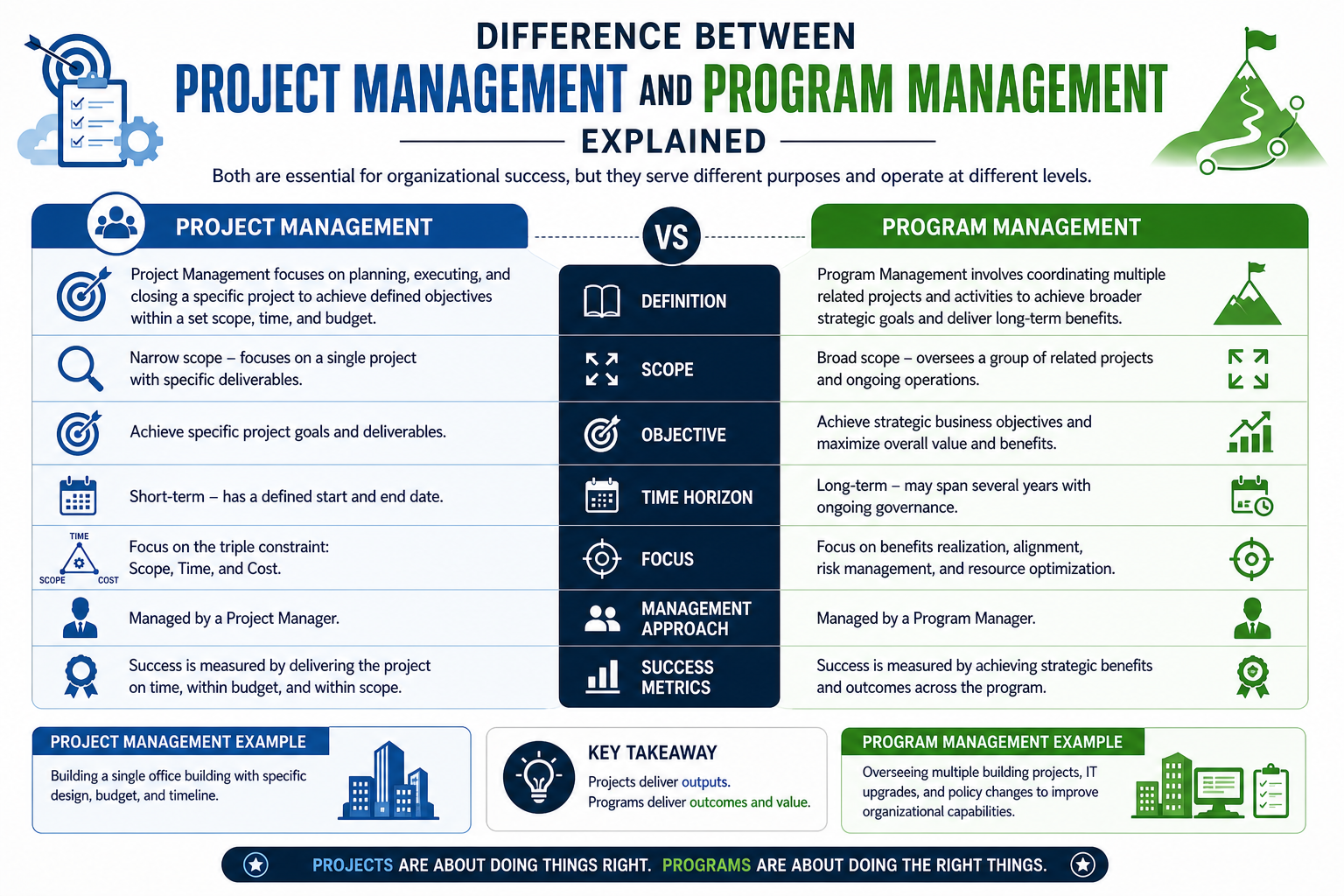
Project management and program management are often confused because both deal with planning, coordination, leadership, and delivery of outcomes. However, they are not the same. Project management focuses on completing a single, clearly defined objective within a fixed timeline, budget, and scope. Program management focuses on managing multiple related projects together so they collectively achieve a larger business goal. The key difference is that project management is task and delivery oriented, while program management is strategy and outcome oriented. In simple terms, a project delivers something specific, while a program ensures all those deliveries work together to create long-term value.
Meaning of Project Management in Practical Terms
Project management is a structured discipline that involves planning, organizing, and controlling work to achieve a specific goal. Every project has a defined start and end point, and its success depends on how well the objectives are achieved within constraints such as time, cost, and scope. In IT environments, project management is used to deliver solutions like software development, system upgrades, infrastructure deployment, or security implementations. The focus remains on producing a tangible result that meets predefined requirements. A project does not continue indefinitely; once the objective is achieved, the project is formally closed.
Core Purpose of Project Management
The main purpose of project management is to ensure that a specific outcome is delivered successfully and efficiently. This involves turning ideas into structured plans and then executing those plans step by step. A project manager is responsible for making sure that every task is completed in the correct sequence and that all team members understand their responsibilities. The purpose is not just completion but controlled completion, meaning the project must be delivered without exceeding approved time, budget, or scope. This controlled environment helps organizations reduce risks and improve success rates.
How Project Management Works in Real Environments
In real-world IT environments, project management begins with defining requirements. Stakeholders explain what needs to be built or achieved, and the project manager converts those requirements into a structured plan. This includes breaking down the work into smaller tasks, assigning responsibilities, and estimating timelines. Once execution begins, progress is continuously tracked. If any issues arise, adjustments are made to keep the project on track. Communication plays a critical role because multiple teams such as developers, testers, designers, and business analysts must stay aligned. The project manager ensures coordination between all these groups so that work progresses smoothly.
Key Responsibilities of a Project Manager
A project manager has several important responsibilities that directly impact the success of a project. One of the most important is planning, where all tasks, milestones, and deadlines are clearly defined before execution begins. Another major responsibility is team coordination, where the project manager ensures that all team members are working in sync and understand their tasks. Risk management is also critical because every project faces uncertainties such as delays, technical issues, or resource shortages. The project manager identifies these risks early and takes preventive actions. Monitoring progress is another key responsibility, ensuring that the project stays aligned with the original plan. Finally, project closure ensures that deliverables are completed, documented, and handed over properly.
Characteristics That Define a Project
A project has certain characteristics that distinguish it from routine work. One of the most important characteristics is that it is temporary, meaning it has a clear beginning and end. It does not continue indefinitely. Another characteristic is uniqueness, where each project delivers something different, even if it belongs to the same category. Projects are also goal-oriented, meaning they are created to achieve specific outcomes such as building a system or improving a process. They operate under constraints like limited time, budget, and resources, which makes proper planning essential. Additionally, projects follow a structured lifecycle that includes initiation, planning, execution, monitoring, and closure.
Meaning of Program Management in a Broader Sense
Program management is a higher-level discipline that focuses on managing multiple related projects together. Instead of delivering a single output, program management ensures that several interconnected projects work in coordination to achieve strategic business goals. Programs are designed to deliver long-term value rather than short-term results. In IT organizations, program management is often used for large-scale initiatives such as digital transformation, cloud adoption, or enterprise-wide system modernization. Unlike projects, programs are not always time-bound in a strict sense and may evolve as business needs change.
Purpose of Program Management in Organizations
The main purpose of program management is to align multiple projects with broader business objectives. While individual projects focus on delivering specific outputs, program management ensures that these outputs collectively contribute to organizational success. It provides a strategic layer of oversight where the focus is not only on completing tasks but also on achieving meaningful outcomes. Program management helps organizations manage complexity by grouping related initiatives together and ensuring they work in harmony. This improves efficiency, reduces duplication of effort, and ensures better use of resources across the organization.
How Program Management Works in Practice
In practice, program management involves overseeing several projects at the same time. Each project has its own project manager, but all of them report to the program manager at a higher level. The program manager ensures that all projects remain aligned with the overall business strategy. If one project is delayed or changed, the program manager assesses its impact on other projects and adjusts accordingly. Communication is more strategic in nature, often involving senior leadership and stakeholders. The program manager focuses on coordination, prioritization, and ensuring that all projects deliver combined value rather than working in isolation.
Core Responsibilities of a Program Manager
A program manager has responsibilities that are broader than those of a project manager. One of the key responsibilities is strategic alignment, ensuring that all projects support long-term business goals. Another responsibility is managing dependencies between projects, since delays or changes in one project can affect others. Program managers also focus on benefit realization, meaning they evaluate whether the combined outcome of all projects is delivering real business value. Resource management is also important because resources must be distributed across multiple projects efficiently. Additionally, program managers communicate with senior leadership to provide updates on overall progress and business impact.
How Project Management Operates in Real IT Environments
Project management in real IT environments is highly structured and execution-driven. It starts when a business identifies a specific need, such as developing a software application, upgrading an existing system, or implementing a new technology solution. Once the need is defined, the project manager translates it into a clear plan that includes scope definition, task breakdown, resource allocation, and scheduling. This planning phase is extremely important because it sets the foundation for the entire project lifecycle.
During execution, the project manager ensures that development teams, testing teams, and other stakeholders are working in coordination. Every task is monitored closely to ensure that deadlines are met and quality standards are maintained. In IT projects, even small delays or miscommunication can impact the entire delivery pipeline, so constant tracking becomes essential. Project managers also hold regular meetings to review progress and resolve issues quickly before they escalate.
Another important aspect is handling changes. In real environments, requirements often evolve as stakeholders gain more clarity. However, uncontrolled changes can disrupt timelines and budgets. That is why project managers use formal change control processes to evaluate whether a change should be accepted, rejected, or modified. This ensures that the project remains stable even when external conditions shift.
Project management also involves working under pressure because deadlines are fixed and expectations are high. Whether it is a software launch or infrastructure deployment, the project manager must ensure that everything is delivered within the agreed constraints. This requires strong decision-making skills, technical understanding, and the ability to manage multiple priorities at once.
Detailed Role of Planning in Project Management
Planning is one of the most critical phases in project management because it defines how the entire project will be executed. Without proper planning, even simple projects can fail due to confusion, missed deadlines, or resource mismanagement. The planning process begins with understanding requirements in detail. The project manager works with stakeholders to identify what needs to be built, why it is needed, and what success looks like.
Once requirements are clear, the project is broken down into smaller tasks. This process helps in creating a structured roadmap that outlines every step required to complete the project. Each task is assigned to specific team members along with estimated timelines. Dependencies between tasks are also identified so that work flows smoothly without unnecessary delays.
Resource planning is another important part of this phase. The project manager determines what skills, tools, and personnel are required to complete the project successfully. This includes ensuring that the right people are assigned to the right tasks and that no resource is overutilized or underutilized.
Risk planning is also included in this stage. Potential risks such as technical failures, delays, or scope changes are identified early. For each risk, a mitigation strategy is prepared so that the project can continue smoothly even if problems arise.
Overall, planning acts as a blueprint that guides the entire project from start to finish. A strong plan increases the chances of success significantly and reduces uncertainty during execution.
Execution Phase and Its Importance in Project Management
The execution phase is where all planning is turned into action. This is the stage where developers write code, engineers configure systems, testers validate functionality, and teams collaborate to produce the final deliverable. The project manager plays a central role in ensuring that this phase runs smoothly.
During execution, coordination becomes extremely important because multiple teams work simultaneously. The project manager ensures that communication flows properly between all stakeholders so that everyone is aligned with the project goals. Any misalignment can lead to rework or delays, which can impact the overall timeline.
Progress tracking is another key responsibility during execution. The project manager regularly monitors task completion, identifies bottlenecks, and ensures that work is progressing according to the plan. If any task is delayed, corrective actions are taken immediately.
Quality control is also an important part of execution. In IT projects, delivering functional output is not enough; the output must also meet quality standards. Testing phases are integrated into execution to ensure that the final product is stable, secure, and reliable.
Execution is often the longest and most resource-intensive phase of a project. It requires continuous attention, problem-solving, and coordination to ensure that everything stays on track until completion.
Monitoring and Control in Project Management
Monitoring and control is a continuous process that runs alongside execution. Its purpose is to ensure that the project remains aligned with the original plan. The project manager tracks performance using key indicators such as progress rate, budget usage, and task completion status.
If deviations are detected, corrective actions are taken immediately. For example, if a task is taking longer than expected, additional resources may be assigned or timelines may be adjusted. The goal is to minimize impact while maintaining overall project stability.
Communication plays a major role in this phase. Regular status reports are shared with stakeholders to keep them informed about progress and any potential risks. Transparency is important because it builds trust and ensures that everyone is aware of the project’s current state.
Change management is also part of monitoring and control. When new requirements or modifications are introduced, they are carefully evaluated to understand their impact on scope, cost, and timeline. Only approved changes are implemented to avoid disruption.
This phase ensures that the project does not drift away from its original objectives and remains controlled throughout its lifecycle.
Understanding Stakeholder Management in Project Management
Stakeholder management is a crucial aspect of project management because projects involve multiple people with different expectations. Stakeholders can include clients, team members, business leaders, end users, and technical teams. Each stakeholder group has its own priorities and concerns.
The project manager is responsible for identifying all stakeholders and understanding their needs. Clear communication is essential to ensure that everyone has the same understanding of project goals and progress.
Managing expectations is another important responsibility. Stakeholders often have high expectations regarding delivery speed, quality, or features. The project manager must ensure that these expectations are realistic and aligned with project constraints.
Conflicts between stakeholders are also common. For example, one group may want faster delivery while another prioritizes quality. The project manager must balance these competing demands and find a solution that works for everyone.
Strong stakeholder management ensures smoother project execution and reduces misunderstandings that can lead to delays or dissatisfaction.
Deep Insight into Program Management Structure and Flow
Program management operates at a higher level compared to project management. Instead of focusing on individual tasks or deliverables, it focuses on how multiple projects interact with each other. A program is essentially a collection of related projects that are grouped together to achieve a larger strategic objective.
Each project within a program has its own project manager, but all of them report to the program manager. This creates a hierarchical structure where execution happens at the project level, while strategy and alignment are managed at the program level.
The program manager does not focus on day-to-day tasks but instead looks at the bigger picture. They ensure that all projects are moving in the right direction and contributing to the overall goal. If any project deviates from its objectives, the program manager intervenes to realign it with the program’s vision.
Programs are often long-term and may evolve over time. New projects can be added, existing ones can be modified, and priorities can shift based on business needs. This flexibility makes program management more dynamic compared to project management.
Strategic Importance of Program Management in Organizations
Program management plays a key role in helping organizations achieve large-scale transformation. Instead of handling isolated efforts, it connects multiple initiatives into a unified strategy. This ensures that all efforts contribute to a shared business goal rather than working independently.
One of the biggest advantages of program management is improved alignment. Without program management, different projects may move in different directions, leading to inefficiencies. Program management ensures that everything stays aligned with organizational priorities.
It also helps in better decision-making. Since program managers have visibility across multiple projects, they can make informed decisions about resource allocation, prioritization, and risk handling.
Another important aspect is value delivery. Program management focuses on ensuring that all projects together deliver measurable business benefits. This could include cost reduction, improved efficiency, better customer experience, or increased revenue.
By managing complexity at a higher level, program management allows organizations to handle large transformation initiatives more effectively.
Key Differences Between Project Management and Program Management
The most important distinction between project management and program management lies in their scope and purpose. Project management is focused on delivering a specific output such as a product, system, or service within defined constraints. Program management focuses on coordinating multiple related projects so that together they achieve a broader business objective. This difference in scope changes everything about how both roles operate, from planning to execution and evaluation.
Another major difference is time horizon. Projects are temporary in nature and are designed to end once their deliverables are completed. Programs, however, are longer-term and may continue for several years as they evolve with business needs. A project is closed once its goal is achieved, while a program may keep running as long as the strategic objective remains relevant.
The level of focus also differs significantly. Project management operates at a tactical level where attention is given to tasks, schedules, budgets, and resource allocation. Program management operates at a strategic level where the focus is on business alignment, long-term value, and overall coordination between projects.
Measurement of success is another key difference. In project management, success is measured by whether the project was completed on time, within budget, and according to scope. In program management, success is measured by overall business impact, such as improved efficiency, cost savings, or achievement of organizational goals.
Differences in Decision-Making Approach
Decision-making in project management is typically short-term and focused on immediate outcomes. Project managers make decisions based on deadlines, resource availability, and task priorities. Their goal is to ensure smooth execution and timely delivery of a defined output.
In program management, decision-making is broader and more strategic. Program managers consider how decisions will impact multiple projects and long-term business objectives. Instead of focusing on one outcome, they evaluate trade-offs between different initiatives to ensure overall program success.
For example, a project manager may decide to allocate additional developers to meet a deadline. A program manager, however, might decide to shift resources between projects within the program to maximize overall efficiency. This difference highlights how program management requires a higher level of thinking and coordination.
Program managers also deal more with uncertainty and ambiguity. Since programs are long-term and evolving, they must continuously adjust strategies based on changing business priorities.
Differences in Scope and Structure
The scope of a project is narrow and well-defined. It focuses on a single deliverable with clear requirements. Everything within a project is structured around achieving that one goal. This makes project management highly organized and controlled.
Program scope is much broader and more flexible. It includes multiple interconnected projects that together support a larger objective. The structure of a program is designed to allow coordination between these projects, ensuring that they do not operate in isolation.
In project management, structure is rigid because the focus is on delivering a specific result. In program management, structure is more adaptive because priorities can shift as business needs evolve. New projects can be added or removed from a program depending on strategic requirements.
This difference in structure makes program management more complex but also more powerful in achieving organizational transformation.
Differences in Skills Required
Project management requires strong organizational, technical, and leadership skills focused on execution. A project manager must be detail-oriented, capable of planning tasks, managing deadlines, and ensuring that team members stay aligned. Problem-solving skills are also essential because issues must be resolved quickly to avoid delays.
Communication is another critical skill in project management. Project managers must communicate clearly with team members, stakeholders, and clients to ensure smooth execution. Time management and risk management are also important because projects operate under strict constraints.
Program management requires a broader skill set focused on strategy, leadership, and coordination. A program manager must be able to see the bigger picture and understand how different projects interact with each other. They must also be strong decision-makers who can balance competing priorities across multiple teams.
In addition, program managers need strong negotiation skills because they often deal with senior stakeholders and must align different departments toward a common goal. Analytical thinking is also important to evaluate program performance and ensure that business value is being delivered.
Differences in Tools and Techniques Used
Project managers typically use tools designed for task tracking, scheduling, and team collaboration. These tools help manage individual tasks, assign responsibilities, and monitor progress. The focus is on ensuring that each task is completed efficiently and on time.
Program managers use more advanced tools that provide visibility across multiple projects. These tools help track dependencies, manage resources at a higher level, and provide insights into overall program performance. The focus is not just on tasks but on how different projects are progressing together.
Techniques also differ between the two roles. Project management relies heavily on methodologies such as Agile, Scrum, and Waterfall to manage execution. These methods help structure work in a predictable and controlled way.
Program management uses techniques such as benefits management, portfolio alignment, and dependency mapping. These techniques ensure that all projects within a program are aligned with strategic goals and are delivering combined value.
Differences in Risk Management Approach
In project management, risk management is focused on identifying and handling risks that directly affect the success of a single project. These risks may include technical issues, resource shortages, delays, or scope changes. The project manager develops mitigation plans to reduce the impact of these risks.
In program management, risk management is broader and more complex. Risks are not limited to one project but can affect multiple projects at the same time. A delay in one project can create a chain reaction across the entire program.
Program managers must evaluate risks at a strategic level and prioritize them based on their impact on business objectives. They also need to coordinate risk responses across multiple project teams to ensure that the overall program remains stable.
This makes risk management in program management more dynamic and interconnected compared to project management.
Differences in Leadership Style
Project management requires a more direct and operational leadership style. The project manager leads the team by providing clear instructions, setting expectations, and ensuring that tasks are completed efficiently. Leadership is focused on execution and delivery.
Program management requires a more visionary and strategic leadership style. The program manager leads by influencing multiple teams, aligning different stakeholders, and ensuring that everyone is working toward a shared objective. Instead of managing tasks directly, they manage direction and alignment.
Project managers are closely involved with daily operations, while program managers operate at a higher level and focus on coordination and governance.
This difference in leadership style reflects the difference in responsibility level between the two roles.
Real-World Comparison of Both Roles in Action
In a real IT organization, project management and program management often work together. For example, consider a company launching a new digital platform. One project team may be responsible for building the website, another for developing the mobile application, and another for setting up backend infrastructure.
Each of these is managed by a project manager who ensures that their specific deliverable is completed successfully. However, all of these projects are part of a larger digital transformation program.
The program manager ensures that all these projects are aligned, integrated properly, and contributing to the overall business goal. If one project is delayed, the program manager evaluates the impact and adjusts the overall plan accordingly.
This collaboration ensures that while individual projects are executed efficiently, the overall business strategy is also achieved successfully.
Career Path in Project Management
Project management is often the starting point for most IT and business professionals who want to move into leadership roles. It is best suited for individuals who prefer structured environments where goals are clearly defined and success is measured through delivery. A project management career usually begins with roles like project coordinator or junior project manager, where the focus is on supporting planning, tracking progress, and handling communication between teams.
As experience grows, professionals move into full project manager roles where they independently handle complete projects from initiation to closure. At this stage, responsibilities expand to include budgeting, risk management, stakeholder communication, and team leadership. The work becomes more complex as projects increase in size and technical difficulty.
With further growth, professionals can move into senior project management roles where they handle larger and more critical projects. These roles require strong decision-making skills and the ability to manage multiple priorities under pressure. Senior project managers often work closely with senior leadership to ensure that projects align with business goals.
This career path is ideal for individuals who enjoy solving problems at a detailed level, managing execution, and seeing tangible results within a defined timeframe.
Common Certifications for Project Management Growth
Certifications play an important role in building credibility in project management careers. One of the most recognized certifications is PMP which validates advanced project management knowledge and is widely accepted across industries. It focuses on predictive, agile, and hybrid project management approaches, making it valuable for professionals working in different environments.
Another popular certification is CSM which focuses on agile methodologies and is especially useful in software development environments. It helps professionals understand iterative development, team collaboration, and adaptive planning.
PRINCE2 is another structured certification that is widely used in certain regions. It focuses on process-driven project management and provides a clear framework for managing projects from start to finish.
These certifications not only improve knowledge but also increase job opportunities and career progression in project management roles.
Career Path in Program Management
Program management is a more advanced career path that typically comes after gaining experience in project management. It is designed for professionals who are ready to move beyond individual project delivery and focus on strategic coordination across multiple initiatives.
A program management career often begins with roles like senior project manager or program coordinator. In these roles, professionals start handling multiple related projects and learn how to manage dependencies and alignment between them.
As experience increases, professionals move into program manager roles where they are responsible for overseeing entire programs. At this level, the focus shifts from managing tasks to managing outcomes. Program managers ensure that all projects within the program are aligned with business objectives and delivering collective value.
At senior levels, professionals may move into roles like portfolio manager or transformation lead. These positions involve overseeing multiple programs and ensuring that organizational strategy is effectively executed across all initiatives. This requires strong leadership, strategic thinking, and the ability to manage complex environments.
Common Certifications for Program Management Growth
Program management certifications are designed for experienced professionals who want to handle complex, multi-project environments. One of the most recognized certifications is PgMP which validates advanced program management skills and focuses on managing multiple related projects to achieve strategic outcomes.
Another important certification is MoP which focuses on portfolio management. It helps professionals understand how to prioritize and manage multiple programs and projects based on business value.
SAFe Program Consultant certification is widely used in agile environments where organizations manage large-scale agile programs. It focuses on scaling agile practices across multiple teams and ensuring alignment at the program level.
These certifications are valuable for professionals who want to move into senior leadership roles and manage large organizational initiatives.
Key Skills Needed for Both Roles
Both project management and program management require strong leadership and communication skills, but the depth and focus of these skills differ. In project management, attention to detail is extremely important because success depends on executing tasks correctly and on time. Organizational skills, time management, and problem-solving are essential for handling daily responsibilities.
Program management requires a broader mindset. Strategic thinking becomes more important than task-level execution. Program managers must understand how different projects interact and how they contribute to business goals. They need strong decision-making skills and the ability to manage ambiguity because programs evolve over time.
Communication is critical in both roles, but program managers communicate more with senior leadership, while project managers communicate more with execution teams. Both roles also require strong stakeholder management skills, but at different levels of complexity.
Tools Used in Project and Program Management
Project managers use tools that help them manage tasks, timelines, and team collaboration. These tools allow them to create project plans, assign work, track progress, and manage deadlines. They are focused on execution and day-to-day management of activities.
Program managers use more advanced tools that provide visibility across multiple projects. These tools help them track dependencies, monitor overall progress, and manage resources at a higher level. The focus is on alignment and strategic oversight rather than individual task management.
The difference in tools reflects the difference in responsibilities. Project tools are operational, while program tools are strategic.
Comparison of Both Career Paths
Project management and program management are both essential for organizational success but serve different purposes. Project management focuses on delivering specific results within defined constraints, while program management focuses on aligning multiple projects to achieve broader business objectives.
Project management is more structured, detail-oriented, and execution-focused. It is ideal for professionals who enjoy working closely with teams and managing specific deliverables. Program management is more strategic, flexible, and outcome-focused. It is ideal for professionals who want to influence organizational direction and manage complex initiatives.
Both career paths offer strong growth opportunities, but they require different mindsets and skill sets. Project management is often the foundation, while program management represents a higher level of leadership responsibility.
Importance of Choosing the Right Path Between Project and Program Management
Choosing between project management and program management is not just about job titles; it is about how you want to work and what level of responsibility you want to handle in your career. Project management suits individuals who prefer working in structured environments where goals are clearly defined and success is measured through timely delivery of specific outputs. It allows professionals to stay close to execution, manage teams directly, and see visible results of their work in a relatively short period of time.
Program management, on the other hand, is designed for professionals who are comfortable with complexity and long-term thinking. It requires the ability to look beyond individual tasks and understand how multiple initiatives connect to form a larger business strategy. This role demands patience, strong analytical thinking, and the ability to influence decisions at a higher organizational level. People who move into program management are usually those who enjoy shaping direction rather than just delivering outcomes.
How Both Roles Complement Each Other in Real Organizations
In real-world organizations, project management and program management do not operate in isolation; they work together as part of a larger system. Projects act as execution units that produce specific deliverables, while programs ensure that all these deliverables align with the organization’s long-term goals. Without project managers, work cannot be executed properly, and without program managers, that work may not align with strategic priorities.
This relationship creates a balanced structure where efficiency and strategy work side by side. Project managers focus on getting things done correctly, while program managers ensure that the right things are being done in the first place. Together, they help organizations handle complexity, reduce risk, and achieve meaningful business outcomes in a coordinated way.
Conclusion
Project management and program management are closely related but operate at different levels of complexity and responsibility. Project management ensures that individual initiatives are completed successfully, while program management ensures that multiple initiatives work together to achieve long-term strategic goals. Both roles are essential in modern organizations, especially in IT environments where multiple systems, teams, and technologies must work together seamlessly. Choosing between these paths depends on whether a professional prefers detailed execution work or strategic leadership across multiple initiatives.